Personal claim injury calculator: your Scotland guide

TL;DR:
- A personal injury calculator estimates Scottish claimants’ compensation based on injury severity and financial losses. Scotland-specific laws and quality evidence affect the accuracy of these estimates, which are only provisional. Scotland Claims Injury Lawyers offers a free tool and legal advice, ensuring claimants keep 100% of their awarded damages.
A personal claim injury calculator is a tool that estimates the compensation you may receive following a personal injury in Scotland caused by someone else’s negligence. Known formally as a personal injury damages calculator, it draws on injury type, severity, and financial losses to produce a compensation range before you speak to a lawyer. Scotland Claims Injury Lawyers offers this tool with a critical difference: claimants keep 100% of their compensation, with no success fees deducted. Most solicitors across Scotland charge a success fee of up to 20% including VAT. That is money straight out of your pocket.
How does a personal claim injury calculator work in Scotland?
A personal injury calculator estimates damages by combining two distinct categories: general damages and special damages. General damages cover pain, suffering, and loss of amenity. Special damages cover financial losses such as lost earnings, travel costs, and care expenses.
The calculator draws on several inputs to produce a figure:
- Injury type and severity. The more serious the injury, the higher the general damages bracket. Calculators categorise injuries into minor, moderate, serious, and severe bands, each corresponding to an established compensation range.
- Medical evidence. A formal medical report confirming diagnosis, prognosis, and treatment history is the single most important document in any calculation.
- Accident details. Date, location, and circumstances of the accident affect liability assessment, which in turn affects the settlement value.
- Financial losses. Lost wages, medical costs, and care expenses are totalled separately and added to the general damages figure.
- Scottish legal standards. The Damages (Scotland) Act 2011 governs how patrimonial loss and lost years claims are calculated, applying a standard 25% deduction for living expenses in lost years cases, though courts retain discretion to adjust this in exceptional circumstances.
Scotland also operates a compulsory pre-action protocol for claims under £25,000. This protocol requires both parties to exchange documents and information early, which directly improves the accuracy of any compensation estimate produced before litigation begins.
Pro Tip: Before entering figures into any accident claim estimator, gather your GP records, any accident report, and receipts for out-of-pocket expenses. The quality of your inputs determines the reliability of the output.

What factors influence your injury compensation estimate?
Several specific factors shape the figure a personal injury settlement calculator produces. Understanding each one helps you enter accurate data and interpret the result correctly.
- Injury severity. A fractured wrist and a spinal cord injury sit in entirely different compensation brackets. Severity is assessed by medical professionals and reflected in the prognosis timeline.
- Impact on daily life. Loss of ability to work, care for dependants, or participate in hobbies all increase general damages. Courts and calculators both account for this.
- Earning capacity. If the injury reduces your ability to earn now or in the future, that loss is quantifiable and forms part of special damages.
- Evidence quality. Accurate compensation estimates rely on detailed medical reports, accident documentation, and clear supporting evidence as required by Scottish pre-action protocols.
- The 25% living expenses deduction. Under the Damages (Scotland) Act 2011, lost years claims apply a standard 25% reduction for living expenses. This is a Scotland-specific rule that many generic online calculators fail to apply correctly.
The table below shows how general and special damages differ in practice:
| Damage type |
What it covers |
Examples |
| General damages |
Pain, suffering, loss of amenity |
Chronic pain, psychological distress, reduced mobility |
| Special damages |
Quantifiable financial losses |
Lost wages, medical costs, travel to appointments, care costs |
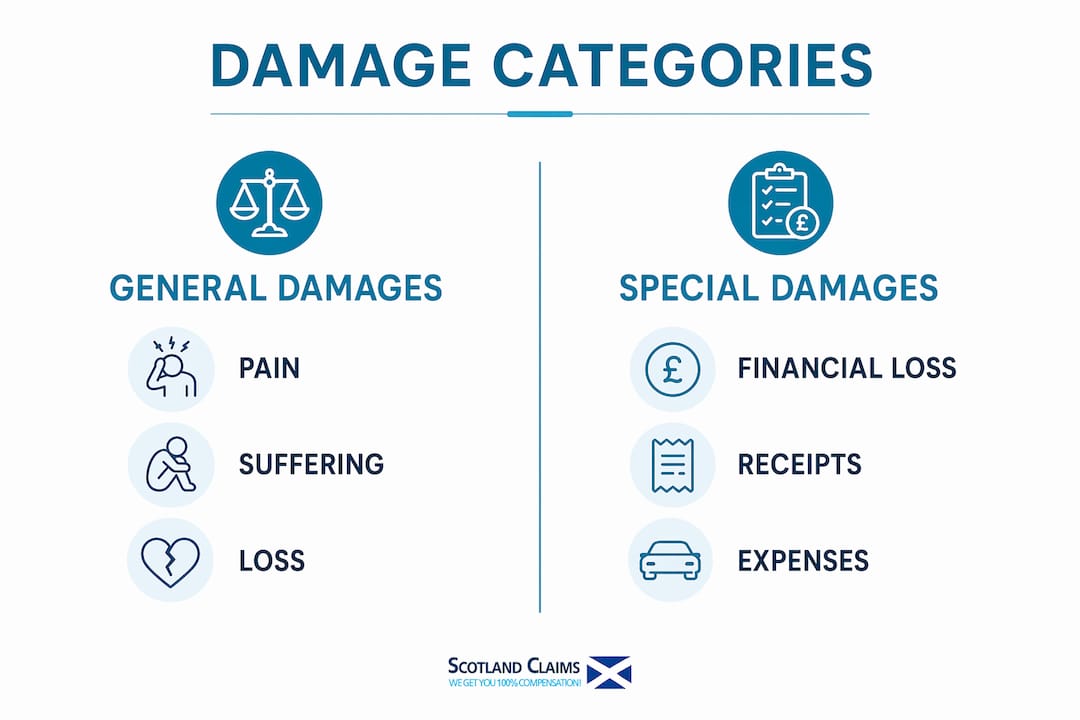
General damages are assessed against established Scottish compensation brackets. Special damages require receipts, payslips, and invoices to substantiate the claim. A reliable injury payout estimator accounts for both categories and applies Scotland-specific rules rather than generic UK-wide figures.
How to use a personal claim injury calculator effectively
Getting an accurate result from any claim value calculator requires preparation. Follow these steps to make the most of the process.
- Collect your documents first. Gather your accident report, medical notes, and any correspondence with your employer or insurer. A complete list of required documents for Scottish claims covers everything from GP referral letters to receipts for prescription costs.
- Enter injury data accurately. Select the injury category that matches your medical diagnosis, not your own perception of severity. Overestimating or underestimating the category skews the result significantly.
- Include all financial losses. Many claimants forget to include travel costs, care provided by family members, and adaptations to their home. These all count as special damages.
- Check for Scotland-specific rules. Confirm that the calculator you are using applies Scottish legal standards, including the Damages (Scotland) Act 2011 framework, rather than English and Welsh guidelines.
- Treat the output as a range, not a guarantee. A personal injury calculator produces an estimate. The actual settlement depends on evidence quality, the defendant’s insurer, and judicial discretion.
Pro Tip: If the calculator asks for a prognosis period, use the figure from your medical report rather than guessing. A six-month recovery versus a two-year recovery produces a dramatically different compensation figure.
Common misconceptions about injury compensation estimators
Many claimants misunderstand what an online injury compensation estimator can and cannot do. Clearing up these misconceptions prevents costly mistakes.
- Calculators are not guarantees. The figure produced is an estimate based on the data you enter. Courts assess evidence independently, and actual awards can differ from calculator outputs.
- Not all calculators apply Scottish law. Personal injury in Scotland covers negligence, occupiers’ liability, employers’ liability, product liability, and road traffic accidents under a distinct legal framework. A calculator built for English claims will produce inaccurate results for Scottish claimants.
- Success fees are not universal. Most solicitors in Scotland deduct a success fee of up to 20% including VAT from your final settlement. Scotland Claims Injury Lawyers takes no success fee. The 100% compensation principle means your award is yours in full.
- Early documentation is not optional. Legal experts stress that early accident reports and medical notes are critical for fair valuation before court intervention becomes necessary. Claimants who delay gathering evidence consistently receive lower estimates and settlements.
- Calculators cannot replace legal advice. When liability is disputed, injuries are severe, or the claim involves lost years, a specialist lawyer adds value that no online tool can replicate.
What Scottish legal protocols shape compensation calculations?
Scotland operates under a distinct legal framework that directly affects how compensation is calculated and settled. Understanding this framework helps you interpret any estimate my injury claim tool produces.
The Scottish personal injury pre-action protocol is compulsory for claims under £25,000. It sets strict timescales for the exchange of documents and information between claimant and defender. The goal is to encourage settlement without litigation, which reduces costs and delays for both parties.
The Damages (Scotland) Act 2011 reformed how lost years claims are calculated. It applies a standard 25% deduction for living expenses from patrimonial loss awards, though courts can modify this in exceptional cases. The Damages (Scotland) Act 1976 and its 2011 reforms together created a more consistent framework for quantifying long-term financial losses.
A significant legal development occurred in february 2026. The Supreme Court decision in CCC v Sheffield Teaching Hospitals NHS Foundation Trust aligned lost years claims in England and Wales with the Scottish approach, confirming that compensation for future loss of earnings applies regardless of the claimant’s age or whether they have dependants. Scotland had already recognised this principle, giving Scottish claimants a legal advantage that the rest of the UK has now adopted.
The table below highlights the key differences between Scottish and English personal injury law:
| Legal area |
Scotland |
England and Wales |
| Lost years deduction |
25% standard (Damages (Scotland) Act 2011) |
Now aligned with Scotland following CCC v Sheffield (2026) |
| Pre-action protocol |
Compulsory for claims under £25,000 |
Voluntary pre-action protocols apply |
| Success fees |
Scotland Claims takes 0% |
Most solicitors charge up to 20% including VAT |
| Governing statute |
Damages (Scotland) Act 2011 |
Damages Act 1996 and related case law |
These differences matter when you calculate personal injury compensation in Scotland. A calculator calibrated to Scottish law will produce a more accurate result than a generic UK-wide tool.
Key takeaways
A personal claim injury calculator is a starting point, not a final answer. Its accuracy depends entirely on Scotland-specific legal inputs, quality evidence, and no deductions for success fees.
| Point |
Details |
| Two damage categories |
Every estimate combines general damages (pain and suffering) and special damages (financial losses). |
| Scotland-specific rules apply |
The Damages (Scotland) Act 2011 governs lost years and patrimonial loss with a standard 25% living expenses deduction. |
| Evidence quality drives accuracy |
Medical reports, accident documentation, and financial records directly determine the reliability of any estimate. |
| No success fees with Scotland Claims |
Scotland Claims Injury Lawyers deducts nothing from your settlement, unlike most solicitors who charge up to 20% including VAT. |
| Calculators need legal validation |
Online tools produce ranges. A specialist lawyer confirms the figure and maximises your actual award. |
Why I think most claimants underestimate their claim from the start
Roger here. After years of working with personal injury claimants across Scotland, the pattern I see most often is not exaggeration. It is underestimation. Claimants consistently enter the lowest injury bracket because they feel uncomfortable claiming for pain they cannot see on a scan. That instinct costs them money.
The second mistake is ignoring special damages entirely. A claimant who travelled 40 miles to physiotherapy twice a week for six months has a legitimate mileage claim. Most never record it. The injury claim calculator for 2026 accounts for these costs, but only if you enter them.
The 100% compensation principle at Scotland Claims Injury Lawyers is not a marketing phrase. It is the difference between receiving £10,000 and receiving £8,000 after a 20% success fee. Over a serious injury claim, that gap is substantial. Use a calculator to get your bearings, then speak to a specialist who will not take a penny of what you are owed.
— Roger
How Scotland Claims can sharpen your compensation estimate
Scotland Claims Injury Lawyers combines a dedicated compensation calculator tool with specialist legal advice at no upfront cost. The calculator applies Scottish legal standards, including the Damages (Scotland) Act 2011 framework, to produce a realistic estimate for your specific injury. If you have suffered a road traffic accident, a slip or trip, or a workplace injury, our injury lawyers in Scotland can validate your estimate and pursue the full amount on a No Win No Fee basis. You pay nothing if the claim is unsuccessful, and you keep every penny of your settlement if it succeeds. No success fees. No deductions. Just 100% of what you are owed.
FAQ
What is a personal claim injury calculator?
A personal claim injury calculator estimates the compensation you may receive for a personal injury in Scotland. It uses injury type, severity, and financial losses to produce a damages range based on Scottish legal standards.
How accurate are online personal injury calculators?
Online calculators produce estimates, not guarantees. Accuracy depends on the quality of data entered and whether the tool applies Scotland-specific rules such as the Damages (Scotland) Act 2011.
What is the difference between general and special damages?
General damages cover pain, suffering, and loss of amenity. Special damages cover quantifiable financial losses such as lost wages, medical expenses, and travel costs to treatment.
Do I pay a success fee if I win my claim in Scotland?
Most solicitors in Scotland charge a success fee of up to 20% including VAT from your settlement. Scotland Claims Injury Lawyers charges no success fee, so claimants keep 100% of their compensation.
What documents do I need to use an injury compensation estimator?
You need a medical report confirming your diagnosis and prognosis, an accident report, and records of all financial losses including payslips, receipts, and care costs. The Scottish pre-action protocol requires this documentation for claims under £25,000.
Recommended