Compensation calculator for Scottish injury claims

TL;DR:
- A compensation calculator estimates Scottish personal injury claims by combining judicial guidelines with injury and financial data. It provides a range, highlights the importance of timely legal advice, and is limited by factors like discount rates and medical evidence. Using the calculator early ensures victims protect their rights within Scotland’s strict three-year deadline.
A compensation calculator is a digital estimation tool that combines the Judicial College Guidelines with your specific injury details and financial losses to produce a projected payout range for a personal injury claim in Scotland. If you have been injured in a road traffic accident, a slip or trip, or a workplace incident, understanding what your claim might be worth is the first step towards making an informed decision. Scotland’s three-year limitation period means that delay carries real legal risk. This guide explains how these tools work, what they need from you, and how to use them wisely alongside proper legal advice.
How does a compensation calculator work in Scotland?
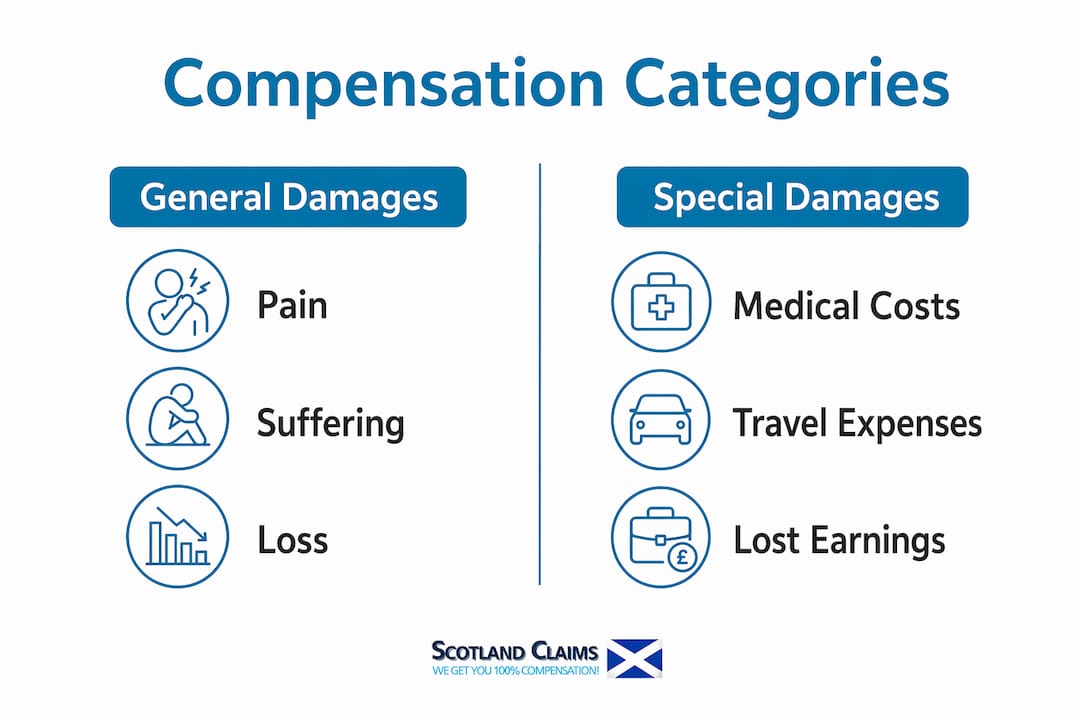
Personal injury compensation in Scotland is divided into two distinct categories: general damages and special damages. General damages cover pain, suffering, and loss of amenity. Special damages cover financial losses you have actually incurred, such as lost wages, medical expenses, travel costs, and rehabilitation fees. A compensation calculator draws on both categories to produce an estimate.
The Judicial College Guidelines are the primary legal reference for general damages awards in the UK. They set out bracket ranges for hundreds of injury types, from minor soft tissue injuries to catastrophic spinal damage. A calculator maps your injury description to the appropriate bracket and adds your declared financial losses to produce a combined figure.
One factor that many claimants overlook is contributory negligence. If you are found partly at fault for your accident, your award is reduced proportionally. A 25% finding of contributory negligence, for example, reduces a £20,000 award to £15,000. Reputable calculators will ask whether you bear any responsibility for the incident and adjust the estimate accordingly.
On the tax side, personal injury awards are not subject to income tax or capital gains tax in the UK. This means the figure you receive is yours in full. Any interest that accumulates on the award after you receive it may be taxable, but the compensation itself is protected.
| Damages category |
What it covers |
Common examples |
| General damages |
Pain, suffering, loss of amenity |
Whiplash, fractures, psychological trauma |
| Special damages |
Quantifiable financial losses |
Lost earnings, physio costs, travel to appointments |
| Future losses |
Ongoing financial impact |
Long-term care, reduced earning capacity |
| Interest on damages |
Statutory interest on delayed awards |
Applied from date of accident to settlement |
Pro Tip: If your injury falls into more than one category, for instance a broken wrist that also caused you to miss three months of work, enter both the physical injury and the earnings loss separately. Calculators that treat these as a single input will undervalue your claim.
The accuracy of any compensation estimator depends entirely on the quality of the information you put into it. Vague or incomplete inputs produce estimates that are too broad to be useful. Gathering the right details before you start takes less than an hour and significantly improves the reliability of your output.
The core details you need are:
- The date of your accident (day, month, and year)
- A clear description of your injuries, including any diagnosis from a GP or hospital
- Your age at the time of the accident
- Whether you were partly at fault and, if so, by roughly what percentage
- Your average weekly or monthly earnings before the accident
- The number of days or weeks you were unable to work
- Receipts or estimates for medical costs, travel, and any care you required
- Details of any ongoing symptoms or treatment still in progress
Special damages such as medical bills, travel costs, and rehabilitation fees must be supported by documentation. A calculator can only include what you tell it, so incomplete financial evidence will produce an underestimate. Gather bank statements, payslips, and receipts before you begin.
Scotland’s prescription rules mean that the date of your accident is not just a calculator field. It is a legal deadline marker. Entering an inaccurate date could give you a false sense of how much time you have left to act.
Pro Tip: Do not estimate your lost earnings from memory. Pull your payslips or bank statements and calculate the exact figure. Underreporting lost income is the single most common reason calculator outputs fall short of what a solicitor would actually recover.
How to use a personal injury compensation calculator step by step
Using a compensation calculator correctly takes around ten to fifteen minutes when you have your documents ready. The process is straightforward, but the order in which you complete it matters.
- Choose a Scotland-specific tool. Generic UK calculators may not reflect Scottish legal nuances, including Scotland’s distinct prescription rules and court procedures. Scotland Claims Injury Lawyers offers a dedicated calculator built around Scottish claims.
- Enter your accident details. Input the date, location type (road, workplace, public space), and a brief description of how the accident occurred. This helps the tool categorise your claim type.
- Describe your injuries. Select from the injury categories provided. Most tools offer a dropdown or checklist covering soft tissue injuries, fractures, head injuries, and psychological conditions. Be as specific as your diagnosis allows.
- Input your financial losses. Enter lost earnings, medical costs, travel expenses, and any care costs separately. Do not combine them into a single figure.
- Indicate contributory negligence. If you were partly responsible, enter your estimated percentage. If you are unsure, leave this at zero and discuss it with a solicitor.
- Review the output range. Most calculators produce a minimum and maximum figure rather than a single number. The range reflects the bracket in the Judicial College Guidelines for your injury type.
- Note the disclaimers. Every reputable tool will state that the output is an estimate, not a guaranteed award. Read these carefully before drawing conclusions.
- Seek legal advice. Use the estimate as a starting point for a conversation with a personal injury solicitor. A solicitor can calculate compensation accurately using medico-legal evidence and full financial documentation.
The difference between a quick online tool and a solicitor-assisted valuation is significant in serious cases. For straightforward whiplash or minor soft tissue injuries, a calculator will give you a reliable ballpark. For claims involving long-term disability, future loss of earnings, or complex medical evidence, a solicitor’s valuation will be materially higher and more defensible in court.
What are the limitations of relying solely on a compensation estimator?
A compensation calculator is a budgeting tool, not a legal guarantee. Understanding where it falls short protects you from making decisions based on figures that may not reflect your final award.
The most significant variable that calculators cannot fully account for is the personal injury discount rate, known as the PIDR. This rate is used by courts to calculate lump-sum awards for future losses, adjusting for the investment return a claimant is assumed to earn on the money. Future losses in serious claims often reflect earnings-related inflation rather than general CPI inflation, which creates meaningful variation in lump-sum valuations. A calculator that uses an outdated PIDR will produce an inaccurate figure for any claim involving long-term care or reduced earning capacity.
Medico-legal evidence is another gap. Serious injury claims require independent medical reports from specialists. These reports can push general damages awards significantly above the bracket midpoint, or below it, depending on prognosis. A calculator cannot replicate that assessment.
| Feature |
Online calculator |
Solicitor valuation |
| Speed |
Instant |
Days to weeks |
| Cost |
Free |
Covered under No Win No Fee |
| Accuracy for minor injuries |
Good |
Excellent |
| Accuracy for serious injuries |
Limited |
Comprehensive |
| Accounts for PIDR changes |
Rarely |
Always |
| Includes medico-legal evidence |
No |
Yes |
| Legally defensible |
No |
Yes |
Early estimates should not delay prompt claim initiation. Scotland’s three-year time bar is absolute in most cases. Spending months refining calculator inputs while the deadline approaches is a risk no claimant should take.
Pro Tip: Treat your calculator output as a floor, not a ceiling. Solicitors routinely recover more than the initial estimate once full medical evidence and financial documentation are in place. Use the figure to understand your minimum position, then act quickly to protect your right to claim.
Key takeaways
A compensation calculator gives you a reliable starting estimate, but Scotland’s three-year limitation period means the most important thing you can do after using one is contact a solicitor without delay.
| Point |
Details |
| Two types of damages |
General damages cover pain and suffering; special damages cover financial losses like lost wages and medical costs. |
| Judicial College Guidelines |
These guidelines set the legal brackets for general damages awards and underpin every reputable calculator. |
| Contributory negligence matters |
If you are partly at fault, your award is reduced proportionally, so enter this honestly for an accurate estimate. |
| Calculators have real limits |
Discount rate changes and medico-legal evidence can shift serious injury awards well beyond any online estimate. |
| Act before the three-year deadline |
Scotland’s prescription rules permanently bar claims not raised within three years of the accident date. |
Why I think most people use compensation calculators at the wrong moment
Most accident victims I speak with use a compensation calculator too late and for the wrong reason. They have already spent weeks or months waiting for their symptoms to stabilise, and they turn to a calculator hoping for reassurance that their claim is worth pursuing. By that point, they have often lost weeks of the three-year window and, in some cases, failed to preserve key evidence.
The right moment to use a calculator is within days of your accident, not weeks. You do not need a final medical diagnosis to get a useful estimate. Even a provisional figure based on your initial injuries and a rough earnings loss calculation tells you whether your claim is likely to be modest or substantial. That information shapes every decision you make next, from whether to instruct a solicitor immediately to how to prioritise gathering your financial documents.
I also think people underestimate how much the fee structure of their chosen solicitor affects the real value of their claim. If a firm takes 20% of your award, a £20,000 settlement becomes £16,000 in your pocket. Scotland Claims Injury Lawyers deducts nothing from your compensation on any claim type - whiplash or otherwise - so you keep 100% of every award. That difference is not a footnote. On a £30,000 award, it is worth up to £6,000 for firms that charge up to 20% including VAT.
Use the calculator early, use it honestly, and then get legal advice before the estimate becomes the only thing you act on. The estimate is the beginning of the process, not the end of it.
— Roger
How Scotland Claims Injury Lawyers can help you estimate and pursue your claim
Scotland Claims Injury Lawyers provides a free personal injury compensation calculator built specifically for Scottish claims, covering road traffic accidents, workplace injuries, slips, trips, and more. Once you have your estimate, specialist injury lawyers are available to review your case, interpret the figures, and advise on next steps at no upfront cost. For every claim type - whiplash, road traffic accidents, back injury claims, workplace accidents, and all others - Scotland Claims Injury Lawyers deducts no success fee at all, so you keep 100% of your compensation, compared with up to 20% including VAT charged by most large national firms. Start with the calculator, then speak to a solicitor who keeps more of your money where it belongs.
FAQ
What does a compensation calculator actually estimate?
A compensation calculator estimates the combined value of your general damages (pain and suffering) and special damages (financial losses) based on the Judicial College Guidelines and the details you provide. The output is a projected range, not a guaranteed award.
Is personal injury compensation taxable in Scotland?
Personal injury compensation is not subject to income tax or capital gains tax in the UK. Any interest that accumulates on the award after you receive it may be taxable, but the compensation itself is not.
How long do I have to make a personal injury claim in Scotland?
Scotland applies a three-year limitation period from the date of the accident or from when you first became aware that another party’s fault caused your injury. Missing this deadline permanently bars your claim in most circumstances.
Can a calculator account for future losses like long-term care?
Online calculators provide only a rough estimate of future losses because they cannot apply the personal injury discount rate accurately or incorporate independent medical evidence. Serious claims involving long-term care or reduced earning capacity require a full solicitor valuation to reflect the true award.
Does being partly at fault reduce my compensation?
Yes. Contributory negligence reduces your award proportionally to your share of fault. If you are found 30% responsible, your compensation is reduced by 30%. A good calculator will ask for this information and adjust the estimate accordingly.
Recommended