Estimate your Scottish injury payout with confidence

TL;DR:
- Personal injury claim values in Scotland depend on general damages, special damages, and future losses, with calculators only providing rough estimates based on judiciary guidelines. Actual awards vary significantly depending on medical evidence, pre-existing conditions, liability disputes, and economic factors, requiring professional legal assessment for precise valuation. Consulting experienced solicitors ensures a personalized evaluation that accounts for all case-specific circumstances beyond online calculator ranges.
Most people who’ve been injured through someone else’s fault have one burning question: how much is my claim actually worth? It’s a fair question, and the frustrating truth is that there’s no single number on a label. Online compensation calculators can give you a rough idea, but they work with broad brackets and can’t account for the specific facts of your situation. This guide explains exactly how compensation is estimated in Scotland, what those calculator figures actually mean, and what you need to do to turn an online estimate into a real, maximised payout.
Table of Contents
Key Takeaways
| Point |
Details |
| Calculators are guides |
Personal injury calculators give rough brackets but cannot guarantee your precise compensation amount. |
| Multiple factors matter |
Severity, special losses, economic shifts, and unique case features all influence your payout. |
| Expert advice is crucial |
Speaking with a solicitor ensures all aspects of your injury and future losses are properly valued. |
| Know your next steps |
After getting an estimate, gather evidence and seek legal advice to pursue your claim fully. |
How personal injury compensation is calculated in Scotland
Understanding how compensation is calculated puts you in a far stronger position before you even speak to a solicitor. In Scotland, as across the rest of the UK, personal injury awards are typically split into what lawyers call “heads of claim”. Think of these as separate buckets, each covering a different type of loss.
The three main categories are:
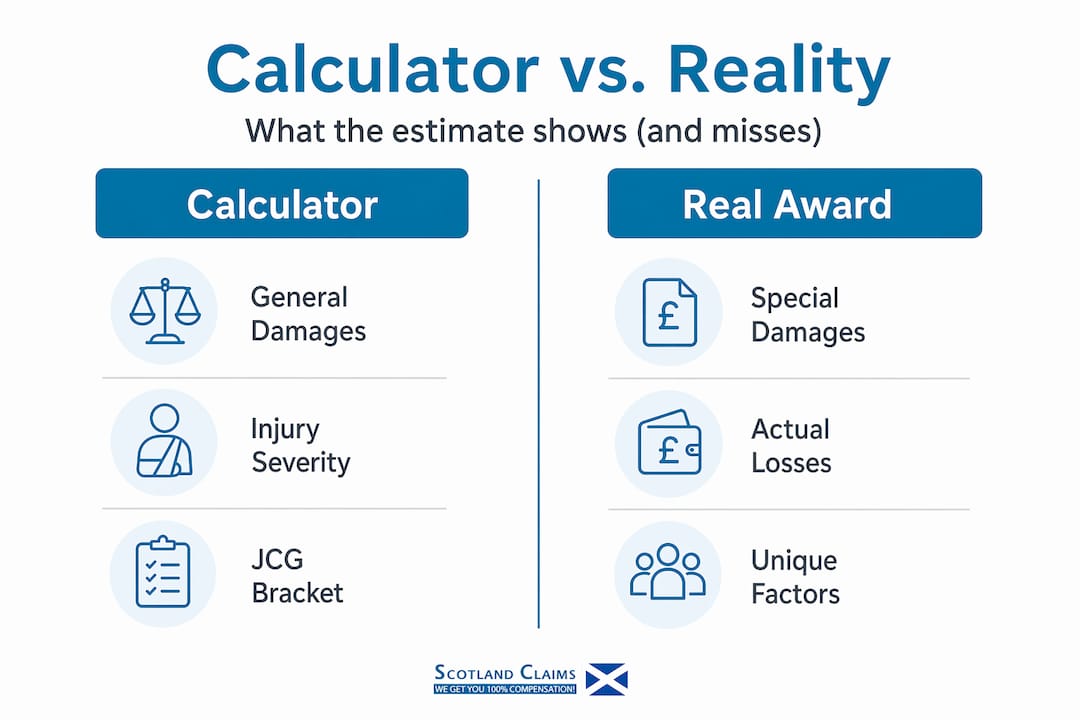
- General damages cover the pain, suffering, and loss of amenity caused by your injury. This is the figure that compensation calculators most commonly estimate. It reflects how the injury has affected your quality of life, your ability to do things you used to enjoy, and how long recovery takes.
- Special damages cover your actual out-of-pocket financial losses. These include medical treatment costs, travel to appointments, damaged clothing or property, and any earnings you’ve already lost because you couldn’t work.
- Future losses cover ongoing financial impacts, including future loss of earnings if your injury affects your ability to work long term, and the cost of care, rehabilitation, or aids and equipment you’ll need going forward.
Courts and insurers in Scotland use the Judicial College Guidelines (JCG) as a reference point when valuing general damages. The JCG is a document published by the Judicial College that sets out recommended compensation brackets for hundreds of injury types, ranging from minor soft tissue injuries to catastrophic spinal cord damage. When you use an online calculator, it is almost always drawing on these same JCG-based compensation brackets to generate a figure.
Learning how calculating injury compensation works in Scotland is genuinely worthwhile before you approach any tool or solicitor. It helps you ask better questions and spot whether an insurer’s early offer is too low.
Pro Tip: Always think of your compensation as having two parts: what the calculator estimates (general damages) and everything else (special damages and future losses). The calculator figure is rarely the full picture.
There is an important distinction between what a calculator estimates and what a court or insurer might actually award. Real awards depend on the quality of medical evidence, your personal circumstances, and how well your case is argued. Understanding the compensation types available in Scotland helps you ensure nothing is left off the table.
What compensation calculators can (and can’t) tell you
Calculators are useful. They give you a quick, accessible way to understand the rough scale of your claim before committing to anything. But knowing their limits is just as important as knowing how to use them.
Here’s a clear breakdown of what online calculators typically cover and what they leave out:
| What calculators do well |
What calculators miss |
| Estimate general damages by injury type |
Special damages (actual financial losses) |
| Provide JCG bracket ranges |
Future loss of earnings |
| Give instant, anonymised estimates |
Pre-existing conditions affecting the injury |
| Help set realistic ballpark expectations |
Psychological impact beyond physical injury |
| Signal whether a claim is worth pursuing |
Care costs and rehabilitation expenses |
Most calculators work by asking you to select an injury category and severity. They then return a range drawn from JCG tables. For example, whiplash to severe spinal injuries span from a few thousand pounds for minor soft tissue injuries, up to £36,000 to £187,000 for moderate brain injuries, and £120,000 to £212,000 for severe spinal damage.
These are genuinely wide ranges. A “moderate brain injury” award at the lower end of the bracket looks very different from one at the upper end, and the difference comes down to case-specific facts that no calculator can assess.
What online tools cannot factor in:
- The credibility and detail of your medical evidence
- How your injury interacts with any pre-existing health conditions
- Whether your employer or insurer disputes liability
- The full economic value of your future care needs
- Any psychological injury running alongside the physical one
For a better sense of what real claims look like in practice, reviewing actual injury compensation examples from road traffic accidents and other common scenarios in Scotland can help ground your expectations.
Pro Tip: Use a calculator to understand the scale of your claim, not the precise figure. If the calculator returns a wide range, that’s a signal that professional advice is essential to understand where within that range your claim might sit.
Examples: Scottish injury compensation brackets explained
To put the numbers into context, here are sample figures drawn from the current Judicial College Guidelines for some of the most common injury types seen in Scottish personal injury claims.
| Injury type |
Severity |
Approximate JCG bracket |
| Whiplash / soft tissue neck injury |
Minor |
£1,000 to £7,410 |
| Whiplash / soft tissue neck injury |
Moderate |
£7,410 to £36,120 |
| Back injury |
Minor |
£2,300 to £11,730 |
| Back injury |
Severe |
£38,780 to £151,070 |
| Brain injury |
Moderate |
£36,740 to £187,060 |
| Brain injury |
Severe |
£282,010 to £403,990 |
| Spinal cord damage |
Severe |
£120,000 to £212,000 |
| Loss of sight (total blindness) |
Total |
£229,000 to £355,000 |
| Leg fracture |
Simple |
£8,550 to £13,210 |
| Knee injury |
Moderate |
£14,840 to £26,190 |
These figures come from JCG compensation brackets for different injury categories and are updated periodically to reflect inflation and legal developments.
A few things are immediately clear when you look at this data:
- The gap between the bottom and top of each bracket is often enormous. For brain injuries, we’re talking about a difference of over £150,000 within a single category.
- More severe injuries with permanent consequences naturally fall into higher brackets, often reflecting lifetime care needs rather than just the initial pain and suffering.
- Common claims like whiplash and minor back injuries sit at the lower end of the scale, which is why they’re often handled more quickly and settled without court proceedings.
It’s also worth noting that catastrophic injuries, such as those resulting in total blindness or severe spinal cord damage, frequently attract additional awards for care costs and loss of earnings that dwarf even the general damages figure. The JCG bracket is just one component of the overall settlement in these cases.
For a detailed walkthrough of how the process works once you know your bracket, the step-by-step compensation guide for Scottish injury claims is an excellent resource.
What influences your compensation: beyond the calculator
Compensation calculators are only part of the story. Many real-world factors influence your actual award, and most of them are invisible to any online tool.
Some of the key influencing factors include:
- Pre-existing conditions: If you already had a back problem and an accident made it worse, compensation may be calculated on the acceleration or aggravation of that condition rather than treating it as a brand new injury. This can increase or reduce the award depending on the evidence.
- Contributory negligence: If you were partly responsible for the accident, for example by not wearing a seatbelt, your award may be reduced proportionally.
- The discount rate: For long-term future losses, courts apply what’s called a discount rate to reflect the fact that a lump sum paid today will earn interest over time. Changes to the discount rate can significantly alter the value of future loss awards.
- Inflation and economic changes: Future care costs and loss of earnings are projected forward over many years. Inflation assumptions have a material effect on the final figure.
“Economic factors and individual circumstances, including discount rates and pre-existing conditions, can cause actual personal injury awards to shift significantly beyond what initial estimates suggest.” — Legal Futures
These are the variables that make personal injury calculation genuinely complex. A solicitor who understands Scottish law and has experience with similar cases can spot these issues and factor them in. A calculator simply cannot.
If you’re unsure how these factors might affect your specific circumstances, arranging a personal injury claim consultation is the single most effective way to get a realistic, personalised estimate.

Next steps: turning calculator results into action
After checking an estimate, here’s how you can move forward and secure the best possible outcome for your claim.
- Document your injuries thoroughly. Get a medical assessment as soon as possible after the accident. Keep copies of every report, prescription, and treatment record. This is the foundation of your general damages claim.
- Record every financial loss. Keep receipts for travel to medical appointments, any private treatment, medication costs, and any damaged property. Note every day of work missed and calculate the lost earnings precisely.
- Gather evidence of the accident itself. Photographs, CCTV footage, witness contact details, police reference numbers, and accident book entries all support the liability aspect of your claim.
- Review what your calculator estimate included. Cross-reference the bracket figure against the full list of losses you’ve suffered. If the calculator only covered general damages, you likely have additional special damages and potentially future losses to add.
- Seek legal advice before accepting any offer. Insurers sometimes make early, lowball settlement offers. Once you accept, you cannot go back. A solicitor can advise whether the offer reflects the true value of your claim.
As Legal Futures notes, a calculator provides a guideline, but legal advice is what customises that value to your individual situation.
Understanding what goes into claim packs in Scotland helps you prepare the right documentation from the start. And if you want guidance quickly, requesting a callback for your claim means a specialist can review your situation without you needing to fill in lengthy forms.
Pro Tip: The notes you write in the days and weeks after an injury, describing your pain levels, what you can’t do, and how your life has changed, can be compelling evidence of your suffering. Keep a simple diary from the start.
Why calculators are a starting point, not the finish line
We see it regularly. Someone uses an online calculator, gets a figure, and then either feels falsely reassured or unnecessarily discouraged. The calculator said £8,000, and they assume that’s their ceiling. Or it said £50,000 and they’re confused when their solicitor suggests the realistic figure is higher or lower depending on the specifics.
The appeal of calculators is entirely understandable. They’re instant, anonymous, and give you something concrete to hold onto when everything else feels uncertain. But that certainty is partly an illusion. The bracket is only as useful as your understanding of where within it your claim sits.
What we’ve seen time and again is that expert input changes outcomes. Someone with a moderate back injury who also suffered significant anxiety and depression may sit at the upper end of the general damages bracket and have a separate award for psychological injury. Someone with a similar physical injury but a documented pre-existing condition may sit lower. Economic factors and individual circumstances can shift awards far beyond what any initial estimate suggests.
The most common mistake people make is treating the calculator result as the answer rather than the starting question. Use it to understand whether your claim is worth pursuing and roughly what scale you’re looking at. Then take it to a solicitor and let them apply the real-world facts.
The legal consultation workflow for personal injury claims in Scotland is more straightforward than most people expect, and it costs nothing upfront under a No Win No Fee arrangement.
Get expert help estimating your Scottish injury claim
Scotland Claims connects injury victims across Scotland with specialist solicitors who understand both the legal framework and the real-world factors that move compensation awards. Start with our personal injury compensation calculator to get an instant bracket estimate based on your injury type and severity. Then take the next step: our no win no fee solicitors can review your case without any upfront cost, meaning you pay nothing unless your claim succeeds and you keep 100% of your compensation. Our injury lawyers in Scotland have the experience to identify every head of claim, challenge low offers, and ensure your settlement reflects the true value of what you’ve been through. Get in touch today for a no-obligation assessment.
Frequently asked questions
How accurate are personal injury compensation calculators for Scotland?
Calculators offer guideline brackets based on JCG figures but cannot fully account for your individual circumstances, so actual awards can differ considerably. As case-specific factors such as pre-existing conditions and economic variables show, no online tool can replicate a proper legal assessment.
Can a compensation calculator in Scotland include costs like loss of earnings?
Most calculators focus on injury severity and general damages rather than specific financial losses. Calculators focus mainly on pain and suffering brackets, leaving special damages such as lost earnings and care costs for a solicitor to calculate separately.
How are future losses calculated for personal injuries in Scotland?
Courts factor in economic variables including the discount rate and projected inflation, making future loss calculations far more complex than a bracket figure. Future losses are affected by these changing economic influences and require specialist legal analysis to value accurately.
What’s the best way to get an accurate estimate for my injury claim?
A qualified solicitor can review the specific facts of your case, including medical records, financial losses, and liability disputes, to provide a personalised and reliable estimate that goes well beyond what a calculator can offer.
Recommended