Medical negligence in Scotland: your rights and how to claim

TL;DR:
- Medical negligence in Scotland occurs when a healthcare professional breaches their duty of care, causing measurable harm to a patient. Victims can pursue compensation if the breach results in injury, health deterioration, or financial loss, provided they act within a three-year period from the date of knowledge.
Medical negligence is defined as a breach of the duty of care owed by a healthcare professional that causes measurable harm to a patient. The formal legal term is clinical negligence, though “medical negligence” is the phrase most people search for and use. Under Scots law, victims have the right to pursue compensation when that breach causes injury, worsened health, or financial loss. The Prescription (Scotland) Act 2018 governs key time limits, and the Judicial College Guidelines inform how compensation is valued. Scotland Claims Injury Lawyers supports victims through this process on a No Win No Fee basis, with no success fee deducted, meaning you keep 100% of your award.
What are the legal grounds for medical negligence claims in Scotland?
Three legal elements must all be present before a claim can succeed. Miss any one of them, and the case will not proceed.
Duty of care is the starting point. Every doctor, nurse, surgeon, and healthcare professional owes a duty of care to the patients they treat. This duty arises automatically from the professional relationship, so you do not need to prove it separately in most cases.

Breach of duty is where most cases are won or lost. A breach occurs when the care provided falls below the standard a reasonably competent professional in that field would deliver. Scottish courts apply the Hunter v Hanley test, which asks whether a responsible body of medical opinion would have acted the same way. If the answer is no, a breach exists.
Causation links the breach to your harm. You must show that the substandard care directly caused your injury or made an existing condition materially worse. This is often the hardest element to prove. Expert medical evidence is required to establish causation, because courts will not accept a patient’s word alone against a clinician’s.
Common examples of breaches include misdiagnosis, surgical errors, delayed treatment, incorrect medication, and failures in post-operative care. Each requires the same three-part test to be satisfied.
- Duty of care: established automatically by the professional relationship
- Breach: care fell below the Hunter v Hanley standard
- Causation: the breach directly caused or worsened harm
- Harm: a measurable injury, financial loss, or deterioration in health
Pro Tip: Keep a written record of every appointment, procedure, and conversation with healthcare staff from the moment you suspect something has gone wrong. These notes become evidence.
How is negligence proven and what evidence do claimants need?
Proving healthcare negligence requires a structured body of evidence, not just a bad outcome. A poor result from treatment is not automatically negligence. The evidence must show the care fell below an acceptable standard and that this caused your specific harm.
Medical records and expert reports form the backbone of every claim. Your solicitor will obtain your full medical records and instruct an independent medical expert to review them. That expert produces a report stating whether the care met the required standard and whether any breach caused your injury.
Documents you should gather as early as possible include:
- All hospital letters, discharge summaries, and clinic notes
- Prescription records and medication lists
- A personal diary recording symptoms, pain levels, and daily limitations
- Receipts for any expenses caused by the injury, such as travel, care, or equipment
- Correspondence with the NHS or private provider, including complaint letters
Where a claimant lacks mental capacity, a litigation friend can act on their behalf. This is a person, usually a family member or professional, who instructs the solicitor and makes decisions in the claimant’s best interests.
Pro Tip: Request your medical records directly from your GP or hospital as soon as possible. Under UK data protection law, providers must supply them within one month. Early access prevents records being lost or altered.
Choosing a solicitor with specific experience in clinical negligence matters enormously. General personal injury solicitors may lack the medical knowledge to identify causation issues or instruct the right experts. Scotland Claims Injury Lawyers connects claimants with specialists who handle these cases regularly.
What are the time limits for raising medical negligence claims in Scotland?
Time limits in Scotland are strict, and missing them ends your right to claim entirely. The standard period is three years from the date of knowledge. That date is not always the date of treatment.
The “date of knowledge” is when you first knew, or reasonably should have known, that you suffered an injury caused by someone else’s act or omission. The Prescription (Scotland) Act 2018 clarified this test for latent damage cases. You do not need to know every detail of the negligence. You need to know that harm occurred and that it was linked to the treatment you received.
Scottish courts have confirmed that limitation periods can start before you have a full expert report in hand. Early awareness of a potential link between treatment and harm is enough to start the clock. This surprises many people who assume they need a solicitor’s letter or a formal diagnosis before time begins to run.
| Claimant type |
When the clock starts |
Special provisions |
| Adults with capacity |
Date of knowledge of injury and link to negligence |
Standard three-year period applies |
| Children |
Their 16th birthday |
Period begins at 16, runs for three years |
| Adults lacking capacity |
Clock may be paused or waived |
Court has discretion under Scots law |
One of the most dangerous misconceptions is that making a formal NHS complaint pauses the three-year clock. It does not. Informal complaint processes have no effect on the limitation period whatsoever. Many victims spend months in NHS complaints procedures believing their legal rights are protected. They are not.
Missing the deadline means the court will almost certainly refuse to hear your case. There is no general discretion to extend time in Scotland the way English courts have. The consequences of delay are final.
Pro Tip: Do not wait for an NHS complaint to conclude before contacting a solicitor. Run both processes in parallel. Your legal rights depend on it.
What compensation can be claimed for medical negligence in Scotland?
Compensation in clinical negligence claims divides into two categories: general damages and special damages. Both are available to claimants in Scotland.
General damages cover pain, suffering, and loss of amenity. These are the non-financial impacts of the injury, including physical pain, psychological harm, loss of enjoyment of life, and impact on relationships. The Judicial College Guidelines provide the framework solicitors and courts use to value these losses. Awards vary significantly depending on the severity and permanence of the injury.
Special damages cover financial losses caused by the negligence. These include both past and future costs directly linked to the injury:
- Past and future care costs, including professional and informal care
- Physiotherapy, psychological therapy, and rehabilitation
- Specialist equipment, adaptations to the home, and mobility aids
- Loss of earnings, both past and projected future income
- Travel expenses to and from medical appointments
For serious injuries with long-term care needs, compensation may be structured as a combination of a lump sum and periodical payment orders (PPOs). PPOs provide inflation-linked, tax-free income paid regularly to cover predicted ongoing care costs. This structure protects claimants from the risk of a lump sum running out.
Where a claimant lacks capacity, the Court of Protection or the Office of the Public Guardian in Scotland oversees how damages are managed. A professional deputy or guardian may be appointed to administer funds in the claimant’s best interests.
Pro Tip: Keep every receipt and invoice related to your injury from day one. Courts award special damages based on documented evidence. Undocumented losses are routinely rejected.
What practical steps should victims take to pursue a claim?
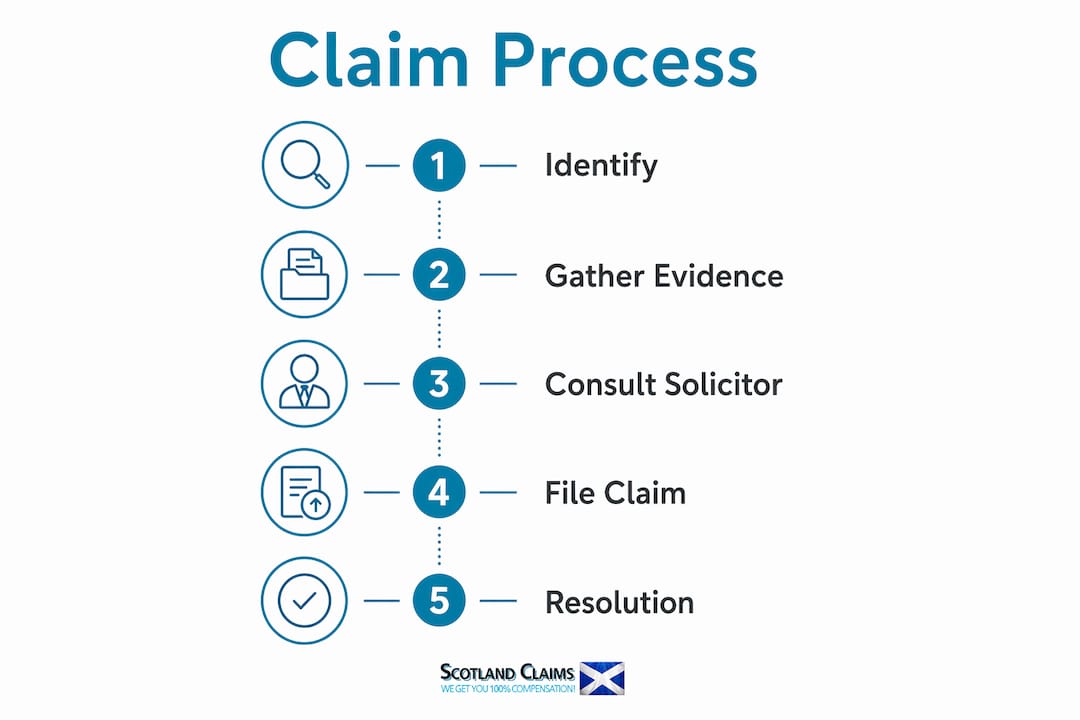
Acting promptly gives your claim the best possible foundation. The steps below reflect how most clinical negligence claims progress in Scotland.
- Seek specialist legal advice immediately. Contact a solicitor with experience in clinical negligence as soon as you suspect negligence has occurred. Early advice protects your time limits and guides evidence gathering from the start.
- Gather and secure your evidence. Request medical records, write a detailed account of events while your memory is fresh, and collect all financial documents related to the injury.
- Agree funding arrangements. No win no fee agreements remove the financial risk of pursuing a claim. You pay nothing upfront, and nothing if the case is unsuccessful.
- Obtain expert medical evidence. Your solicitor instructs an independent expert to review your records and produce a report on breach and causation. This report drives the claim forward.
- Send a letter of claim. Once evidence is assembled, your solicitor sends a formal letter to the negligent party setting out the allegations and the losses claimed.
- Negotiate or litigate. Most claims settle before reaching court. Where the other side disputes liability or quantum, court proceedings may be necessary. Interim payments can be sought for urgent financial needs while the case continues.
Avoid the two most common mistakes: delaying legal advice, and failing to document losses as they arise. Both reduce the value of your claim and risk losing it entirely. Scotland Claims Injury Lawyers can assess your position and advise on avoiding claim mistakes from the outset.
Pro Tip: Ask your solicitor at the first meeting to confirm the exact date your limitation period expires. Get it in writing. Then work backwards to set deadlines for each stage of evidence gathering.
Key takeaways
Medical negligence claims in Scotland require proof of duty, breach, and causation, and must be raised within three years of the date of knowledge or the right to claim is permanently lost.
| Point |
Details |
| Three-part legal test |
Duty of care, breach, and causation must all be proven for a claim to succeed. |
| Three-year time limit |
The clock starts from the date of knowledge, not necessarily the date of treatment. |
| Complaints do not pause time |
NHS complaint processes have no effect on the three-year limitation period under Scots law. |
| Two types of compensation |
General damages cover pain and suffering; special damages cover financial losses past and future. |
| No win no fee funding |
Scotland Claims Injury Lawyers charges no success fee, so claimants keep 100% of their award. |
Why I think victims in Scotland wait too long before acting
The single biggest problem I see in medical negligence cases is delay. People spend months, sometimes over a year, going through NHS complaints, waiting for apology letters, or hoping the situation resolves itself. By the time they speak to a solicitor, the three-year clock is already deep into its run.
What makes this worse is the misconception that the limitation period starts from the date of treatment. It does not always. But Scottish courts have confirmed that early awareness of a link between treatment and harm is enough to start time running, even without a formal expert report. That means the clock may already be ticking before you realise it.
The other pattern I notice is victims underestimating their claim’s value. They focus on the immediate injury and forget to document the ripple effects: the care their partner provides, the gym membership they can no longer use, the promotion they missed. Special damages are built from receipts and records. Without them, those losses simply do not get paid.
Scotland Claims Injury Lawyers operates with no success fee deducted from your compensation. Most solicitors in Scotland take up to 20% of your award as a success fee. That is a significant sum on any meaningful settlement. The fact that you can access specialist legal support and keep every penny of your award is not a minor detail. It is the difference between justice and a reduced version of it.
My advice is straightforward: if you suspect negligence, call a solicitor this week. Not after the complaint process. Not after the next appointment. This week. The three-year claim limit in Scotland is unforgiving, and no amount of sympathy from a court will extend it once it has passed.
— Roger
How Scotland Claims Injury Lawyers can support your claim
Scotland Claims Injury Lawyers works with specialist solicitors who handle personal injury and clinical negligence claims across Scotland. Every case runs on a No Win No Fee basis, meaning you pay nothing upfront and nothing if the claim is unsuccessful. Critically, Scotland Claims charges no success fee at all. Most solicitors in Scotland deduct up to 20% of your compensation as a success fee. Scotland Claims deducts nothing, so you receive 100% of your award. If you have been harmed by negligent treatment, speak to a specialist injury lawyer in Scotland today. You can also explore your no win no fee options and understand exactly what you are entitled to before committing to anything.
FAQ
What is medical negligence in Scotland?
Medical negligence is a breach of the duty of care owed by a healthcare professional that causes measurable harm to a patient. Under Scots law, the breach must fall below the standard set by the Hunter v Hanley test.
How long do I have to make a medical negligence claim in Scotland?
The standard limitation period is three years from the date of knowledge. For children, the period begins on their 16th birthday.
Does making an NHS complaint pause the three-year time limit?
No. NHS complaint processes do not pause or extend the three-year limitation period under Scots law. You must pursue formal legal action within the period regardless of any complaint.
What compensation can I receive for medical negligence?
You can claim general damages for pain and suffering, and special damages for financial losses including care costs, lost earnings, therapies, and equipment. Compensation may be structured as a lump sum, periodical payments, or both.
Will I have to pay legal fees if my claim is unsuccessful?
No. Scotland Claims Injury Lawyers operates on a No Win No Fee basis. If your claim does not succeed, you pay nothing. If it does succeed, no success fee is deducted, so you keep 100% of your compensation.
Recommended