Maximum compensation in Scottish injury claims explained
TL;DR:
- There is no statutory maximum on personal injury compensation in Scotland; awards can reach millions.
- Award amounts depend on injury severity, evidence quality, and how losses are presented to the court.
- Scottish courts have greater discretion and flexibility compared to England, allowing for higher or tailored awards.
Many people assume there is a fixed ceiling on what they can receive after a personal injury in Scotland. That assumption is wrong, and it could cost you dearly if it shapes how you approach your claim. There is no statutory maximum for personal injury compensation in Scotland, and in catastrophic cases, awards can run into millions of pounds. What you actually receive depends on the specific facts of your situation, the quality of your evidence, and how well your losses are presented to the court. Understanding this reality is the first step towards building a claim that reflects your true entitlement.
Table of Contents
Key Takeaways
| Point |
Details |
| No set maximum |
Scottish law does not impose a statutory ceiling on compensation, allowing for multi-million-pound awards in severe cases. |
| Evidence is essential |
The value of your claim is driven by the quality of evidence of injury, financial loss, and future need. |
| Edge cases affect outcomes |
Factors like partial blame or multiple defendants can significantly alter the final compensation. |
| Judicial discretion matters |
Scottish judges use reference guidelines but can depart from them to achieve fair results. |
| Specialist help improves outcomes |
Expert advice increases the chance of a full and tailored compensation award for your circumstances. |
How maximum compensation is determined in Scotland
Scottish personal injury law splits compensation into two broad categories. The first is solatium, which covers pain, suffering, and loss of amenity. The second is patrimonial loss, which covers every financial consequence of your injury, from lost wages to future care costs. Both are assessed independently, then combined to produce your total award.
For solatium, courts refer to the Judicial College Guidelines (JCG), a set of brackets developed in England that group injuries by type and severity. A severe brain injury attracts solatium of £200,000 or more, while very severe brain injuries carry a range of £344,150 to £493,000. These figures give a useful starting point, but Scottish courts treat them as guidance, not gospel.
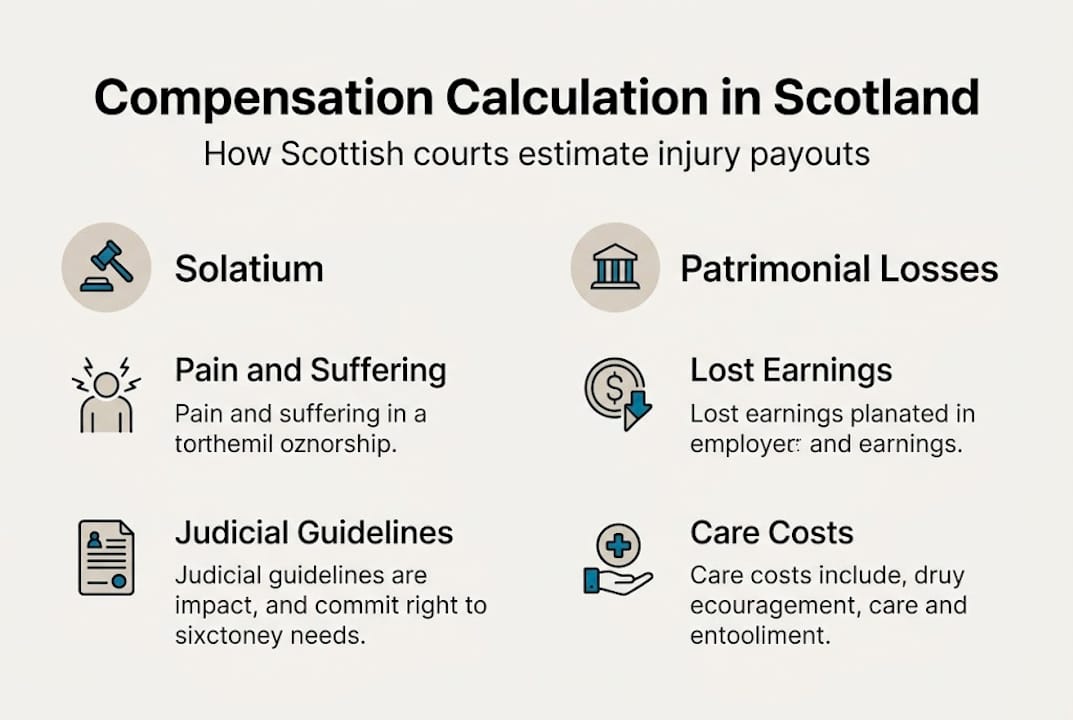
Patrimonial losses are calculated with precision. Your solicitor will use payslips, employment records, and independent expert reports to quantify exactly what you have lost and what you will lose in the future. Future losses are discounted using the Personal Injury Discount Rate, which currently stands at +0.5% as of 2026. This rate reflects the expected investment return on a lump-sum payment, ensuring the figure is fair over time.
| Loss type |
Examples |
How it is valued |
| Solatium |
Pain, suffering, loss of enjoyment |
JCG brackets, judicial discretion |
| Past patrimonial |
Lost wages, medical costs to date |
Documented evidence |
| Future patrimonial |
Ongoing care, lost earnings, adaptations |
Expert reports, discount rate applied |
The key drivers of a high award include:
- Severity and permanence of the injury
- Long-term care and medical requirements
- Impact on earning capacity over a lifetime
- Psychological consequences alongside physical harm
Getting the figures right matters enormously. When calculating injury compensation for serious cases, even a small error in the discount rate calculation can mean a difference of tens of thousands of pounds.
Pro Tip: Always ask your solicitor to provide a written breakdown of both solatium and patrimonial elements separately. This transparency helps you understand where the value in your claim lies and allows you to challenge any underestimation.
Are there any upper limits to compensation?
The short answer is no. Awards can reach millions in catastrophic personal injury cases in Scotland. A young person left with a severe spinal injury, requiring round-the-clock care for fifty or more years, could see a total award that dwarfs any figure most people associate with injury claims. The law does not place a ceiling on this.
However, practical factors can reduce what you actually receive, even when the theoretical entitlement is large.
Contributory negligence is one of the most significant. If the court finds you were partly responsible for your own injury, your award is reduced proportionally. A 30% contributory negligence finding means your compensation drops by 30%. This is not unusual in road traffic accidents where seatbelt use or speed is disputed.
Other factors that can affect your final figure include:
- Multiple defendants. When blame is shared between two or more parties, the court apportions liability. You may not recover the full amount from any single defender.
- Psychiatric injuries. These are assessed separately and divisibly, meaning the court may attribute only a portion of a psychological condition to a specific defendant’s actions.
- Strength of evidence. A poorly documented claim, even one involving serious injury, is harder to maximise.
- Pre-existing conditions. If you had a relevant condition before the accident, the defender may argue they are only liable for the additional harm caused.
When maximising compensation potential becomes the goal, understanding these pitfalls in advance is essential. A specialist solicitor will anticipate contributory negligence arguments and build your case to counter them.
| Scenario |
Effect on award |
| Full liability established |
Full calculated award |
| 30% contributory negligence |
Award reduced by 30% |
| Shared blame across two defendants |
Award apportioned between them |
| Psychiatric injury, divisible cause |
Only proportionate element awarded |
If you are unsure how these factors apply to your situation, reviewing understanding compensation payouts in detail can help clarify the picture.
Key factors that influence maximum awards
Not all serious injuries produce maximum awards. The size of your compensation is ultimately driven by the interplay of several distinct factors, and understanding them helps you see where your own claim is strongest.
- Severity and permanence. Injuries that are permanent, progressive, or that result in significant disability attract the highest solatium. A fractured wrist that heals fully is valued very differently from an amputation or a traumatic brain injury.
- Long-term care needs. If your injury requires ongoing professional care, specialist equipment, or property adaptations, every one of those costs is quantifiable and claimable.
- Lost earnings and future financial prospects. A 30-year-old professional who can no longer work faces decades of lost income. These future losses, properly evidenced and discounted, form the largest component of many high-value claims.
- Quality of evidence. Payslips, medical records, independent medical reports, and expert witness testimony all strengthen the figures being claimed. Weak or incomplete evidence is the single biggest reason claims are undervalued.
- Specialist legal representation. Scotland offers case-by-case flexibility via precedent-led awards rather than rigid brackets, meaning the skill of your solicitor in presenting lifelong consequences genuinely shapes the outcome.
A useful statistic: in severe spinal injury cases, future care alone can exceed £3 million over a claimant’s lifetime, making the correct calculation of care costs arguably the most financially significant task in the entire claim.

It is also worth considering psychological harm. Psychiatric injury claims are increasingly recognised as a substantial element of many personal injury cases, particularly where trauma, chronic pain, or life-altering disability is involved.
Pro Tip: Commission an independent care expert report as early as possible in serious cases. Defenders routinely challenge care cost calculations, and an early, robust report from a qualified expert sets a credible baseline that is much harder to undermine.
Knowing your injury rights under Scottish law is the foundation for building any strong claim, regardless of injury type.
How Scottish compensation awards differ from England
Scotland and England share the Judicial College Guidelines as a reference point, but their legal systems approach compensation quite differently. Understanding the distinction matters if you are a Scottish claimant reading information that was written with English law in mind.
In England, the JCG brackets function as a relatively structured framework. Courts lean heavily on them, and awards tend to cluster within the published ranges. The system is predictable, which has advantages, but it can also mean less room to argue for exceptional awards where the individual circumstances warrant them.
Scotland’s approach is more precedent-driven. Scottish judges consider the JCG as a useful reference, not a binding constraint. Scottish courts use the JCG for guidance while retaining the flexibility to depart from those ranges when case-specific facts justify it. This gives claimants a genuine opportunity to argue for higher solatium based on the particular impact of their injury on their life.
The discount rate is another area of active debate. The Scottish Government has been consulting on discount rate methodology and which inflation index to use for future loss calculations, meaning the framework for large awards may evolve further in coming years.
| Feature |
Scotland |
England |
| JCG usage |
Reference only, not binding |
More formulaic adherence |
| Judicial discretion |
Greater flexibility |
More structured approach |
| Future loss discount rate |
+0.5%, under consultation |
Separate rate applies |
| Precedent role |
Significant |
Moderate |
Key differences that benefit Scottish claimants:
- Ability to argue above JCG brackets using case precedents
- Greater judicial discretion allows awards to reflect unique individual impact
- Active Scottish Government review of discount rates suggests continued responsiveness
For claimants seeking guides on maximising awards within the Scottish system, leveraging this flexibility through skilled legal argument is one of the most powerful tools available.
A fresh perspective on maximising Scottish compensation
Here is something worth saying plainly: chasing the theoretical maximum is the wrong goal. The claimants who receive the strongest awards are not those who demand the highest possible figure. They are those who build a precise, evidence-rich account of their actual losses and find legal representation that can articulate those losses convincingly to a court.
The figures attached to severe injuries can seem abstract until you work through what a lifetime of care, lost earnings, and lost independence actually costs in pounds. When you do that calculation rigorously, the numbers can be genuinely substantial, without any need to exaggerate or overreach.
The role of your solicitor is not simply administrative. In Scotland, where judicial discretion is real, a solicitor who understands the relevant precedents and knows how to present lifelong consequences persuasively can make a measurable difference to what you receive. That is worth prioritising above almost any other consideration when choosing who represents you.
Find out your real compensation potential
If reading this has left you wondering where your own claim sits, the most useful next step is a tailored assessment from a specialist. General figures are interesting, but they will not tell you what your injury, your losses, and your circumstances are worth. That requires a real conversation with someone who knows Scottish personal injury law inside and out.
You can use our compensation calculator for an initial estimate, then speak to a specialist injury lawyer for a proper assessment at no cost to you. Every claim we handle is offered on no win no fee terms, meaning there is no financial risk in finding out exactly where you stand.
Frequently asked questions
What is the largest personal injury compensation awarded in Scotland?
Awards can reach millions in catastrophic cases involving lifelong injury and care needs, as there is no statutory upper limit on compensation in Scotland.
Can contributory negligence affect my compensation?
Yes. If you are found partly at fault, your award is reduced proportionally, for example a 30% contributory negligence finding results in a 30% reduction to your total compensation.
Do Scottish and English compensation awards differ?
Yes. Scottish courts use the JCG as a reference but retain greater judicial discretion, allowing awards to be tailored more closely to individual circumstances than in England.
How is future loss calculated in large compensation awards?
Future losses are projected based on expert evidence, then adjusted using the Personal Injury Discount Rate of +0.5%, which accounts for the expected return on a lump-sum investment over time.
Recommended