Lawyers for accidents at work in Scotland: free claim guide

TL;DR:
- You can pursue compensation for workplace injuries caused by employer negligence in Scotland. Acting promptly to gather evidence and consulting a specialist solicitor with a clearly capped success fee can help secure your compensation.
If you have been injured at work in Scotland, you can instruct a specialist personal injury solicitor right now. Most workplace injuries caused by employer negligence, unsafe conditions, or inadequate equipment give you a valid basis to explore a compensation claim. The fastest first step is a free case assessment from Scotland Claims Injury Lawyers, with no upfront costs and a success fee capped at 18% including VAT if you win.
Your immediate next steps:
- Get medical treatment and keep every record, prescription, and GP or A&E note
- Report the accident to your employer and request a copy of the accident book entry
- Photograph the scene, any faulty equipment, and your injuries
- Note witness names and contact details
- Contact Scotland Claims Injury Lawyers for a free callback — no win no fee, with a success fee capped at 18% including VAT
Under the Prescription and Limitation (Scotland) Act 1973, you normally have three years from the date of your injury to bring a claim. That clock starts immediately, so acting promptly matters.
Table of Contents
Can you make a workplace accident claim in Scotland?
Most people injured at work can bring a claim, but eligibility turns on one central question: did your employer (or a third party at your workplace) fail in their duty to keep you safe? That failure is what lawyers call negligence, and it is the foundation of any personal injury claim.
Common grounds for a claim include:
- Your employer provided unsafe or defective equipment
- There was no adequate training for a hazardous task
- The working environment breached health and safety regulations
- A colleague or contractor caused your injury through their own negligence
- Manual handling risks were not properly assessed or controlled
- Inadequate supervision led directly to your accident
The standard time limit is three years from the date of injury, set out in section 17 of the Prescription and Limitation (Scotland) Act 1973. Two important exceptions apply. First, if you are under 18, the three-year period does not start until your 18th birthday. Second, if you only became aware of your injury’s cause at a later date (common with occupational diseases such as industrial deafness), the clock runs from that date of knowledge rather than the accident date.
If you are a trade union member, your union may arrange free legal assistance for workplace injury claims. Citizens Advice Scotland recommends seeking a solicitor who specialises in personal injury and notes that union routes can reduce early costs for members. Even if you are not in a union, a specialist solicitor can assess your case for free.
Documents to check immediately: the date of the accident, your first medical report or sick note, any correspondence with your employer about the incident, and whether a RIDDOR report was filed.

What types of workplace accidents lead to claims?
Workplace accidents take many forms, and the injury type often shapes the legal route. The following categories cover the most common scenarios seen by personal injury solicitors in Scotland.
- Slips, trips and falls: A wet floor with no warning sign, an uneven surface, or poor lighting. Typical injuries include fractures, soft-tissue damage, and head injuries.
- Manual handling injuries: Lifting, carrying, or repetitive movement without proper training or mechanical aids. Back injuries and herniated discs are the most frequent outcome — if you have suffered one, back injury claims in Scotland are among the most commonly pursued.
- Machinery and guarding accidents: Unguarded moving parts, inadequate maintenance, or missing safety interlocks. These often cause crush injuries, amputations, or lacerations.
- Construction site falls: Falls from height remain one of the most serious categories. Scaffolding collapses, unsecured ladders, and unprotected roof edges all fall within this group.
- Vehicle incidents at work: Forklift accidents, reversing vehicles in loading bays, or road traffic collisions while driving for work. Injuries range from whiplash to severe orthopaedic trauma.
- Offshore and industrial accidents: High-risk sectors including oil and gas, manufacturing, and heavy industry. Exposure to chemicals, explosions, and structural failures can cause life-changing injuries.
- Exposure-related conditions: Occupational diseases such as industrial deafness, vibration white finger, or asbestos-related illness. These claims often rely on a date-of-knowledge limitation rule rather than the accident date.
High-risk sectors in Scotland include construction, manufacturing, logistics, and offshore energy. If a contractor or supplier caused or contributed to your injury, they may share liability alongside your employer. A specialist solicitor will identify all potentially liable parties from the outset. You can find sector-specific guidance on common workplace hazards in Scotland and your rights as a claimant.
What should you do straight after a workplace accident?
The actions you take in the hours and days after an accident can make a real difference to your claim. Follow these steps in order.
- Get medical treatment immediately. Even if the injury seems minor, attend A&E or your GP and describe exactly how the accident happened. Those clinical notes become evidence.
- Report the accident to your employer. Ask for a copy of the accident book entry or, if your employer refuses, write down the date, time, location, and what happened and send it to your employer by email so there is a written record.
- Photograph everything. Take pictures of the scene, the hazard that caused the accident, any defective equipment, and your visible injuries. Do this as soon as it is safe to do so.
- Collect witness details. Names, job roles, and contact numbers. Witnesses often become harder to trace as time passes.
- Keep a symptom diary. Note your pain levels, time off work, treatment appointments, and any out-of-pocket expenses such as travel costs or prescription charges.
- Contact a specialist solicitor. The sooner you instruct a solicitor, the sooner evidence can be preserved formally.
Pro Tip: Take photographs discreetly if you are concerned about employer reaction. Use your phone’s timestamp feature and back up images to cloud storage immediately. A photograph taken within hours of an accident is far more persuasive than one taken days later, and prompt reporting to your employer creates a contemporaneous record that is very difficult for an insurer to challenge.
How does the claims process work, and what will it cost you?

The step-by-step pathway
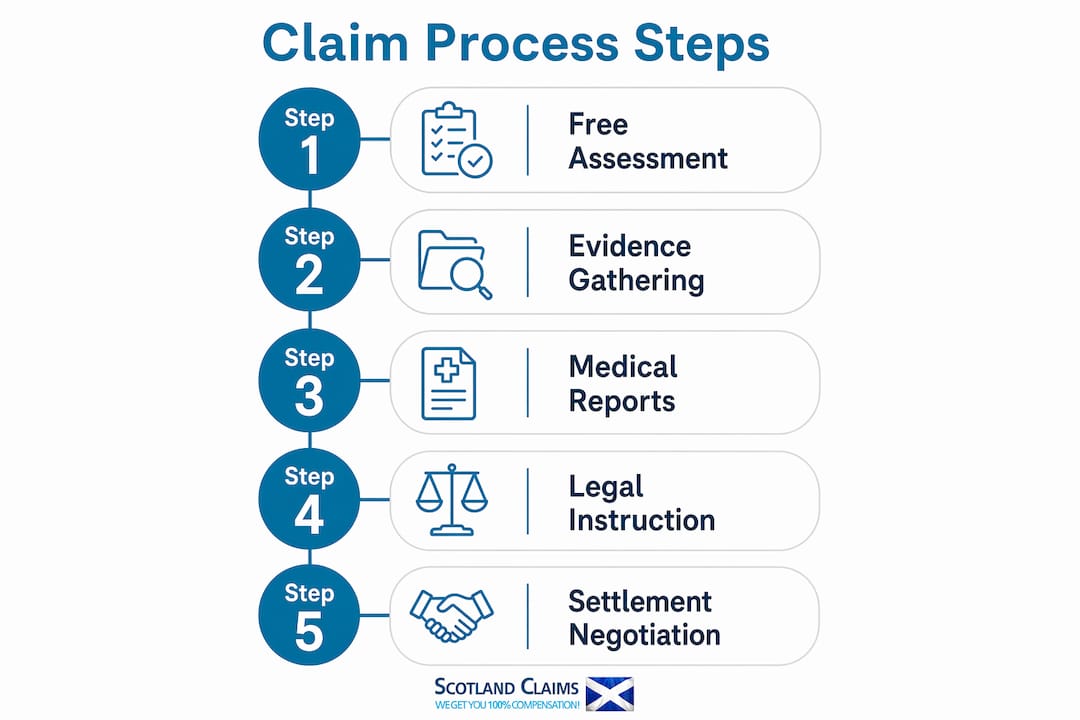
The process from first contact to settlement follows a broadly consistent pattern, though the timeline varies with complexity.
- Free assessment: A specialist solicitor reviews your circumstances at no cost and advises whether you have a viable claim.
- Instruction and evidence gathering: Medical records, expert reports, witness statements, and any RIDDOR documentation are collected.
- Letter of claim: Your solicitor writes formally to your employer’s insurer setting out the basis of the claim.
- Negotiation: Most claims settle at this stage without going to court.
- Litigation (if required): If the insurer disputes liability or the offer is inadequate, your solicitor raises proceedings. In Scotland, pursuers can choose between the sheriff court, the specialist All-Scotland Sheriff Personal Injury Court for employer’s liability claims above certain thresholds, or the Court of Session for the largest cases.
Typical timescales
| Stage |
Typical duration |
| Free assessment and instruction |
1–2 weeks |
| Evidence gathering and medical reporting |
3–6 months |
| Letter of claim and insurer response |
1–3 months |
| Settlement negotiation |
1–6 months |
| Litigation (if required) |
12 months or more |
Most personal injury claims resolve within 12–18 months, though straightforward cases sometimes settle faster and complex litigation can take several years. Early evidence preservation tends to shorten timelines by reducing disputes about what actually happened.
What does it cost you?
- If you win: Scotland Claims Injury Lawyers recovers its costs from the at-fault insurer. The success fee is capped at 18% including VAT. Our success fee is capped at 18% including VAT, with no hidden extras.
- If you lose: Under a no win no fee arrangement, you pay nothing.
- No upfront costs: There is nothing to pay to start your claim.
Under Scottish fee regulations, success fees in personal injury cases are capped as a percentage of the compensation, subject to regulatory limits. Many solicitors charge up to the maximum allowed. Scotland Claims Injury Lawyers caps its fee at 18% including VAT, which means a claimant who recovers £20,000 keeps at least £16,400 rather than handing back the full £4,000 maximum. You can also use the compensation calculator to get an early estimate of what your claim might be worth before you even speak to a solicitor.
For a broader overview of how legal fees work in accident cases, this independent guide to accident case fees explains conditional-fee arrangements in plain language.
When does the HSE get involved in a workplace accident?
The Health and Safety Executive (HSE) is the UK’s primary workplace safety regulator, and its involvement can significantly strengthen a civil compensation claim.
When must an accident be reported to the HSE?
Under the Reporting of Injuries, Diseases and Dangerous Occurrences Regulations 2013 (RIDDOR), employers must report certain incidents to the HSE. These include:
- Deaths and specified serious injuries (fractures, amputations, loss of sight, crush injuries)
- Accidents causing an employee to be incapacitated for more than seven consecutive days
- Occupational diseases such as carpal tunnel syndrome or occupational dermatitis
- Dangerous occurrences (near-misses with serious injury potential)
How does an HSE investigation affect your claim?
An HSE investigation and a civil compensation claim run on separate tracks. The HSE may prosecute your employer for criminal health and safety breaches; your solicitor pursues civil damages on your behalf. The two are independent, but an HSE investigation can produce highly persuasive evidence for your civil claim. Inspectors’ reports and RIDDOR records document breaches of statutory duties in detail, and that documentation is difficult for an insurer to dismiss.
If the HSE is involved in your case, tell your solicitor:
- The RIDDOR report reference number
- The name and contact details of the HSE inspector assigned
- Any correspondence between your employer and the HSE
- Whether an improvement or prohibition notice has been issued
Statistic: The HSE’s published statistics record tens of thousands of non-fatal workplace injuries reported by employers each year in Great Britain, underscoring how frequently workers are harmed and how often RIDDOR reporting is triggered.
How do you choose the right workplace accident solicitor in Scotland?
Not every personal injury solicitor has the depth of experience that a workplace accident claim demands. Employer’s liability cases involve health and safety law, occupational medicine, and sometimes complex multi-party liability. Here is what to look for.
Selection criteria:
- Demonstrable experience in Scottish personal injury and employer’s liability cases specifically
- Membership of the Association of Personal Injury Lawyers (APIL) or equivalent accreditation, as Citizens Advice Scotland recommends
- A clear, written explanation of the funding arrangement before you sign anything
- A named solicitor or case manager handling your file, not a call-centre triage model
- Transparent written confirmation of the success fee percentage, capped at 18% including VAT
Questions to ask at first contact:
- Have you handled claims involving my type of accident before?
- Who will actually manage my case day to day?
- What evidence will you need from me, and when?
- What is the realistic timescale for a case like mine?
- Will any fee be deducted from my compensation if I win?
Red flags to watch for:
- Vague or evasive answers about fee structures
- Pressure to sign immediately without time to read the agreement
- No experience of Scottish jurisdiction or the All-Scotland Sheriff Personal Injury Court
- No clear route to a free initial assessment
What to have ready for your first call:
Accident date and location, a brief description of what happened, details of any medical treatment received, your employer’s name and insurer if known, and any photographs or witness details you have already gathered. Having these to hand speeds up the assessment considerably. A practical guide on requesting a callback explains exactly what information to prepare.
How Scotland Claims Injury Lawyers handles your claim
Scotland Claims Injury Lawyers connects injured workers in Scotland with specialist personal injury solicitors who focus exclusively on claims like yours. The service is built around one straightforward principle: you should know exactly what you will pay before your claim starts.
What the service includes:
- A free initial case assessment with no obligation
- Specialist solicitors experienced in Scottish employer’s liability claims
- No win no fee funding, with costs recovered from the at-fault insurer on success
- Success fee capped at 18% including VAT — never more
- A named point of contact throughout your claim
- Access to the compensation calculator to estimate your likely award before you commit
- Regular updates on your case progress
The fee position is worth spelling out plainly. Under Scottish regulations, a success fee can legally be charged on compensation, subject to caps. Most solicitors charge up to the maximum allowed. Scotland Claims Injury Lawyers agrees its lower cap in writing before the claim starts.
To start, visit the injury at work claims page, use the compensation calculator for an early estimate, or request a free callback. There is nothing to pay and no commitment required at that stage.
Key takeaways
Specialist workplace accident solicitors in Scotland can pursue your claim on a no win no fee basis, and under Scotland Claims Injury Lawyers’ model the success fee is capped at 18% including VAT.
| Point |
Details |
| Three-year time limit |
The Prescription and Limitation (Scotland) Act 1973 gives you three years from injury or date of knowledge to bring a claim. |
| Preserve evidence early |
Photographs, witness details, and a symptom diary taken promptly reduce disputes and can shorten claim timescales. |
| HSE involvement helps |
RIDDOR reports and HSE inspection records document statutory breaches and can strengthen your civil claim. |
| Success fee capped at 18% inc. VAT |
Scotland Claims Injury Lawyers caps its success fee at 18% including VAT, below the statutory maximum. |
| Scotland Claims Injury Lawyers |
Free case assessment, no upfront costs, and a compensation calculator available at scotlandclaims.co.uk. |
Why the fee question matters more than most injured workers realise
There is a tendency, when you are in pain and worried about your job, to focus entirely on whether you have a claim at all. The fee structure gets treated as a detail to sort out later. That is understandable, but it is worth pausing on.
A 20% success fee on a modest workplace injury settlement is not a trivial sum. On a £10,000 award, it is £2,000 gone before you have paid a single bill or replaced a single item of lost income. The legal maximum exists because regulators recognised that uncapped percentage fees were causing real harm to claimants. But the cap is still a cap, not a prohibition. Most solicitors use it.
Scotland Claims Injury Lawyers’ position is different, and it is worth being direct about why that matters. The firm’s costs are recovered from the at-fault insurer, not from your damages. That is the model that actually serves the claimant rather than the solicitor’s revenue target. When you are choosing who to instruct, ask the fee question first, not last. The answer tells you a great deal about whose interests the firm is actually prioritising.
Start your free workplace injury assessment today
If you have been injured at work in Scotland, Scotland Claims Injury Lawyers offers a free case assessment with no upfront costs and a success fee capped at 18% including VAT. Successful claimants know exactly what they will receive. Whether your injury involved a fall, a manual handling accident, machinery, or a vehicle incident at work, specialist solicitors are ready to assess your claim. Use the compensation calculator for an early estimate, or go straight to the injury lawyers Scotland page to request a free callback. No commitment, no cost, and a success fee capped at 18% including VAT if you win.
Useful sources
The following resources provide authoritative detail on the legal rules, funding options, and practical guidance relevant to workplace accident claims in Scotland.
- Prescription and Limitation (Scotland) Act 1973, section 17: The primary legislation setting out the three-year limitation period and exceptions for minors and date-of-knowledge cases.
- HSE RIDDOR guidance: The Health and Safety Executive’s official explanation of which workplace incidents must be reported and how.
- HSE workplace injury statistics: Published data on the scale of workplace injuries in Great Britain each year.
- Citizens Advice Scotland: personal injuries: Practical guidance on finding a specialist solicitor and the role of trade unions in workplace injury claims.
- Law Society of Scotland: speculative fee agreements: Explains how success fees are regulated in Scotland and what solicitors can and cannot charge.
- Lexology: personal injury claim timescales: Guidance on typical claim durations and the factors that affect how long a case takes to resolve.
- Burness Paull: 10 things to know about personal injury claims in Scotland: A clear overview of forum choices, jurisdictional thresholds, and procedural considerations for Scottish claimants.
- Scotland Claims Injury Lawyers: injury at work claims: The firm’s dedicated page for workplace injury claims, including how to start a free assessment.
- Scotland Claims Injury Lawyers: no win no fee: Explains the funding arrangement and confirms the success fee is capped at 18% including VAT.
- Scotland Claims Injury Lawyers: compensation calculator: An interactive tool to estimate potential compensation before instructing a solicitor.
This article provides general information about workplace accident claims in Scotland. It is not legal advice. For guidance specific to your situation, speak with a qualified personal injury solicitor or consult the primary sources listed above.
FAQ
Can I sue my employer for an accident at work?
Yes, provided your employer’s negligence caused or contributed to your injury. Seeking advice from a specialist solicitor is the standard first step, and many workers worry unnecessarily about repercussions — your right to claim compensation is protected by law.
What type of solicitor do you need for a workplace accident?
You need a personal injury solicitor with specific experience in employer’s liability claims in Scotland. Look for APIL membership or equivalent accreditation, and confirm upfront what success fee will be deducted from your compensation and whether it is capped in writing.
How much compensation could you receive for a workplace accident?
The amount depends on the severity of your injury, your financial losses (lost earnings, care costs, medical expenses), and the long-term impact on your life. Use the Scotland Claims compensation calculator for an early estimate, and a solicitor will give a more precise assessment once medical evidence is available.
How long does a workplace accident claim take to resolve?
Most claims settle within 12–18 months, though straightforward cases can conclude faster and complex litigation may take longer. Preserving evidence early and instructing a solicitor promptly are the two factors most likely to keep your claim on the shorter end of that range.
Get medical treatment, report the accident to your employer in writing, photograph the scene and any hazard involved, collect witness details, and contact a specialist solicitor for a free assessment. Acting quickly protects both your health and the evidence your solicitor will need.
Recommended