How to organise accident paperwork for a Scottish claim

TL;DR:
- Gathering photos, witness details, and accident reports immediately proves liability and preserves evidence. Organizing documents in a clear, searchable folder with a detailed diary supports a strong, timely claim. Accurate record-keeping and prompt action are crucial within Scotland’s three-year limit to secure compensation.
The documents you need to collect right now are: photographs of the scene and your injuries, the exact date, time and location of the accident, witness names and contact details, a police or incident report reference, written confirmation of any medical attendance, and receipts or payslips proving financial loss. These are the items a solicitor will ask for first, and they are the ones that prove liability, causation and loss under Scotland’s pre-action protocol. You also have a legally fixed limitation period from the date of injury within which to raise a claim in Scotland — so recording that date accurately, today, is non-negotiable.
Collect immediately:
- Photographs of the hazard, scene and visible injuries (timestamped)
- Date, time and precise location of the accident
- Names, phone numbers and addresses of any witnesses
- Police report number or employer accident book entry reference
- Name of the hospital, GP or paramedic who attended you
- Payslips or wage certificates if you have missed work
- Receipts for any out-of-pocket costs (travel, medication, aids)
Pro Tip: Never edit or crop original photos. Keep the unaltered originals and let the metadata timestamp do the work. A cropped image loses the EXIF date data that corroborates when and where it was taken.
Table of Contents
What documents should you gather for a personal injury claim?
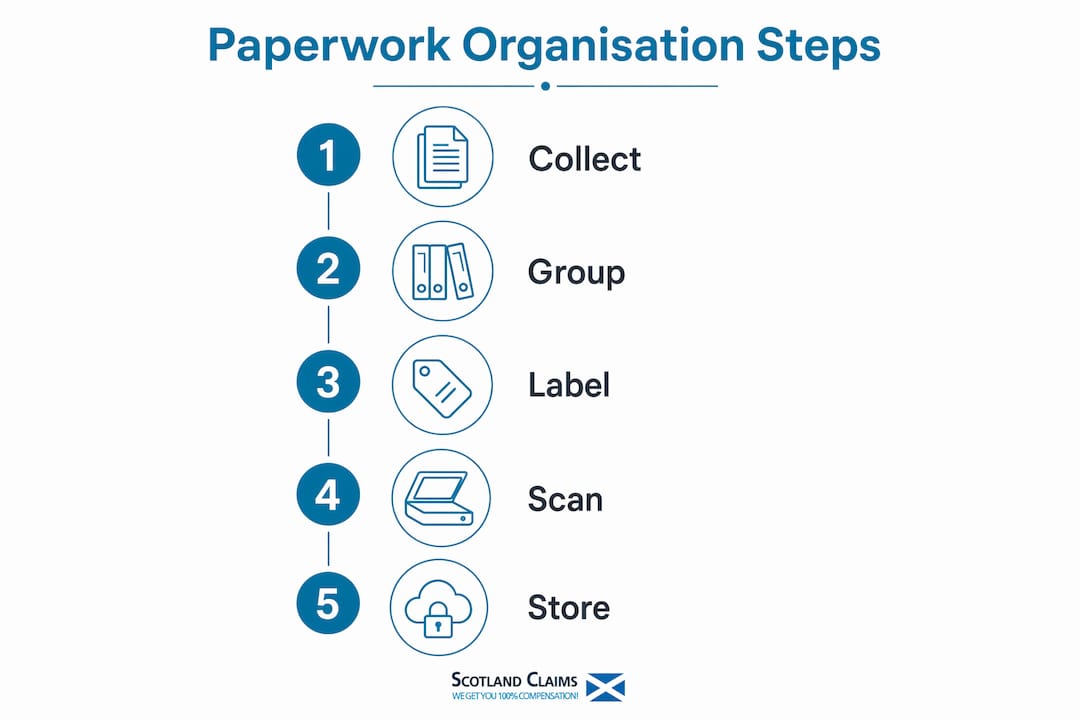
Organised evidence gathered early is far more reliable than anything reconstructed months later. Group your documents by purpose from the start, and handing them to a solicitor becomes a five-minute job rather than a frantic search.
| Document type |
Where to get it / why it matters |
| Scene and injury photographs |
Your phone camera — timestamped images prove the hazard existed and show injury severity |
| Police report or accident book entry |
Police Scotland reference number, or employer’s accident book — independent contemporaneous record |
| A&E attendance notes |
NHS hospital records department — confirms injury and date of first treatment |
| GP records and referral letters |
Data subject access request to your GP practice — free, up to 30 days to supply |
| Specialist and imaging reports |
Hospital records or private clinic — establishes diagnosis and prognosis |
| Payslips and wage certificates |
Your employer’s HR or payroll team — quantifies lost earnings, important for how to claim car finance compensation in the UK in related finance claims |
| Receipts and invoices |
Keep originals and photos — covers travel, medication, care costs, adaptations |
| Repair estimates (vehicle or property) |
Garage or tradesperson quotes — documents property loss |
| Witness contact details and statements |
Collected at the scene or shortly after — corroborates your account |
| Client chronology statement |
Written by you — gives the solicitor a clear narrative of events |
The Scottish Legal Aid Board lists a client statement, photographs, medical reports, expert reports, wage certificates and receipts as the core evidential requirements for reparation cases. Prioritise medical records and photographs first; financial documents can follow, but the sooner you request NHS records the better, since they can take up to 30 days to arrive.
How to keep a symptom and expense diary that actually helps your claim
A dated diary entry, written the same day, is worth far more than a summary written six months later. Solicitors and medical experts look for contemporaneous detail: what you felt, what you could not do, who helped you, and what it cost.
What to record each day:
- Symptoms (location, severity on a scale of 1–10, duration)
- Medication taken and dosage
- Appointments attended (GP, physio, hospital) and what was said
- Tasks you could not perform (driving, cooking, working, childcare)
- Care provided by family or friends (hours, nature of help)
- Out-of-pocket costs (taxi to hospital, prescription charge, equipment hire)
Example entries:
Day 1: “Sharp pain in lower back, rated 8/10. Attended A&E at [hospital], discharged with co-codamol. Unable to walk unaided. Partner drove me home and helped me dress.”
Week 1: “Pain reduced to 5/10 but constant. Missed three days of work. GP appointment on [date] — referred to physiotherapy. Taxi to GP: £12.50.”
Month 1: “Physiotherapy started. Still unable to lift anything over 2 kg. Work has placed me on reduced duties. Ongoing prescription costs: £9.90 per month.”
Pro Tip: Photograph every receipt immediately and save it to a dedicated folder on your phone. Most smartphone cameras embed the date and GPS location in the file metadata, giving you automatic proof of when and where you incurred each cost.
How should you store and name your claim files?
Use a simple folder structure with a YYYY-MM-DD date prefix on every filename, and keep both originals and digital copies. A solicitor who can find any document in under a minute processes your claim faster and with fewer delays. Clear, searchable naming paired with an index spreadsheet also preserves the chain of evidence when sharing files.
Recommended folder structure:
01_Scene_Evidence — photos, hazard notes, location screenshots02_Official_Reports — police reference, accident book scan03_Medical — A&E notes, GP records, specialist reports, imaging04_Financial — payslips, receipts, invoices, repair quotes05_Witnesses — contact details, written statements06_Correspondence — letters, emails, insurer communications07_Diary — symptom diary entries (one file per month)
Filename convention: YYYY-MM-DD_Category_Description.pdf — for example, 2026-03-14_Medical_AandE_Discharge_Notes.pdf.
Keep physical originals in a labelled cardboard folder in the same category order. Scan or photograph each one and upload it to your digital folder. Back up to a second location (a cloud service such as Google Drive or OneDrive, or an external hard drive).
Pro Tip: Create a single index spreadsheet with columns for filename, document type, date, source and a one-line description. When your solicitor asks “do you have the GP referral letter?”, you can answer in seconds.

What are the key timelines for a Scottish personal injury claim?
The triennium limitation period means you usually have three years from the date of injury to raise a court action in Scotland. Miss that deadline and your claim is almost certainly time-barred. Write the date of your accident down now and keep it at the front of your claim folder.
The Scottish pre-action protocol requires parties to exchange information and attempt settlement before raising court proceedings. Claimants who comply fully benefit from costs protection; those who bypass the protocol risk sanctions. Well-organised documentary files make compliance straightforward and reduce the risk of delays or penalties. LegalClarity explains that the protocol aims to resolve many lower-value claims without court, and that procedural compliance directly affects costs outcomes.
Most personal injury claims in Scotland resolve within 12–18 months, though cases involving complex medical evidence or court scheduling can take longer. The typical stages are: collect evidence → instruct a solicitor → pre-action letter of claim → exchange of information → negotiation → settlement or litigation. Organised paperwork shortens every stage except the last.
What will a Scottish personal injury solicitor actually ask for?
Solicitors want three things in this order: proof of liability (it was someone else’s fault), proof of injury (you were hurt), and proof of loss (it cost you something). Provide them in that sequence and you give the claim its clearest possible shape.
The Scottish Legal Aid Board’s evidential requirements for reparation cases confirm the standard list:
- Liability: photographs, hazard description, police or accident book entry
- Injury: A&E notes, GP records, specialist and imaging reports
- Loss: payslips, wage certificates, receipts, repair estimates
- Corroboration: witness statements, independent reports
- Narrative: a clear chronology statement in your own words
An intake-ready set of documents often allows a solicitor to provide an early compensation estimate using a tool such as Scotland Claims Injury Lawyers’ compensation calculator, which speeds early settlement offers considerably.
Pro Tip: Write a one-page chronology statement before your first solicitor meeting: date of accident, what happened, injuries sustained, treatment received, work and daily life impact, and costs to date. It saves the first appointment and gives the solicitor an immediate overview.
What mistakes can damage your personal injury claim?
The fastest ways to weaken a claim are altering evidence, failing to record dates, deleting digital images, and posting inconsistent content on social media. Stop all four now.
- Altered documents: never edit, annotate or crop original photos or records. Keep unaltered originals and work from copies.
- Missing dates: every document, diary entry and receipt must carry a date. An undated medical note is far harder to rely on.
- Delayed reporting: failure to report to police, an employer or a property owner weakens the independent record. Report as soon as possible and keep the reference number.
- Incomplete medical notes: attend every appointment and describe all symptoms, even minor ones. Gaps in the medical record invite the defence to argue the injury was not serious.
- Social media posts: a photograph of you at a social event, or a post suggesting you are fully recovered, can be used to contradict your account. Restrict your profiles and avoid posting about the accident or your recovery.
- Inconsistent witness contact: collect witness details at the scene. Witnesses become harder to trace and their recollections less reliable with every passing week.
- Seek medical attention and keep written confirmation of every appointment.
- Photograph the scene, hazard and your injuries before anything changes.
- Collect witness names, phone numbers and addresses on the spot.
- Report the accident to police, your employer or the property owner and obtain a reference number.
- Start your symptom and expense diary today — use the template entries above.
- Request your NHS medical records via a data subject access request to your GP practice.
- Back up all digital files to a cloud folder and contact a solicitor for a free case assessment.
Scotland Claims Injury Lawyers offers a free claim assessment and can review your organised paperwork to advise whether you have a strong case, with no upfront costs and no success fee to pay.
Key takeaways
Organising your accident paperwork to match the Scottish pre-action protocol and three-year limitation period is the single most effective step you can take to protect your compensation claim.
| Point |
Details |
| Collect evidence immediately |
Photographs, witness details, and an incident report reference must be gathered at the scene or within hours. |
| Record the accident date |
The triennium gives you three years from the date of injury; missing it bars your claim entirely. |
| Keep a dated diary |
Daily symptom and expense entries provide contemporaneous proof of causation and financial loss. |
| Name and back up files |
Use YYYY-MM-DD prefixes and a cloud backup so any document can be found in seconds. |
| Scotland Claims Injury Lawyers |
No success fee and no upfront costs mean you keep 100% of your compensation on a successful claim. |
Why organised paperwork changes everything about a claim
Most people assume the solicitor does the heavy lifting on evidence. The reality is different. When a client arrives with a well-indexed folder — photographs dated and labelled, medical records requested, a clear chronology statement, receipts in order — the first meeting moves straight to strategy rather than spending an hour reconstructing a timeline from memory.
The role of evidence in Scottish claims is not just about having the right documents. It is about having them in a form that a solicitor can use immediately. A disorganised bundle of screenshots and undated letters creates delays, repeated document requests, and in some cases genuine gaps in the evidential chain that the defence will exploit. An organised file does the opposite: it signals a credible, prepared claimant and shortens the path to settlement.
The conventional wisdom is that you hire a solicitor and hand the problem over. What actually works is arriving as a prepared client. The solicitor’s job becomes far easier, the pre-action protocol exchanges go faster, and the compensation valuation is grounded in real documented loss rather than estimates.
Scotland Claims Injury Lawyers: free paperwork review and claim assessment
If you have been injured in a road traffic accident, a workplace accident, or a slip or trip in Scotland, Scotland Claims Injury Lawyers will review your organised paperwork for free and tell you whether you have a strong claim. There are no upfront fees and, unlike many other solicitors who deduct up to 20% of your settlement as a success fee, Scotland Claims takes nothing from your compensation. You keep 100%.
The free assessment covers a document review, an early indication of likely compensation using the compensation calculator, and a clear recommendation on next steps. To get started, visit the injury lawyers Scotland page, complete the short claim form, or request a callback. Your paperwork is ready. The next step takes two minutes.
Useful sources and further reading
| Resource |
What it covers |
| LegalClarity — personal injury claims in Scotland |
Pre-action protocol, evidence requirements, limitation period explained plainly |
| Lexology — claim timescales |
Realistic timelines for Scottish personal injury claims (12–18 months typical) |
| Scottish Legal Aid Board — reparation cases |
Official evidential requirements for reparation actions in Scotland |
| Complete document checklist — Scotland Claims |
Full downloadable document list and naming guide for Scottish claims |
| No Win No Fee explained — Scotland Claims |
How the no success fee model works and what clients keep |
FAQ
How long do I have to make a personal injury claim in Scotland?
You have a legally fixed limitation period from the date of injury to raise a claim. Missing this deadline will almost certainly bar your claim, so record the accident date immediately.
What documents does a solicitor need first?
Photographs of the scene and injuries, a police or accident book reference, A&E attendance notes, and witness contact details are the priority items. Financial documents such as payslips and receipts follow once liability evidence is secured.
Can I get my NHS medical records for free?
Yes. Submit a data subject access request to your GP practice or NHS hospital records department at no charge. Allow up to 30 days for the records to arrive, so request them as early as possible.
Does organising paperwork affect how quickly my claim settles?
Directly. Claims where documents are indexed, named clearly, and grouped by purpose require fewer follow-up requests from solicitors, which shortens the pre-action protocol exchanges and speeds settlement.
Will I pay a success fee if Scotland Claims Injury Lawyers handles my claim?
No. Scotland Claims Injury Lawyers charges no success fee, so you retain 100% of your compensation on a successful claim, unlike many solicitors who deduct up to 20% of your settlement.
Recommended