How to file pedestrian claims in Scotland

If you have been hit by a vehicle or injured in a pedestrian accident in Scotland, start your claim by getting medical treatment, preserving evidence, and contacting a specialist personal injury solicitor under a no win no fee arrangement. Scotland Claims Injury Lawyers handles pedestrian claims with a success fee capped at 18% including VAT, below the Scottish statutory maximum.
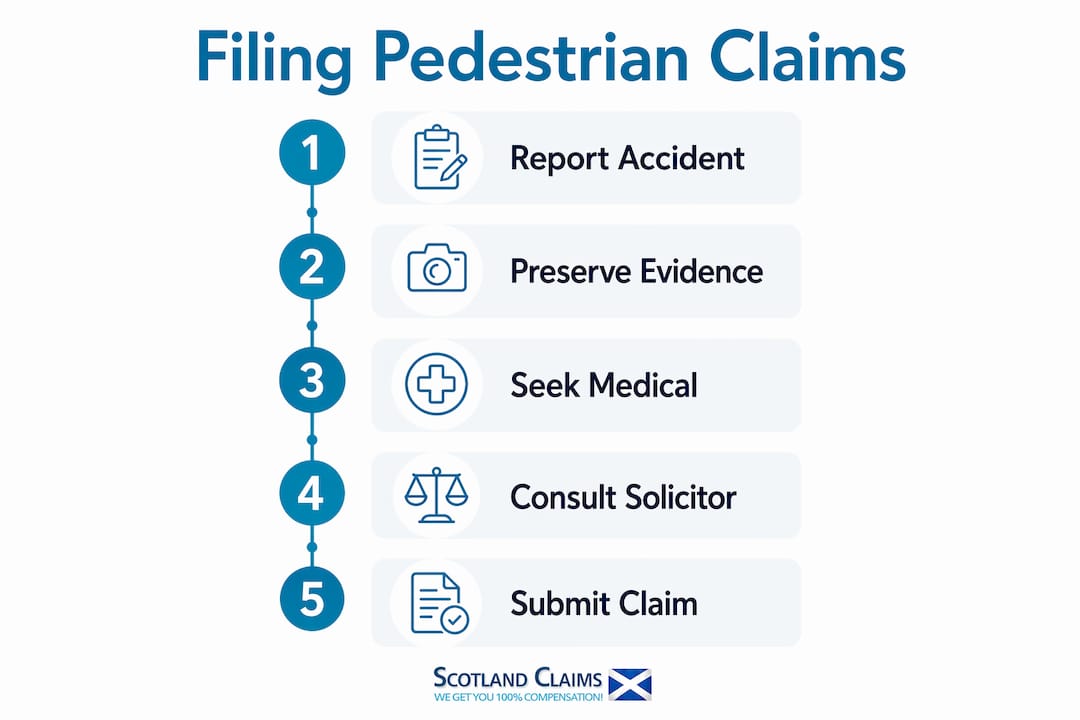
Your first 48-hour checklist:
- See a doctor or attend A&E — even if you feel fine; get injuries on record
- Photograph the scene, your injuries, and any vehicle involved — timestamped photos carry real weight
- Take witness names and contact details before people leave
- Note the driver’s name, vehicle registration, and insurer if a vehicle was involved
- Report to Police Scotland if the driver failed to stop or there is a dispute about fault
- Contact Scotland Claims Injury Lawyers for a free claim assessment — no upfront cost, success fee capped at 18% inc. VAT
The statutory deadline for personal injury actions in Scotland is three years under the Prescription and Limitation (Scotland) Act 1973. Miss it and you lose the right to claim entirely.
Pro Tip: Call a solicitor before you speak to the other driver’s insurer. Insurers move quickly to limit their liability; a specialist solicitor levels the playing field from day one.
Table of Contents
Can you make a pedestrian accident claim?
Most pedestrians who are injured through someone else’s fault can claim compensation. The legal test in Scotland has four elements: the other party owed you a duty of care, they breached that duty, the breach caused your injury, and you suffered a loss as a result. If all four apply, you have a viable claim.
Common eligible scenarios include:
- Being struck by a car, van, lorry, or motorcycle at a road crossing or pavement
- A hit-and-run collision (the Motor Insurers’ Bureau handles untraced driver claims)
- A pavement or footpath accident caused by a local authority’s failure to maintain the surface
- Being knocked down in a car park or private road
- A pedestrian injury at work, for example being struck by a forklift or vehicle on a work site
Contributory negligence can reduce your award if you were partly at fault. Crossing outside a designated crossing, stepping out without looking, or being distracted by a phone are examples a defendant may raise. The court apportions blame as a percentage: if you were partly responsible, your award is reduced proportionally. Partial fault does not bar a claim; it just adjusts the figure.
Claiming for someone else: a parent or guardian can bring a claim on behalf of a child, and a litigation friend or court-appointed guardian can act for an incapacitated adult. Crucially, the three-year clock does not start running for a child until their 18th birthday, giving them until age 21 to raise proceedings in their own right. More on that in the time limits section below.
Pro Tip: If you are unsure whether the other party was at fault, contact Scotland Claims Injury Lawyers for a free assessment. Eligibility is assessed on the facts, not on your initial impression of who was to blame.
The actions you take in the first hour matter as much as anything that happens later. Evidence disappears fast, injuries worsen without treatment, and insurers note the timeline.
Follow these steps in order:
- Move to safety — get off the road or away from the hazard if you can do so without worsening an injury.
- Call 999 if anyone is seriously injured or the driver has failed to stop.
- Seek medical attention — go to A&E or your GP the same day, even for minor symptoms. A medical record created on the day of the accident is far harder for an insurer to dispute than one made a week later.
- Photograph everything — the scene, road markings, signage, your injuries, the vehicle, and any damage. Use your phone’s timestamp.
- Collect witness details — full name and a phone number or email address; do not rely on bystanders to come forward later.
- Record driver and vehicle details — name, registration number, insurer name if visible, and the driver’s contact details.
- Report to Police Scotland — legally required if the driver did not stop; also advisable when fault is disputed.
- Notify your own insurer if you have relevant cover, but do not admit liability or give a recorded statement to the other driver’s insurer without legal advice.
Preserving CCTV and dashcam footage is time-critical. Many councils and businesses overwrite footage within 14–31 days. Note the exact location and time of the accident and contact the relevant operator — council CCTV, a nearby shop, a petrol station, or a bus company — in writing as soon as possible, asking them to preserve the footage. Your solicitor can send a formal preservation request on your behalf.
Pro Tip: Write a contemporaneous account of the accident in your own words within 24 hours, including road conditions, lighting, speed of the vehicle, and anything the driver said. Courts treat a prompt, detailed note as credible evidence.

What evidence do you need for a strong pedestrian claim?
Strong evidence is what separates a settled claim from a disputed one. Solicitors can help gather records, but the more you preserve early, the stronger your starting position.
Core evidence checklist:
- Timestamped photographs of the scene, injuries, road conditions, and any vehicles
- Witness names and contact details
- Driver’s name, vehicle registration, and insurer details
- Police incident or crime reference number
- A&E attendance records and GP notes from the date of the accident
- Follow-up medical records, specialist referrals, and any physiotherapy notes
- Receipts for out-of-pocket expenses (travel, prescription charges, equipment)
- Payslips and employer confirmation of any time off work
- A personal diary of symptoms, pain levels, and how the injury affects daily life
Requesting CCTV footage:
| What to record |
Why it matters |
| Exact location (street name, nearest landmark) |
Identifies the correct camera operator |
| Date and time of the accident |
Allows the operator to locate the correct clip |
| Name of the camera operator (council, business, transport) |
Directs your written preservation request |
| Your solicitor’s contact details |
Enables direct follow-up if you instruct one |
Write to the operator within days of the accident. If footage is overwritten before a formal request is made, it may be lost permanently. Acting quickly on CCTV is one of the most time-sensitive steps in any road accident claim.
Medical records are obtained by submitting a Subject Access Request to your GP surgery or NHS trust. Your solicitor will usually arrange an independent medical examination to produce a medico-legal report, which is the document that formally links your injuries to the accident and sets out your prognosis.
Pro Tip: Keep every receipt, no matter how small. Travel costs to hospital appointments, over-the-counter medication, and care provided by a family member all count as recoverable losses. A shoebox of receipts is worth more than a vague estimate.
The role of evidence in injury claims is covered in detail in the Scotland Claims resource library if you want a deeper breakdown of documentation standards.
What losses and injuries can you claim for?
A pedestrian injury claim can cover far more than the immediate pain. Scottish personal injury law allows claimants to pursue compensation under several heads of loss.
General damages cover pain, suffering, and loss of amenity. This is the element that reflects the injury itself: how severe it is, how long recovery takes, and how it affects your quality of life.
Special damages cover financial losses, both past and future:
- Loss of earnings from time off work, including self-employed income
- Future loss of earnings if the injury affects your capacity to work long-term
- Care and assistance provided by family members or paid carers
- Travel costs to medical appointments
- Rehabilitation, physiotherapy, and private treatment costs
- Equipment, aids, and home adaptations
- Future treatment costs where ongoing care is needed
Injury severity shapes the claim significantly. A soft-tissue injury that resolves in six weeks sits at a very different level from a fractured pelvis or a spinal injury with permanent consequences. For serious long-term injuries, future losses often exceed the general damages figure by a considerable margin.
Where a pedestrian dies as a result of their injuries, dependants can pursue a claim under the Damages (Scotland) Act 2011, covering loss of financial support, services, and grief awards for close relatives.
For pedestrian accident claims with complex injury profiles, a specialist Scottish solicitor will instruct the appropriate medical experts to ensure every head of loss is properly evidenced and valued.
How much compensation might you receive?
Compensation figures depend on the nature and severity of your injury, your prognosis, and the financial losses you can evidence. The table below gives illustrative ranges; they are not guarantees and every case turns on its own facts.
| Injury type |
Illustrative range |
| Minor soft-tissue injuries (full recovery within months) |
£1,000–£5,000 |
| Moderate fractures (e.g. wrist, ankle, with full or near-full recovery) |
£5,000–£25,000 |
| Serious fractures or multiple injuries (extended recovery) |
£25,000–£75,000 |
| Severe or permanent injuries (spinal, brain, long-term disability) |
£75,000–£250,000+ |
These figures reflect general damages only. Add special damages — lost earnings, care costs, future treatment — and the total can be substantially higher.
What reduces a figure: contributory negligence, as explained earlier, is the most common deduction. A finding that you were 20% responsible reduces the award by 20%.
What increases it: strong medical evidence, clear proof of financial losses, and a defendant who cannot credibly dispute liability all support a higher settlement.
One thing Scotland Claims Injury Lawyers never leaves open: the success fee. Most solicitors in Scotland take up to 20% of your compensation as a success fee. Scotland Claims takes nothing. Ours is capped at 18% including VAT and agreed in writing before your claim starts.
Use the compensation calculator on the Scotland Claims website for a tailored early estimate based on your injury type and circumstances. Calculators give a planning figure; the final award depends on medical evidence and documented losses.
What are the time limits for a pedestrian claim in Scotland?
Scotland operates a three-year limitation period, known as the triennium, for personal injury actions. Section 17 of the Prescription and Limitation (Scotland) Act 1973 provides that a claim must be raised within three years of the date of the accident or the date the claimant first became aware of the injury, whichever is later.
Key rules on when the clock starts and stops:
- For most pedestrian accidents, the three years runs from the date of the accident
- Where an injury was not immediately apparent (for example, a delayed spinal condition), time runs from the date of awareness
- For children, the clock does not start until their 18th birthday; they have until age 21 to raise proceedings
- For adults who lack legal capacity, the period is suspended while the incapacity continues
A critical point that many claimants miss: negotiations and settlement discussions do not stop the prescriptive period from running. You can be in active talks with an insurer for two years, reach no agreement, and find that you are now time-barred. The only reliable ways to protect your position are to raise formal court proceedings or obtain a written agreement from the other side to extend time.
Most Scottish personal injury actions are raised in the sheriff court, with high-value or complex cases proceeding in the Court of Session.
Three-year deadline: Under the Prescription and Limitation (Scotland) Act 1973, failing to raise proceedings within three years of your accident will ordinarily extinguish your right to claim entirely.
Pro Tip: Seek legal advice as soon as possible after the accident, not as the deadline approaches. Early instruction gives your solicitor time to gather evidence, instruct medical experts, and negotiate without the pressure of an imminent time bar.
How do you start a pedestrian claim step by step?
The process from first contact to settlement follows a clear sequence. Knowing what to expect at each stage removes much of the uncertainty.
Step-by-step claim process:
- Initial enquiry — contact Scotland Claims Injury Lawyers by phone or online form; provide a brief account of the accident and your injuries.
- Free assessment — a specialist solicitor reviews the facts, advises on eligibility and likely value, and explains the no win no fee terms.
- Evidence review — you provide the documents and information you have gathered; the solicitor identifies any gaps and requests additional records.
- Instruction under no win no fee — you sign a conditional fee agreement; no upfront payment is required and the success fee is capped at 18% including VAT.
- Medical evidence — an independent medical examination is arranged; the resulting report sets out your injuries, prognosis, and any future treatment needs.
- Notification to the defender — the solicitor notifies the at-fault party or their insurer and sets out the basis of the claim.
- Negotiation — most claims settle at this stage through correspondence and negotiation; your solicitor will advise on any offer made.
- Settlement or court — if a fair settlement is agreed, the case concludes; if the defender disputes liability or the offer is inadequate, court proceedings are raised.
What to have ready for your first call:
- Date, time, and location of the accident
- A brief description of what happened
- Driver and vehicle details (if applicable)
- Police reference number (if reported)
- Details of any medical treatment received
- Any photographs or witness details you have already gathered
For a straightforward claim with clear liability and a soft-tissue injury, many cases resolve within a year to 18 months. Complex matters involving serious injuries, disputed liability, or extensive future losses can take longer, particularly if court proceedings are needed. The road accident injury workflow guide on the Scotland Claims website sets out a more detailed timeline for different claim types.

Costs, funding options, and the no win no fee explained
Personal injury claims in Scotland can be funded in several ways. Understanding the options helps you choose the right route and avoid unexpected costs.
Common funding routes:
- No win no fee (conditional fee agreement) — the solicitor is paid from the opponent’s insurer if the claim succeeds; you pay nothing if it fails
- Legal expenses insurance — cover that may already exist in your home, motor, or travel insurance policy; worth checking before instructing a solicitor
- Official Injury Claim — a simplified route for minor road collision injuries introduced in 2021; suitable for lower-value soft-tissue claims only
- Legal aid — available in very limited circumstances for personal injury in Scotland; rarely applicable to road accident claims
- Private funding — paying a solicitor at an hourly rate; rarely the best option for personal injury
What no win no fee means in practice: if your claim succeeds, the solicitor’s fees are recovered from the at-fault party’s insurer, not from your compensation. If the claim fails, you pay nothing. Some arrangements include an after-the-event insurance premium to cover the opponent’s legal costs if you lose; your solicitor will explain whether this applies.
Scotland Claims’ commitment: most solicitors in Scotland charge a success fee of up to 20% of your compensation. Scotland Claims Injury Lawyers caps its success fee at 18% including VAT, below the Scottish statutory maximum. There are no hidden extras, and our legal costs are recovered from the other side. Check the no win no fee terms on the Scotland Claims website for the full detail.
It is also worth knowing that claims management companies are not solicitors. They can handle initial intake and negotiation, but they must instruct a solicitor if the case goes to court, and they typically charge a percentage of compensation for doing so. Instructing a solicitor directly from the outset is usually more straightforward.
Pro Tip: Before signing any conditional fee agreement, ask specifically whether a success fee applies and, if so, what percentage. With Scotland Claims, the answer is zero.
Can someone else make a claim on your behalf?
Yes, and in some circumstances it is the only way a claim can proceed.
Who can act for someone else:
- A parent or guardian can bring a claim on behalf of a child under 16 (or under 18 in some contexts); the child’s limitation period does not start until their 18th birthday
- A litigation friend can act for an adult who lacks mental capacity to conduct litigation themselves; this is usually a close relative or a solicitor appointed for the purpose
- A court-appointed guardian may act where no suitable family member is available
Practical steps for a third-party claim:
- Provide proof of your authority to act (parental responsibility, guardianship order, or court appointment)
- Gather the same evidence as for a direct claim: medical records, accident details, witness information
- The solicitor will advise on whether the court’s approval is needed for any settlement on behalf of a child or incapacitated adult
For guidance on who can represent a claimant and how the process works, the claimant representatives guide on the Scotland Claims website covers the practical and procedural steps in detail.
One practical note on children’s claims: any settlement reached on behalf of a child must be approved by the court, which adds a step but also protects the child’s interests. The funds are typically held until the child reaches adulthood.
How long does a pedestrian claim usually take?
Many pedestrian claims resolve within 12–18 months, particularly where liability is clear and the injuries are not severe. Complex cases can take considerably longer.
Factors that lengthen a claim:
- Serious or permanent injuries requiring specialist medical evidence and long prognosis periods
- Disputed liability, where the defendant denies fault or argues contributory negligence
- Multiple defenders (for example, both a driver and a local authority)
- Court availability and listing delays if proceedings are raised
- Delays in obtaining medical records or expert reports
Factors that speed a claim:
- Clear liability with photographic or CCTV evidence
- Prompt medical attention and well-documented injuries
- Organised evidence from the outset
- A defendant insurer willing to engage in early settlement discussions
The medical evidence stage is often the longest single phase. A solicitor will not recommend accepting a settlement offer until your prognosis is clear, because settling too early can mean you receive nothing for losses that emerge later. For back or spinal injuries, that can mean waiting 12–24 months for a stable medical picture.
Pro Tip: If you are offered a quick settlement by the other driver’s insurer shortly after the accident, do not accept it without legal advice. Early offers are almost always lower than a properly evidenced claim would achieve, and accepting one may prevent you from claiming for future losses.
Key takeaways
Filing a pedestrian accident claim in Scotland requires prompt medical attention, preserved evidence, and early instruction of a specialist solicitor before the three-year triennium expires.
| Point |
Details |
| Act within three years |
The Prescription and Limitation (Scotland) Act 1973 sets a hard three-year deadline; miss it and the claim is lost. |
| Preserve evidence immediately |
Photograph the scene, collect witness details, and request CCTV preservation within days of the accident. |
| Negotiations do not stop the clock |
Settlement talks with an insurer do not pause the limitation period; raise proceedings or agree an extension in writing. |
| Success fee capped at 18% including VAT |
Scotland Claims Injury Lawyers caps its success fee below the 20% most solicitors deduct, and agrees it in writing. |
| Get a free estimate |
Use the Scotland Claims compensation calculator for an early indication of your claim’s value. |
Why specialist Scottish solicitors make a real difference
The conventional wisdom about personal injury claims is that any solicitor will do. Having looked closely at how Scottish pedestrian cases actually play out, that view is hard to defend.
Scottish personal injury law operates under its own statutory framework, its own court system, and its own procedural rules. The triennium under the Prescription and Limitation (Scotland) Act 1973 is not the same as the English limitation period. The sheriff court process differs from the County Court. The Damages (Scotland) Act 2011 governs how certain heads of loss are calculated for Scottish claimants. A solicitor unfamiliar with these specifics is not just less efficient; they can make errors that cost claimants money or, in the worst cases, allow claims to become time-barred.
Early solicitor involvement also changes the dynamic with insurers. A claimant who contacts an insurer directly, without representation, signals that they may not know the full value of their claim. An insurer’s first offer is rarely their best one. A specialist solicitor who knows the going rate for a particular injury type, who has the medical contacts to instruct the right expert, and who is prepared to raise proceedings if necessary, negotiates from a fundamentally different position.
The capped fee matters here too. When a solicitor's fee is left open until settlement, the incentive can be to settle quickly rather than fight for the maximum figure. When the fee is capped in writing from the start, the alignment is different. Scotland Claims Injury Lawyers’ model removes that tension entirely.
Scotland Claims Injury Lawyers: free assessment, capped success fee
Scotland Claims Injury Lawyers offers pedestrian accident claimants in Scotland something straightforward: specialist legal representation with no upfront costs and a success fee capped at 18% including VAT. If the claim does not succeed, you pay nothing.
The process starts with a free claim assessment. A specialist injury lawyer in Scotland reviews your case, advises on eligibility and likely value, and explains exactly how the no win no fee arrangement works. There is no obligation and no charge for that initial conversation.
If you have suffered a back or spinal injury, the back injury claims page covers the specific evidence and valuation considerations for those injuries. For a broader overview of the service and how to get started, visit the Scotland Claims homepage and use the compensation calculator to get an early estimate of what your claim may be worth.
Contact Scotland Claims Injury Lawyers today by phone or online form to begin your free assessment.
Useful sources and further reading
- Prescription and Limitation (Scotland) Act 1973 — the primary legislation setting the three-year limitation period for personal injury actions in Scotland; read this to understand the statutory basis of the deadline.
- mygov.scot: road crash compensation — the Scottish Government’s official guidance on compensation after a road accident, covering no win no fee, evidence, and the claims process.
- Citizens Advice: claiming compensation for a personal injury — practical, impartial guidance on funding options including conditional fee agreements and the Official Injury Claim route for minor injuries.
- Scotland Claims: pedestrian accident claims guide — a detailed reference covering Scottish compensation rules, evidence requirements, and claim values specific to pedestrian accidents.
- Scotland Claims: compensation calculator — an interactive tool for estimating your potential compensation based on injury type and circumstances; useful as a planning figure before your first solicitor call.
FAQ
How much compensation do you get as a pedestrian hit by a car?
Compensation depends on injury severity and financial losses. Minor soft-tissue injuries may attract £1,000–£5,000 in general damages; serious or permanent injuries can reach £75,000–£250,000 or more when future losses are included.
Is a driver always at fault when hitting a pedestrian in the UK?
Not automatically. Fault depends on the circumstances: a driver who ran a red light is clearly liable, but a pedestrian who stepped out suddenly may be found contributorily negligent, reducing their award by the percentage of fault attributed to them.
What evidence do you need for a pedestrian injury claim?
The core evidence is timestamped photographs of the scene and injuries, witness contact details, driver and vehicle information, a police reference number, and medical records from the date of the accident onwards. Receipts for expenses and work absence records support the financial losses element.
Do I have to report hitting a pedestrian to the police?
A driver involved in an accident causing injury must stop, exchange details, and report the incident to police if details were not exchanged at the scene. As a pedestrian claimant, reporting to police is advisable whenever fault is disputed or the driver failed to stop.
How long does a pedestrian claim take to settle in Scotland?
Many straightforward claims resolve within 12–18 months. Complex cases involving serious injuries, disputed liability, or court proceedings can take longer, depending on medical evidence timelines and court availability.
Recommended