
Most law firms in Scotland expect you to hand over 20% of your settlement as a success fee just for doing their job. We believe that is wrong. When you are hit by a vehicle, the physical pain and the stress of lost wages are enough to deal with without worrying about solicitors taking a cut of your recovery. This guide to pedestrian accident claims explains why you should never settle for less than the full amount you are owed.
It is completely normal to feel anxious about your finances whilst you are unable to work. You may be struggling with restricted mobility or wondering how you will access the specialist medical treatment you need to recover. We understand these pressures and the fear that hidden fees might eat into your final award. This article will show you exactly how to secure 100% of your compensation in 2026 without losing a single penny to legal success fees.
We will walk you through the latest 18th edition Judicial College Guidelines and the specific Scottish laws that protect your rights. You will discover the methodical process for recovering lost earnings and ensuring your settlement reflects the true impact of your injuries. This is your roadmap to a full and fair recovery.
- Understand your rights under Scottish Delict law and how the "Hierarchy of Road Users" prioritises your safety as a vulnerable pedestrian.
- Learn how to manage pedestrian accident claims to ensure you retain 100% of your compensation without any deductions for legal success fees.
- Discover how to calculate the full value of your settlement, from solatium for physical pain to patrimonial loss for your lost earnings.
- Identify the essential steps to take following an incident, including the importance of a police report for securing specialist medical treatment.
- Explore how a transparent "No Win, No Fee" model provides you with expert legal advocacy at zero financial risk if your claim is unsuccessful.
Pedestrian accident claims are legal actions you take when you are injured by a vehicle whilst walking, running, or simply standing on a Scottish pavement. Unlike the English legal system which operates under Tort, Scots law is governed by the law of Delict. This legal framework focuses on the duty of care. Every driver on our roads has a non-negotiable responsibility to avoid causing harm to others through negligence. When they fail in that duty, the law provides you with a clear path to seek financial redress.
You have the right to pursue a claim if you were struck by a car, lorry, motorbike, or even an e-scooter. These claims aren't restricted to people using designated crossings. In Scotland, your right to use the road is robust. Unlike some other countries, UK Jaywalking Laws do not exist as a criminal offence. This means that even if you were crossing away from a green man, you still have a strong legal standing to pursue a claim if a driver failed to anticipate your movement or was travelling too fast for the conditions.
The Vulnerability of Pedestrians on Scottish Roads
Pedestrians are classified as vulnerable road users for a simple reason: you have no physical protection. You don't have a roll cage, airbags, or crumple zones to absorb the force of an impact. Even a low-speed collision can result in severe physical trauma. We see cases ranging from minor fractures and soft tissue damage to life-altering head and spinal injuries. The psychological impact can be just as devastating, often leading to a long-term fear of traffic. This is why injury lawyers Scotland specialise in these high-impact cases. They understand that your recovery requires a comprehensive settlement that covers both your visible injuries and your mental well-being.
The 3-Year Time Limit Rule
Timing is critical in the Scottish legal system. Under the Prescription and Limitation (Scotland) Act 1973, you generally have exactly three years from the date of the accident to raise a court action. If you miss this window, your right to claim is usually lost forever. Recent updates from the Prescription (Scotland) Act 2018, which fully came into force in early 2025, have further clarified these periods, but the three-year rule remains the standard for personal injury.
There are specific exceptions to this rule. For children, the three-year clock doesn't start until their 16th birthday, giving them until they are 19 to initiate a claim. Different rules also apply to individuals who lack the mental capacity to manage their own affairs. However, you shouldn't wait. Starting your claim early is the best way to preserve vital evidence. CCTV footage is often deleted within weeks, and witnesses' memories fade. By acting now, you ensure the facts of your accident are secured, making it much harder for an insurance company to dispute what happened.
Determining fault in pedestrian accident claims is rarely a matter of guesswork. The law is structured to protect the most vulnerable people on our streets. In Scotland, the burden of care rests primarily on the individual operating the heavy machinery. This is especially true for commercial drivers; to understand the standards expected of professional delivery fleets, you can learn more about SpeedLink Transport Limited. If you were hit by a vehicle, the starting point for any investigation is the driver's behaviour and whether they met their legal obligations. We don't accept the excuse that a pedestrian "came out of nowhere."
Drivers must anticipate that pedestrians will be present. This is especially true in residential areas, near schools, or at bus stops. A driver cannot simply claim they didn't see you. They have a duty to scan the road and adjust their speed to the environment. If a child runs out from behind a parked car near a school, the court will often ask why the driver was not travelling slowly enough to stop. This concept of proactive safety is a cornerstone of Scottish road law. If you've been injured because a driver failed to pay attention, you may want to speak with our injury lawyers in Scotland to understand your position.
The Hierarchy of Road Users and the Highway Code
The "Hierarchy of Road Users" introduced in the Highway Code is a vital tool for your claim. This system places the greatest legal responsibility on drivers because they can do the most harm. Rules H1, H2, and H3 are particularly relevant. For instance, Rule H2 states that at a junction, drivers should give way to pedestrians crossing or waiting to cross a road into which or from which the vehicle is turning.
According to Road Safety Scotland, this hierarchy ensures that those who pose the greatest risk have the highest level of responsibility. When a driver ignores these rules, they are negligent. A specialist solicitor will use these specific breaches to prove that the driver failed in their duty of care, even if the weather conditions were poor. Drivers are legally required to adjust their speed for Scottish rain or ice; "the road was slippery" is an admission of fault, not a valid defence.
While legal responsibility is clear, the technical design of our streets also plays a role in safety; to see how professional transport planning and traffic engineering impact road development, you can discover ML Traffic Engineers UK.
Contributory Negligence: When Fault is Shared
A common fear is that you cannot claim if you made a mistake. This is not true. In Scotland, we use the principle of "Contributory Negligence." This simply means that if you were partly responsible for the accident, your compensation is reduced by a set percentage. It does not cancel your claim.
For example, if you were crossing the road whilst distracted by your mobile phone and a speeding car hit you, a court might decide you were 20% at fault. You would still receive 80% of your total settlement. The law recognises that humans make errors, but it holds drivers to a higher standard because of the lethal potential of their vehicles. Even if you weren't at a crossing, the driver still had a duty to avoid hitting you. Don't let an insurance company convince you that you have no rights just because you weren't standing at a zebra crossing.
Evaluating the true value of pedestrian accident claims involves a rigorous assessment of both physical trauma and financial impact. In the Scottish legal system, we don't rely on broad estimates. Instead, your solicitor builds a case based on the specific hardships you have endured since the incident. This ensures that the final figure is a comprehensive reflection of your experience rather than a generic payout. Every detail of your recovery is factored into the final negotiation to ensure nothing is overlooked.
The foundation of this valuation often rests on the driver’s failure to observe The Highway Code. When a motorist breaches these safety standards, their insurer becomes liable for every consequence of that breach. This liability extends far beyond immediate hospital treatment, covering the long-term ripple effects on your lifestyle and your household's financial stability.
Solatium vs. Patrimonial Loss
Solatium is the specific Scottish legal term used to describe compensation for your physical and mental distress. To determine this value, we use the 18th edition of the Judicial College Guidelines, published on 9 April 2026. These figures now include an 8.2% uplift to account for recent inflation. Whilst our compensation calculator UK provides a useful starting point for injuries like head trauma or fractures, the final settlement is cemented by specialist medical reports that detail your recovery journey.
Patrimonial Loss accounts for the tangible financial hits you have taken. This includes your lost wages for time off work, the cost of private physiotherapy to speed up your mobility, and even smaller expenses like travel to hospital appointments. By documenting these costs meticulously, we ensure the insurance company reimburses you for every penny spent as a result of the accident.
The 100% Compensation Advantage
Most law firms in Scotland operate a model where they deduct a success fee, often 20%, from your final award. We find this practice unacceptable for victims of road traffic accidents who are already facing enough pressure. If your claim is worth £10,000, a traditional firm might keep £2,000 for themselves. At Scotland Claims Injury Lawyers, we ensure you receive the full £10,000.
We recover our legal costs directly from the at-fault party's insurance company rather than taking a portion of your settlement. This transparency ensures that the money intended for your rehabilitation stays in your hands. You can visit our index page to see how Scotland Claims Injury Lawyers guarantees a zero success fee model. Retaining the full value of your claim is not just a financial benefit; it is a matter of fairness and professional integrity.
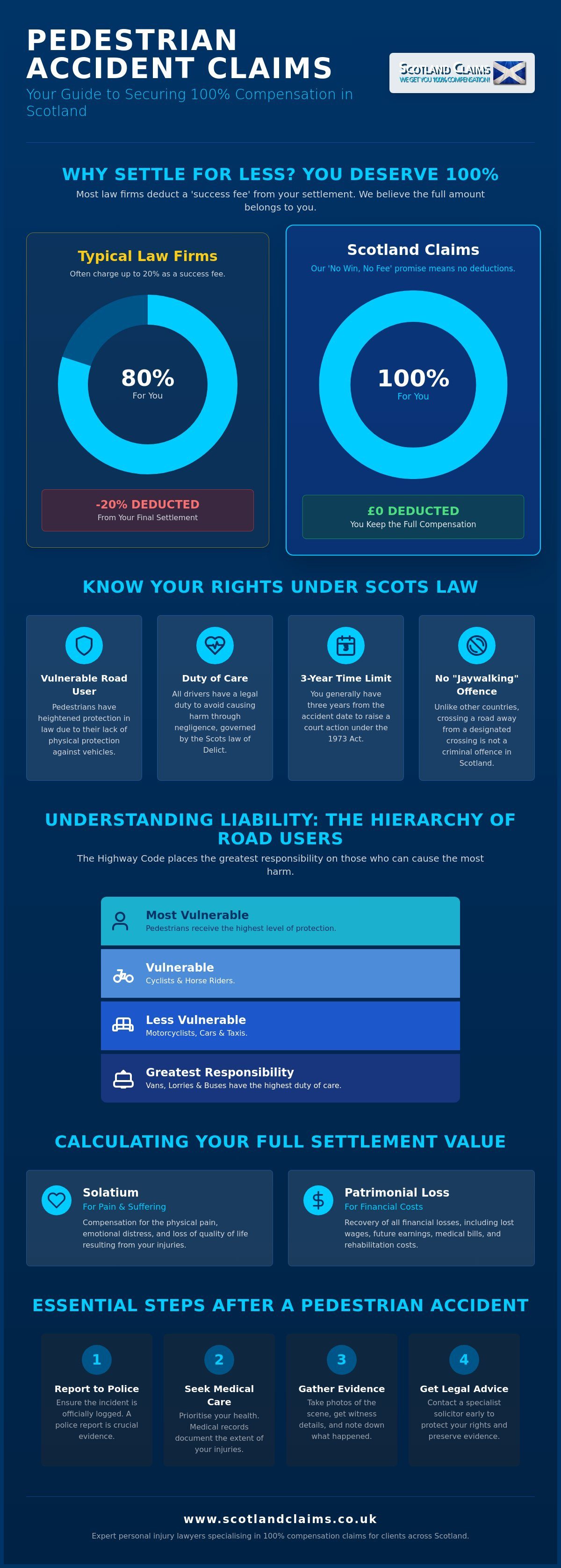
Your actions immediately following a collision are the foundation of successful pedestrian accident claims. Your first priority must be medical attention, even if you feel uninjured. Adrenaline often masks serious trauma like internal bruising or a concussion. A medical record created on the day of the incident provides an irrefutable link between the crash and your injuries. Without this, insurance companies will frequently attempt to argue that your condition was caused by a separate event.
Once you are safe, report the incident to Police Scotland. This is a legal requirement if anyone is injured. A police reference number is essential, especially if the driver was aggressive or left the scene. Whilst at the site, or as soon as possible after, gather witness details and take photographs of the vehicle, the road layout, and the weather conditions. These facts prevent the driver from changing their story later. If you are ready to take action, you can begin your claim with Scotland Claims Injury Lawyers today.
You should also start a pain diary. Document how your injuries affect your daily life, from restricted mobility to sleep disturbances. Keep every receipt for accident-related expenses, such as prescriptions or travel to hospital. These records prove the patrimonial loss we discussed earlier, ensuring you aren't left out of pocket. Detailed documentation is the key to transparency and fairness in the legal process.
Dealing with Hit and Run or Uninsured Drivers
The Motor Insurers’ Bureau (MIB) exists to protect you if the driver fled the scene or had no insurance. You can still secure 100% compensation through this scheme. However, the MIB has strict rules. You must report a hit-and-run involving an injury to the police within 14 days. Failure to meet this deadline can jeopardise your right to a settlement. We handle these complex MIB applications regularly, ensuring the lack of a known driver doesn't stop your recovery.
The Role of CCTV and Dashcam Evidence
Modern technology provides the silent witness you need to prove liability. CCTV from local businesses or council cameras can prove exactly what happened. Most systems overwrite footage within 14 to 30 days. You must act quickly to request a copy or have your solicitor do so. Dashcam footage from other motorists is also invaluable. If witnesses stopped to help, ask if they have a camera running. This objective evidence often forces insurers to admit fault without a long, drawn-out dispute.
Initiating your pedestrian accident claim with Scotland Claims Injury Lawyers is designed to be a seamless, low-risk process. We understand that your focus should be on recovery, not paperwork. It begins with a single call to our 24-hour freephone helpline. You will speak with a specialist assessment team that understands the nuances of Scottish law, rather than a generic call centre. This initial consultation is entirely free and provides you with an expert assessment of your situation without any obligation to proceed.
Once we accept your case, we immediately step in as your protective advocate. We take over all communication with the at-fault party's insurance company to stop them from pressuring you into a low settlement. Our solicitors manage the entire workflow, from securing the technical evidence discussed earlier to coordinating with medical experts. You will receive direct, punchy updates at every stage, ensuring the process moves with speed and efficiency until the final settlement is in your hands.
True No Win, No Fee: Zero Risk Justice
Our commitment to fairness means you face zero financial risk. If your claim is unsuccessful, you don't owe us a penny in legal fees. There are no hidden charges or surprise costs at the end of the process. We are transparent about how we work; we recover our costs from the at-fault party's insurer, not from your settlement. For a broader view of our expertise in road traffic incidents, you can refer to our Road Traffic Accident Claims Complete Guide.
Qualified Solicitors Authorised by the Law Society of Scotland
Every case at Scotland Claims Injury Lawyers is managed by a qualified solicitor authorised by the Law Society of Scotland. This regulation ensures you receive expert legal representation that meets the highest professional standards. We don't use unqualified claims handlers to process your future. By choosing a specialist Scottish firm, you avoid the industry-standard trap of losing 20% of your award to success fees. We believe you should retain the full value of your compensation to support your long-term well-being.
Start your claim online today or call 0800 611 8132 to speak with a specialist right now.
You shouldn't have to pay the price for a driver's negligence. Understanding your rights under the law of Delict is the first step toward rebuilding your life. We've explored how the hierarchy of road users protects you and why the 100% compensation model is the only fair way to handle pedestrian accident claims. Traditional firms that take a large cut of your award are simply not putting your interests first. You deserve a legal partner that prioritises your financial integrity as much as your physical rehabilitation.
Our team consists of specialist solicitors authorised by the Law Society of Scotland. We operate as dedicated No Win, No Fee experts to ensure that seeking justice never puts your personal finances at risk. With our 100% Compensation Guarantee, you retain the full value of your settlement to cover your lost wages and specialist medical care. It's time to move forward with the professional advocacy you deserve.
Secure 100% of your pedestrian accident compensation today with Scotland Claims. You have the right to a full recovery, and we're here to ensure you get it without any hidden costs or deductions.
Can I make a pedestrian accident claim if I was crossing the road away from a zebra crossing?
Yes, you can still pursue a claim even if you were not at a designated crossing. Drivers in Scotland have a proactive duty of care to anticipate pedestrians at all times. Whilst a court might consider if you contributed to the accident, the driver's failure to maintain a proper lookout is usually the primary factor in pedestrian accident claims. You are not barred from justice simply because you crossed the road elsewhere.
How much compensation will I get for being hit by a car as a pedestrian in Scotland?
The value of your settlement depends on the severity of your injuries and the total of your financial losses. We use the 18th edition Judicial College Guidelines, updated in 2026, to calculate solatium for your physical and mental distress. This is added to your patrimonial losses, such as lost wages and medical costs. Our 100% compensation model ensures you retain the full amount awarded without any deductions for success fees.
What happens if the driver who hit me was uninsured or didn't stop?
You can still receive your full compensation through the Motor Insurers’ Bureau (MIB). This organisation handles claims involving untraced or uninsured drivers to ensure victims aren't left without support. It's vital that you report the hit-and-run to Police Scotland within 14 days of the incident. We handle the complex MIB application process on your behalf to secure the settlement you need for your recovery.
Can I claim on behalf of my child if they were involved in a pedestrian accident?
Yes, a parent or guardian can initiate a claim for a child under the age of 16. The compensation is usually held in a protected account until the child reaches adulthood. It's important to remember that a child's three-year legal time limit doesn't start until their 16th birthday. However, you should start the process immediately to ensure that evidence like witness statements and CCTV footage is preserved whilst it's still available.
Will I have to go to court for a pedestrian accident claim?
It's highly unlikely that you'll need to step foot in a courtroom. The vast majority of our cases settle through direct negotiation with the at-fault party's insurance company. We build a robust evidence file from the start, which often forces insurers to admit liability and offer a fair settlement. We only suggest court action as a last resort if an insurer refuses to pay the full value of your claim.
How long does a pedestrian accident claim take to settle in Scotland?
The duration of a claim varies based on the complexity of your injuries and whether the driver admits fault. A straightforward case where liability is clear might settle within six to nine months. If your injuries are severe and require long-term medical assessment to determine a future prognosis, the process will take longer. We prioritise accuracy to ensure your final cheque covers all your future needs, not just your current ones.
Is there a time limit for making a pedestrian injury claim?
The standard time limit is three years from the date the accident occurred. This is a strict statutory deadline governed by the Prescription and Limitation (Scotland) Act 1973. If you don't initiate legal proceedings within this window, you'll likely lose your right to compensation forever. There are very few exceptions to this rule, so it's essential to seek professional legal advice as soon as you feel able to do so.
Why should I choose a Scottish solicitor instead of a UK-wide claims company?
Scottish law is entirely separate from the legal system in England and Wales. A UK-wide company may use call centre staff who aren't familiar with the law of Delict or the specific procedures of the Scottish courts. By choosing a firm authorised by the Law Society of Scotland, you're guaranteed that a qualified local solicitor will handle your case. You'll receive expert advocacy and the benefit of our unique 100% compensation guarantee.