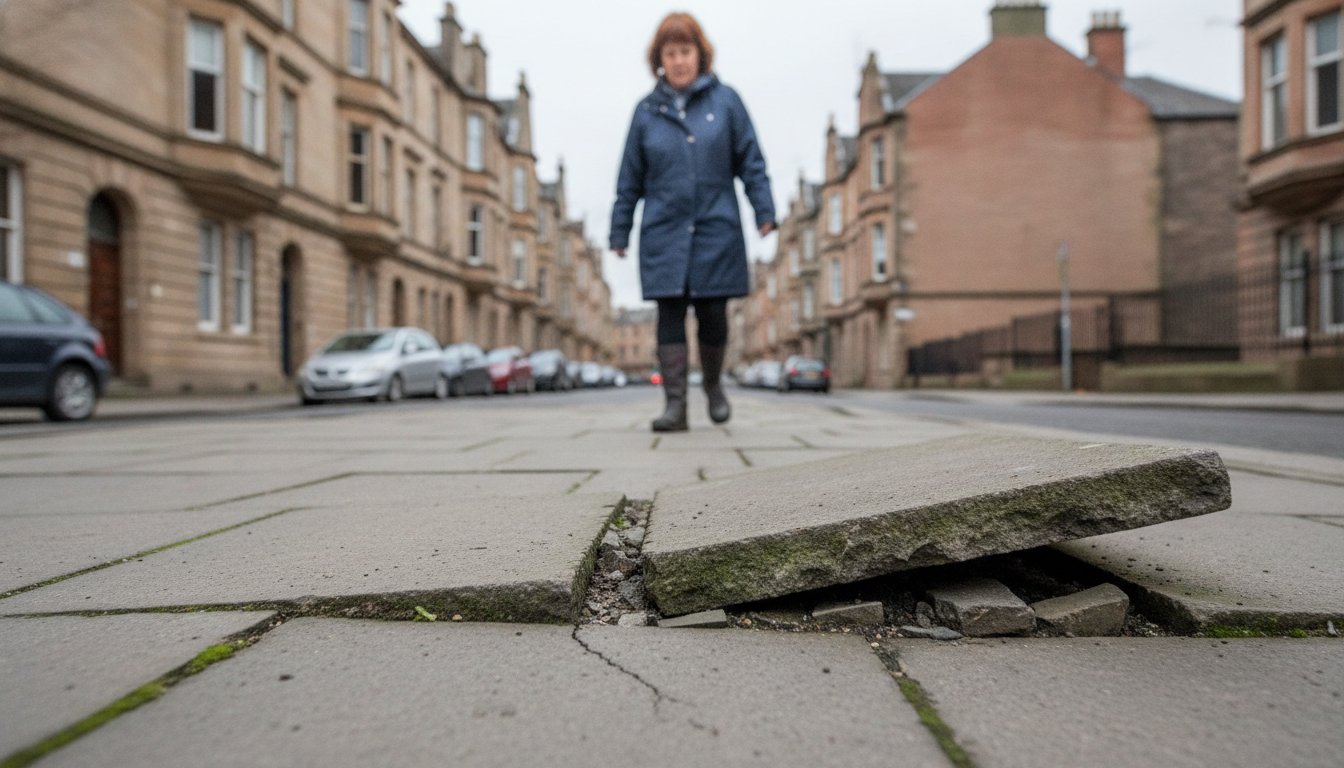
You shouldn't have to pay a success fee to get the money you are legally owed after an injury. Most law firms handling pavement accident claims in Scotland take a significant portion of your settlement, leaving you to cover the cost of your own recovery. If you have suffered a painful break or a sprain due to a poorly maintained walkway, you are already dealing with lost wages and physical distress. You deserve a process that prioritises your financial integrity over a solicitor's profit margin.
Navigating the Scottish legal system is different from the rest of the UK, and understanding these specific rules is the key to a successful outcome. This guide explains exactly how to hold the council accountable for hazards whilst ensuring you retain 100% of your compensation. We will show you how the law works, what evidence you need to prove the council failed in its duty, and how to recover every penny of your lost earnings without losing a portion to legal fees.
Key Takeaways
- Learn why Scottish public liability laws differ from English rules and how these regulations govern your right to a safe walkway.
- Discover the precise measurements that distinguish a minor defect from valid pavement accident claims against local authorities.
- Protect your settlement from "contributory negligence" arguments by gathering the specific evidence required to meet the burden of proof in Scottish courts.
- Follow a methodical procedure to notify the council and navigate their internal investigation phase with confidence.
- Secure 100% of your compensation through a specialist model where legal fees are recovered from the insurer, not your settlement.
What are Pavement Accident Claims in Scotland?
A pavement accident claim is a legal demand for compensation after you have been injured by a defect on a walkway. In Scotland, these cases fall under the categories of public liability or occupiers' liability. The core of the claim is proving that the person or organisation responsible for the ground failed to keep it safe. This isn't just about a minor stumble. It's about holding authorities accountable when their negligence leads to broken bones, lost wages, and physical pain.
Many people assume that all pavement accident claims follow the same rules as those in England. They don't. The Scottish legal system has its own statutes and court procedures. Whether you tripped on a cracked council paving slab or slipped on an icy path in a private retail park, you need a specialist who understands the specific Scottish standards of maintenance. We ensure you move through this system without the stress of hidden costs, providing a 100% compensation model where you keep every penny awarded to you.
The 3-Year Time Limit in Scots Law
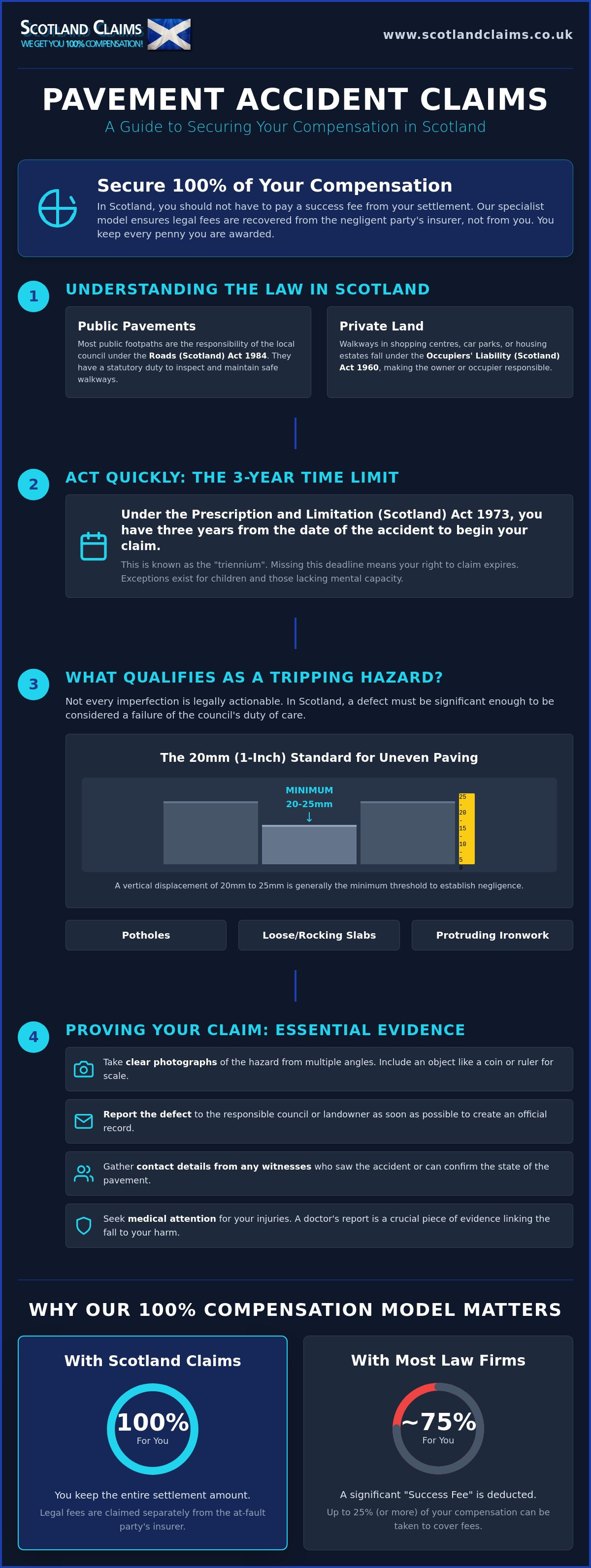
Timing is everything in a personal injury case. Under the Prescription and Limitation (Scotland) Act 1973, you generally have three years from the date of the accident to start your claim. This is known as the "triennium". If you miss this deadline, the law considers your right to claim to have expired. You won't be able to seek justice, no matter how severe your injuries are. It's best to act quickly whilst the evidence is still fresh.
There are specific rules for certain groups. For children, the three-year period doesn't begin until they turn 16. If an adult lacks the mental capacity to manage their own affairs, the time limit might be suspended. However, for the vast majority of pedestrians, the clock starts the moment your foot hits the ground. Waiting too long makes it significantly harder to find witnesses or secure CCTV footage of the hazard that caused your fall.
Liable Parties: Who is Responsible for the Pavement?
Determining who to sue depends on where the accident happened. Most public footpaths are the responsibility of the local council. Under the Roads (Scotland) Act 1984, authorities have a statutory duty to maintain and repair public roads and pavements. They are required to carry out regular inspections. If they knew about a defect or should have known about it through a proper inspection and did nothing, they are liable for your injuries.
Not every path belongs to the council. You might find yourself on a private pavement in a shopping centre, a car park, or a modern housing estate. In these instances, the What is a 'slip and fall' claim? concept applies under the Occupiers' Liability (Scotland) Act 1960. Liability can become complex if a defect sits right on the boundary between public and private land. We identify the correct liable party immediately so your claim doesn't get bogged down in jurisdictional disputes.
Identifying Common Hazards and the "Trip Hazard" Standard
Not every crack in the pavement justifies a legal case. To succeed in pavement accident claims, you must prove the defect was dangerous rather than a minor imperfection. A "minor" defect is usually anything below the standard threshold used by Scottish local authorities. However, hazards become more treacherous when combined with Scotland’s frequent rain and ice. Standing water can hide deep potholes, whilst ice turns a simple uneven surface into a high-risk zone for fractures.
Councils must follow a strict inspection regime to identify these risks. They are expected to categorise defects based on their potential to cause harm. This process aligns with Health and Safety Executive guidance, which emphasises proactive risk assessment. If a council ignores a known hazard or fails to inspect a busy street for over a year, their defence weakens significantly. You can use our personal injury compensation calculator to estimate the value of your potential settlement based on the severity of your injury.
The 20mm (1-Inch) Rule for Uneven Paving
In the Scottish legal system, a vertical displacement of 20mm to 25mm is generally the minimum requirement for a claim to proceed. If a paving slab is lower than this, the court may view it as a reasonable wear-and-tear imperfection. To measure this, place a ruler or a standard object like a 2-pound coin inside the gap and take a clear photograph. The 20mm rule serves as the standard threshold for establishing negligence against a Scottish local authority in court.
Potholes, Loose Flags, and Protruding Ironwork
Hazards aren't always static. A "rocking" slab might look level but shift violently when you step on it. These are particularly dangerous because they are invisible to the eye until the moment of impact. Similarly, protruding ironwork from utility covers, such as water or gas stopcocks, often creates a lethal trip point. If a utility company or the council fails to seat these covers flush with the surrounding surface, they are liable for the resulting injury. Tree roots also frequently buckle pavements in urban areas, creating steep, jagged edges that the council has a statutory duty to manage. These specific defects are common triggers for successful pavement accident claims when they are left unaddressed by the responsible party.
Ensuring pedestrian safety also extends to modern architectural elements in public and commercial spaces; for example, the installation of load-bearing surfaces by Structural Glass Design Ltd must follow precise engineering and safety guidelines to avoid creating new hazards.
Essential Evidence: How to Prove Your Pavement Accident Claim
In Scotland, the law doesn't assume the council is at fault just because you fell. The burden of proof lies entirely with you. You must provide clear evidence that a specific defect caused your injury. Without this, the council's insurers will likely reject your pavement accident claims. They often use a tactic called "contributory negligence" to reduce your payout. This involves arguing that you were distracted, wearing unsuitable footwear, or simply not looking where you were going. Strong evidence shuts down these arguments before they can gain traction.
You need to prove the council failed in their duty of care. This requires showing the hazard existed and that it was significant enough to cause harm. Getting a professional legal assessment early in the process is vital. It ensures your evidence meets the specific requirements of the Scottish courts. We help you build a robust case from the start, protecting your right to a full settlement without any deductions for legal fees.
Capturing the Scene: Photos and Measurements
Take photos immediately. If you are too injured, ask a friend or return to the spot as soon as possible. Use a reference object to show scale. A 50p coin or a standard ruler works best. Follow these steps:
- Take a close-up shot showing the measurement of the depth or height.
- Take a mid-range photo to show the defect in relation to the rest of the pavement.
- Take wide-angle shots to capture the surrounding area, including street signs or shop fronts.
This provides essential context. It proves exactly where the hazard is located so the council cannot claim they couldn't find it. If the council repairs the defect shortly after your accident, your photos become the only proof that the hazard ever existed.
Witness Statements and Medical Records
Witnesses are powerful allies. If anyone saw you fall, get their name and phone number. A neutral third party's account is much harder for an insurer to dispute than your own. Their testimony can confirm the weather conditions, the state of the pavement, and your own behaviour at the time. This adds a layer of credibility that is difficult to challenge.
Equally vital is your medical record. Visit a GP or A&E immediately. This creates an official link between the hazard and your physical condition. Don't wait. A delay of even a few days allows the council to argue that your injury happened elsewhere. Once you have your medical report, you can use our compensation calculator to see what your claim might be worth. Documenting every detail ensures you don't lose out on the 100% compensation you deserve.
The Step-by-Step Process of Claiming Against the Council
Starting a claim against a local authority is a formal legal process. It begins with a letter of claim sent directly to the council’s legal department. This document outlines exactly where the accident happened, the nature of the defect, and the injuries you sustained. Once they receive this notification, the council's internal investigation phase begins. They will review their maintenance logs and inspection records for that specific stretch of pavement. If they cannot prove they inspected the area according to their own schedule, their liability is often established.
A specialist injury lawyer in Scotland manages this entire sequence for you. They handle the complex correspondence and ensure the council doesn't use procedural delays to stall your payout. Most pavement accident claims are settled without ever stepping foot in a courtroom. In fact, over 90% of personal injury claims in Scotland are settled out of court, which makes the process faster and less stressful for you. A standard case can take anywhere from six to twelve months, depending on the complexity of the medical evidence and the council's willingness to admit fault.
Reporting the Defect and Filing the Claim
You should report the hazard to the council as soon as possible. This ensures the defect is repaired so no one else gets hurt. However, reporting a defect is merely an administrative step; it is not the same as starting a legal claim. Reporting a hazard to the council is a statutory right, not a legal barrier to claiming. Be wary if the council offers a small "goodwill gesture" immediately after you report the trip. These offers are usually far lower than the true value of your claim. Never sign anything or accept a payment before speaking with an expert who can assess your full loss of earnings and medical costs.
The Compulsory Pre-Action Protocol in Scotland
Scottish law uses a specific set of rules called the Compulsory Pre-Action Protocol. This framework dictates how solicitors and insurance companies must communicate. It sets strict deadlines for the council to acknowledge your claim and provide a decision on liability. This system is designed to speed up settlements and prevent unnecessary court dates. Kerr Brown Solicitors manage these procedural deadlines with precision, ensuring your case never loses momentum. This methodical approach forces the council’s insurers to take your claim seriously from day one. If you are ready to hold the council accountable, start your claim with our specialist team today to secure your 100% compensation.
Why Choose Scotland Claims for Your Pavement Injury?
You shouldn't have to settle for less than the full value of your injury. Most "big-brand" law firms operate on a model that prioritises their profit over your recovery. In Scotland, it is standard practice for solicitors to deduct a success fee from your final payout. This deduction is often capped at 20% of your settlement, but it still represents a significant loss of your rightful money. We don't follow this industry norm. Our 100% compensation guarantee ensures that every penny awarded by the court or the insurer stays in your pocket.
Working with a specialist who understands the specific nuances of Scottish civil law is essential for a successful outcome. Volume-based firms often treat cases like a production line, lacking the local expertise required to challenge a council's maintenance records effectively. Our team focuses exclusively on the Scottish jurisdiction. Because we are authorised by the Law Society of Scotland, you are protected by the highest professional standards. We don't just win cases; we maximise the value of your pavement accident claims by ensuring no part of your award is diverted to pay our bills. We recover our legal costs directly from the at-fault party’s insurance company, protecting your financial integrity from start to finish.
True No Win, No Fee: Zero Financial Risk
We believe legal help should be accessible to everyone, regardless of their financial situation. Our true No Win, No Fee model means we take on all the financial risk ourselves. If your claim doesn't result in a settlement, you don't owe us a single penny. This transparency eliminates the "lawyer fee anxiety" that often prevents people from seeking the justice they deserve. It allows you to focus entirely on your physical recovery whilst we handle the legal pressure and procedural deadlines. You can find more details about our risk-free process on our slip or trip claims page.
Starting Your 100% Compensation Claim Today
Take the first step toward a full recovery without any delay. Our online assessment tool and 24-hour freephone helpline provide immediate access to expert legal advice whenever you need it. We offer a free initial consultation where we review your evidence, assess the council's liability, and explain the likely value of your case. There is no obligation to proceed, but you will leave the conversation with a clear, professional understanding of your rights. To learn more about our specific methodology for winning cases against local authorities, read our Accident Claim Guide. Holding the council accountable for dangerous walkways shouldn't be a financial gamble. Contact us today to ensure you keep 100% of the compensation you are owed.
Secure Your Full Settlement Today
You now understand the 20mm hazard standard and the vital role of immediate evidence in building a successful case. You know that the Scottish legal system requires a specialist approach to hold local authorities accountable for their negligence. Your physical and financial recovery shouldn't be compromised by standard industry legal costs. We've removed the financial barriers that often prevent victims from seeking the justice they are legally owed.
By choosing a firm regulated by the Law Society of Scotland, you ensure your case is handled with the highest level of professional expertise and integrity. We stand by our 100% Compensation Guarantee; you keep every penny awarded for your pavement accident claims. There are no success fees to worry about and no hidden charges to fear. It's time to reclaim the wages and costs you've lost during your recovery period. You don't have to navigate this complex system alone.
Start your 100% compensation pavement claim online now.
You've suffered enough through the physical pain of your injury. Let us handle the legal weight whilst you focus on getting back on your feet.
Frequently Asked Questions
Can I claim compensation for falling on a pavement in Scotland?
Yes, you can claim if your fall was caused by a defect that the local council or a private landowner failed to repair. You must prove that the hazard was dangerous and that the responsible party breached their duty of care. Successful pavement accident claims require evidence that the authority knew about the defect or failed to carry out regular inspections as required by law.
How much compensation will I get for a pavement accident?
The amount you receive depends on the severity of your injuries and the financial impact on your life. Compensation covers physical pain, emotional distress, and out-of-pocket expenses like medical bills or travel costs. It also includes "loss of earnings" if you were unable to work during your recovery. Each case is unique, so a specialist assessment is necessary to determine the exact value of your settlement.
Is there a time limit for making a pavement accident claim?
You have three years from the date of the accident to initiate a claim in the Scottish courts. This period is known as the "triennium" under the Prescription and Limitation (Scotland) Act 1973. If you do not start legal proceedings within this window, your right to seek compensation is usually lost forever. For children, this three-year limit only begins on their 16th birthday.
What is the "1-inch rule" for pavement claims in Scotland?
The "1-inch rule" refers to the standard height threshold used to identify actionable defects. In most cases, a trip hazard must be at least 20mm to 25mm high to be considered a breach of the council's maintenance duty. Anything smaller is often categorised as minor wear and tear. Always use a ruler or a coin to photograph the defect's height to prove it meets this legal standard.
Can I claim if the pavement was icy or wet when I fell?
Claims involving weather conditions are possible but require proof of a specific failure in the council's gritting or maintenance schedule. You cannot claim for a slip caused solely by rain or naturally occurring ice. However, if ice formed because of a blocked drain or if the council ignored its own winter weather policy, you may have a valid case. Combining a weather hazard with an underlying structural defect often strengthens your position.
What happens if I was partially at fault for my pavement trip?
You can still recover compensation even if you were partially responsible for the accident. This is known as "contributory negligence" in Scots law. If the court decides you were 25% at fault because you were distracted, your final payout will be reduced by 25%. We work to minimise these deductions by proving that the council's failure to maintain the walkway was the primary cause of your injury.
How do I prove the council was negligent in maintaining the walkway?
Proof comes from a combination of physical evidence and council records. We request the council’s inspection logs to see if they followed their statutory maintenance plan. If they missed a scheduled check or ignored a reported fault, negligence is easier to establish. Your photos, witness statements, and medical reports provide the necessary link between their failure and your physical suffering.
Do I have to pay any legal fees if I win my pavement accident claim?
No, you keep every penny of your settlement when you choose our 100% compensation model. Whilst other firms might deduct a success fee of 20% or more, we recover our costs directly from the at-fault party's insurance company. This ensures that the money intended for your recovery stays with you. You face zero financial risk because if the claim is unsuccessful, you don't owe us anything.