Guide to secondary injury claims in Scotland 2026

TL;DR:
- A secondary injury claim seeks compensation for a new condition caused directly by a primary accident or its treatment.
- Building a strong claim requires continuous medical evidence, a nexus letter, and expert opinions linking the conditions.
A secondary injury claim is a legal action that seeks compensation for a new injury or condition arising directly from a primary accident or its medical treatment. Many people in Scotland do not realise they can claim for these subsequent conditions, even when the original claim has already been settled or is still ongoing. This guide to secondary injury claims explains what qualifies, how to build your evidence, and how to navigate the claim process in Scotland. Scotland Claims Injury Lawyers specialises in exactly this area, and unlike many firms, retains 100% of your compensation with no success fees deducted.
What qualifies as a secondary injury claim?
A secondary injury is any physical or psychological condition that develops as a direct result of a primary injury or its treatment. The legal term used in personal injury law is a “super-added injury,” and it must sit within an unbroken chain of causation linking it back to the original accident.
Physical secondary injuries are the most straightforward to understand. A knee injury sustained in a road traffic accident, for example, may alter a person’s gait over months, eventually causing chronic hip or lower back problems. A back injury treated with surgery may lead to nerve damage as a direct result of that procedure. Secondary conditions caused by the primary incident relate back to the original date, which is critical for compensation eligibility and benefit continuity.
Psychiatric secondary injuries carry a significantly higher legal threshold. Under the House of Lords judgment in Alcock v Chief Constable of South Yorkshire, five strict control tests must be satisfied for a psychiatric secondary victim claim to succeed. These tests require a close tie of love and affection with the primary victim, direct witnessing of the event, proximity to the event in time and space, perception through unaided senses, and a medically recognised psychiatric illness rather than ordinary grief or distress.
Pro Tip: Do not assume that emotional distress alone qualifies as a psychiatric secondary injury. A formal diagnosis of PTSD or clinical depression from a qualified medical professional is a legal requirement, not just supporting evidence.
The burden of proof rests entirely on the claimant. You must demonstrate that the secondary condition is directly connected to the primary injury or its treatment, with no independent intervening cause breaking the chain. Common qualifying scenarios include:
- Arthritis developing in a joint injured in a workplace accident
- Depression or PTSD following a traumatic road traffic accident witnessed directly
- Nerve damage resulting from surgery to treat a primary fracture
- Chronic pain syndrome developing after soft tissue injuries are left inadequately treated
- Respiratory complications arising from prolonged immobility after a serious accident
How to document medical evidence for a secondary injury claim
Continuous, gap-free medical treatment is the single most powerful asset in a secondary injury claim. Insurers exploit treatment breaks to argue that secondary conditions were caused by something unrelated to the original accident. A claimant who stops attending appointments, even briefly, hands the insurer a ready-made defence.
The practical steps for building a strong evidential record are clear:
- Report every new symptom immediately. Do not wait to see whether a new condition resolves itself. Visit your GP or specialist and have the symptom formally recorded in your medical notes on the date it first appears.
- Keep a daily symptom diary. Record pain levels, functional limitations, and the impact on your daily life. Courts and insurers treat contemporaneous diaries as credible evidence because they are written in real time, not reconstructed later.
- Request a nexus letter from your treating specialist. A nexus letter is a formal medical opinion that explicitly links your secondary condition to the primary injury or its treatment. Without this, insurers will deny compensation on the basis that the connection is unproven.
- Obtain independent expert medical opinion. Your solicitor can instruct an independent medical expert to produce a report that supports the chain of causation. This carries significant weight in disputed claims.
- Preserve all records. Keep copies of every prescription, referral letter, scan, and appointment note. Digital copies stored securely are acceptable.
The role of evidence in injury claims cannot be overstated. Vague or unsupported medical opinions carry far less weight in disputes than specific, documented, expert testimony. Claimants bear the evidential burden to prove the nexus between conditions, and that burden is met through records, not recollection.
Pro Tip: Ask your GP to add a specific note to your records stating that your new symptom is “consistent with” or “likely related to” your original injury. This simple step creates an early evidential anchor that is difficult for insurers to challenge.

A personal injury checklist can help you organise your documentation systematically from the outset, reducing the risk of gaps that could undermine your claim later.
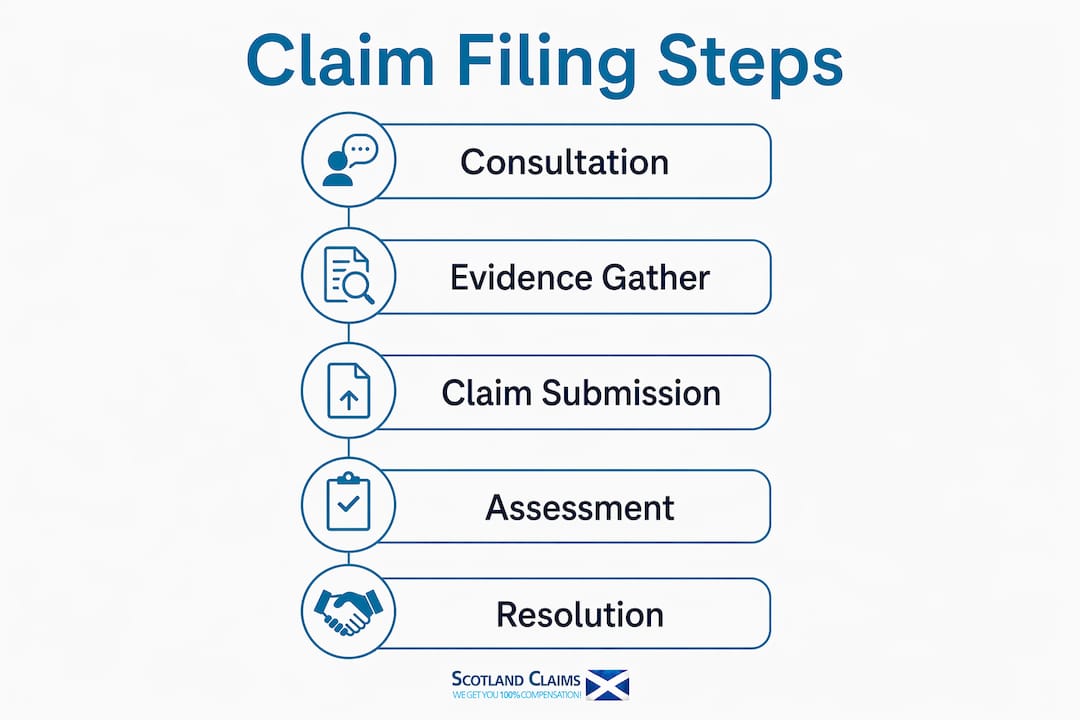
How to file a secondary injury claim in Scotland: step by step
The secondary injury claim process in Scotland follows a structured path, but it differs from a straightforward primary claim because you must establish two linked legal facts: the primary injury occurred through negligence, and the secondary condition flows directly from it.
The key stages are:
- Initial consultation and eligibility assessment. Contact a specialist solicitor to assess whether your secondary condition meets the legal threshold. Scotland Claims Injury Lawyers offers this consultation on a no win no fee basis, with no upfront costs.
- Gathering and submitting documentation. Your solicitor will compile your medical records, symptom diary, nexus letter, and expert reports into a formal claim pack. Claim eligibility in Scotland depends on satisfying both the causation test and the three-year limitation period, which typically runs from the date you became aware of the secondary condition.
- Notifying the responsible party. A formal letter of claim is sent to the negligent party or their insurer, setting out the primary and secondary injuries and the compensation sought.
- Responding to insurer tactics. Insurance companies commonly deploy the “pre-existing condition” argument and the “failure to mitigate” argument to reduce claim values. Early expert testimony linking injuries is the most effective counter to both tactics.
- Negotiation or litigation. Most claims settle through negotiation. If the insurer disputes liability or quantum, your solicitor will issue court proceedings. In Scotland, the Court of Session handles higher-value claims, while the Sheriff Court handles lower-value matters.
- Settlement and payment. With Scotland Claims Injury Lawyers, you receive 100% of the compensation awarded. No success fee is deducted, which is a distinct advantage over firms that take up to 20% from your settlement.
The step-by-step compensation guide for Scottish injury claims provides further detail on each procedural stage and what to expect at each point.
| Stage |
What happens |
| Consultation |
Solicitor assesses eligibility and causation |
| Evidence gathering |
Medical records, nexus letter, expert reports compiled |
| Letter of claim |
Formal notification sent to the negligent party |
| Insurer response |
Insurer accepts, disputes, or makes an offer |
| Settlement or court |
Claim resolves by agreement or judicial decision |
Common challenges in secondary injury claims and how to overcome them
Secondary injury claims face more resistance from insurers than primary claims. Understanding the obstacles in advance gives you a clear advantage.
The most frequent challenges are:
- Pre-existing condition arguments. Insurers argue the secondary condition existed before the accident. Counter this with medical records predating the accident that show no such condition, combined with expert opinion confirming the new onset.
- Treatment gaps. A break in medical attendance, even a few weeks, gives insurers grounds to argue the condition resolved and then recurred independently. Maintain continuous treatment without exception.
- Psychiatric injury threshold. Normal grief is insufficient for a psychiatric secondary claim. You must have a formal diagnosis of a recognised psychiatric illness, and you must have directly witnessed the traumatic event rather than learned of it secondhand.
- Weak causation evidence. Without a nexus letter and independent expert report, the chain of causation is difficult to establish. Engage expert medical witnesses early, before the insurer instructs its own experts.
- Delayed reporting of symptoms. Symptoms reported months after the primary accident, without contemporaneous records, are treated with scepticism. Report every symptom the moment it appears.
“The critical legal concept for secondary injuries is the chain of causation linking the primary injury and treatment to the subsequent condition. This is fundamental to claim success.”
Understanding insurance adjuster tactics helps claimants recognise when they are being managed rather than fairly assessed. Specialist legal representation is the most effective safeguard against these tactics.
Key takeaways
Secondary injury claims succeed when claimants establish an unbroken chain of causation, maintain continuous medical records, and obtain expert evidence linking the secondary condition to the original accident.
| Point |
Details |
| Chain of causation |
Prove the secondary condition links directly to the primary injury or its treatment. |
| Continuous treatment |
Never allow gaps in medical attendance; insurers use breaks to dispute causality. |
| Expert nexus letter |
A formal medical opinion linking conditions is the cornerstone of a strong claim. |
| Psychiatric injury threshold |
A formal diagnosis and direct witnessing of the event are both legally required. |
| 100% compensation |
Scotland Claims Injury Lawyers deducts no success fees, so you keep every penny awarded. |
Why early action defines the outcome of secondary claims
Secondary injury claims are the area of personal injury law where I see the most avoidable losses. Claimants come to me months or even years after a secondary condition has developed, with patchy medical records and no nexus letter. By that point, the insurer has already built its defence around the gaps.
The single most common mistake is under-reporting. People feel embarrassed to keep returning to their GP with new symptoms, or they assume the new pain will pass. That instinct is understandable, but it is costly. Every unreported symptom is a gap the insurer will exploit. Every missed appointment is evidence that the condition was not serious enough to treat consistently.
The second mistake is treating psychiatric symptoms as less legitimate than physical ones. A PTSD diagnosis following a traumatic accident is a recognised medical condition with real legal standing. The threshold under Alcock v Chief Constable of South Yorkshire is high, but it is not insurmountable with the right medical evidence and legal strategy.
What I find reassuring about the Scottish claims system is that it does treat secondary injuries seriously when they are properly evidenced. The law recognises that an accident does not always cause a single, contained injury. Bodies and minds respond to trauma over time, and the legal framework accounts for that. The claimants who succeed are those who document everything from day one and seek specialist legal advice before the insurer sets the terms of the conversation.
— Roger
How Scotland Claims Injury Lawyers supports secondary injury claimants
Scotland Claims Injury Lawyers handles secondary injury claims across Scotland on a no win no fee basis, meaning you pay nothing upfront and nothing if the claim does not succeed. Crucially, no success fee is deducted from your compensation. You receive 100% of what is awarded, which compares directly against the 20% success fees charged by many other firms. The team manages evidence gathering, expert medical instruction, and insurer negotiations on your behalf. Whether your secondary condition is physical or psychiatric, the specialist injury lawyers in Scotland at Scotland Claims have the experience to build and pursue your claim effectively. Request a free callback to discuss your situation today.
FAQ
What is a secondary injury claim?
A secondary injury claim seeks compensation for a new condition that develops as a direct result of a primary injury or its medical treatment. The secondary condition must sit within an unbroken chain of causation linked to the original accident.
How long do I have to file a secondary injury claim in Scotland?
The three-year limitation period typically runs from the date you became aware of the secondary condition, not necessarily the date of the original accident. Seek legal advice promptly to confirm your specific deadline.
Can I claim for psychiatric injury as a secondary victim?
Yes, but the legal threshold is high. Under Alcock v Chief Constable of South Yorkshire, you must satisfy five strict control tests, including direct witnessing of the event and a formal diagnosis of a recognised psychiatric illness.
What evidence do I need for a secondary injury claim?
You need continuous medical records, a symptom diary, a nexus letter from a treating specialist, and ideally an independent expert medical report linking the secondary condition to the primary injury.
Will a treatment gap ruin my secondary injury claim?
A treatment gap significantly weakens your claim. Insurers use breaks in treatment to argue the secondary condition was caused by something unrelated to the original accident. Maintain continuous medical attendance throughout your recovery.
Recommended