Fell in a supermarket? Your Scotland claims guide

TL;DR:
- If you fell in a supermarket in Scotland and suffered an injury, you may have a valid claim if the store failed to exercise reasonable care.
- You must act within three years from the accident date to preserve your right to pursue compensation.
If you fell in a supermarket and suffered an injury, you may be entitled to compensation under Scottish law. A supermarket owes every customer a duty of reasonable care, and when that duty is breached, a personal injury claim becomes possible. The legal framework governing your right to claim is the Prescription and Limitation (Scotland) Act 1973, which sets a strict three-year window to act. Understanding your rights quickly is the difference between a valid claim and a time-barred one.
What determines supermarket liability in fall accidents?
Supermarket liability is not automatic. Legal experts confirm that premises owners owe a duty of reasonable care, not a guarantee of perfection. That distinction matters enormously. A supermarket is not liable simply because you fell. It is liable when it knew about a hazard, or should have known, and failed to act within a reasonable time.
Common hazards that give rise to supermarket slip and fall claims include:
- Spillages left unattended on shop floors
- Wet floors with no warning signs displayed
- Poor lighting in aisles or near entrances
- Cluttered walkways or misplaced stock
- Damaged or uneven flooring
Each of these hazards is preventable. A supermarket that runs regular inspection checks and acts on known risks will have a strong defence. One that ignores a spillage reported by staff, or fails to inspect for hours, will not.
Proving negligence requires showing the supermarket had actual or constructive knowledge of the hazard. Actual knowledge means staff were aware. Constructive knowledge means the hazard had existed long enough that a reasonable inspection programme would have caught it. CCTV footage and employee statements are the two most powerful tools for establishing this.

Pro Tip: Ask store staff directly whether the hazard had been reported before your fall. Any admission, even an informal one, can constitute evidence of actual knowledge.
A common misconception is that falling in a store automatically means the store is at fault. Successful claims rest on proving negligence, not simply the fact that a fall occurred. This is why the steps you take immediately after a fall accident in a supermarket are so critical.
How to collect and preserve evidence after a fall in store
The evidence you gather in the first hours after a fall shapes the entire claim. Acting quickly is not optional. Delay weakens claim credibility and allows physical evidence to disappear.
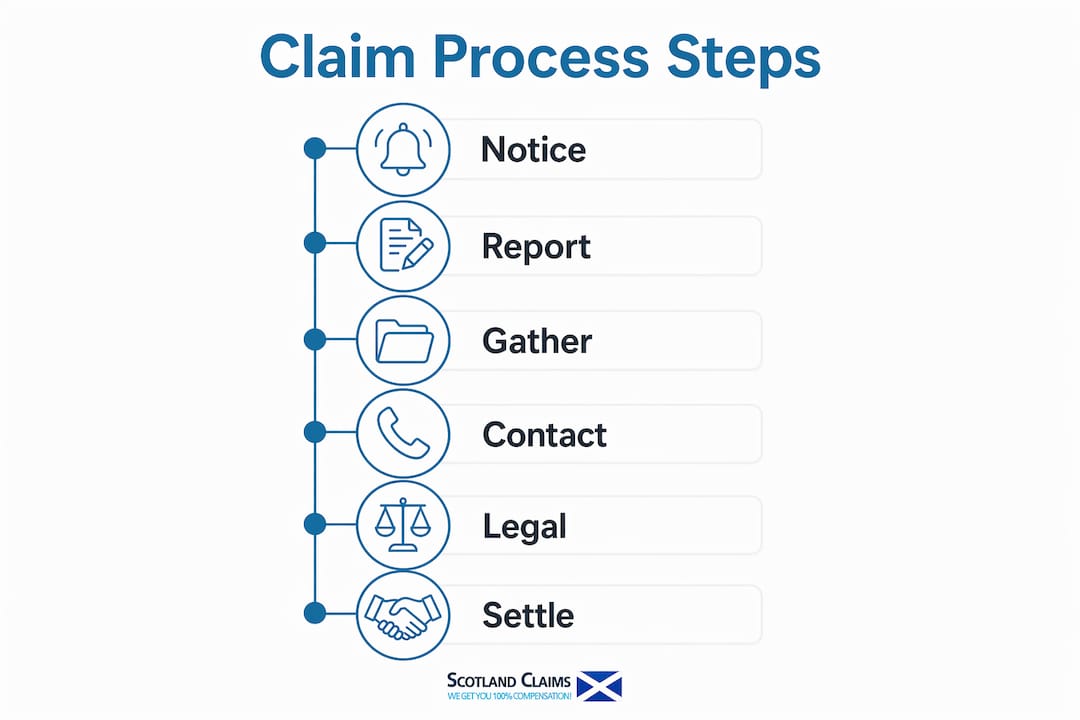
Follow these steps as soon as you are able:
- Seek medical attention immediately. Even if your injuries feel minor, a medical record creates a direct link between the fall and your injury. Gaps in treatment give insurers grounds to dispute severity.
- Report the accident to store management. Ask for the incident to be logged in the store’s accident book. Filing an incident report at the time of the fall creates a critical paper trail that strengthens your claim.
- Photograph everything. Take photos of the hazard, the surrounding area, any warning signs (or the absence of them), and your injuries. Video is even better if you can manage it safely.
- Collect witness details. Without witness statements, proving supermarket liability becomes significantly harder. Ask anyone nearby for their name and contact details.
- Request CCTV preservation in writing. Supermarket CCTV footage is often automatically deleted within 7–30 days. A formal written preservation request, sometimes called a spoliation letter, stops that deletion and preserves footage that may show the hazard existed before your fall.
- Avoid signing any statement that admits fault. Store staff may ask you to sign documents. Read everything carefully. Never accept blame or minimise your injuries in writing.
Pro Tip: Send your CCTV preservation request by recorded delivery and keep a copy. An informal verbal request carries no legal weight and will not prevent deletion.
Preparing your evidence thoroughly is one of the most important things you can do. Scotland Claims Injury Lawyers has a dedicated guide on how to prepare injury evidence for Scottish claims, which covers documentation in detail.
What are the legal time limits for a supermarket fall claim in Scotland?
Scotland operates under a specific statutory deadline for personal injury claims. Under the Prescription and Limitation (Scotland) Act 1973, you have three years from the date of your accident to raise court proceedings. Miss that deadline and your claim is almost certainly time-barred, regardless of how strong your evidence is.
The three-year period, known as the triennium, typically begins on the date of the fall. Where an injury is not immediately apparent, the clock may start from the date you became aware of the injury and its cause. This distinction matters for conditions that develop gradually after a fall, such as certain back or joint problems.
| Scenario |
When the three-year period starts |
| Immediate injury on date of fall |
Date of the accident |
| Injury symptoms appear later |
Date of awareness of injury and cause |
| Claimant is under 16 at time of fall |
Three years from their 16th birthday |
| Claimant lacks legal capacity |
Period may be suspended until capacity is regained |
Children have additional protection. If the person who fell in a supermarket was under 16 at the time, the triennium does not begin until their 16th birthday. That gives them until age 19 to raise a claim. A parent or guardian may also raise a claim on their behalf before that point.
Acting well within the three-year limit is always advisable. Evidence degrades, witnesses forget details, and legal preparation takes time. Scotland Claims Injury Lawyers provides clear guidance on claim time limits in Scotland if you need to check where you stand.
What compensation can you expect after falling in a supermarket?
Compensation for a supermarket fall injury claim covers two main categories. General damages compensate for pain, suffering, and loss of amenity. Special damages cover financial losses such as medical costs, travel to appointments, and lost earnings.
The value of a claim depends on the nature and severity of the injury. Common claim values range from approximately £10,000 for minor injuries to over £100,000 for severe cases involving long-term disability or significant loss of earnings. These figures reflect the wide spectrum of injuries that result from grocery store falls.
Injuries commonly claimed after a fall accident in a supermarket include:
- Wrist and hand fractures from bracing a fall
- Knee ligament damage and cartilage injuries
- Hip fractures, particularly in older claimants
- Shoulder injuries and rotator cuff tears
- Spinal and back injuries ranging from soft tissue strains to disc damage
- Head injuries where a claimant strikes a shelf or floor
The quality of your evidence directly affects the value of your settlement. A claim supported by CCTV footage, an incident report, medical records, and witness statements will achieve a significantly better outcome than one relying on memory alone. Many claims resolve through negotiation before reaching court, but having a specialist lawyer means you are never pressured into accepting a low early offer.
Legal representation also matters when dealing with supermarket insurers. Large retailers carry substantial insurance and employ experienced loss adjusters whose job is to minimise payouts. A specialist injury lawyer levels that playing field. You can use the compensation calculator on the Scotland Claims Injury Lawyers website to get an early estimate of what your claim may be worth.
For a broader overview of how slip and trip claims work in Scotland, including the burden of proof required to establish negligence, the Scotland Claims Injury Lawyers site covers the full legal picture.
Key takeaways
A supermarket fall claim in Scotland succeeds when you prove the store breached its duty of reasonable care, preserve evidence immediately, and raise proceedings within the three-year triennium under the Prescription and Limitation (Scotland) Act 1973.
| Point |
Details |
| Liability requires proof of negligence |
A fall alone is not enough; you must show the supermarket knew or should have known about the hazard. |
| Evidence must be preserved urgently |
CCTV footage is deleted within 7–30 days; send a formal written preservation request immediately. |
| Scotland’s three-year deadline is strict |
Under the 1973 Act, missing the triennium almost always bars your claim permanently. |
| Compensation covers multiple losses |
Awards include medical costs, lost earnings, and pain and suffering, ranging from £10,000 to over £100,000. |
| Legal representation maximises recovery |
A specialist lawyer prevents early low offers and manages insurer negotiations on your behalf. |
Why I tell every client the same thing on day one
People often contact Scotland Claims Injury Lawyers weeks after their fall, having spent that time hoping the pain would pass or assuming the supermarket would “do the right thing.” That delay costs them dearly. CCTV footage is gone. The hazard has been fixed with no record. Witnesses have moved on.
The single most important thing I have learned from years in this field is that the first 48 hours after a fall in a supermarket are worth more than any legal argument made months later. Evidence gathered at the scene, before anything is cleaned up or deleted, is the foundation of every strong claim. Without it, even a clear-cut case of negligence becomes an uphill battle.
I also see claimants make the mistake of speaking too freely with store managers or insurers in the days after a fall. They want to be reasonable. They do not want to cause trouble. That instinct is understandable, but it can seriously damage a claim. Anything you say informally can be used to suggest the injury was minor or that you accepted some responsibility.
The other thing worth knowing is that Scotland Claims Injury Lawyers charges no success fee. Other firms take up to 20% of your compensation as their fee. We take nothing. You keep 100% of whatever you are awarded. That is not a small difference on a claim worth £30,000 or £50,000. It is the difference between full justice and a reduced payout. Seek specialist legal advice as soon as possible after your accident. The sooner you act, the stronger your position.
— Roger
Scotland Claims Injury Lawyers: no success fees, full compensation
Scotland Claims Injury Lawyers specialises in supermarket fall injury claims across Scotland. Unlike most firms, which deduct up to 20% of your settlement as a success fee, Scotland Claims takes nothing from your compensation. You receive 100% of your award. That commitment applies whether your claim involves a back injury, a knee injury, or any other injury sustained in a grocery store fall. The team handles evidence gathering, insurer negotiations, and the full legal process on a No Win No Fee basis. Contact Scotland Claims Injury Lawyers today for a free case evaluation and find out exactly what your claim could be worth.
FAQ
Can I claim if I fell in a supermarket but did not report it at the time?
You can still pursue a claim, but the absence of an incident report makes proving liability harder. Gather any other evidence you have, including photos, medical records, and witness details, and contact a specialist lawyer promptly.
How long does a supermarket fall claim take to settle in Scotland?
Most claims resolve within 12–18 months, though straightforward cases with strong evidence can settle sooner through negotiation without court action.
What if the supermarket says the hazard was not their fault?
The supermarket’s denial does not end your claim. Your lawyer will use CCTV footage, inspection records, and witness statements to establish whether the store had knowledge of the hazard and failed to act within a reasonable time.
Is there a time limit for children who fell in a supermarket?
Yes. Under the Prescription and Limitation (Scotland) Act 1973, the three-year period begins on a child’s 16th birthday, giving them until age 19 to raise a claim independently.
Does Scotland Claims Injury Lawyers charge a success fee?
Scotland Claims Injury Lawyers charges no success fee. You keep 100% of your compensation, compared with the 20% deducted by most other firms.
Recommended