Table of Contents
Last Updated: September 13, 2026
What Counts as a Public Park Accident
Can you claim for a fall in a public park? Yes, in Scotland you can pursue a personal injury claim if a fall in a public park was caused by the failure of the body responsible for that space to take reasonable care. This guide from Scotland Claims Injury Lawyers explains how claims work under Scots law, what evidence proves negligence, and how the process runs from first report to settlement.
A public park accident is any injury sustained on land that the public is permitted to enter, where the occupier's failure to maintain safe conditions caused harm. Glasgow's parks, from Kelvingrove to the smaller community greens, are maintained by Glasgow City Council, and that body carries a legal duty of care to people who use them.
The bar is higher than most people expect. According to guidance on occupiers' liability in Scotland, the Occupiers' Liability (Scotland) Act 1960 requires that the occupier takes "such care as in all the circumstances of the case is reasonable" to see that a person entering the land does not suffer injury. Reasonable care is not the same as perfection.
Key Takeaway
A fall alone does not create a claim. You must be able to show that the condition of the park fell below a reasonable standard and that this caused your injury.
Common Causes of Falls in Public Parks
The most frequent causes are uneven or broken paving, potholes in paths, wet leaves and ice, damaged steps, and poorly maintained play equipment. Each of these points to a maintenance failure rather than simple bad luck, which is what makes a claim possible.
Scottish weather does much of the damage. Freeze-thaw cycles crack tarmac, heavy rain washes gravel onto paths, and fallen branches create trip hazards that a council should clear within a reasonable time.
- Slip and trip hazards: cracked slabs, raised edges, loose gravel
- Surface defects: potholes, subsidence, worn or missing grip on steps
- Weather-related hazards: ice, standing water, wet leaves
- Hazardous equipment: broken swings, rusted railings, damaged benches
- Poor lighting on paths used after dark
A common mistake is assuming that because a hazard existed, the council is automatically at fault. In practice, the question is whether the council knew, or ought to have known, about the defect and had a reasonable opportunity to fix it.
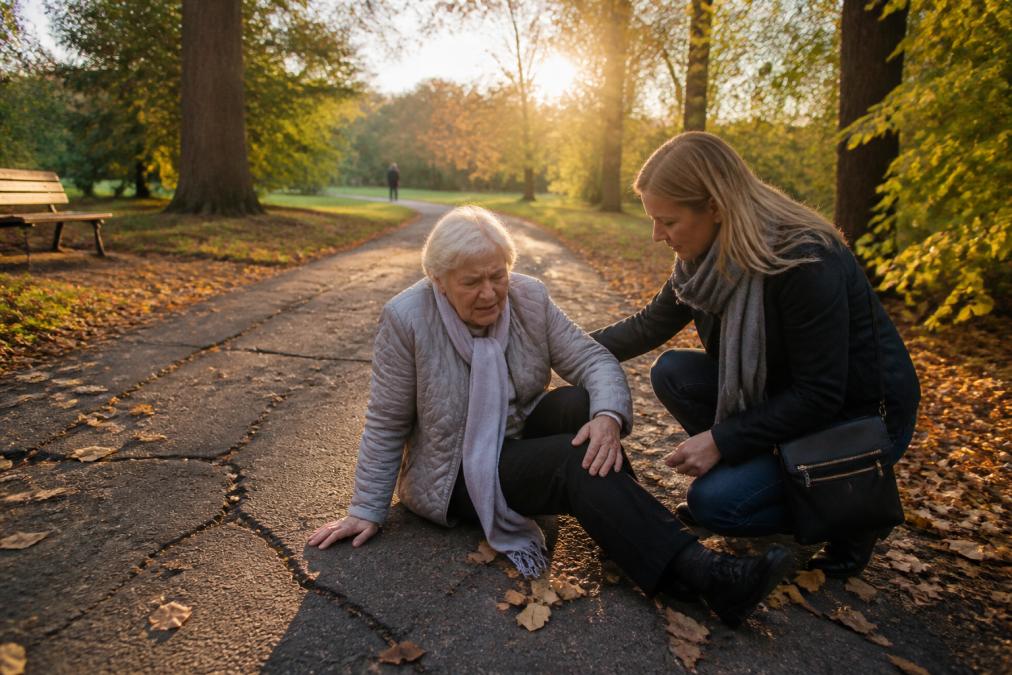 A cracked and uneven tarmac path in a Scottish public park with fallen leaves scattered across it, low autumn sunlight casting long shadows, a bench visible in the background
Who Is Liable for a Public Park Accident?
Liability for a fall in a Scottish public park normally rests with the occupier of the land, and in most cases that is the local authority. In Glasgow, the occupier of the city's parks, from Kelvingrove Park and Glasgow Green to smaller community greens, is Glasgow City Council. Where a park is leased, held in trust, or managed by a private operator or a community trust, the occupier may be a different body, and identifying the correct defender is the first practical step in any claim.
Under the Occupiers' Liability (Scotland) Act 1960, the occupier owes a duty to take "such care as in all the circumstances of the case is reasonable" to see that a person entering the land does not suffer injury. That duty is not absolute. It does not require the council to eliminate every conceivable hazard, and it does not make the council an insurer of your safety. What it does require is a reasonable system of inspection, maintenance and repair, proportionate to the nature of the park and the level of public use it receives.
In practice, liability turns on four questions:
- Who was the occupier? Usually Glasgow City Council for council-run parks, but check whether the park is leased, trust-held or privately managed.
- What was the defect? A cracked slab, a pothole, a broken railing, a damaged bench or play equipment, each points to a different maintenance regime.
- Did the occupier know, or ought they to have known? A defect that had been reported previously, or that a reasonable inspection would have revealed, is far stronger than one that appeared overnight.
- Was there a reasonable opportunity to repair? A council is not expected to fix a hazard the moment it appears, but it is expected to act within a reasonable time once on notice.
There is a second layer to consider. Even where a claimant shares some responsibility for their own accident, they may still be entitled to compensation. In Scotland this is called contributory negligence, and it reduces the award rather than eliminating it (lawscot.org.uk). The court or the defender's solicitors will assess the extent of your own carelessness, for example, if you were distracted, wearing unsuitable footwear, or ignored a visible barrier or warning sign, and apply a percentage reduction to the damages.
Watch Out
If you were distracted, wearing unsuitable footwear, or ignored a visible barrier or warning sign, the council will argue contributory negligence. That argument can cut your compensation, so be honest with your solicitor about the full circumstances from the start.
A common pattern in Scottish public park claims is that the council denies liability on the basis that the defect was not previously reported and that its inspection regime was reasonable. The counter is evidence: maintenance records obtained through a subject access request or disclosure, a history of complaints about the same defect, and photographs showing the hazard clearly. Where a park is managed by a body other than the council, for example, a trust or a private operator, the same principles apply, but the correct defender changes, and getting that wrong at the outset can delay or derail a claim.
Proving Negligence in Public Park Accidents
Proving negligence in public park accidents comes down to three linked elements: a duty of care owed to you, a breach of that duty, and causation, meaning the breach caused your injury. Miss any one of these and the claim weakens considerably.
The duty is set by the Occupiers' Liability (Scotland) Act 1960, which requires reasonable care rather than guaranteed safety. Breach is shown by evidence that the park fell below a reasonable standard, often through maintenance records or a history of complaints about the same defect. Causation links that failure directly to your injury.
Photographic evidence is the single most useful thing you can gather. A dated photo of the defect, taken before it is repaired, frequently settles arguments that would otherwise run for months. Witness statements from anyone who saw the fall add weight, and medical evidence ties your injury to the incident.
- Photographs of the defect and the surrounding area, with something for scale
- Witness statements, including contact details
- Your own written account, made while memory is fresh
- Medical evidence from your GP or hospital attendance
- Any accident report book entry or council reference number
How to Report an Accident to Glasgow City Council
Reporting the accident to Glasgow City Council promptly is one of the most practical steps you can take, because it creates an official record and often triggers an inspection of the defect. How to report an accident to Glasgow City Council is straightforward: use the council's online reporting form, phone the relevant department, or report in person, and always ask for a reference number.
Keep the report factual. State where you fell, when, what caused the fall, and what injury you sustained. Do not speculate about fault in the report itself, and do not accept any suggestion that the incident was simply your own carelessness.
Get Started Today →
If the fall happened in a park managed by a different body, report to that organisation instead. For parks within Glasgow, the council is normally the correct point of contact. Ask whether the defect had been reported previously, as a history of complaints strengthens a claim.
Personal Injury Claim Time Limit Scotland
The personal injury claim time limit in Scotland is three years from the date of the accident, or from the date you became aware of the injury where that is later (legislation.gov.uk). This is set by the Prescription and Limitation (Scotland) Act 1973, and it is a strict cut-off.
Missing that deadline usually ends the claim entirely. There are narrow exceptions, including cases involving children or people without capacity, where the clock starts later, but relying on an exception is a poor strategy. Start the claim well inside the three-year window.
Pro Tip
Gather your evidence in the first few weeks, not the first few months. Councils repair defects quickly once they are reported, and the photographic evidence that proves your case can disappear with the hazard.
How to Make a Compensation Claim: Step by Step
Making a compensation claim follows a predictable path, and most cases settle without ever reaching court. The steps below are the same whether the claim is handled directly or through a solicitor.
Total time: typically several months from instruction to settlement, though complex cases run longer.
- Get medical attention and record your injuries. Attend your GP or hospital and keep every appointment record.
- Collect evidence at the scene. Photograph the defect, note the location, and take details from witnesses.
- Report the accident to the council or the body responsible for the park, and keep the reference number.
- Speak to a solicitor who handles Scottish personal injury claims and understands the Occupiers' Liability (Scotland) Act 1960.
- Compile medical evidence through a report from a medical expert, arranged by your solicitor.
- Submit the claim and allow the pre-action protocol for Scottish courts to run, which encourages settlement before litigation.
- Negotiate settlement, covering general damages for pain and suffering and special damages for financial loss and out-of-pocket expenses.
- Settle or proceed to court if a fair offer is not made.
| Stage |
What Happens |
Typical Timescale |
| Evidence gathering |
Photos, witnesses, medical records |
First few weeks |
| Reporting |
Council report and reference number |
Within days of the fall |
| Medical report |
Expert assessment of your injuries |
1-3 months |
| Pre-action protocol |
Formal claim and settlement talks |
Several months |
| Court proceedings |
Only if settlement fails |
Longer, case by case |
The pre-action protocol for Scottish courts matters here. It sets out how claims should be exchanged and negotiated before either side goes to court, and it gives both parties a structured route to settlement. Most public park claims resolve at this stage.
No Win No Fee Agreements Explained
No win no fee agreements, more formally called conditional fee agreements or, in Scotland, often structured as speculative fee agreements, let you pursue a claim without paying upfront legal costs. If the case is unsuccessful, you owe nothing for your solicitor's fees. If it succeeds, the fee is recovered, and the arrangement is set out in writing before you instruct anyone.
In Scotland, the practical mechanics differ from the rest of the UK. Scottish solicitors are regulated by the Law Society of Scotland, and the terms of any speculative agreement must be clear, fair and explained to you before you sign. The agreement should set out what happens if the claim succeeds, what happens if it fails, and whether any deduction will be taken from your compensation.
This matters most when a claim is uncertain. Public park claims are not straightforward: the council may deny liability, argue contributory negligence, or point to a reasonable inspection regime. The risk of losing is real. A no win no fee agreement removes the financial barrier that stops many people with genuine claims from ever starting.
Scotland Claims Injury Lawyers works on a No Win No Fee basis and operates a 100% Compensation Guarantee, so clients keep the full amount awarded when the claim succeeds. Some firms in the market deduct a success fee from the settlement, commonly around 20%, which reduces what the claimant actually receives. That practice is worth checking before you sign anything with any firm.
When you are comparing agreements, ask three questions:
- What is the success fee, if any? Some firms take a percentage of your compensation; others do not.
- What happens if the claim fails? In a properly structured no win no fee agreement, you should not be out of pocket for your own solicitor's fees.
- Are there any disbursements? These are costs such as medical reports or court fees, and the agreement should explain who pays them if the claim fails.
Best For
People with a genuine injury from a park fall who want to pursue a claim without upfront cost or a deduction from their compensation.
A well-drafted agreement also explains the pre-action protocol for Scottish courts, which encourages settlement before litigation and keeps costs proportionate. Most public park claims resolve at this stage, which is one reason no win no fee arrangements work well for this type of case: the risk is manageable, the process is structured, and the claimant is not exposed to upfront cost.
can you claim for a fall in a public parkpersonal injury claim time limit scotlandhow to report an accident to glasgow city councilproving negligence in public park accidents