100 percent injury compensation in Scotland: your guide

TL;DR:
- Full injury compensation in Scotland involves recovering all damages legally owed with minimal solicitor fees. Claimants must gather strong evidence early and avoid accepting low insurer offers before medical prognosis. Scotland Claims Injury Lawyers offers no win, no fee services and never deducts a success fee on any claim type, so clients keep 100% of their compensation.
100 percent injury compensation is defined as recovering the full legal value of your personal injury claim in Scotland, covering every penny of damages you are entitled to under the law. The industry term for this is “full damages recovery,” encompassing both general damages for pain and suffering and special damages for financial losses. If you were injured in a road traffic accident and were not at fault, Scotland Claims Injury Lawyers takes nothing from your compensation. For all other injuries such as slips, trips, or accidents at work, Scotland Claims Injury Lawyers also deducts no success fee, meaning clients keep 100% of their compensation - compared with up to 20% including VAT charged by most large firms. Understanding this distinction is the first step to protecting what you are owed.
What does 100 percent injury compensation actually mean?
Full injury compensation does not mean you receive a settlement with zero deductions in every case. Compensation is defined as the sum of general and special damages, reduced by any contributory negligence and then subject to agreed solicitor fees. Claimants often misunderstand the phrase as a guarantee of no deductions at all, when it actually means pursuing the maximum legal entitlement available to you. The goal is to leave nothing on the table.
For road traffic accident victims who were not at fault, including both drivers and passengers, Scotland Claims Injury Lawyers passes 100% of the settlement directly to the client. No solicitor fee is deducted. That is a genuine total accident payout in the truest sense of the phrase.
How is personal injury compensation calculated in Scotland?
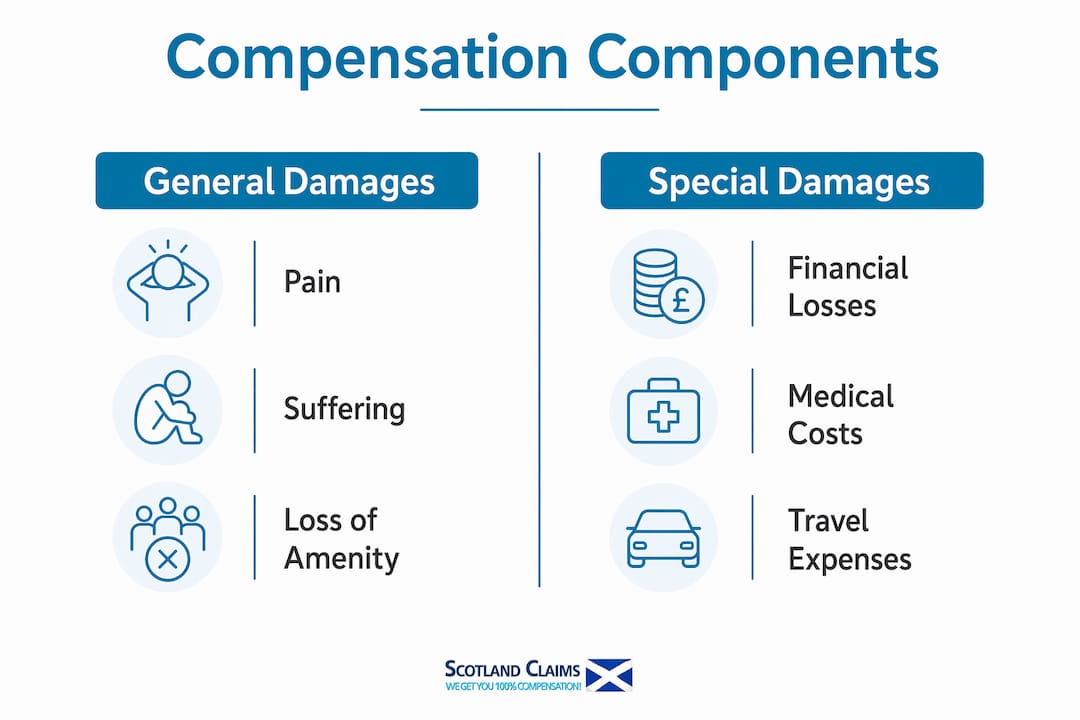
Compensation in Scotland is built from two distinct components. General damages cover pain, suffering, and loss of amenity. Special damages cover every financial loss caused by the injury.
General damages: pain, suffering, and loss of amenity
General damages are assessed using the Judicial College Guidelines, a published framework used by courts and solicitors across the UK to assign monetary values to specific injuries. A moderate whiplash injury, for example, falls within a defined bracket. A severe spinal injury sits in a far higher bracket. The guidelines are updated regularly, and using the correct edition matters for your claim value.

Independent medical assessments are the legal keystone for translating your injury into a recognised compensation value. A basic GP letter carries far less weight than a formal report from an independent medical expert. That expert report is what locks in your position under the Judicial College Guidelines.
Special damages: your documented financial losses
Special damages require evidence. Every receipt, invoice, and payslip counts. Common categories include:
- Lost earnings from time off work, including future lost income if your capacity to work is reduced
- Medical and rehabilitation costs, such as physiotherapy, prescription charges, and private treatment
- Travel expenses to and from medical appointments
- Care costs if a family member or carer assisted your recovery
- Property damage, such as a vehicle written off in a road traffic accident
| Damage category |
Examples |
| General damages |
Whiplash, fractures, psychological trauma, chronic pain |
| Special damages (past) |
Lost wages, medical bills, travel costs, care received |
| Special damages (future) |
Ongoing treatment, reduced earning capacity, long-term care |
Pro Tip: Keep a daily injury diary from the moment of your accident. Record pain levels, activities you cannot perform, and how the injury affects your sleep and mood. This diary becomes direct evidence for your general damages claim.
What evidence do you need to secure your maximum injury settlement?
Strong claims require consistent medical care, preserved evidence, and a clear legal strategy from the very start. Evidence gathered in the hours and days after an accident is almost always stronger than evidence collected weeks later. Delays allow insurers to argue that injuries were less serious or caused by something else.
- Seek medical attention the same day. A&E records, GP notes, and ambulance reports all create a contemporaneous medical trail that is difficult to dispute.
- Photograph everything at the scene. Capture the hazard, your injuries, vehicle damage, road conditions, and any signage. Immediate documentation is critical because delays result in lost evidence that can reduce your compensation.
- Collect witness details. Full names and contact numbers from anyone who saw the accident are valuable. Witnesses become harder to trace as time passes.
- Report the accident formally. For workplace accidents, this means the employer’s accident book. For road accidents, a police report. For slips and trips, a written report to the property owner or local authority.
- Obtain an independent medical assessment. Do not rely solely on NHS records. An independent expert report assigns a formal value to your injuries under the Judicial College Guidelines.
- Keep all receipts and financial records. Every cost linked to your injury must be documented to recover it as a special damage.
The pitfalls that cost claimants thousands
Over 95% of personal injury cases settle out of court, and insurers know this. They frequently make early, low offers to close claims before the full extent of injuries is known. Accepting an early offer before your medical prognosis is confirmed is one of the most common and costly mistakes a claimant can make.
A fractured wrist that appears straightforward may develop into chronic pain or reduced grip strength. Settling before that outcome is confirmed means you cannot go back for more. Legal advice before accepting any offer is not optional if you want a maximum injury settlement.
Pro Tip: Never accept an insurer’s first offer without speaking to a solicitor. The first offer is almost never the best offer, and accepting it ends your right to claim further compensation for the same injury.
How do contributory negligence and solicitor fees affect your payout?
Contributory negligence reduces your total award proportionally based on your share of fault for the accident. If you are found 25% responsible for a collision, your £20,000 award becomes £15,000. The reduction is applied to the gross settlement before solicitor fees are calculated.
Solicitor fees: where the real difference lies
Most large solicitor firms in Scotland charge a success fee of up to 20% including VAT. Scotland Claims Injury Lawyers charges no success fee at all on any claim type, meaning you keep 100% of your compensation. That difference is significant in real terms.
| Scenario |
Gross settlement |
Solicitor fee |
Net to client |
| Road traffic accident (not at fault) |
£8,000 |
0% (Scotland Claims) |
£8,000 |
| Slip and trip injury |
£12,000 |
0% (Scotland Claims) |
£12,000 |
| Slip and trip injury |
£12,000 |
up to 20% incl. VAT (competitor) |
£9,600 |
The difference between a 0% fee and a competitor's fee of up to 20% including VAT on a £12,000 settlement is up to £2,400 in your pocket. Scotland Claims Injury Lawyers operates on a No Win No Fee basis, meaning you pay nothing if your claim is unsuccessful. No upfront costs. No financial risk.
Pro Tip: Always ask a solicitor for their exact success fee percentage before signing anything. A competitor charging up to 20% including VAT on a £20,000 settlement takes up to £4,000 that could stay with you - Scotland Claims Injury Lawyers deducts nothing.
Practical steps to claim 100 percent compensation in Scotland
Knowing the steps and their timing protects your claim from procedural errors that insurers exploit.
- Act within the 3-year limitation period. UK personal injury claims must be initiated within three years of the accident date. Exceptions apply for children, who have until their 21st birthday, and for those who lacked mental capacity at the time. Missing this deadline ends your right to claim.
- Instruct a solicitor early. Early legal involvement shapes evidence gathering, correspondence with insurers, and the framing of your claim. Solicitors who join late often inherit poorly documented cases.
- Send a Letter of Claim. This formal document notifies the defendant of your intention to claim. Under the Pre-Action Protocol, the defendant must acknowledge receipt within 21 days and complete their investigation within three months.
- Obtain your independent medical report. Schedule this assessment only after your condition has stabilised enough to reflect the true long-term impact. Rushing this step risks undervaluing your claim.
- Negotiate from a position of evidence. Delay settlement talks until your medical evidence fully supports the true value of the claim. Premature negotiation leads to undervalued settlements.
- Review any offer carefully with your solicitor. Compare the offer against the Judicial College Guidelines bracket for your injury. If it falls short, reject it and counter with a documented valuation.
Understanding Pre-Action Protocol timelines helps you manage expectations. The early phases of a claim routinely span several months. Patience, combined with strong evidence, produces better settlements.
Key takeaways
Full injury compensation in Scotland means recovering every legal penny you are entitled to, with the right solicitor fee structure determining how much of that settlement you actually keep.
| Point |
Details |
| Definition of full compensation |
General and special damages combined, reduced only by proven contributory negligence. |
| Evidence is everything |
Independent medical reports and contemporaneous documentation determine your claim’s value. |
| Avoid early offers |
Insurers’ first offers routinely undervalue claims before the full injury picture is known. |
| Solicitor fees matter |
Scotland Claims Injury Lawyers charges 0% for all claim types - road traffic accidents, slips, trips, and workplace injuries alike. |
| Act within three years |
The limitation period is strict; missing it ends your right to claim compensation entirely. |
Why I think most claimants leave money behind without realising it
The phrase “100 percent compensation” creates a false sense of security for many people I speak with. They assume it means the full headline figure lands in their bank account with nothing taken out. The reality is more nuanced, and that gap in understanding costs claimants real money every year.
The two biggest losses I see are avoidable. First, claimants accept early insurer offers before their medical prognosis is confirmed. A soft tissue injury that resolves in six weeks is worth a fraction of one that causes chronic pain for two years. Settling at week four is a gamble that almost always favours the insurer. Second, claimants sign with solicitors charging up to 20% including VAT without shopping around. On a £15,000 settlement, that is up to £3,000 gone that Scotland Claims Injury Lawyers would never deduct. The legal work is identical. The outcome for the client is not.
My honest view is that your full compensation entitlement is only as strong as the evidence and the legal team behind it. Choosing a solicitor who deducts no success fee on any claim type, combined with proper evidence from day one, is the clearest path to keeping the most from your settlement. Do not let urgency or insurer pressure push you into a decision that cannot be undone.
— Roger
How Scotland Claims Injury Lawyers can help you claim in full
Scotland Claims Injury Lawyers specialises in personal injury claims across Scotland, operating on a No Win No Fee basis with the lowest solicitor fees available. For road traffic accident victims who were not at fault, including drivers and passengers, 100% of the settlement goes directly to the client. For slips, trips, and workplace injuries, Scotland Claims Injury Lawyers deducts No Success fee, meaning clients keep 100% of their compensation - well below the 20% including VAT charged by most large firms. Whether you need a compensation estimate or specialist legal support, Scotland Claims Injury Lawyers connects you with experienced injury lawyers in Scotland who prioritise your net recovery. Contact Scotland Claims today for a free, no-obligation consultation.
FAQ
What does 100 percent injury compensation mean in Scotland?
It means recovering the full legal value of your personal injury claim, covering general and special damages, with no reduction for contributory negligence where you were entirely not at fault. For road traffic accident victims who were not at fault, Scotland Claims Injury Lawyers deducts nothing from the settlement.
How long do I have to claim injury compensation in Scotland?
The standard limitation period is three years from the date of the accident. Exceptions apply for children and those who lacked mental capacity at the time of injury.
Will I pay solicitor fees if I claim through Scotland Claims Injury Lawyers?
No fee is deducted from your compensation on any claim type. Scotland Claims Injury Lawyers never charges a success fee, so you keep 100% of your compensation whether your claim is for a road traffic accident, slip, trip, or workplace injury.
Should I accept the insurer’s first settlement offer?
No. Early insurer offers routinely undervalue claims before the full extent of injuries is established. Always obtain independent legal advice before accepting any offer.
How is my compensation amount calculated?
Compensation is calculated by adding general damages, assessed using the Judicial College Guidelines, to documented special damages such as lost earnings and medical costs. Any contributory negligence reduces the total proportionally.
Recommended