What are general damages in personal injury claims?

TL;DR:
- In Scotland, general damages compensate for non-financial losses like pain, suffering, and loss of enjoyment that cannot be itemized. They are assessed using medical reports and judicial guidelines, with the 2025 update reflecting inflation by about 8 percent. Proper documentation and timely action are essential to maximize compensation and ensure a strong claim.
If you have been injured in an accident in Scotland, you have probably heard the term “compensation” thrown around without much explanation of what it actually covers. Understanding what are general damages is one of the most important steps you can take before pursuing a claim. Unlike the costs you can tot up on a receipt, general damages cover the things that cannot be itemised: your pain, your suffering, and the ways your injury has changed your life. Getting this right can make a significant difference to the amount you walk away with.
Table of Contents
Key takeaways
| Point |
Details |
| General damages cover intangible losses |
They compensate for pain, suffering, and loss of amenity, not measurable financial costs. |
| Judicial College Guidelines set the framework |
Courts and solicitors use these brackets to value injuries, updated in 2025 to reflect inflation. |
| General and special damages work together |
Your total compensation combines both types, covering both your suffering and your financial losses. |
| Medical evidence is central |
The strength of your medical report directly influences the size of your general damages award. |
| Scottish claimants can keep more |
Scotland Claims Injury Lawyers deducts no success fee on any claim type, so clients keep 100% of their compensation, while most large firms charge up to 20% including VAT. |
What are general damages? Definition and role in Scottish law
The general damages definition in personal injury law refers to compensation for losses that cannot be given an exact monetary value. As uklegalguides.com explains, general damages compensate for the physical and psychological effects of an injury that cannot be precisely quantified. They exist because the law recognises that suffering is real even when there is no invoice to prove it.
In Scottish personal injury law, general damages sit within the broader category of what is compensatory damages, which is the overarching principle that you should be restored, as far as money can achieve it, to the position you were in before the accident. General damages in tort law handle the part of that restoration that no receipt or payslip can cover.
The main components of general damages in a personal injury claim are:
- Pain and suffering resulting from the injury itself, including both the initial trauma and any ongoing discomfort
- Loss of amenity, meaning the reduction in your ability to enjoy hobbies, relationships, or activities you valued before
- Psychological impact, such as anxiety, depression, or post-traumatic stress caused by the accident
- Disfigurement or permanent disability, where the injury leaves a lasting physical change to your body
- Loss of enjoyment of life, particularly where your daily routine has been permanently altered
To put a figure on these losses, solicitors and courts in Scotland use the Judicial College Guidelines as a primary reference tool. These guidelines group injuries by type and severity, providing compensation brackets that help both sides reach a fair valuation.
Examples of general damages vs special damages
Understanding the difference between general and special damages is not just academic. It shapes what evidence you need and what you can expect to receive.
General damages cover pain and suffering, emotional distress, loss of enjoyment of life, disfigurement, and loss of consortium. None of these come with a paper trail. They are established through medical reports, personal statements, and expert testimony. By contrast, special damages are quantifiable financial losses that must be specifically pleaded and proven with receipts, payslips, and invoices.
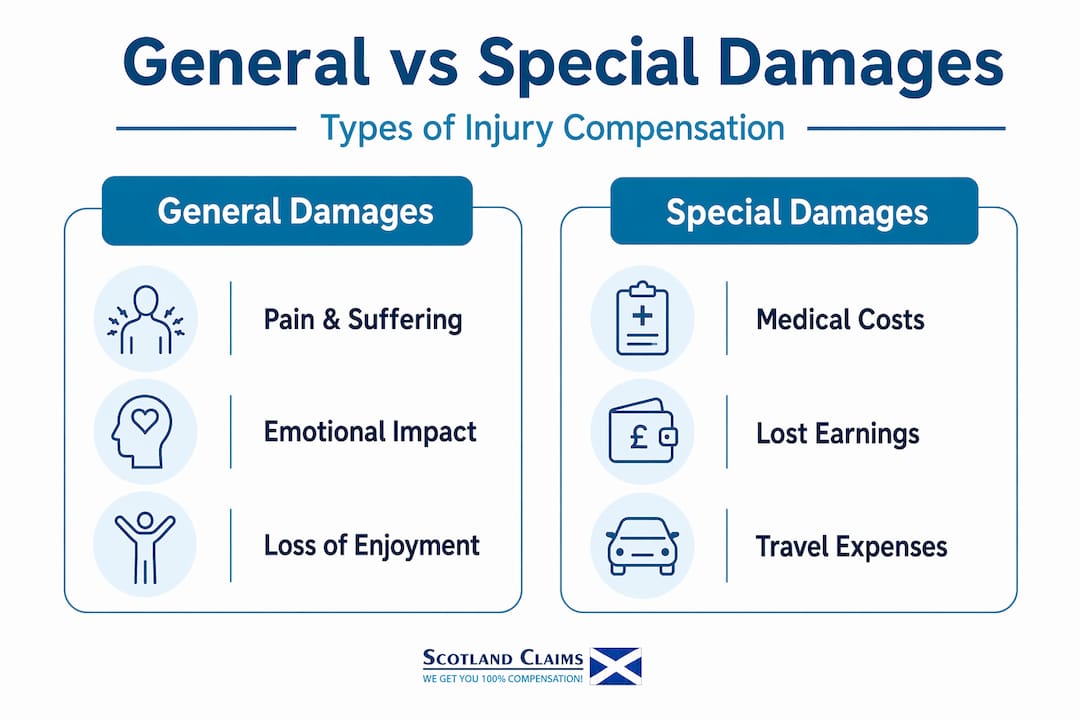
Here is a practical comparison:
| Type |
Examples |
How it is proved |
| General damages |
Chronic back pain, inability to play sport, depression after a road accident |
Medical expert reports, witness statements, personal diary |
| Special damages |
Physiotherapy bills, loss of earnings during recovery, travel to hospital appointments |
Receipts, payslips, bank statements, invoices |
Think of it this way. If you broke your leg in a workplace accident and could not run for a year, your physio bills are special damages. The months of pain, the missed family holidays, and the frustration of not being able to walk the dog are general damages. Both are real. Both are recoverable.

The distinction also matters because general damages do not require itemised proof. They recognise harms that naturally flow from the defendant’s wrongdoing and rely on projected future impact and medical estimation rather than a spreadsheet. This is actually helpful for claimants, because suffering is often the greatest loss they have experienced and yet the hardest to quantify on their own.
You can learn more about the types of compensation in Scotland available to injury claimants, which breaks down how both heads of loss work together in practice.
How general damages are calculated in Scotland
Knowing how to calculate damages is not about doing the maths yourself. It is about understanding what drives the figure so you can present the strongest possible claim.
The process follows these key steps:
- Obtain a medical report from an independent expert who assesses the nature, severity, and prognosis of your injury. This is the single most influential document in your claim.
- Match the injury to a Judicial College Guidelines bracket. The guidelines provide upper and lower figures for hundreds of injury types, from minor whiplash to catastrophic spinal damage.
- Apply the appropriate bracket. Where your award falls within that bracket depends on factors such as the duration of symptoms, the effect on your daily life, and whether you have made a full recovery or face permanent limitations.
- Consider any special circumstances. Pre-existing conditions, your age, and the psychological impact of the injury can all move the figure upwards or downwards.
Two formal methods are sometimes used by solicitors to estimate general damages. The multiplier method multiplies special damages by a factor of between 1.5 and 5 depending on injury severity. The per diem method assigns a daily rate and multiplies it by the number of days in recovery. Both are used as cross-checks rather than definitive calculations, particularly in higher-value claims.
The 18th edition of the Judicial College Guidelines updated compensation brackets to reflect inflation, increasing them by approximately 8%. This uplift was driven by the Retail Prices Index rising from 376.6 in August 2023 to 407.7 in August 2025. That is not a trivial adjustment. On a mid-range soft tissue injury claim, an 8% increase could mean several hundred pounds more in your pocket.
The same edition also made clinical terminology more accurate. For example, it replaces outdated terms like “grand mal” epilepsy with modern medical language, ensuring that assessments reflect current medical understanding rather than outdated labels that could undervalue a genuine condition.
Pro Tip: Ask your solicitor specifically which edition of the Judicial College Guidelines they are using and which bracket they have applied to your injury. If they cannot explain this clearly, it may be worth seeking a second opinion.
For a sense of where your injury might sit, the compensation calculator at Scotland Claims Injury Lawyers gives you an initial estimate based on your injury type and circumstances.
Practical advice for claimants in Scotland
Making a general damages claim in Scotland involves more than hiring a solicitor and waiting. How you document your experience has a direct bearing on the outcome.
Here is what experienced claimants and their legal teams typically do to build the strongest case:
- Keep a pain and symptom diary. Write down daily how you feel, what you cannot do, and how the injury is affecting your sleep, mood, and relationships. Courts give real weight to consistent personal records.
- Attend all medical appointments and follow treatment plans. Gaps in treatment can be used to argue that your symptoms were not as serious as claimed.
- Photograph visible injuries and document the accident scene. Even for general damages, visual evidence supports the broader narrative of your injury’s impact.
- Collect evidence of life changes. If you had to cancel a holiday, give up a sport, or modify your home, keep documentation.
Time limits are also critical in Scotland. For most personal injury claims, you have three years from the date of the accident to raise proceedings. Miss that window and your claim is almost certainly lost, regardless of how strong it is on the merits.
Solicitor fees are another practical consideration that directly affects how much of your general damages you retain. Scotland Claims Injury Lawyers charges no success fee on any claim type, meaning you keep 100% of your compensation whether your claim involves a road traffic accident, a workplace injury, or any other kind of personal injury, while most large national firms charge up to 20% including VAT. That difference is not abstract. On a £15,000 general damages award, a 20% deduction elsewhere would cost you £3,000 that Scotland Claims Injury Lawyers lets you keep.
Pro Tip: Before signing with any solicitor, ask specifically what percentage they will deduct from your damages, not just your total compensation. Some firms quote fees based on total recovery, which can obscure how much they take from the general damages portion specifically.
Roger’s perspective on general damages claims
I have worked with injury claimants across Scotland for long enough to notice a consistent pattern. Most people undervalue their general damages before they speak to a specialist. They focus entirely on their medical bills and lost wages, which are real and recoverable, but they dismiss the pain, the disrupted sleep, the holidays they did not take, and the activities they gave up as somehow less legitimate. They are not. In many claims, general damages represent the majority of the total award.
What I have found is that claimants who take the time to understand the process, document their experience properly, and work with solicitors who know how the Judicial College Guidelines apply in practice consistently receive better outcomes. It is not luck. It is preparation. The pain and suffering guide from Scotland Claims Injury Lawyers is one of the clearest explanations of how this head of loss actually works in Scottish claims, and I would recommend reading it before your first solicitor meeting.
The other thing worth stating plainly is that you do not need to know what your claim is worth before you contact a solicitor. That is what the solicitor is for. What you do need is a clear account of what happened, how it has affected you, and a willingness to pursue the compensation you are genuinely entitled to.
— Roger
How Scotland Claims Injury Lawyers can help with your claim
Understanding general damages is the first step. Getting the right legal support to pursue them is the next. Scotland Claims Injury Lawyers connects injury victims across Scotland with specialist personal injury solicitors on a no win no fee basis, meaning you pay nothing upfront and face no financial risk if your claim does not succeed. For road traffic accidents where you are not at fault, you keep 100% of your compensation. For all other claims including workplace injuries and slips and trips, Scotland Claims Injury Lawyers still deducts no success fee, so you keep 100% of your compensation on every claim type, while most large national firms charge up to 20% including VAT. Use the compensation calculator to get an initial estimate of what your claim could be worth, then speak to a specialist who can assess your specific circumstances.
FAQ
What are general damages in a personal injury claim?
General damages compensate for non-financial losses such as pain, suffering, loss of amenity, and emotional distress. They are assessed using medical evidence and the Judicial College Guidelines rather than receipts or invoices.
What is the difference between general and special damages?
Special damages cover measurable financial losses like medical bills and lost earnings, which must be proved with documentation. General damages cover intangible losses like pain and suffering, which are estimated using medical reports and judicial guidelines.
How are general damages calculated in Scotland?
Solicitors match the injury to a bracket in the Judicial College Guidelines, taking into account severity, duration, and lifestyle impact. The 18th edition of the guidelines, published in 2025, increased brackets by approximately 8% to reflect inflation.
Do I need evidence to claim general damages?
Yes, though not in the form of receipts. Strong medical reports, a personal symptom diary, and witness statements all support a general damages claim by demonstrating the genuine impact of your injury on your daily life.
How long do I have to make a personal injury claim in Scotland?
In most cases, you have three years from the date of your accident to raise a claim. Acting promptly gives your solicitor more time to gather evidence and build the strongest possible case.
Recommended