How to build a strong injury case in scotland

TL;DR:
- Building a strong injury case requires evidence of liability, injuries, and damages from the outset. Proper documentation, prompt medical treatment, and timely evidence preservation are essential to maximize compensation. Avoiding early mistakes and working with low-fee solicitors in Scotland improves your chances of a successful claim.
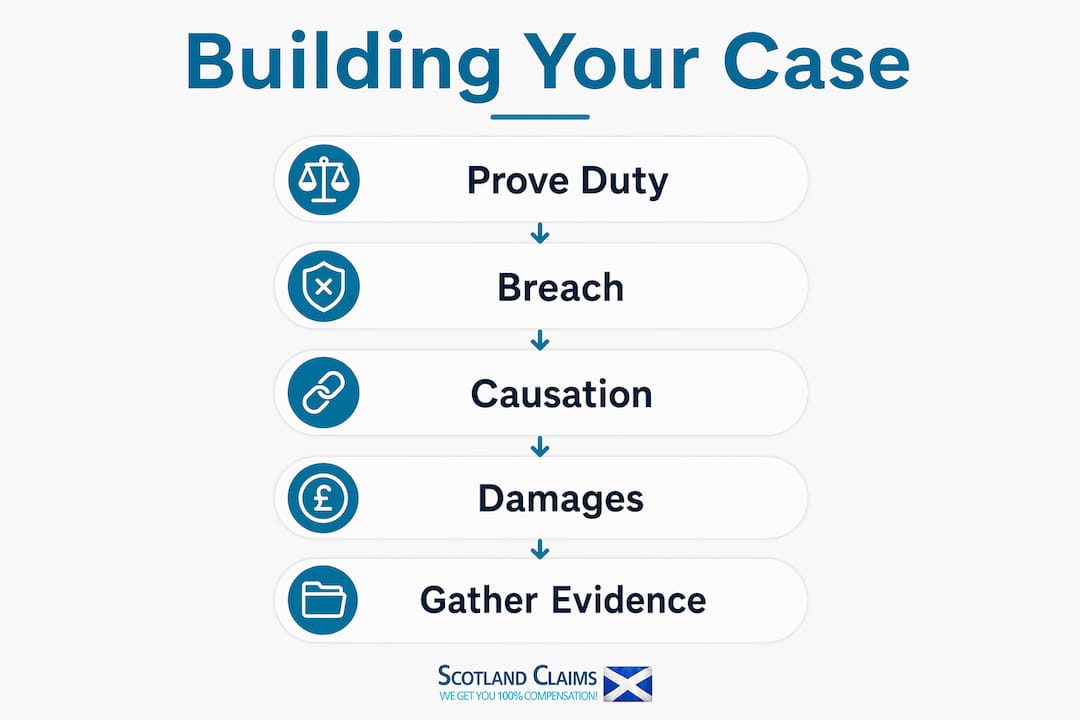
Building a strong injury case means proving liability, documenting injuries promptly, and substantiating your damages with clear, organised evidence from the very first day. In Scotland, a personal injury claim, the recognised legal term for this process, rests on four pillars: duty of care, breach, causation, and damages. Get all four right and your claim stands on solid ground. Miss one and the whole case can unravel. This guide walks you through every step, from the scene of the accident to working with a solicitor, so you can approach your claim with confidence and protect every penny of compensation you are owed.
How to build a strong injury case: the four legal pillars
Building a strong injury case requires proving duty of care, breach, causation, and actual damages with sufficient evidence for each element. Failure to prove any single element can lead to claim dismissal. Understanding what each pillar means in practice is the foundation of every successful personal injury claim in Scotland.

Duty of care is the legal obligation one party owes another to act reasonably and avoid causing harm. A driver owes a duty of care to other road users. An employer owes it to every worker on site. A shop owner owes it to every customer who walks through the door.
Breach is what happens when that duty is violated. A driver who runs a red light breaches their duty. An employer who fails to maintain safe equipment breaches theirs. The breach must be specific and provable, not just a general sense that something went wrong.
Causation links the breach directly to your injury. It is not enough to show someone acted negligently. You must show their negligence caused your specific harm. This is where medical evidence becomes critical, because it connects the incident to the injury in a way that is hard to dispute.
Damages are the losses you suffered as a result. These fall into two categories:
- Economic damages: lost earnings, medical expenses, travel costs to appointments, and future care costs
- Non-economic damages: pain and suffering, loss of enjoyment of life, and psychological impact
Every element needs evidence. Without it, even a clear-cut case can collapse before it reaches settlement.
How does early medical treatment affect your injury claim?
Medical evaluation within 24–72 hours post-accident is the single most effective step you can take to link your injuries directly to the incident. This timeline prevents insurers from disputing causation or arguing that your injuries arose from a separate event. Delay seeking treatment and you hand the other side their strongest argument.
Consistency matters just as much as speed. Attendance at all recommended treatments strongly impacts a claim’s credibility. Insurance adjusters scrutinise treatment gaps carefully, using them to argue that injuries were not serious or that you failed to take reasonable steps to recover. A missed physiotherapy appointment might seem trivial to you. To an adjuster, it is a note in your file.
Specialist referrals and diagnostic imaging, such as MRI scans or X-rays, add another layer of credibility. They produce objective, documented findings that are far harder to challenge than a claimant’s self-reported pain. If your GP refers you to a specialist, attend every appointment and keep every report.
Here is what consistent medical engagement looks like in practice:
- See a GP or attend A&E within 24–72 hours of the accident, even if symptoms feel mild
- Follow every treatment plan prescribed, including physiotherapy and follow-up consultations
- Request copies of all medical records, scan results, and referral letters
- If you must miss an appointment, reschedule immediately and document the reason in writing
- Keep a daily journal recording your pain levels, physical limitations, and how the injury affects your daily life
Pro Tip: A daily pain journal is one of the most underused tools in personal injury claims. Write a brief entry every day noting your symptoms, what you could not do, and how you felt. Over weeks, this builds a compelling, first-hand account of your suffering that no insurer can easily dismiss.
What types of evidence are most effective for your case?
Evidence is the currency of a personal injury claim. The more organised and varied your evidence, the stronger your negotiating position. Insurance adjusters favour a clear, consistent narrative supported by visuals and timelines over disorganised documentation. A coherent story improves responsiveness from both adjusters and, if it reaches that stage, a jury.
CCTV and surveillance footage requires immediate preservation requests within 24–72 hours of an incident. Most digital footage is overwritten automatically within days due to storage policies. Once it is gone, it is gone. Write to the premises owner or relevant authority the same day if possible.
The table below compares the most common evidence types and their relative impact on a claim:
| Evidence Type |
Why It Matters |
| Photographs and video of the scene |
Captures conditions at the time, prevents dispute over hazards |
| Police or incident report |
Official third-party record that establishes facts independently |
| Witness statements |
Corroborates your account from a neutral perspective |
| CCTV or surveillance footage |
Objective visual proof of the incident as it happened |
| Medical records and imaging |
Links injuries directly to the accident with clinical authority |
| Daily pain journal |
Demonstrates ongoing impact and supports non-economic damages |
Social media is routinely monitored by insurers seeking to devalue claims. A photograph of you at a family barbecue, even if you were in pain throughout, can be used to contradict your account of your limitations. Restrict your profiles and avoid posting anything related to your physical activity or wellbeing during the claims process.
Pro Tip: When gathering witness details, ask for a full name, phone number, and email address. A witness who cannot be contacted later is of limited use. Take a brief written or voice-recorded statement at the scene if the person is willing.
For a thorough breakdown of how to prepare your evidence correctly, the Scotland Claims Injury Lawyers guide on preparing injury evidence for Scottish claims covers the legal standards in detail.
What are the common mistakes that weaken injury claims?
Most claims are not lost in court. They are weakened long before a solicitor drafts the first letter, through avoidable errors made in the days and weeks after an accident. Recognising these pitfalls is as important as knowing what to do right.
- Accepting a settlement too early: Accepting settlement offers before Maximum Medical Improvement risks undervaluing your compensation, particularly for future medical needs. Maximum Medical Improvement is the point at which a doctor confirms your condition has stabilised. Settle before then and you may receive nothing for ongoing treatment or long-term complications.
- Gaps in medical treatment: Unexplained breaks in treatment give adjusters grounds to argue your injuries resolved or were not serious. If life circumstances force a gap, document the reason clearly.
- Giving a recorded statement without legal advice: Insurers may contact you quickly after an accident and ask for a recorded account. Anything you say can be used to limit your payout. Speak to a solicitor first.
- Failing to document the scene: Photographs taken hours after an accident are far less valuable than those taken at the time. Conditions change, hazards are repaired, and evidence disappears.
- Contradictory social media posts: Even a post that seems unrelated to your injury can be used against you. Insurers are thorough.
- Delaying legal advice: The sooner a solicitor is involved, the sooner evidence is preserved and the claim is structured correctly. Early involvement consistently produces better outcomes.
How to work effectively with injury lawyers in scotland
A solicitor does far more than file paperwork. They gather evidence, instruct medical experts, manage communications with the other side, and draft the demand letter that often determines whether a case settles or proceeds to court. A detailed demand letter with factual chronology and itemised damages frequently achieves favourable settlements without the need for litigation. The pre-suit phase is where most cases are won or lost.
Fee structures in Scotland matter enormously to claimants. For road traffic accidents, including whiplash injuries, where you are the driver or passenger who was not at fault, Scotland Claims Injury Lawyers takes nothing from your compensation. You keep 100%. For all claim types - including slips, trips, and accidents at work - Scotland Claims Injury Lawyers deducts no success fee whatsoever, meaning you keep 100% of your compensation. Most large and national firms charge up to 20% including VAT, so that difference can amount to thousands of pounds on a significant claim.
Here is how to get the most from your solicitor relationship:
- Provide all documentation promptly, including medical records, photographs, and witness details
- Be honest and thorough about your symptoms, even those that seem minor
- Ask questions about the process and expected timelines so you are never left in the dark
- Avoid discussing your case with anyone other than your solicitor, including on social media
- Trust the process: a well-managed claim through injury lawyers in Scotland gives you the best chance of maximum recovery
The role of evidence in Scottish injury claims is something your solicitor will guide you through, but arriving prepared makes the entire process faster and more effective.
Key takeaways
A strong personal injury case in Scotland requires prompt medical treatment, organised evidence, and legal support from the outset to maximise your compensation.
| Point |
Details |
| Prove all four legal pillars |
Duty of care, breach, causation, and damages must each be evidenced clearly. |
| Seek medical treatment within 72 hours |
Early evaluation links your injuries to the incident and prevents causation disputes. |
| Preserve evidence immediately |
Request CCTV footage within 24–72 hours before automatic deletion destroys it. |
| Avoid premature settlement |
Never accept an offer before Maximum Medical Improvement is confirmed by a doctor. |
| Choose a solicitor with low fees |
Scotland Claims Injury Lawyers deducts no success fee on any claim type - you keep 100% of your compensation on every kind of claim. |
What i have learned from watching claimants get this wrong
The most common reason a solid claim falls short is not lack of evidence. It is lack of discipline in the weeks after the accident. I have seen claimants with strong liability cases accept the first settlement offer because they were exhausted and wanted it over. Months later, when their back injury required surgery that the settlement did not cover, the financial reality hit hard.
The second pattern I see repeatedly is the social media problem. People understand intellectually that they should be careful online, but they underestimate how thoroughly insurers investigate. A single photograph posted by a family member, tagging you at an event, can undo months of careful claim management. The safest approach is a complete pause on social media for the duration of the claim.
What actually works is simple: get medical attention fast, keep every appointment, document everything, and get a solicitor involved early. The claimants who do all four consistently are the ones who walk away with fair compensation. The ones who cut corners on any of these steps are the ones who call back months later wishing they had done things differently. Scotland has a three-year limitation period for personal injury claims, so time is on your side at the start. Use it wisely.
— Roger
Start your claim with Scotland Claims Injury Lawyers today
Scotland Claims Injury Lawyers connects injury victims across Scotland with specialist solicitors who know exactly how to build a case that holds up. For road traffic accidents and whiplash claims where you are not at fault, you keep 100% of your compensation. For slips, trips, and workplace injuries, Scotland Claims deducts no success fee at all - you keep 100% of your compensation, while most large and national firms charge up to 20% including VAT. There are no upfront costs and no fees if your case is unsuccessful. Use the compensation calculator to get an estimate of what your claim could be worth, or speak directly with the no win no fee team to get your claim assessed today.
FAQ
What are the four elements needed to prove an injury case?
Every personal injury claim must establish duty of care, breach of that duty, causation linking the breach to the injury, and quantifiable damages. Failure to prove any one element can result in the claim being dismissed.
How soon should i see a doctor after an accident in scotland?
See a GP or attend A&E within 24–72 hours of the accident. This timeline is critical for linking your injuries to the incident and preventing insurers from disputing causation or severity.
Can social media posts really affect my injury claim?
Yes. Insurers routinely monitor claimants’ social media profiles for posts that contradict injury claims. Even an innocent photograph can be used to argue your injuries are less serious than stated. Restrict your profiles and avoid posting during the claims process.
What is maximum medical improvement and why does it matter?
Maximum Medical Improvement is the point at which a doctor confirms your condition has stabilised and is unlikely to change significantly. Accepting a settlement before this point risks leaving future medical costs and long-term complications uncompensated.
How much will a solicitor take from my compensation in scotland?
With Scotland Claims, every claimant keeps 100% of their compensation regardless of claim type - there is no success fee deducted on whiplash, slips, trips, workplace accidents, or any other claim. Most large and national firms charge up to 20% including VAT.
Recommended