Why is liability disputed in personal injury claims?

TL;DR:
- Liability disputes in personal injury claims arise from disagreements over fault, often driven by insurers’ financial motives.
- These disputes slow the process, increase evidence gathering, and rely heavily on quality evidence and legal representation to resolve fairly.
A liability dispute occurs when the parties involved in a personal injury claim disagree about who is legally responsible for the accident or resulting injury. In Scotland, this disagreement most commonly arises between the injured claimant and the at-fault party’s insurer, and it directly affects how much compensation you receive and how long the process takes. Understanding why is liability disputed in your case is not a passive exercise. It is the foundation of your entire legal strategy.
Why is liability disputed in personal injury claims?
Liability disputes arise from fundamental disagreements about who caused an accident, and insurers have a clear financial incentive to reduce or deny payouts wherever possible. That is the blunt reality. The insurer on the other side of your claim is not a neutral party. Their job is to pay out as little as possible, and disputing liability is one of the most effective tools they have.
The most common reasons for liability disputes include:
- Unclear or conflicting facts. Accidents happen quickly, and the physical evidence left behind is often incomplete. Skid marks fade, witnesses leave the scene, and CCTV footage is not always available.
- Insurer financial motives. Denying or reducing liability saves insurers money. This is a structural incentive built into how claims are handled.
- Shared fault or comparative negligence. Under Scottish law, fault can be split between parties. An insurer may accept partial responsibility while arguing you contributed to the accident yourself.
- Multiple parties involved. Road traffic accidents involving several vehicles, or workplace accidents with multiple contractors, create genuine complexity about who bears legal responsibility.
- Inconclusive police or witness reports. Official reports do not always assign blame clearly, and witness recollections are unreliable under stress, particularly in the immediate aftermath of a collision.
- Human error and inconsistent accounts. Most liability disputes are not the result of deliberate deception. They stem from the fact that people remember events differently, especially traumatic ones.
Pro Tip: Photograph the accident scene, your injuries, and any vehicle or property damage as soon as it is safe to do so. Contemporaneous photographic evidence is far more persuasive than memory alone.
Understanding these common accident causes in Scotland helps you anticipate where disputes are most likely to arise before they derail your claim.

How do liability disputes affect your personal injury claim?
When liability is contested, the entire claims process slows down. Investigations deepen with more evidence gathering, expert reports, and accident reconstructions, and communication from the insurer often slows to a crawl. This is not always accidental. Delay is a tactic.
Here is what typically happens once liability is disputed:
- The insurer formally denies or partially denies responsibility. You receive written notification that they do not accept your version of events, or that they believe you share some of the blame.
- Evidence gathering intensifies. Both sides begin collecting police reports, medical records, witness statements, and any available footage. The quality and completeness of this evidence will largely determine the outcome.
- Expert reports may be commissioned. In complex cases, accident reconstruction specialists are brought in to analyse the physical evidence and provide an independent technical opinion on how the accident occurred.
- Fault percentages are assigned. Under comparative negligence principles, fault percentage determination is critical. If you are found 20% at fault, your compensation is reduced by 20%.
- Negotiations begin in earnest. Solicitors on both sides attempt to reach a settlement. If they cannot, the matter may proceed to formal legal proceedings before a Scottish court.
Case outcomes depend heavily on how evidence is presented and interpreted, which is why legal representation at this stage is not optional. It is the difference between a fair settlement and a significantly reduced one.
What evidence resolves a liability dispute?
The right evidence does not just support your claim. It closes the argument. Police reports, witness accounts, photographs, medical records, and technical analyses are all crucial to resolving disputes, and each type of evidence carries different weight depending on the circumstances.
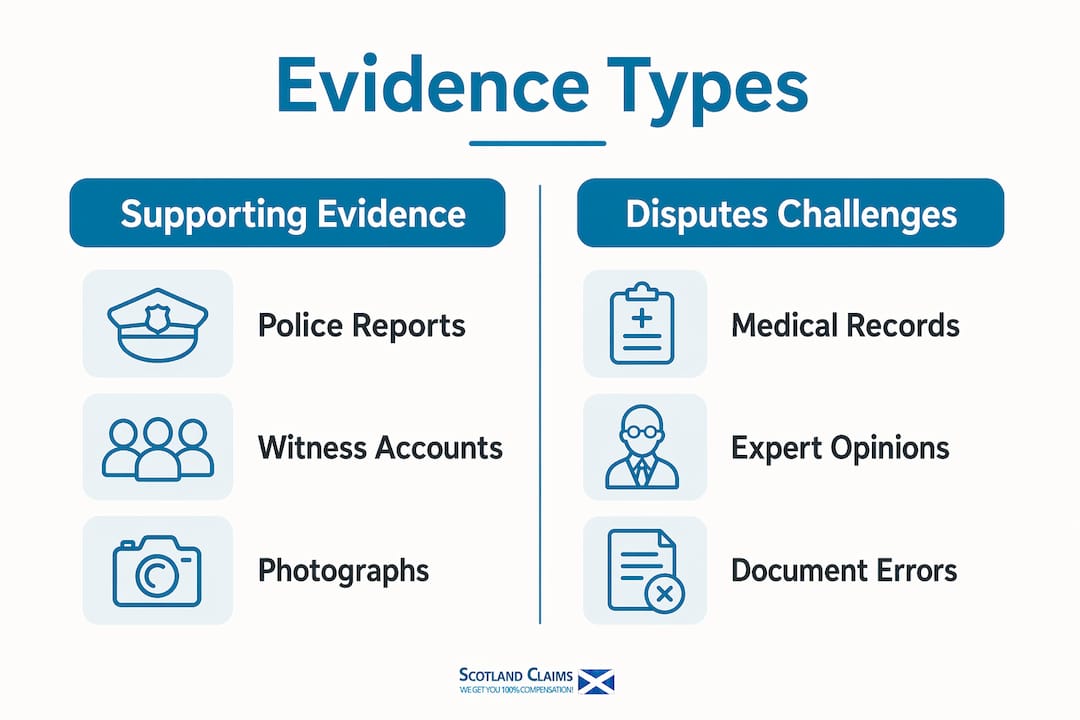
| Evidence type |
Strengths and limitations |
| Police reports |
Official and credible, but do not always assign fault directly |
| Witness statements |
Powerful when consistent, but memory degrades quickly after an accident |
| Photographs and video footage |
Dashcam and CCTV footage is often the most persuasive evidence available |
| Medical records |
Link your injury directly to the accident, countering insurer arguments about pre-existing conditions |
| Accident reconstruction reports |
Add technical authority in complex cases, but take time and cost to commission |
Medical records deserve particular attention. Insurers frequently argue that an injury predates the accident or is unrelated to it. A clear, contemporaneous medical record created shortly after the accident is one of the strongest tools for countering that argument. Linking your injury to the accident through back injury documentation, for example, can be decisive in disputes involving spinal or soft-tissue damage.
Pro Tip: Request a copy of the police report as soon as it is available and check it carefully for factual errors. Mistakes in official reports can be corrected, but only if you act quickly.
Objective evidence and expert reports are the primary tools for breaking negotiation deadlocks when both sides have reached an impasse.
How does comparative negligence work in Scotland?
Comparative negligence, sometimes referred to as contributory negligence, is the legal principle that allows fault to be shared between parties rather than assigned entirely to one side. In Scotland, this operates under the Law Reform (Contributory Negligence) Act 1945, which means your compensation can be reduced proportionally if you are found partly responsible for the accident.
The practical implications are significant:
- A finding of 25% contributory negligence on a £20,000 claim reduces your payout to £15,000.
- Insurers routinely argue for higher fault percentages on the claimant’s side because even a modest increase saves them money.
- Disputed liability frequently results in partial fault allocations, and negotiations focus on minimising the claimant’s assigned percentage to maximise the final payout.
- The difference between a full denial of liability and a partial fault dispute is legally and financially significant. A full denial means no compensation unless you prove your case entirely. A partial fault dispute means compensation is likely, but the amount is contested.
- Legal strategy in these cases focuses less on proving complete innocence and more on reducing the percentage of blame attributed to you. Even a reduction from 30% to 10% contributory negligence can materially increase what you recover.
Understanding third party liability in Scotland is particularly relevant here, as it clarifies who bears primary responsibility and how shared fault is assessed in practice.
How to strengthen your position when liability is disputed
The steps you take in the hours and days after an accident have a disproportionate influence on the outcome of a disputed liability claim. Most claimants do not realise this until it is too late.
- Do not give spontaneous statements to the other party’s insurer. Insurers treat initial statements as fixed facts. An off-the-cuff remark made while you are shaken and in pain can be used months later to undermine your claim.
- Gather evidence immediately. Photographs, dashcam footage, and witness contact details should be collected at the scene if you are physically able to do so.
- Instruct a solicitor before engaging with the insurer. A solicitor experienced in disputed liability will manage all communications on your behalf and prevent you from inadvertently weakening your position.
- Keep a detailed record of everything. This includes all correspondence with insurers, medical appointments, treatment costs, and any time off work resulting from your injury.
- Prepare for a longer process. Disputed claims take more time than straightforward ones. Strategic legal support and comprehensive evidence management increase your chances of a successful outcome, but the process requires patience.
- Do not accept an early settlement offer without legal advice. Early offers from insurers are almost always lower than what you are entitled to, particularly when liability is being contested.
Pro Tip: Keep a daily diary of how your injury affects your life, including pain levels, activities you cannot perform, and the emotional impact. This record can significantly strengthen your claim for general damages.
Key takeaways
Liability is disputed when insurers or other parties contest fault, and the outcome depends entirely on the quality of your evidence and the strength of your legal representation.
| Point |
Details |
| Disputes are financially motivated |
Insurers dispute liability to reduce payouts, not because your claim lacks merit. |
| Evidence quality determines outcomes |
Photographs, medical records, and expert reports are the most persuasive tools available. |
| Comparative negligence reduces compensation |
Even partial fault findings cut your payout, so minimising your assigned percentage matters. |
| Early statements carry serious risk |
Anything said to an insurer before legal advice can be used to dispute your claim later. |
| Legal representation changes the result |
Experienced solicitors challenge insurer tactics and manage evidence to maximise recovery. |
The uncomfortable truth about disputed liability claims
I have seen claimants walk away from genuinely strong cases with far less than they deserved, not because the evidence was weak, but because they did not understand what they were dealing with. A liability dispute is not a polite disagreement. It is an adversarial process in which the insurer has professional negotiators, legal teams, and institutional experience on their side.
The most common mistake I see is people engaging directly with the opposing insurer in the belief that honesty and goodwill will be reciprocated. They will not be. An insurer’s representative is not there to help you. They are there to protect the insurer’s financial position.
The second most common mistake is waiting. People assume they have time to gather evidence, find witnesses, and instruct a solicitor. In reality, CCTV footage is overwritten within days, witnesses forget details within weeks, and the insurer’s investigation is already underway from the moment the accident is reported.
A disputed liability claim is not the end of your case. It is a signal that you need proper legal support immediately. In Scotland, the cost of that support should not be a barrier. Scotland Claims Injury Lawyers caps its success fee at 18% including VAT on any claim type - whether a road traffic accident, slip, trip, or workplace injury. Most large and national firms charge up to 20% including VAT. That written cap exists precisely because claimants in disputed cases should not be penalised twice.
— Roger
How Scotland Claims Injury Lawyers supports you through a liability dispute
When liability is disputed, you need more than general advice. You need a solicitor who understands the Scottish legal system and knows how to challenge insurer tactics effectively. Scotland Claims Injury Lawyers connects you with specialist injury lawyers in Scotland who handle disputed liability claims every day. On every claim type - road traffic accidents, slips, trips, workplace injuries, and all others - the success fee is capped at 18% including VAT, agreed in writing. The service operates on a no win no fee basis, meaning you pay nothing upfront and nothing at all if your claim is unsuccessful. Contact Scotland Claims Injury Lawyers today for a free case review and find out where you stand.
FAQ
Why is liability disputed after a road accident?
Liability is disputed when the parties involved disagree about who caused the accident, often because the facts are unclear or because the insurer has a financial incentive to reduce the payout. Conflicting witness accounts, incomplete police reports, and complex accident scenarios all contribute to disputes.
Does a liability dispute mean my claim will fail?
A liability dispute does not mean your claim will fail. It means the process will take longer and require stronger evidence. Many disputed claims are successfully resolved through negotiation or, where necessary, through formal legal proceedings.
How is fault percentage calculated in Scotland?
Fault percentage is assessed based on the available evidence, including police reports, witness statements, and expert analysis. Under the Law Reform (Contributory Negligence) Act 1945, your compensation is reduced by the percentage of fault attributed to you.
How long does a disputed liability claim take?
Disputed claims typically take significantly longer than straightforward ones, often several months to over a year, depending on the complexity of the evidence and whether the matter proceeds to court.
What should I avoid saying to an insurer when liability is disputed?
Avoid making any spontaneous or informal statements to the opposing insurer before taking legal advice. Insurers treat early statements as fixed facts, and inconsistencies between your initial account and later evidence can be used to undermine your claim.
Recommended