Common accident causes for drivers in Scotland
TL;DR:
- Speeding, distraction, and impairment are the leading preventable causes of serious road accidents in Scotland. Reducing risky behaviors and practicing defensive driving significantly lower your chances of being involved in a life-changing collision. Accurate police reports and awareness of these causes can help drivers improve safety and seek appropriate legal support if injured.
Scotland’s roads carry real risk. Understanding the common accident causes for drivers is not just useful background knowledge. It could be the difference between arriving safely and being involved in a life-changing collision. Road traffic accidents claim lives and cause serious injuries across Scotland every year, yet many of the most frequent causes are preventable. This article breaks down the top reasons for car accidents on Scottish roads, what the data tells us, and what you can do to reduce your personal risk every time you drive.
Table of Contents
Key takeaways
| Point |
Details |
| Speed multiplies risk exponentially |
Every 1% rise in mean speed produces a 4% increase in fatal crash risk, making even small speed reductions significant. |
| Mobile phones quadruple crash risk |
Using a phone while driving makes you four times more likely to be involved in a collision. |
| Alcohol impairment starts early |
Crash risk increases meaningfully at a BAC of just 0.04 g/dl, well before most drivers feel impaired. |
| Risky behaviour is a major cause |
Aggression, poor junction decisions, and tailgating are consistently flagged by Scottish police as collision contributors. |
| Scotland-specific data guides prevention |
Police-reported contributory factors from STATS19 records provide the most reliable picture of accident causes in Scotland. |
1. Common accident causes for drivers: speeding
Speed is the single most studied and most consequential factor in road accidents. The relationship between speed and crash risk is not linear. Every 1% increase in mean speed produces a 4% rise in fatal crash risk and a 3% rise in serious crash risk. That compounding effect means driving even marginally faster than conditions allow can dramatically change an outcome.
The numbers become stark when pedestrians are involved. Pedestrian death risk rises 4.5 times when a vehicle’s impact speed increases from 50 km/h to 65 km/h. In Scottish towns and cities, that difference is often just a few miles per hour above a posted limit.
Scottish data reinforces this. Speeding contributed to 26% of all road fatalities in Scotland, making it the most significant behavioural factor in deadly crashes. It also featured in 6% of serious injuries. These are not outlier figures from remote rural roads alone. They span urban and rural settings alike.
Reducing speed has a compounding safety effect. Lower speeds shorten stopping distances, give more time to react to hazards, and reduce the severity of any collision that does occur.
- Stay within posted limits, but also adjust your speed for weather, road surface, and visibility
- On rural A-roads, resist the temptation to treat a 60 mph limit as a target rather than a ceiling
- Allow more following distance than you think you need, especially at higher speeds
Pro Tip: Scan 12 to 15 seconds ahead of your vehicle so you spot hazards early and can reduce speed gradually rather than braking sharply.
2. Driver distraction and mobile phone use
Distraction is one of the most insidious accident risk factors because drivers routinely underestimate how impaired they are while doing it. The evidence is unambiguous. Drivers using mobile phones are approximately four times more likely to be involved in a crash than those who are not using one.
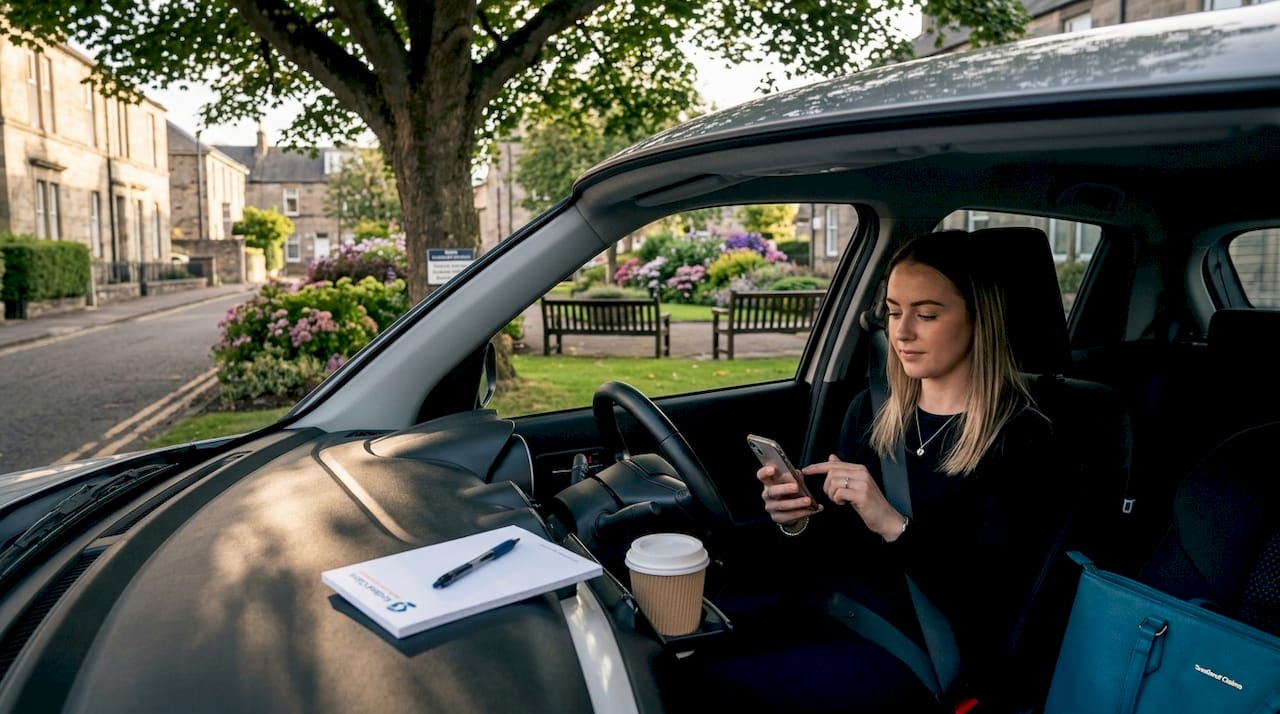
The mechanism matters here. Distraction does not just mean missing a hazard you would otherwise have spotted. It impairs lane keeping and following distance as well, meaning your vehicle control degrades even when nothing dangerous is immediately visible. You can be looking at the road and still be driving badly because your brain is occupied elsewhere.
Hands-free phones are not the safe alternative many assume. Research confirms they carry almost as much risk as handheld use, because the cognitive load of a conversation is what degrades performance. Texting is the highest-risk behaviour of all, combining visual, manual, and mental distraction simultaneously.
In Scotland, distraction contributed to 3% of road fatalities and 4% of serious injuries. Given that distraction is likely under-reported at crash scenes, these figures should be treated as conservative.
- Put your phone out of reach before you start the engine, not just on silent
- If you use a sat-nav, programme the route before moving and resist the urge to adjust it while driving
- Passengers can be distracting too. Conversations during complex manoeuvres, overtakes, or poor-visibility conditions should be kept brief
Pro Tip: The best in-car rule is also the simplest: no phone, no exceptions. Not even at traffic lights. The habit of reaching for your phone when stationary builds the reflex that eventually causes accidents when moving.
3. Alcohol and drug impairment
Impaired driving is one of the most preventable causes of vehicle collisions, yet it remains a consistent feature of serious crashes. Crash risk increases significantly at a blood alcohol concentration of just 0.04 g/dl. Scotland’s legal drink-drive limit for most drivers is 0.05 g/dl, lower than England and Wales but still a threshold that many drivers misjudge after a couple of drinks.
Drug driving is equally dangerous and, depending on the substance, potentially worse. Amphetamine use increases fatal crash risk approximately fivefold compared to sober drivers. Cannabis, opioids, and sedatives all impair the cognitive functions you need to drive well, including reaction time, hazard perception, and decision-making under pressure.
Scottish police-reported factors in 2024 consistently identify impairment alongside distraction and excessive speed as the primary contributors to road incidents. Drink-driving continues to feature in both fatal and serious injury statistics across Scotland year on year.
The practical advice here is non-negotiable:
- If you have consumed alcohol, do not drive. Use a taxi, public transport, or arrange a designated driver
- Be aware that some prescription medicines and over-the-counter remedies can impair driving. Always check the label and speak to your pharmacist
- Morning-after driving is a genuine risk. Alcohol from the previous evening can still push you over the legal limit the following morning, particularly after heavy drinking
4. Poor driving behaviour and inexperience
Not every collision is caused by a single dramatic error. Many of the most frequent accident causes are patterns of behaviour that build up over time, often unremarked, until they result in a crash. Scottish police identify aggressive driving, reckless behaviour, and poor junction manoeuvres as consistent contributors to collisions across Scotland.
Tailgating is a particularly widespread problem. Drivers who follow too closely give themselves almost no stopping distance if the vehicle ahead brakes unexpectedly. At 70 mph on a motorway, a two-second gap is barely enough in ideal conditions. In wet weather, it is genuinely insufficient.
Inexperience amplifies these risks. Newer drivers are disproportionately represented in accident statistics not because they are reckless but because they have not yet developed the automatic hazard recognition that experienced drivers build over years. They are more likely to be caught out by junction decisions, unexpected road layouts, and complex traffic scenarios.
Here are the most important defensive driving habits to develop:
- Maintain at least a two-second gap in dry conditions and double it in the wet
- Check your mirrors every five to eight seconds to maintain full situational awareness
- At junctions, take a second look in both directions before pulling out. Most junction errors happen when a driver commits too quickly
- Avoid driving when fatigued. Tiredness impairs driving performance comparably to low-level alcohol intoxication
- Do not assume other drivers will behave predictably. Anticipate mistakes from others, especially at roundabouts and multi-lane junctions
Ongoing training beyond the initial driving test is underused and undervalued. Advanced driving courses offered through organisations like IAM RoadSmart give drivers the tools to genuinely improve, not just maintain existing habits. If you passed your test more than a decade ago, your skills may have drifted in ways you have not noticed.
5. How accident causes compare: a practical reference
The table below gives you a clear side-by-side view of the most common driving mistakes, their relative severity, and what you should do about each one.
| Cause |
Frequency in serious accidents |
Severity of risk |
Key prevention action |
| Speeding |
Very high (26% of Scottish fatalities) |
Extreme. Small speed increases multiply fatal risk rapidly |
Stay well within limits; adjust for conditions |
| Distraction (incl. mobile use) |
High (3% fatalities, 4% serious injuries) |
Severe. Impairs vehicle control, not just hazard detection |
No phone use at any point; limit in-car distractions |
| Alcohol and drug impairment |
High, consistently flagged in 2024 data |
Severe to extreme depending on substance and BAC |
Zero tolerance policy for yourself before driving |
| Poor behaviour and inexperience |
High. Risky behaviours flagged as a key cause in Scotland |
Moderate to severe. Often compounded with other factors |
Defensive driving habits; consider advanced training |
It is worth noting that police-reported contributory factors from Scotland’s STATS19 records are the most reliable guide to accident causes available. Conviction data alone does not assign causation, so the figures in official reports reflect what officers observed at the scene, not what was later proved in court.
Pro Tip: Use this table to audit your own driving. If you regularly exceed limits on familiar roads or routinely pick up your phone at red lights, you are not a safe driver who occasionally bends the rules. You are a higher-risk driver who has not had an accident yet.
My perspective on driver safety in Scotland
I have read enough accident reports and spoken with enough road safety professionals to be convinced of one uncomfortable truth: most drivers believe these risks apply to someone else. Speeding, distraction, and impairment are the top reasons for car accidents in Scotland not because drivers are unaware of the dangers but because awareness alone rarely changes behaviour.
What does change behaviour is a combination of genuine enforcement, social norms, and personal consequences. In Scotland, the cultural attitude towards drink-driving has shifted dramatically over the past 30 years. That shift happened because enforcement became consistent and because the social stigma became real. The same mechanism needs to operate around mobile phone use and excessive speed.
In my experience, the drivers who consistently avoid accidents are not those who know the most about road safety. They are the ones who have genuinely internalised that every journey carries risk and that their decisions directly determine the level of that risk. Defensive driving is not a technique for nervous people. It is the only rational response to sharing the road with dozens of unpredictable variables at speed.
If you have been injured in a road traffic accident caused by another driver’s poor behaviour, that is a different matter entirely. Knowing these causes helps you understand your rights as much as it improves your driving.
— Roger
Injured in a road accident? Scotland Claims Injury Lawyers can help
If you or someone you know has been injured in a road accident caused by another driver’s speeding, distraction, or impairment, you may be entitled to compensation. Scotland Claims Injury Lawyers connects accident victims across Scotland with specialist injury lawyers in Scotland who work on a No Win No Fee basis. For all road traffic accident injuries, you keep 100% of your compensation - Scotland Claims Injury Lawyers never deducts a success fee on any claim type, while most large national firms charge up to 20% including VAT. You can also explore no win no fee claims to understand exactly how the process works before you commit to anything.
FAQ
What is the most common cause of fatal accidents in Scotland?
Speeding is consistently the leading contributory factor in fatal road accidents in Scotland, featuring in 26% of fatalities according to police-reported data.
Does using a hands-free phone while driving make me safer?
No. Hands-free phones carry almost as much risk as handheld use because the mental distraction of a conversation, not just the physical act of holding a phone, is what impairs your driving.
How much alcohol is safe before driving?
There is no genuinely safe level. Crash risk rises from a BAC of 0.04 g/dl, and individual responses to alcohol vary. Scotland’s limit is 0.05 g/dl, but the safest approach is not to drink at all before driving.
Can I claim compensation if another driver caused my accident?
Yes. If another driver’s negligence, whether through speeding, distraction, or impairment, caused your injury, you are likely entitled to make a claim. Scotland Claims Injury Lawyers offers a guide to car accident injuries and the compensation you may be able to recover.
Are Scottish accident statistics reliable for understanding cause?
Police-reported STATS19 factors are the most reliable source for accident cause analysis in Scotland. Conviction data from courts does not assign causation and should not be used as a direct proxy for what caused a crash.
Recommended