What is repetitive strain injury? a scotland guide

TL;DR:
- Repetitive strain injury (RSI) encompasses conditions caused by overuse or awkward postures affecting muscles, tendons, nerves, or joints. Accurate diagnosis and targeted treatment are essential for effective recovery, with prevention focusing on ergonomic adjustments and scheduled breaks. Workers in Scotland have legal rights to workplace risk assessments, and if their injury results from job-related hazards, they may pursue compensation claims.
Repetitive strain injury (RSI) is an umbrella term for conditions affecting muscles, tendons, nerves, or joints caused by repeated overuse or sustained awkward postures rather than a single traumatic event. The NHS and Mayo Clinic both recognise RSI as one of the most common work-related health complaints in the UK. Symptoms range from mild aching to severe weakness and can affect your hands, wrists, elbows, and shoulders. If you live or work in Scotland and you have noticed persistent pain after repetitive tasks, understanding this condition is the first step toward protecting your health and knowing your rights.
What is repetitive strain injury and how does it differ?
RSI is not a single diagnosis. It is a broad description covering dozens of specific conditions, all sharing one root cause: tissue stress that outpaces the body’s ability to repair itself. The medical community sometimes uses the term “repetitive motion injury” or “overuse syndrome” to describe the same group of problems.
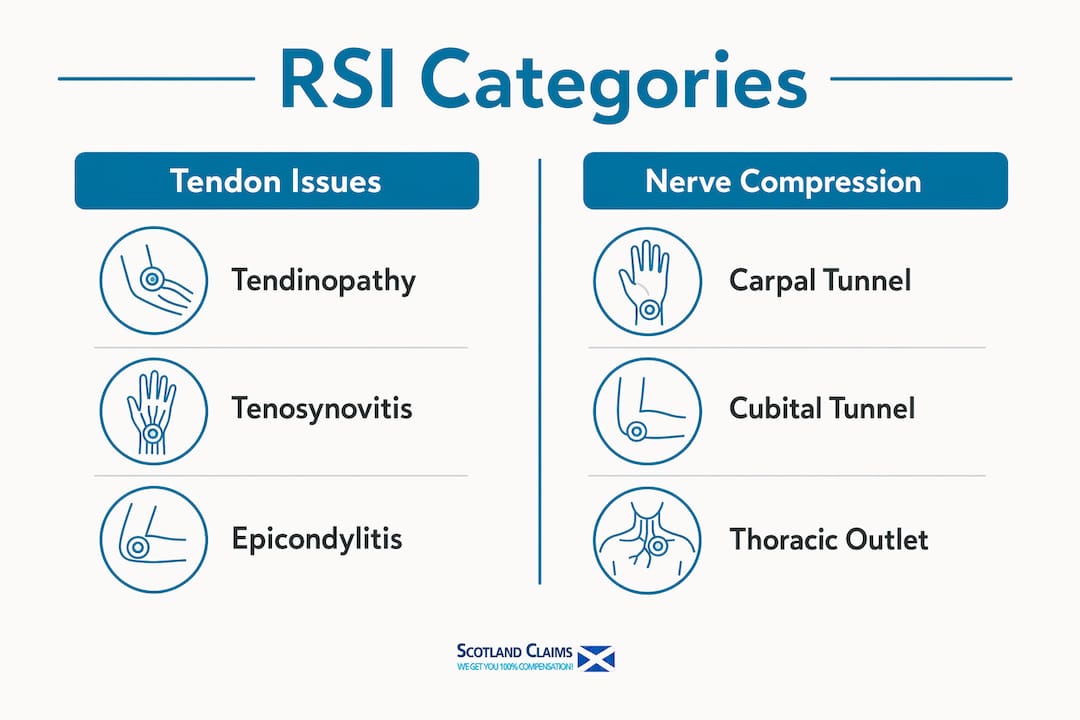
Two main categories sit under the RSI umbrella. The first covers tendon-related problems, such as tendinopathy and tenosynovitis, where the tendon or its surrounding sheath becomes inflamed or degenerates. The second covers nerve compression syndromes, the most well-known being carpal tunnel syndrome, where a nerve is squeezed by surrounding swollen tissue. These two categories require markedly different clinical approaches, which is why a precise diagnosis matters far more than the general RSI label.
Understanding the distinction early saves you months of ineffective treatment. A person with carpal tunnel syndrome needs nerve decompression strategies, while someone with Achilles tendinopathy needs graded loading exercises. Treating both identically produces poor results.
What symptoms indicate repetitive strain injury?
RSI symptoms include pain, tingling, numbness, and weakness in the affected area. These do not usually appear overnight. They build gradually as tissues are repeatedly stressed without adequate recovery time.
The most commonly reported symptoms are:
- Pain or aching in the muscles or joints, often worse during or after activity
- Stiffness that is most noticeable first thing in the morning or after rest
- Tingling or numbness, particularly in the fingers or hands, which can suggest nerve involvement
- Weakness when gripping or lifting, making everyday tasks harder
- Throbbing or pulsing sensations that persist even when you stop the triggering activity
Symptoms typically affect the hands, wrists, elbows, and shoulders, though the neck and upper back are also common sites. The pattern matters as much as the location. Pain that appears only during a specific task and eases with rest suggests early-stage RSI. Pain that persists at rest or at night signals a more advanced problem that needs professional assessment.
Pro Tip: Keep a simple symptom diary for two weeks. Note when pain appears, what you were doing, and how long it lasts. This information is invaluable to any clinician assessing your condition.
What causes repetitive strain injury and which tissues are involved?
RSI develops when repetitive microtrauma exceeds the body’s natural tissue repair cycles. Every time you perform a repetitive movement, small amounts of stress accumulate in the tissue. Given enough recovery time, the body repairs this micro-damage. Without that recovery, inflammation builds, connective tissue stiffens, and nerve pathways become sensitised.
The main mechanical triggers are:
- Repetitive movements performed at high frequency, such as typing, assembly line work, or playing a musical instrument
- Sustained awkward postures, such as holding your wrist bent while using a mouse or craning your neck forward at a screen
- Forceful exertion, such as gripping tools tightly or lifting heavy loads repeatedly
- Vibration, common in trades using power tools, which accelerates tendon and nerve damage
The tissues most commonly involved are muscles, tendons, tendon sheaths, nerves, and joint cartilage. Because these musculoskeletal parts are stressed repeatedly or forcefully, symptoms vary considerably depending on which tissue is primarily affected.
| Tissue Type |
Condition |
Key Feature |
| Tendon |
Tendinopathy |
Painful degeneration from overuse |
| Tendon sheath |
Tenosynovitis |
Inflammation of the tendon’s outer sleeve |
| Nerve |
Carpal tunnel syndrome |
Compression causing tingling and numbness |
| Muscle |
Myofascial pain |
Trigger points and referred aching |
| Joint |
Bursitis |
Inflamed fluid sac near a joint |
Pro Tip: Vibration exposure from power tools is a recognised occupational hazard in Scotland’s construction and engineering sectors. If your job involves regular use of vibrating equipment, ask your employer about hand-arm vibration assessments.
How is repetitive strain injury diagnosed?
RSI diagnosis focuses on identifying the specific underlying condition rather than simply labelling the pain as “overuse.” Diagnosis ideally examines movement patterns, posture, force, and recovery habits to distinguish tendon problems from nerve compression.
A thorough clinical assessment typically follows these steps:
- Symptom history: When did the pain start? What activities trigger it? Does it ease with rest or persist?
- Physical examination: The clinician tests strength, range of motion, and specific provocative tests such as Phalen’s test for carpal tunnel syndrome or the Cozen’s test for tennis elbow.
- Occupational review: Your daily tasks, workstation setup, and work hours are assessed to identify the mechanical cause.
- Imaging or nerve conduction studies: These are ordered when the diagnosis is unclear or when surgery is being considered. An ultrasound can reveal tendon tears, while nerve conduction studies confirm nerve compression.
- Differential diagnosis: The clinician rules out other causes of similar symptoms, including arthritis, fibromyalgia, and referred pain from the cervical spine.
One common reason RSI diagnosis is delayed is that clinicians focus solely on where it hurts rather than why it hurts. A wrist that aches may be driven by shoulder mechanics or a poorly positioned keyboard. Addressing only the painful site without examining the full movement chain often leads to incomplete recovery.
What are effective ways to prevent repetitive strain injury?
Ergonomics and structured breaks outperform exercise-only approaches for early RSI prevention. This is a finding that surprises many people who assume stretching alone is sufficient protection. Adjusting how and where you work reduces the mechanical load on tissues before damage accumulates.
Practical prevention strategies include:
- Recognise early warning signs: Mild aching or stiffness after a task is your body’s signal to change something. Do not wait for sharp pain.
- Adjust your workstation: Your screen should sit at eye level, your keyboard should allow your wrists to remain neutral, and your chair should support your lower back. Small adjustments make a significant difference over an eight-hour working day.
- Schedule regular breaks: Recovery between repetitive movements is critical to prevent tendon overload. A two-minute break every 30 minutes is more effective than one long break every two hours.
- Vary your tasks: Rotating between different activities reduces the cumulative load on any single tissue group.
- Strengthen supporting muscles: Targeted exercises for the shoulder, forearm, and core reduce the strain placed on tendons and joints during repetitive work.
Scottish workers in common workplace hazard environments, including manufacturing, healthcare, and office settings, are particularly exposed. Knowing your rights around workstation assessments is part of effective prevention.
Pro Tip: The Health and Safety Executive (HSE) requires UK employers to assess and reduce risks from repetitive work under the Manual Handling Operations Regulations 1992. If your employer has not carried out a risk assessment, you can request one formally in writing.
What treatment options exist for repetitive strain injury?
Treatment depends entirely on the underlying diagnosis. RSI management differs based on whether the primary problem is a tendon issue or nerve compression, and the two pathways are distinct.
Tendinopathy treatment
Tendinopathy is treated with physical therapy, pain control using NSAIDs such as ibuprofen, and graded loading exercises. Complete rest alone does not resolve tendinopathy. The tendon needs progressive mechanical stress to stimulate healing. Steroid injections may reduce short-term pain but are used cautiously because repeated injections can weaken tendon structure. Surgery is reserved for cases where conservative treatment has failed after several months.
Nerve compression treatment
Carpal tunnel syndrome and similar nerve compression conditions are managed differently. Splinting the wrist at night reduces pressure on the median nerve. Corticosteroid injections can provide temporary relief. Surgical decompression, a straightforward procedure with high success rates, is considered when symptoms are severe or persistent.
The table below summarises the main treatment approaches:
| Treatment |
Best For |
Notes |
| Physical therapy |
Tendinopathy, muscle pain |
Graded loading is central to recovery |
| NSAIDs (e.g., ibuprofen) |
Acute inflammation |
Short-term use only |
| Splinting |
Nerve compression syndromes |
Particularly effective at night |
| Steroid injection |
Short-term pain relief |
Use sparingly to protect tissue |
| Surgery |
Severe or unresponsive cases |
High success rate for carpal tunnel |
Recovery timelines vary. Mild tendinopathy may resolve within 6–12 weeks with consistent physical therapy. Nerve compression syndromes can take longer if the nerve has been compressed for an extended period. The key principle across all treatment for repetitive strain is gradual return to activity rather than abrupt rest followed by abrupt return.
Key takeaways
Effective management of repetitive strain injury requires accurate diagnosis, targeted treatment, and workstation changes, not rest alone.
| Point |
Details |
| RSI is an umbrella term |
It covers tendon, nerve, muscle, and joint conditions caused by overuse. |
| Symptoms build gradually |
Pain, tingling, and weakness worsen without recovery time between repetitive tasks. |
| Diagnosis drives treatment |
Tendinopathy and nerve compression require different clinical approaches. |
| Prevention beats cure |
Ergonomic adjustments and scheduled breaks reduce tissue overload more effectively than stretching alone. |
| Scottish workers have legal rights |
Employers must assess repetitive work risks; compensation claims are available if they fail to do so. |
RSI: what i have learned from years of watching people get it wrong
The most common mistake I see is people treating RSI as a problem that rest will fix. They stop the painful activity for two weeks, feel slightly better, return to exactly the same workload in exactly the same posture, and wonder why the pain comes back within days. Rest reduces inflammation. It does not change the mechanical cause.
The second mistake is waiting too long to seek help. By the time most people see a clinician, they have had symptoms for three to six months. At that point, the tendon or nerve has often adapted to a chronic state, which takes considerably longer to reverse. If you notice persistent aching after a repetitive task that does not ease within a few days, get it assessed. Early intervention is genuinely faster and cheaper than late intervention.
What actually works, in my experience, is a combination of three things: an accurate diagnosis that identifies the specific tissue involved, a physical therapy programme built around graded loading rather than passive rest, and a genuine change to the working environment. All three together produce lasting results. Any two without the third tends to produce partial recovery followed by relapse.
For workers in Scotland, there is also a legal dimension worth understanding. If your RSI developed because your employer failed to carry out proper risk assessments, provide adequate equipment, or allow sufficient breaks, you may have grounds for a workplace injury claim. That is not a minor point. It is your right, and exercising it also creates pressure on employers to improve conditions for everyone else.
— Roger
Did your RSI develop at work? Scotland Claims Injury Lawyers can help
If your repetitive strain injury was caused or worsened by your working conditions, you may be entitled to compensation. Scotland Claims Injury Lawyers connects you with specialist injury lawyers in Scotland who handle workplace injury claims on a No Win No Fee basis. You pay nothing upfront, and if your claim is unsuccessful, you pay nothing at all. For all claim types - including workplace injuries - Scotland Claims Injury Lawyers deducts no success fee whatsoever, meaning you keep 100% of your compensation, while most other large firms charge up to 20% including VAT. Use the compensation calculator to get an estimate of what your claim could be worth, or request a callback to speak with a specialist today.
FAQ
What is the difference between RSI and a repetitive motion injury?
The two terms describe the same group of conditions. RSI is the common British term, while “repetitive motion injury” is used more widely in North American medical literature. Both refer to overuse injuries affecting muscles, tendons, nerves, or joints.
How long does RSI take to recover?
Recovery depends on the specific condition and how early treatment begins. Mild tendinopathy typically resolves within 6–12 weeks with physical therapy and load management. Nerve compression syndromes such as carpal tunnel syndrome may take longer, particularly if symptoms have been present for several months.
Can RSI be claimed as a workplace injury in scotland?
Yes. If your employer failed to reduce repetitive work risks through proper assessments, equipment, or rest breaks, you may have a valid No Win No Fee claim in Scotland. Scotland Claims Injury Lawyers specialises in exactly this type of case.
Is rest alone enough to treat RSI?
Rest reduces acute inflammation but does not resolve the underlying problem. Research from the MSD Manual confirms that graded exercise and physical therapy are central to tendinopathy recovery. Returning to full activity without addressing posture and load management almost always leads to relapse.
Which jobs carry the highest RSI risk in scotland?
Manufacturing, construction, healthcare, and office-based roles carry the highest risk. Specific risk factors include keyboard and mouse use, use of vibrating tools, assembly line work, and sustained awkward postures. The HSE requires employers in all these sectors to assess and reduce repetitive work risks.
Recommended