What counts as a road traffic accident in Scotland?
TL;DR:
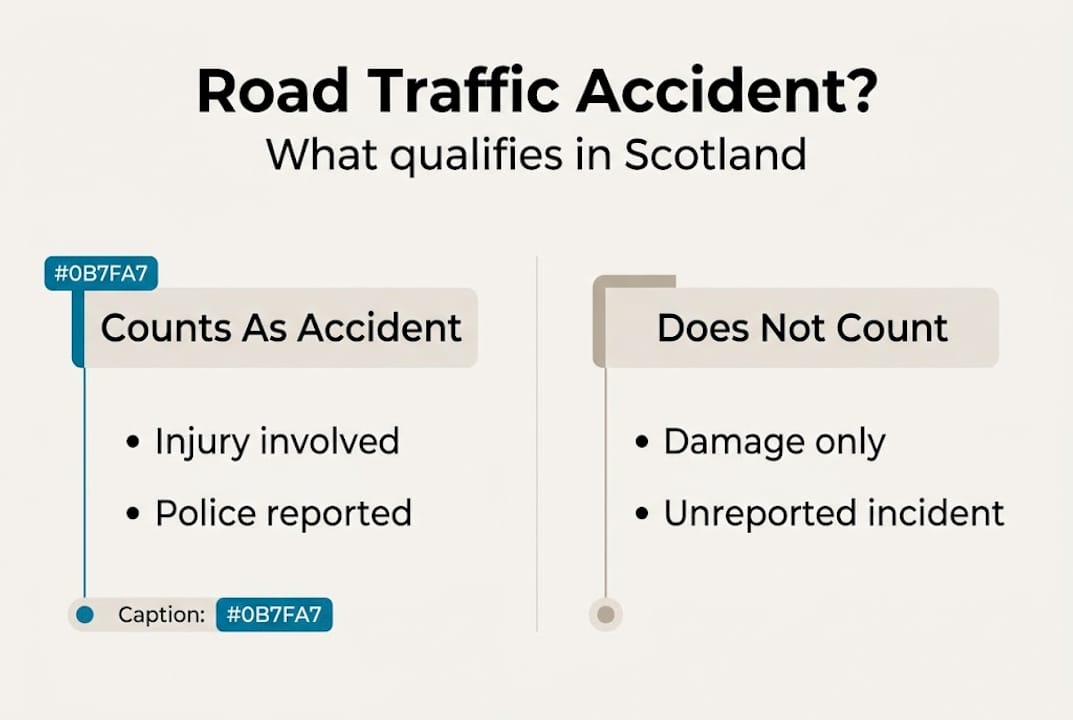
- An incident must involve injury or death to qualify as an official Scottish road traffic accident.
- Damage-only incidents without injury are excluded from official statistics and legal claims.
- Reporting duties include accidents involving injuries, specific animals, or serious property damage.
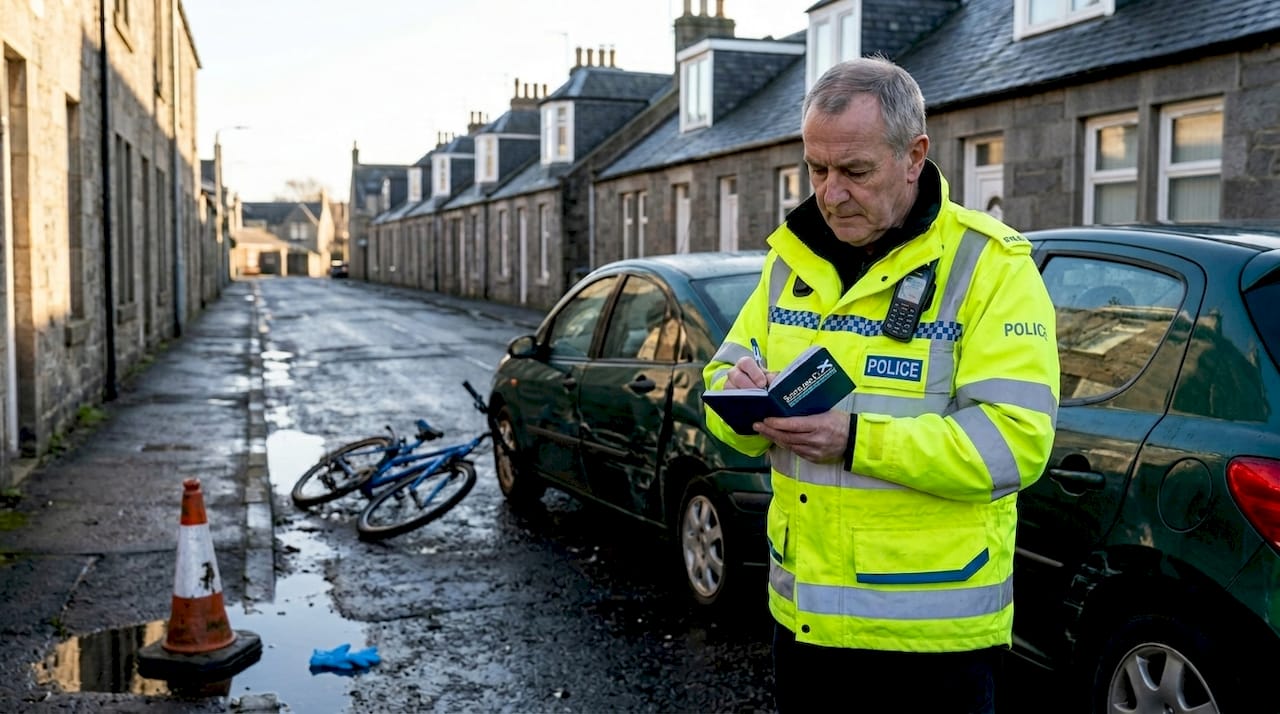
A car park bump, a cyclist clipping a kerb, a collision with a stray sheep on a Highland road — it is easy to assume all of these automatically count as road traffic accidents in the eyes of Scottish law. Many people in Scotland make that assumption, and it costs them. Whether an incident qualifies as an official road traffic accident (RTA) directly affects your legal duties, your ability to claim compensation, and how police and insurers respond. Getting this wrong from the start can undermine an otherwise valid claim. This guide sets out exactly what counts, what does not, and why it matters to you.
Table of Contents
Key Takeaways
| Point |
Details |
| Injury is key |
Scottish law only classifies incidents as official road traffic accidents if someone is injured or killed. |
| Reporting obligations |
You must report accidents with injuries or specific animals under UK law. |
| Official record matters |
A police report greatly strengthens an injury compensation claim in Scotland. |
| Damage-only cases |
Incidents with only vehicle or property damage are not counted as RTAs for official statistics or most claims. |
Official definition of a road traffic accident in Scotland
The phrase “road traffic accident” gets used loosely in everyday conversation, but Scottish authorities apply a precise, consistent standard. Understanding that standard is the foundation of any compensation claim or reporting obligation.
“Official statistics from Transport Scotland define reported road casualties as collisions where someone is injured or killed and become known to Police Scotland; damage-only collisions are excluded.”
That single distinction — injury versus damage only — is the dividing line. If no one is hurt, the incident does not enter Scotland’s official casualty records, regardless of how serious the vehicle damage looks. Police Scotland follows strict recording standards that prioritise injury cases, meaning a crumpled bonnet without a scratch on any person simply does not register in the same way legally.
This matters beyond statistics. Insurers, solicitors, and courts in Scotland all reference official definitions when assessing claims. An incident that does not meet the threshold may still have insurance implications, but it will not trigger the same legal processes as a qualifying RTA.
The Scottish road casualty statistics published by the Scottish Government reflect only those incidents that meet this injury-based threshold. So when you hear that road casualties in Scotland have fallen or risen, those figures exclude thousands of damage-only incidents each year.
Here is a quick summary of what is included and excluded:
| Incident type |
Injury involved? |
Counted as official RTA? |
| Two-car collision with whiplash |
Yes |
Yes |
| Car reversing into a wall, no injury |
No |
No |
| Cyclist knocked off bike, broken wrist |
Yes |
Yes |
| Vehicle scraping a parked car, no injury |
No |
No |
| Pedestrian struck at crossing |
Yes |
Yes |
| Minor bump in car park, no injury |
No |
No |
Key points to remember about the official definition:
- The incident must involve a vehicle on or near a public road or accessible place.
- At least one person must be injured or killed.
- The incident must become known to Police Scotland.
- Damage-only incidents are excluded from official RTA statistics.
For guidance on reporting accidents in Scotland, including timelines and what information to provide, it is worth understanding these definitions before you contact police or your insurer.
Which incidents are covered by the Road Traffic Act 1988?
The official statistics definition and the legal definition are closely related but not identical. The Road Traffic Act 1988 sets out specific duties that apply to drivers involved in accidents, and these duties go slightly further than the injury-only threshold in some respects.
Under Road Traffic Act 1988 s170, drivers must report accidents causing injury to any person, animal, or property. The key legal trigger points are:
- Injury to any person — this includes passengers, pedestrians, cyclists, and other drivers.
- Injury to certain animals — specifically horses, cattle, sheep, pigs, goats, donkeys, and mules. Notably, dogs and cats are not listed in the Act, though injuring them may still have other legal consequences.
- Serious damage to property — this includes other vehicles, buildings, road furniture such as lamp posts, and similar structures.
- Damage to a vehicle you are not in — even if no injury occurs, you must stop and exchange details.
If another party is present and you exchange details at the scene, you do not always need to report separately to police. However, if no one else is present or details cannot be exchanged, you must report the incident to a police station within 24 hours.
Your legal reporting duties after an accident in Scotland follow this sequence:
- Stop immediately at the scene.
- Provide your name, address, and vehicle registration to anyone with reasonable grounds to ask.
- If injury is involved, produce your insurance certificate at the scene or at a police station within seven days.
- If you cannot exchange details at the scene, report the accident to police within 24 hours.
- Retain copies of any accident claim forms and correspondence for your records.
For a full legal summary of reporting obligations, the Crown Prosecution Service guidance is a reliable reference, even though it covers England and Wales — the core Road Traffic Act provisions apply UK-wide.
Pro Tip: Even if you believe your injury is minor, report it to police and seek medical attention promptly. Symptoms such as whiplash can take days to appear, and early documentation protects your legal position considerably.
Examples of what does and does not count as a road traffic accident
Theory is useful, but real-world scenarios are where confusion most often arises. Here are typical Scottish situations and how they are classified under official definitions.
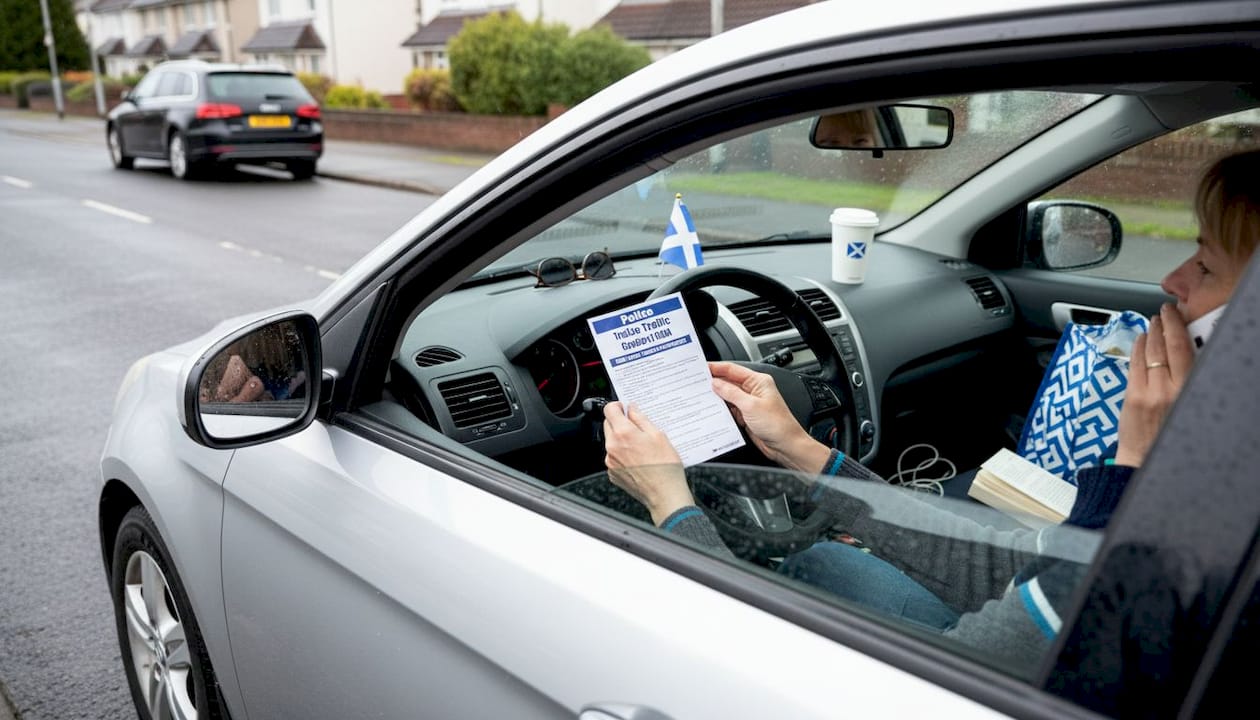
Police recording in Scotland follows the Scottish Crime Recording Standard, which applies a balance of probability test. For RTAs specifically, the focus is on injury collisions that become known to police, rather than every incident involving a vehicle.
| Scenario |
Counts as official RTA? |
Must report to police? |
Claim eligible? |
| Two cars collide on the A9, driver injured |
Yes |
Yes |
Yes |
| Car bumps another in a supermarket car park, no injury |
No |
Exchange details only |
Insurance only |
| Cyclist falls after pothole, breaks collarbone |
Yes |
Yes |
Yes |
| Driver swerves to avoid a deer, hits kerb, no injury |
No |
No |
Insurance only |
| Vehicle strikes a horse on a rural road |
Yes |
Yes |
Yes |
| Dog runs into road, driver brakes sharply, passenger hurt |
Yes |
Yes |
Yes |
Common points of confusion include:
- Bicycle-only incidents: If a cyclist falls without involving a motor vehicle, it may not qualify as an RTA under the Act, though injury claims may still be possible depending on circumstances.
- Car park incidents: These are frequently misunderstood. A car park is not always a public road, but if it is accessible to the public, the Road Traffic Act can still apply.
- Single-vehicle incidents with no injury: Hitting a kerb or a wall without injuring anyone does not meet the official RTA threshold, even if the vehicle is written off.
- Injury to a dog: Dogs are not listed animals under s170, so striking a dog does not trigger the same mandatory reporting duty, though you should still stop and act responsibly.
For a detailed breakdown of how these scenarios affect your right to claim, the road traffic accident claim guide covers the process from incident to settlement in plain language.
Why the definition matters for injury claims and compensation
Knowing whether your incident qualifies as an official RTA is not just academic. It has direct, practical consequences for your compensation claim.
“Transport Scotland only records RTAs resulting in injury or death, not damage-only incidents.”
Only qualifying RTAs allow access to certain injury claims processes in Scotland, including the Motor Insurers’ Bureau for uninsured or untraced drivers. If your incident does not meet the threshold, your route to compensation changes significantly.
Here is how the definition affects your claim step by step:
- Police report as evidence: Insurers and solicitors rely on police reports to establish facts. An accident claim process that begins with a police report is far more straightforward than one that does not.
- Three-year deadline: In Scotland, you generally have three years from the date of the accident to begin a personal injury claim. This clock starts ticking from the accident date, or from the date you became aware of your injury in some circumstances.
- Damage-only incidents: If no injury occurred, your route is through your insurer rather than a personal injury claim. You will not be entitled to compensation for pain and suffering, only for vehicle repair or replacement.
- Insurer cooperation: Insurers are far more cooperative when a police report exists. Without one, expect delays, disputes over liability, and requests for additional evidence for Scottish claims that you may struggle to provide.
The official casualty data from Transport Scotland shows that thousands of injury collisions are recorded each year. Each one represents a person whose legal classification of their incident determined whether they could claim compensation.
Pro Tip: Take photographs at the scene, gather witness contact details, and keep a written record of your symptoms from day one. This evidence is often the difference between a successful claim and a disputed one.
What most people miss about road traffic accident definitions
Here is something we see repeatedly: people assume that because they were in a collision involving a vehicle, they automatically have a claim. That assumption is wrong, and it leads to costly mistakes.
The legal status of your incident hinges on two things — injury and reporting. A bump that leaves no one hurt and goes unreported is, in legal terms, barely an incident at all. Yet many people spend weeks assuming they have a valid personal injury claim, only to discover their case lacks the foundation it needs.
Police involvement is not just a formality. It often makes or breaks a claim, particularly when liability is disputed. Without a police record, the entire burden of proof shifts to you. That is a significant disadvantage when facing an insurer whose interests are the opposite of yours.
The other oversight we see is relying on gut feeling at the scene. People underestimate their injuries, skip the hospital, and fail to photograph the scene because everything seems minor. Weeks later, when the importance of evidence becomes clear, that evidence is gone. Document everything, report promptly, and let a specialist assess whether your incident qualifies. Do not make that judgement alone at the roadside.
Get help with your road traffic accident claim in Scotland
Now that you understand what officially counts as a road traffic accident in Scotland, the next step is knowing where to turn. At Scotland Claims, we connect injury victims with specialist solicitors who handle exactly these situations every day. Whether you are unsure if your incident qualifies, or you are ready to begin your claim, our team can guide you through the process with no upfront costs. Our no win no fee claims arrangement means you pay nothing if your case is unsuccessful, and you keep 100% of your compensation if it succeeds. Speak to our injury lawyers in Scotland today, or use our compensation calculator to get an estimate of what your claim could be worth.
Frequently asked questions
Does a car park collision count as a road traffic accident in Scotland?
Only if someone is injured or the incident is reported to the police as required by law. Damage-only collisions are excluded from official statistics, so a minor bump with no injuries will not qualify as an official RTA.
Do I need to report all road traffic accidents to the police?
Not every incident requires a police report, but you must report accidents involving injuries, specified animals, or serious property damage. Drivers must report accidents causing injury or specified animal or property damage under the Road Traffic Act 1988.
Can I make a compensation claim if there is no police report?
It is possible, but claims are considerably stronger when a police report exists. Undocumented cases face more insurer resistance, and without a report, insurer cooperation becomes much harder to secure.
Which animals are covered by the legal requirement to report an accident?
You must report accidents involving horses, cattle, sheep, pigs, goats, donkeys, and mules. Section 170 covers certain animals, requiring reporting under the Road Traffic Act 1988, but dogs and cats are not included in this specific list.
Recommended