Accident at work in Scotland: your rights and compensation

TL;DR:
- An accident at work involves an employee suffering injury or harm due to unsafe conditions or employer negligence. Workers must report incidents promptly, document evidence, and seek medical attention to support their compensation claims under Scottish law. Timely action and proper evidence collection are essential for securing maximum compensation following a workplace injury.
An accident at work is any unintended incident in which an employee suffers injury or harm as a direct result of their work environment, tasks, or employer’s failure to maintain a safe workplace. Under the Health and Safety at Work Act 1974, employers carry a statutory duty to protect workers so far as is reasonably practicable. If yours failed in that duty and you were hurt, you have the right to claim compensation. This guide covers what counts as a reportable accident, the most common injuries in Scottish workplaces, how compensation is calculated under Scots law, and the practical steps you should take right now.
What counts as an accident at work and how to report it
A workplace accident is formally defined under the Reporting of Injuries, Diseases and Dangerous Occurrences Regulations 2013, known as RIDDOR. RIDDOR requires employers to report work-related deaths, specified injuries, diagnosed occupational diseases, and dangerous occurrences to the Health and Safety Executive. This is not optional. It is a legal obligation that sits entirely with your employer, not with you.
The distinction between recording and reporting matters here. Employers must record any accident that leaves you incapacitated for more than three days. The reporting duty to the HSE kicks in when incapacitation exceeds seven days. Specified injuries, such as fractures, amputations, crush injuries, and loss of consciousness, must be reported immediately regardless of how long you are off work.
As a worker, your role is to notify your employer as soon as possible after the incident. Most workplaces hold an accident book, and you should insist your account is entered accurately and in full. Do not leave it to a supervisor to summarise events on your behalf. Your written record of what happened, where, when, and who witnessed it forms the foundation of any future workplace injury claim.
RIDDOR reporting also generates national safety data that the HSE uses to identify hazardous industries and drive accident prevention strategies across Great Britain. Accurate reporting protects the next worker, not just you.
- Ask your employer for the RIDDOR incident reference number once a report has been submitted.
- Keep a personal copy of your accident book entry, signed and dated.
- Note the names and contact details of any witnesses at the scene.
- Photograph the hazard that caused your injury before it is corrected or removed.
Pro Tip: Requesting your RIDDOR incident reference from your employer gives you an official record of what was reported to the HSE. If an insurer later disputes the severity or timing of your injury, that reference number is a powerful counter-argument.
What are the most common workplace injuries in Scotland?
Common workplace injuries include slips, trips, falls from height, manual handling strains, repetitive motion injuries, and exposure to hazardous substances. Scotland’s major employment sectors add specific risk profiles that workers should recognise.
- Slips, trips, and falls. Wet floors, uneven surfaces, and poor lighting cause a significant proportion of workplace accidents across retail, hospitality, and healthcare settings in Scotland. Falls from height remain the leading cause of fatal injuries on construction sites.
- Manual handling injuries. Lifting, carrying, and repetitive bending cause back, shoulder, and knee injuries across warehousing, agriculture, and care work. Back injuries are among the most frequently claimed injuries in Scottish workplaces.
- Repetitive strain injuries. Office workers, factory operatives, and tradespeople who perform the same motion repeatedly develop conditions such as carpal tunnel syndrome and tendinitis. These injuries build gradually and are just as compensable as sudden accidents.
- Struck by objects. Workers in construction, manufacturing, and logistics face risks from falling tools, moving vehicles, and unsecured loads. Head and spinal injuries from these incidents can have lifelong consequences.
- Exposure to harmful substances. Scotland’s oil and gas sector, farming industry, and older building stock expose workers to chemicals, pesticides, and asbestos. Occupational diseases arising from such exposure fall within the scope of employer liability claims.
Medical documentation linking your symptoms directly to the incident is the single most important piece of evidence in any claim. See a GP or attend A&E on the day of the accident, even if your injury feels minor. Delayed medical attention gives insurers grounds to argue the injury was not caused at work. You can read more about common workplace hazards and your rights under Scottish law on the Scotland Claims Injury Lawyers website.
How is compensation for a workplace accident calculated in Scotland?
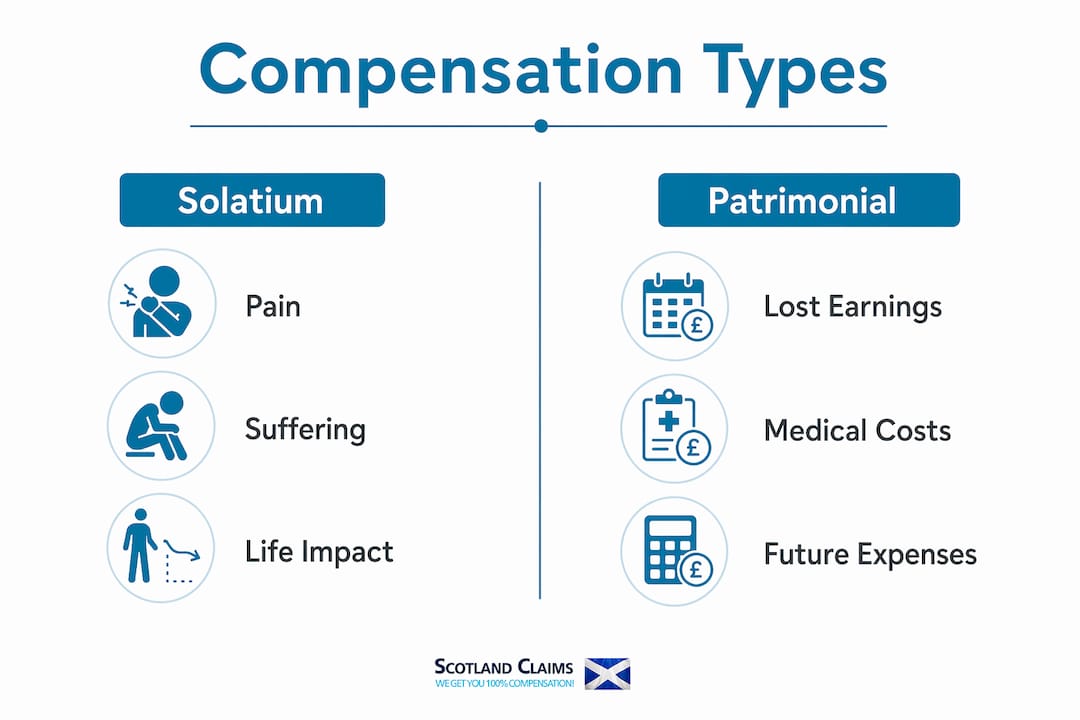
Compensation in Scotland is divided into two distinct heads of damage: solatium and patrimonial loss. Understanding both is critical to knowing what you are entitled to claim.

Solatium covers pain, suffering, and loss of amenity. It is the non-financial impact of your injury, including physical pain, psychological distress, and the activities you can no longer enjoy. The amount is assessed by reference to the Judicial College Guidelines and the specific facts of your case.
Patrimonial loss covers every measurable financial consequence of the injury. This includes past and future loss of earnings, the cost of medical treatment, physiotherapy, prescription charges, travel to appointments, and the cost of services you can no longer perform yourself, such as gardening or childcare.
| Compensation head |
What it covers |
| Solatium |
Pain, suffering, and loss of enjoyment of life |
| Loss of earnings |
Past income lost and projected future earnings reduction |
| Treatment costs |
Physiotherapy, surgery, prescriptions, and rehabilitation |
| Services |
Tasks others perform for you because of your injury |
| Travel expenses |
Costs of attending medical appointments and legal meetings |
Contributory negligence can reduce your award if you are found partly responsible for the accident. For example, if you ignored a safety instruction or failed to wear provided protective equipment, a court may reduce your compensation by a percentage reflecting your share of fault. This does not bar your claim. It adjusts the final figure.
Employers are legally required to hold Employers’ Liability insurance with a minimum cover of £5 million. This means compensation is paid by the insurer, not directly from your employer’s pocket. Most workers worry that claiming will bankrupt a small employer. In practice, the insurer carries the financial risk.
Claims in Scotland are subject to a three-year time limit from the date of the accident, or from the date you became aware your injury was work-related. Act before that window closes.
Pro Tip: Detailed receipts and appointment records are essential because insurers routinely challenge unsupported financial losses. Keep every receipt, payslip, and letter from your GP or specialist in a single folder from day one. Use the Scotland Claims Injury Lawyers compensation calculator to get an early estimate of what your claim may be worth.
The actions you take in the hours and days following an accident at a job site directly determine the strength of your claim. Most workers lose evidence simply by not knowing what to preserve.
- Seek medical attention first. Go to A&E, a minor injuries unit, or your GP on the same day. Tell the clinician exactly how the injury occurred and that it happened at work. This creates a contemporaneous medical record that ties your injury to the incident.
- Report to your employer in writing. Verbal reports disappear. Send an email or complete the accident book and photograph your entry. If your employer refuses to record the accident, note the refusal in writing and send it to HR.
- Photograph the scene. Capture the hazard, the location, any warning signs that were absent, and your injuries. Hazards are often corrected within hours of an accident. Your photographs may be the only evidence of the conditions that caused your harm.
- Collect witness details. Colleagues who saw the accident or the unsafe conditions are valuable. Take names, job titles, and contact numbers while memories are fresh.
- Retain all financial records. Keep payslips showing your normal earnings, receipts for any treatment or travel costs, and any correspondence from your employer about sick pay or return to work. Early documentation of financial impacts strengthens every head of your compensation claim.
- Take legal advice before speaking to insurers. Your employer’s insurer may contact you quickly. Do not give a recorded statement or accept any offer without first speaking to a solicitor. Early offers are almost always below what you are entitled to receive.
You can also review guidance on documenting accident injuries for a strong legal case to understand exactly what evidence solicitors and courts find most persuasive.
Key takeaways
Workers in Scotland who suffer an accident at work are entitled to compensation covering both physical suffering and financial loss, provided their employer breached a duty of care.
| Point |
Details |
| Report under RIDDOR |
Insist your employer records and reports the accident; request the incident reference number. |
| Document everything |
Photographs, witness details, and same-day medical records are the foundation of a strong claim. |
| Know your compensation heads |
Solatium covers suffering; patrimonial loss covers earnings, treatment, and services. |
| Contributory negligence applies |
Your award may be reduced if you share responsibility, but your claim is not barred. |
| Act within three years |
Scottish law sets a three-year limitation period from the date of accident or date of knowledge. |
Why most workers underestimate what they are owed
I have seen the same pattern repeat itself across hundreds of workplace injury cases. Workers accept the first offer from an insurer, or worse, they never claim at all because they assume the accident was partly their fault. Both decisions cost people money they are legally entitled to receive.
The contributory negligence point is the one that trips workers up most often. An insurer will frequently suggest you bear significant responsibility for your own injury. In my experience, the initial figure they propose is almost always inflated. A solicitor who understands Scots law will negotiate that percentage down, and the difference to your final award can be substantial.
The other misunderstanding I encounter constantly is around solatium. Workers focus on their lost wages and forget entirely that the pain, the sleepless nights, the inability to play with their children, or the anxiety about returning to work all carry a monetary value in Scottish courts. These are not soft claims. They are recognised heads of damage with established valuation frameworks.
My honest advice is this: do not attempt to navigate employer liability claims alone. The insurer has experienced claims handlers working against your interests from the moment you report the accident. You deserve someone equally experienced working for you. Get advice early, keep every piece of paper, and do not accept anything until you know the full value of what you are owed.
— Roger
How Scotland Claims Injury Lawyers can help after a workplace accident
Scotland Claims Injury Lawyers connects injured workers across Scotland with specialist injury lawyers who handle workplace accident claims on a no win no fee basis. You pay nothing upfront and nothing at all if your case is unsuccessful. For accidents at work and every other claim type, Scotland Claims Injury Lawyers deducts no success fee at all, meaning you keep 100% of your compensation - while most other large firms charge up to 20% including VAT. Make an educated decision on who to go with. Same Scot's Law, same court, just different success fees. Whether you have suffered a back injury, a knee injury, or another serious workplace injury, the team can assess your claim, explain your rights, and pursue the full compensation you are entitled to under Scots law.
FAQ
What is RIDDOR and does it affect my claim?
RIDDOR is the Reporting of Injuries, Diseases and Dangerous Occurrences Regulations 2013, which requires employers to report serious workplace accidents to the HSE. A RIDDOR report creates an official record of your accident that supports your compensation claim and is difficult for insurers to dispute.
How long do I have to make a workplace injury claim in Scotland?
You have three years from the date of your accident, or from the date you first knew your injury was work-related, to bring a claim under Scots law. Missing this deadline will almost certainly bar your claim entirely.
Can I claim if the accident was partly my fault?
Yes. Contributory negligence reduces your compensation by a percentage reflecting your share of responsibility, but it does not prevent you from claiming. Even a 50% reduction still leaves you with a significant award in serious injury cases.
What compensation can I receive for a workplace accident?
Scottish courts award solatium for pain and suffering and patrimonial loss for financial consequences including lost earnings, treatment costs, and the cost of services you can no longer perform. Use the Scotland Claims Injury Lawyers compensation calculator for an initial estimate.
Will claiming affect my job?
Employers cannot lawfully dismiss or penalise you for making a legitimate workplace injury claim. Your employer’s liability insurer, not your employer personally, funds the compensation. Retaliation for claiming is itself a legal wrong that can give rise to separate employment law proceedings.
Recommended