Burden of proof in UK law: what you need to know

TL;DR:
- In UK law, the burden of proof determines who must prove a case and to what standard, varying between criminal and civil proceedings. The prosecution must prove guilt beyond reasonable doubt, while claimants in civil cases must show their case is more likely true than not on the balance of probabilities.
In UK law, the burden of proof determines who must prove a case and to what standard. In criminal proceedings, the prosecution must prove guilt beyond reasonable doubt. In civil cases, including personal injury claims, the claimant must prove their case on the balance of probabilities, meaning their version of events is more likely true than not.
Two standards, two very different thresholds. Here is the quick summary:
- Criminal cases: the prosecution bears the burden; the defendant need prove nothing unless raising a specific statutory defence.
- Civil cases: the claimant bears the burden of proving both breach of duty and causation.
- Scotland civil standard: the same balance of probabilities applies; if evidence is finely balanced, the party relying on it may lose that issue.
- Foundational authority: R v Woolmington [1935] AC 462 established that the prosecution must prove criminal guilt; a defendant is presumed innocent until that burden is discharged.
- Fair trial protection: Article 6 of the European Convention on Human Rights (ECHR) governs how courts scrutinise any statutory attempt to reverse that burden onto a defendant.
If you are pursuing a personal injury claim in Scotland, Scotland Claims Injury Lawyers can assess your case free of charge, with no success fee taken from your compensation.
Table of Contents
What does ‘burden of proof’ actually mean in law?
The burden of proof is the legal obligation placed on a party to establish the facts necessary to win their case. Without meeting it, that party loses, regardless of what may actually have happened.
Three terms sit at the heart of this concept, and confusing them is the most common mistake non-lawyers make:
- Legal burden (persuasive burden): the duty to persuade the court of a fact to the required standard. This stays with one party throughout the case in most circumstances. LexisNexis describes it as the obligation to satisfy the tribunal of fact on the issue.
- Evidential burden: the duty to produce enough evidence to raise an issue so it becomes live before the court. A defendant who wants to rely on self-defence, for example, must first adduce sufficient evidence to put that issue in play. The legal and evidential burdens are distinct: the legal burden requires persuading the court; the evidential burden is the threshold for getting an issue considered at all.
- Standard of proof: the level of persuasion required. This is not the same as the burden itself. The burden tells you who must prove; the standard tells you how convincingly they must do so.
The concept applies across criminal law, civil litigation, administrative tribunals, and even everyday reasoning. In every context, the underlying logic is the same: assertions must be evidenced, not merely asserted. A court will not fill evidential gaps on a party’s behalf.
Claimants in personal injury cases often worry they need absolute certainty. They do not. Success requires proving a version of events is more likely than not, not proving it beyond all doubt.
What standards of proof apply across the UK?
The UK uses two primary standards, and they operate in very different settings.
Beyond reasonable doubt
This is the criminal standard. The prosecution must make the court sure of guilt. Judges in England, Wales, and Scotland now typically direct juries to be “sure” rather than to apply the older “beyond reasonable doubt” formulation, though both phrases describe the same high threshold. If any genuine doubt remains, the defendant must be acquitted.
Balance of probabilities
This is the civil standard. A claimant wins if the court finds their account is more probable than not, essentially a greater than 50% likelihood. A judge does not need to be certain; they need to be persuaded that one version of events is more likely true than the alternative.
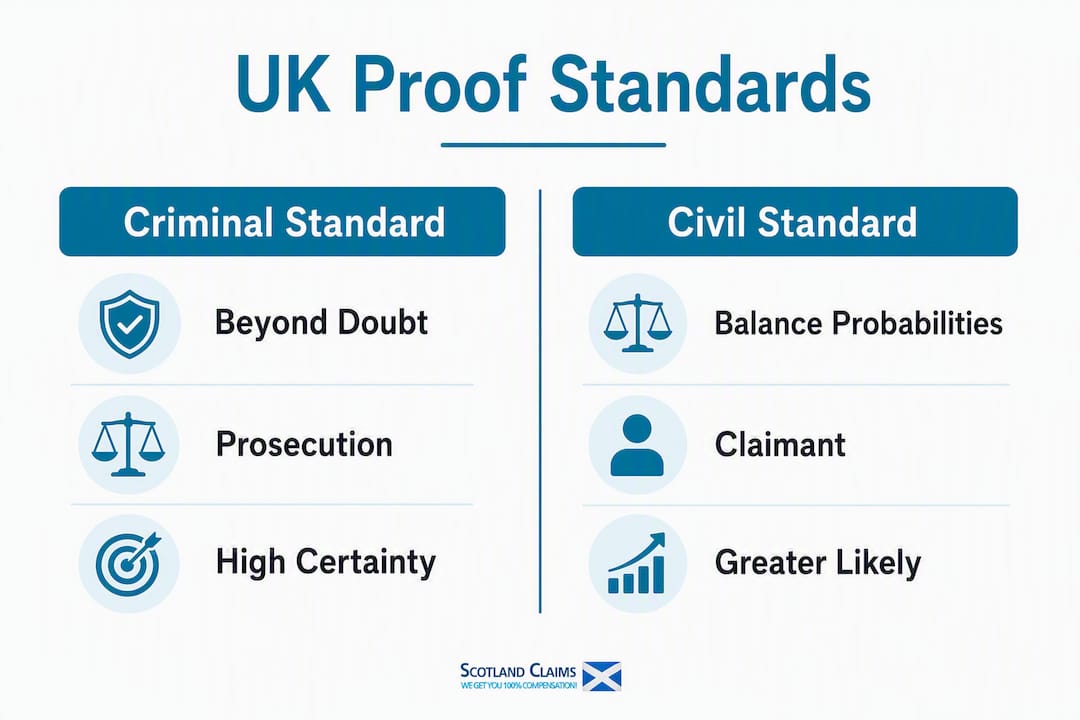
| Feature |
Criminal standard |
Civil standard |
| Phrase used |
“Sure” / beyond reasonable doubt |
Balance of probabilities |
| Threshold |
Very high; near certainty |
More likely than not (>50%) |
| Who bears it |
Prosecution |
Claimant |
| Consequence of failure |
Acquittal |
Claim dismissed |
| Scotland position |
Same as England and Wales |
Same civil standard applies |
Scotland note: In Scottish civil proceedings, the balance of probabilities is the applicable standard. Where evidence leaves an issue finely balanced, the party who relies on that issue may lose it. There is no separate Scottish civil standard; the threshold is identical to that applied in England and Wales.
Reverse burdens and Article 6 ECHR: Statutes may place a legal burden on defendants for particular defences, but courts scrutinise such provisions for compatibility with Article 6 ECHR and proportionality. A reverse burden that is disproportionate may be read down to an evidential burden only.
Who normally carries the burden, and when can it shift?
The default allocation is straightforward:
- Criminal proceedings: the prosecution carries the legal burden throughout. The defendant carries no burden to prove innocence.
- Civil proceedings: the claimant carries the legal burden of proving each element of their claim.
- Personal injury claims: the claimant must prove both breach of duty and causation on the balance of probabilities. If either element is not proved, the claim fails.
The evidential burden can move during a case even when the legal burden does not. A defendant who raises a defence such as contributory negligence must adduce enough evidence to put that issue before the court. The legal burden of disproving it may then rest with the claimant or, in some statutory contexts, remain with the defendant.
When the burden can reverse or shift:
- Statutory reverse burdens: Parliament can expressly place a legal burden on a defendant for a specific defence. Courts then test that provision against Article 6 ECHR.
- Conviction-based presumptions: if a defendant has been convicted of an offence arising from the same incident, a rebuttable presumption may arise. In Scottish personal injury claims, this can shift the evidential advantage to the claimant, who can rely on that conviction as evidence of negligence unless the defendant rebuts it.
- Res ipsa loquitur: where the facts speak for themselves (a surgical instrument left inside a patient, for example), an inference of negligence may arise without the claimant proving each step in detail.
R v Woolmington remains the foundational authority. The prosecution bears the burden of proving guilt beyond reasonable doubt; that principle has not changed since 1935. For a deeper look at how liability disputes play out in practice, see Scotland Claims Injury Lawyers’ guide on why liability is disputed in personal injury claims.
How do parties actually discharge the burden?
Meeting the burden is not about volume of evidence. It is about persuasion. Judges decide on persuasion; there are no fixed legal rules assigning weight to any particular item. A single compelling medical report can outweigh a stack of inconsistent witness accounts.
Common evidence types used in UK proceedings:
- Witness statements: first-hand accounts of what happened, when, and where. Witness statements are often the backbone of a personal injury claim.
- Contemporaneous documents: accident report forms, employer records, maintenance logs. Courts give these significant weight precisely because they were created at the time, not in anticipation of litigation.
- Medical records and GP notes: establish the nature, extent, and causation of injuries.
- Expert reports: orthopaedic surgeons, road accident reconstruction specialists, occupational health experts. Instructed early, they frame the case.
- CCTV and photographs: objective, hard to dispute, and often decisive.
- Site inspection evidence: plans, measurements, and photographs of the accident location.
The process runs from evidence-gathering through to judicial assessment. A solicitor gathers and preserves material, instructs experts where needed, prepares witness statements, and then presents the case in a way that builds a coherent, persuasive narrative. The judge weighs everything in the round.
Pro Tip: Instruct your expert early. An expert who examines a claimant six months after the incident can speak to current condition; one instructed within weeks can speak to the immediate aftermath. That temporal proximity materially strengthens causation arguments.

What happens when the burden is not met?
Failure to discharge the burden has a clean, binary consequence: the court finds for the other party on that issue. The claimant does not need to be proved wrong; they simply need to have failed to prove themselves right.
Practical outcomes include:
- Acquittal in criminal proceedings where the prosecution has not made the court sure of guilt.
- Dismissal of the claim in civil proceedings where the claimant has not proved breach or causation on the balance of probabilities.
- Loss of a specific issue even within an otherwise successful case, for example, a finding that injury occurred but causation was not proved to the required standard.
A finely balanced evidential picture almost always favours the defendant. Where evidence is equally consistent with negligence and with no negligence, the claimant will typically fail. That is not a technicality; it is the logical consequence of placing the burden on the party making the assertion.
The foundational criminal authority puts it plainly:
Statutory reverse burdens complicate this picture. Where Parliament places a legal burden on a defendant for a specific defence, courts scrutinise that provision for proportionality under Article 6 ECHR. A disproportionate reverse burden may be read down to an evidential burden only, preserving the defendant’s fair trial rights.
How does the burden work in practice? Three examples
1. Criminal case
A driver is charged with causing serious injury by dangerous driving. The prosecution must prove beyond reasonable doubt that the driving fell far below the standard of a competent driver and that this caused the injury. The defendant need not testify. If the jury retains any genuine doubt after the prosecution’s evidence, the verdict must be not guilty.
2. Personal injury claim in Scotland
A worker slips on an unmarked wet floor at their workplace and suffers a knee injury. The claimant must prove, on the balance of probabilities:
- The employer owed a duty of care.
- The employer breached that duty (the floor was wet, unmarked, and the employer knew or should have known).
- That breach caused the injury.
If any element is not proved, the claim fails. See Scotland Claims Injury Lawyers’ proven personal injury claim examples for how these cases play out in practice.
3. Administrative/regulatory matter
A regulatory body alleges a business breached a licensing condition. The burden allocation depends on the statute. Some regulatory regimes expressly place the burden on the regulated party to prove compliance; others require the regulator to prove breach. The wording of the enabling legislation is decisive.
| Proceeding type |
Who bears the burden |
Standard |
Consequence of failure |
| Criminal |
Prosecution |
Beyond reasonable doubt |
Acquittal |
| Civil (personal injury) |
Claimant |
Balance of probabilities |
Claim dismissed |
| Regulatory (varies) |
Regulator or regulated party |
Usually balance of probabilities |
Penalty quashed or upheld |
How burden of proof works in personal injury claims in Scotland
For claimants in Scotland, understanding the burden is not just academic. It directly shapes what you need to do from the moment an accident happens.
Practical checklist for claimants:
- Record the scene immediately: photographs, video, exact location.
- Report the incident formally (to an employer, a local authority, a shop manager) and obtain a copy of the report.
- Seek medical attention promptly; the medical records created at that point become your contemporaneous evidence of injury.
- Collect witness details: names and contact information, not just a verbal account.
- Preserve any physical evidence (damaged clothing, defective equipment).
- Keep a diary of symptoms, treatment, and how the injury affects daily life.
The role of evidence in injury claims in Scotland is decisive. A claimant who cannot produce contemporaneous evidence of the accident and its consequences will struggle to meet the balance of probabilities standard, however genuine their injury.
Common evidential pitfalls:
- Delayed medical attendance, which allows a defendant to argue the injury was not serious or was caused elsewhere.
- Failure to report the accident formally, leaving no contemporaneous record.
- Inconsistent accounts between the initial report and later witness statements.
On timelines: most personal injury claims resolve through negotiation or settlement, with fewer than 5% proceeding to a final court hearing where the burden is formally tested by a judge. That means the quality of your evidence drives the settlement offer, not just the outcome at proof.
One tactical point worth knowing: if a defendant has been criminally convicted arising from the same incident, a rebuttable presumption can arise in the civil claim. That shifts the evidential advantage to the claimant and can materially strengthen a negotiating position.
Pro Tip: Do not wait for a solicitor to instruct your GP to write a report. Ask your GP to note your symptoms and their likely cause at your very first appointment. That contemporaneous clinical note, made before any litigation is contemplated, carries far more weight than a report prepared months later.
Scotland Claims Injury Lawyers operates on a No Win No Fee basis, meaning you pay nothing upfront and keep 100% of your compensation if your claim succeeds. No success fee is deducted from your award. Use the compensation calculator to estimate what your claim may be worth, or speak to a specialist solicitor about a No Win No Fee claim in Scotland.
Key takeaways
The burden of proof in UK law places the obligation to persuade the court on the party making the claim: the prosecution in criminal cases and the claimant in civil cases, each to a different standard.
| Point |
Details |
| Criminal standard |
Prosecution must make the court sure of guilt; any genuine doubt means acquittal. |
| Civil standard |
Claimant must prove breach and causation are more likely than not on the balance of probabilities. |
| Scotland civil position |
The balance of probabilities applies; finely balanced evidence may cause the relying party to lose that issue. |
| Evidential vs legal burden |
The legal burden requires persuading the court; the evidential burden is the lower threshold of raising an issue. |
| Conviction-based presumption |
A defendant’s criminal conviction from the same incident can shift the evidential advantage to the claimant in a civil claim. |
Why the burden of proof matters more than most claimants realise
Most people who contact a personal injury solicitor are focused on what happened to them. Understandably so. But the legal question is not “did this happen?” It is “can you prove it, to the required standard, with the evidence you have?”
That distinction matters enormously in practice. A claimant with a genuine injury and a credible account can still lose if the evidence is thin. Conversely, a claimant who has preserved contemporaneous records, obtained a prompt medical assessment, and secured witness statements is in a strong position even before a solicitor has drafted a single letter of claim.
The statistic about settlement rates is worth sitting with. Fewer than 5% of personal injury claims reach a final court hearing. That means the burden of proof is almost always discharged, or not, through the quality of the evidence presented in negotiation, not in a courtroom. Defendants and their insurers assess the same evidential picture a judge would. Strong evidence produces better settlement offers.
The other point that gets overlooked: claimants do not need certainty. The balance of probabilities is a genuinely accessible standard for a well-evidenced claim. “More likely than not” is not a high bar when you have photographs, a contemporaneous accident report, medical records from the day of the incident, and a credible witness. The burden is yours to carry, but it is not designed to be impossible.
If you have been injured in Scotland through someone else’s negligence, the practical steps are the same regardless of the legal theory: preserve evidence early, get medical attention, and speak to a specialist solicitor before memories fade and records become harder to obtain.
Useful sources and further reading
For those who want to go deeper, these are the primary and authoritative sources on burden of proof in UK law:
- European e-Justice Portal: Taking of evidence in civil cases (Scotland) — official guidance on civil evidence rules and the balance of probabilities standard in Scotland.
- LexisNexis UK: Legal burden of proof glossary — precise legal definitions of legal and evidential burdens with UK case law context.
- LexisNexis UK: Burden of proof in personal injury claims — practitioner-level guidance on proving negligence, causation, and the balance of probabilities in civil claims.
- Judiciary of England and Wales: Cooper paper on burden and standard of proof — judicial discussion of R v Woolmington and the theoretical foundations of criminal burden.
- Medical Protection: Clinical negligence claims in Scotland — explains the balance of probabilities standard and settlement prevalence in Scottish claims.
- Scotland Claims Injury Lawyers: injury lawyers in Scotland — specialist solicitors for personal injury claims in Scotland, No Win No Fee, with no success fee deducted from your compensation.
This article provides general legal information, not legal advice. Laws and procedural rules can change; confirm current rules with a qualified Scottish solicitor or the relevant primary source before acting on any information here.
FAQ
What is the burden of proof in the UK?
The burden of proof is the legal obligation on a party to prove their case. In criminal proceedings, the prosecution must prove guilt beyond reasonable doubt; in civil cases, the claimant must prove their claim on the balance of probabilities.
Whose responsibility is the burden of proof?
In criminal cases, the burden rests with the prosecution throughout. In civil and personal injury cases, it rests with the claimant, who must prove both breach of duty and causation to succeed.
Who has the burden of proof in an argument or dispute?
The party making the assertion carries the burden of proving it. In law, this means the prosecution in criminal matters and the claimant in civil matters; in everyday reasoning, the person advancing a claim must support it with evidence.
What is the difference between burden of proof and standard of proof?
The burden of proof identifies who must prove a fact; the standard of proof sets how convincingly they must prove it. The two concepts are related but distinct: you can carry the burden and still fail if you do not meet the required standard.
Can the burden of proof shift during a case?
Yes. While the legal burden usually stays with one party, the evidential burden can shift when a defendant raises a specific defence or when a statute expressly places a burden on the defendant. Courts scrutinise statutory reverse burdens for compatibility with Article 6 ECHR.
Recommended