What does breach of duty mean in Scottish law?

TL;DR:
- Breach of duty is the failure to meet the legally required standard of care owed to another person in Scotland. It is essential for establishing negligence, and both acts and omissions can constitute a breach. Understanding this standard helps claimants determine if someone’s conduct caused their injury and if their case will succeed legally.
Breach of duty is defined as the failure to meet the legally required standard of care owed to another person, and it is the second essential element of any negligence claim in Scotland. Without proving breach, a personal injury claim cannot succeed, regardless of how serious the injury. Understanding this concept clearly is the difference between a claim that stands up in court and one that falls apart at the first hurdle. If you have been injured in Scotland through someone else’s negligence, knowing what does breach of duty mean in legal terms is the foundation of your case.
What does breach of duty mean in Scottish negligence law?
Breach of duty is legally defined as the failure to meet the required standard of care, sitting as the second of four core elements in a negligence claim. The four elements are: duty of care, breach of duty, causation, and damages. Every element must be established for a personal injury claim to succeed. Miss one, and the entire claim fails.
The definition of breach of duty in law is deliberately practical. It does not ask whether the defendant was a bad person or had bad intentions. It asks whether their conduct fell below the standard a reasonable person would have maintained in the same situation. That is a crucial distinction, and one that catches many claimants off guard.
A breach can take two forms. Breach can be an act or omission: either doing something a reasonable person would not do, or failing to do something a reasonable person would do. The law requires reasonable care, not perfection. This principle traces back to the landmark case Blyth v Birmingham Waterworks, which established that negligence is the omission to do something a reasonable person would do, or doing something a prudent person would not do.
How do Scottish courts determine if a breach has occurred?

Scottish courts apply an objective test to assess breach of duty. The reasonable person standard asks what an average, prudent person would have done to avoid foreseeable harm in the same circumstances. If the defendant’s conduct falls below that standard, a breach is established.
The test is entirely objective. Courts do not consider the defendant’s personal beliefs or their own assessment of the risk. What the defendant thought was safe is irrelevant. What matters is what a reasonable person in their position would have thought and done.
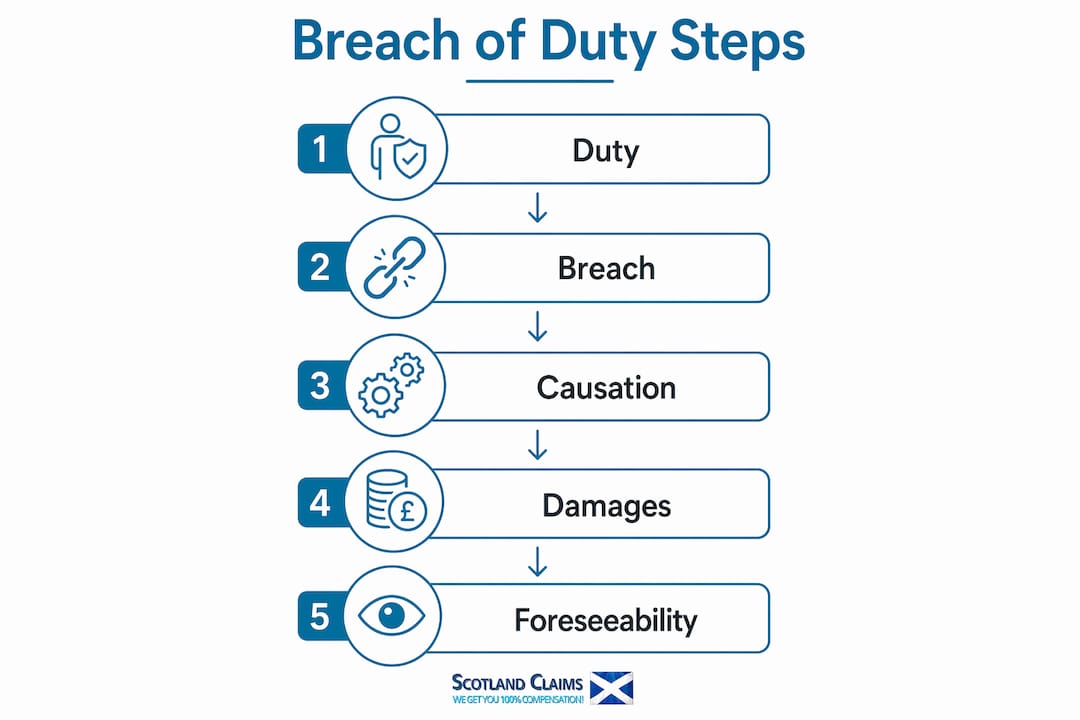
Foreseeability of harm plays a central role. If the resulting harm was not reasonably predictable, the breach claim is unlikely to succeed. Courts require that a prudent person could have anticipated the type of injury that occurred. An unforeseeable freak accident will not meet this threshold, no matter how severe the outcome.
Causation is equally non-negotiable. Establishing breach requires proof that the duty existed, the conduct fell below the legal standard, and that failure caused actual harm. Without the direct causal link between the breach and the injury, the claim is not actionable. A defendant can behave carelessly and still escape liability if their carelessness was not what caused the claimant’s injury.
Pro Tip: Keep a detailed record of how and where your accident happened. Photographs, witness details, and medical reports all help establish the causal link between the breach and your injury, which is the part of a claim that most often needs the strongest evidence.
The negligence fundamentals in Scotland follow these same principles, and understanding how breach fits within the wider negligence framework strengthens any personal injury claim.
What are common examples of breach of duty in Scotland?
Breach of duty examples in Scottish personal injury claims tend to fall into three main categories. Each illustrates how the reasonable person standard applies in real situations.
-
Slip and trip accidents on unsafe premises. A shop owner who fails to clean up a spillage, or a landlord who ignores a broken step, may breach their duty to visitors. The question courts ask is whether a reasonable property owner would have identified and fixed the hazard. If yes, and the owner did not act, a breach exists. Scotland’s occupiers’ liability rules place a specific duty on those who control premises to keep them reasonably safe.
-
Road traffic accidents. A driver who runs a red light, exceeds the speed limit, or uses a mobile phone while driving breaches the duty of care owed to other road users. The Highway Code sets the standard against which driver behaviour is measured. Departing from that standard without good reason is a breach.
-
Accidents at work. An employer who fails to provide adequate safety equipment, ignores a known hazard on the factory floor, or does not train staff properly may breach their duty to employees. Workplace breach claims are among the most common in Scotland, and the standard expected of employers is well established in both statute and case law.
Pro Tip: Do not assume your accident was “just one of those things.” Many incidents that feel like bad luck are actually the result of someone else’s failure to take reasonable precautions. A specialist solicitor can assess whether a breach occurred even when it is not immediately obvious.
The distinction between acts and omissions matters here. A driver who swerves into another lane commits an act. A landlord who fails to repair a broken handrail commits an omission. Both can constitute a breach of duty, and both are equally actionable in Scottish personal injury law. For real examples of how these cases play out, negligence case examples from Scotland provide useful context.
How does the standard differ for professionals versus ordinary people?
The standard of care is not the same for everyone. Professionals are held to a higher benchmark than ordinary individuals. This distinction matters enormously in personal injury claims.
Professionals are assessed against the Bolam test, which requires them to meet the standard expected of a reasonably competent professional in their field. A plumber, an engineer, or a safety inspector is not judged against what an average member of the public would do. They are judged against what a competent peer in their profession would do.
The table below shows how the two standards compare:
| Standard |
Who it applies to |
The test used |
| Reasonable person |
Ordinary individuals |
What a prudent, average person would do |
| Reasonably competent professional |
Qualified professionals |
What a competent peer in the same field would do |
The Bolam test originates from Bolam v Friern Hospital Management Committee and applies across UK and Scottish law. It means a professional can defend a breach claim by showing their conduct was in line with a responsible body of professional opinion, even if other professionals would have acted differently.
This higher standard cuts both ways. Professionals are more likely to be found in breach when they make errors that a competent colleague would not make. A scaffolding contractor who ignores British Standards for erecting scaffolding, or a structural engineer who misses an obvious load-bearing fault, faces a breach claim measured against professional norms, not everyday common sense.
What role does the severity of potential harm play?
Courts do not apply the reasonable person standard in a vacuum. They weigh up a range of factors when deciding whether a defendant took sufficient precautions.
Courts apply a balancing test that considers the seriousness of potential harm, the likelihood of that harm occurring, and the practicality of taking precautions. Greater risk demands greater care. A construction site near a school requires more rigorous safety measures than a low-traffic warehouse, because the potential harm to children is both more serious and more foreseeable.
The key factors courts consider include:
- Severity of potential harm. The more serious the likely injury, the higher the standard of care required.
- Probability of harm. A risk that is highly likely to materialise demands more precaution than a remote possibility.
- Practicality of precautions. Courts ask whether the steps needed to prevent the harm were reasonable and affordable. A simple warning sign or a non-slip mat can be enough to discharge a duty in many slip and trip cases.
- Contextual factors. Weather conditions, emergency situations, and the characteristics of those at risk all influence the assessment. Icy pavements in a Scottish winter raise the standard expected of a local authority maintaining public paths.
Contextual factors like weather or emergency scenarios directly influence how courts assess breach. A defendant who acts in a genuine emergency may be judged less harshly than one who had ample time to identify and address a risk. This nuance is why breach of duty claims benefit from careful legal analysis rather than a simple yes or no answer.
Understanding how these factors interact is critical for claimants. A case that looks straightforward on the surface may involve competing arguments about probability, severity, and precaution. Getting the evidence right from the start makes a significant difference to the outcome.
Key takeaways
Breach of duty is the failure to meet the required standard of care, and proving it is the central challenge in any Scottish personal injury negligence claim.
| Point |
Details |
| Core legal definition |
Breach of duty means failing to meet the standard of care a reasonable person would exercise in the same situation. |
| Objective test applies |
Courts judge conduct against the reasonable person standard, not the defendant’s personal beliefs or intentions. |
| Acts and omissions both count |
A breach can be something done carelessly or something a reasonable person would have done but was not done. |
| Professionals face a higher bar |
The Bolam test holds professionals to the standard of a reasonably competent peer, not just an average person. |
| Causation is non-negotiable |
The breach must be the direct cause of the injury, or the claim will not succeed regardless of how careless the conduct was. |
Why understanding breach of duty changes everything for Scottish claimants
Most people who contact a personal injury solicitor after an accident focus on the injury itself. They describe the pain, the time off work, the financial impact. What they often do not realise is that the legal question is not “how badly were you hurt?” but “did someone fail to meet the standard of care they owed you?”
That shift in framing matters. I have seen claimants with serious injuries lose confidence in their case because they assumed the other side would argue they were partly at fault. Understanding contributory negligence in Scotland alongside breach of duty gives claimants a far clearer picture of where they actually stand.
The most common misunderstanding I encounter is the belief that breach requires proof of deliberate wrongdoing. It does not. A driver who simply was not paying attention, a shop that did not put out a wet floor sign, an employer who forgot to update a risk assessment: none of these people intended harm. All of them may have breached their duty of care. The law does not require malice. It requires reasonable care.
My honest advice is this: do not try to assess breach of duty yourself. The objective standard sounds simple, but applying it to the specific facts of your case requires legal training and experience. What feels obvious to you may face a credible counter-argument. What feels uncertain to you may actually be a clear-cut breach. Get specialist advice before you decide whether to pursue a claim.
— Roger
How Scotland Claims Injury Lawyers can help with your claim
Scotland Claims Injury Lawyers specialises in personal injury claims across Scotland, including cases where breach of duty is the central issue. Whether your injury happened on someone else’s premises, on the road, or at work, the team works on a no win no fee basis, meaning you pay nothing upfront and keep 100% of your compensation if your claim succeeds. Other large firms take up to 20% of your award as a success fee. Scotland Claims Injury Lawyers takes nothing. Use the compensation calculator to get an estimate of what your claim could be worth, or speak directly to a specialist injury lawyer in Scotland about your situation today.
FAQ
What is the legal definition of breach of duty?
Breach of duty is the failure to meet the standard of care legally required to avoid causing harm to others. It is the second element of a negligence claim, following the establishment of a duty of care.
Does breach of duty require proof of intent?
No. Breach of duty is assessed objectively against the reasonable person standard, not the defendant’s intentions. Careless or inattentive behaviour is enough to establish a breach if it falls below the required standard.
What is the difference between breach of duty and negligence?
Negligence is the overall legal wrong, made up of four elements: duty of care, breach of duty, causation, and damages. Breach of duty is one specific element within a negligence claim, not the whole claim itself.
How does the Bolam test affect breach of duty claims in Scotland?
The Bolam test applies to professionals and holds them to the standard of a reasonably competent peer in their field. A professional who meets an accepted standard of practice in their profession is unlikely to be found in breach, even if others would have acted differently.
Can a breach of duty claim fail even if someone was careless?
Yes. If the careless conduct was not the direct cause of the injury, the claim will fail. Courts require proximate causation, meaning the breach must be what actually caused the harm, not merely a background factor.
Recommended