RTA claims in Scotland: Your complete no win no fee guide

TL;DR:
- Scottish road traffic accident claims follow a distinct legal process, with no whiplash portal and different courts.
- Prompt evidence gathering and expert legal advice are crucial for maximizing compensation under Scots law.
- Most claims settle out of court, with no win no fee arrangements reducing financial risk for claimants.
Many people assume that making a road traffic accident claim works the same way across the whole of the UK. It does not. Scots law is distinct from the rules in England and Wales, and if you approach your claim without understanding those differences, you could leave significant compensation on the table. This guide walks you through everything you need to know about making a no win no fee RTA claim in Scotland, from the moment of impact to the final settlement. Whether you are dealing with a minor whiplash injury or something far more serious, knowing how the Scottish legal system works puts you in a much stronger position.
Table of Contents
Key Takeaways
| Point |
Details |
| Scotland’s unique RTA rules |
RTA claims in Scotland differ from England and Wales, affecting process and payouts. |
| No win no fee protection |
You can claim compensation without financial risk using genuine no win no fee solicitors. |
| Evidence is crucial |
Gathering thorough evidence and acting within three years maximise your claim’s value. |
| Most claims settle |
More than ninety percent of Scottish RTA claims are resolved out of court through negotiation. |
| Choose the right solicitor |
An independent Scottish solicitor increases your chance of receiving the compensation you deserve. |
What makes RTA claims in Scotland unique?
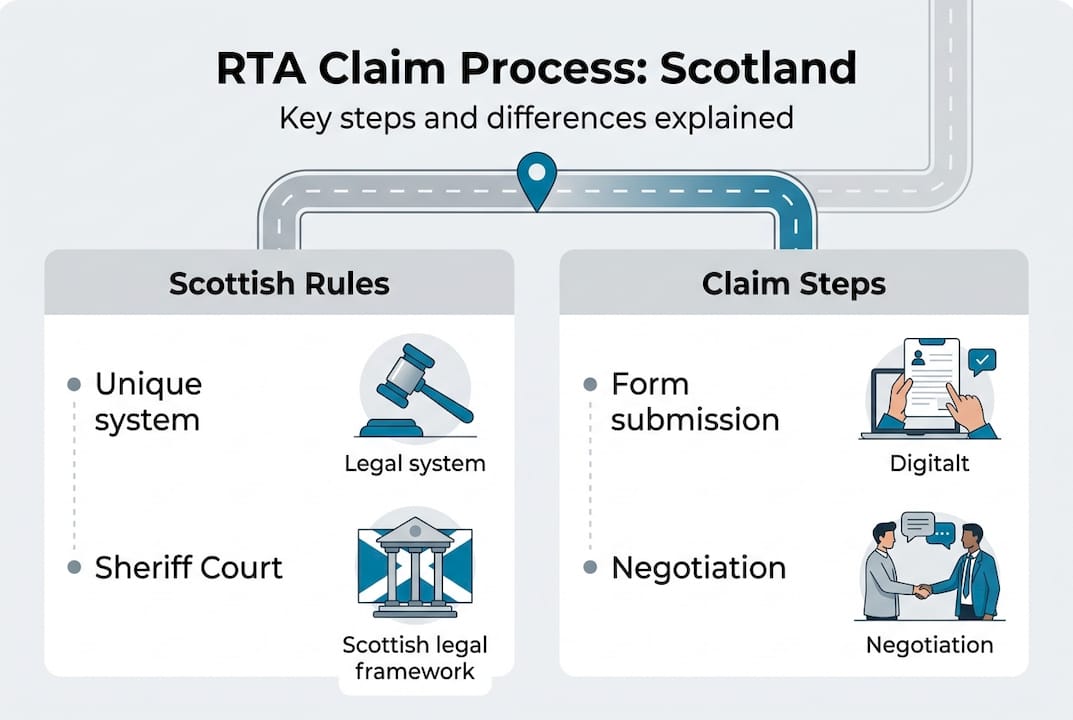
Scotland operates under its own distinct legal system, and that matters enormously when you are pursuing a road traffic accident claim. One of the most significant differences is that Scotland has no whiplash portal, unlike England and Wales where lower-value whiplash claims are processed through a government-run online portal. In Scotland, all claims go through the traditional legal route, which means more involvement from solicitors and, for complex cases, higher associated legal costs.
Scottish courts also apply different procedural rules. The Sheriff Court handles most personal injury claims, while the Court of Session deals with higher-value or more complex cases. Evidence standards and how damages are assessed can differ too, which is why working with a solicitor who understands personal injury rights in Scotland is so important. A solicitor based in England simply may not be familiar with how Scottish courts approach liability or quantum (the legal term for the amount of compensation owed).
Here is a quick comparison of how Scottish RTA claims differ from those in England and Wales:
| Feature |
Scotland |
England and Wales |
| Whiplash portal |
No |
Yes |
| Court system |
Sheriff Court / Court of Session |
County Court / High Court |
| Legal costs for complex claims |
Generally higher |
Lower for portal claims |
| Governing law |
Scots law |
English law |
Some common misconceptions worth addressing:
- Your insurer’s solicitor will act in your best interest. They will not. Insurer-appointed solicitors have a conflict of interest.
- All UK solicitors can handle Scottish claims. Only solicitors admitted in Scotland can represent you in Scottish courts.
- Small claims are not worth pursuing. Even modest injuries can attract meaningful compensation under Scots law.
“Scottish claimants deserve legal representation that understands the local system, not a one-size-fits-all UK approach.”
The FCA review of insurance claims highlighted ongoing concerns about how insurers handle motor claims, reinforcing why independent legal advice matters so much.
The complete process for making an RTA claim in Scotland
Knowing what to do immediately after a road traffic accident can make or break your claim. The steps you take in the hours and days following the incident directly affect the strength of your case.
Here is the typical sequence for a Scottish RTA claim:
- Seek medical attention immediately. Even if you feel fine, see a doctor. Medical records are foundational evidence.
- Report the accident to the police if there are injuries, and obtain the incident reference number.
- Gather evidence at the scene. Photographs, dashcam footage, and the other driver’s details are all valuable.
- Collect witness information. Names and contact details from independent witnesses can be decisive.
- Contact a Scottish solicitor. The sooner you do this, the better your solicitor can preserve evidence and advise you.
- Your solicitor investigates the claim. They will obtain medical reports, police records, and any available CCTV footage.
- Negotiation begins. Your solicitor puts the claim to the at-fault party’s insurer and negotiates a settlement.
- Settlement or court proceedings. If a fair offer is not made, your solicitor can raise court proceedings on your behalf.
Understanding the accident claim forms process early on saves time and avoids costly errors. Most people are surprised to learn that over 90% of claims in Scotland settle out of court through negotiation, meaning the vast majority of claimants never set foot in a courtroom.
Pro Tip: Keep a daily diary of your symptoms and how your injury affects your work and daily life. This personal account can significantly strengthen your claim for general damages.
If you are unsure where to begin, reading about how to start an injury compensation claim in Scotland gives you a clear starting point. You should also think carefully about how to prepare evidence for your claim from day one, as strong evidence is the single biggest factor in achieving a fair settlement.
“Acting quickly after an accident is not just good advice. Under Scots law, delay can genuinely cost you your right to claim.”
No win no fee explained: Costs, risks and finding the right solicitor
No win no fee, known formally as a Conditional Fee Agreement or in Scotland sometimes as a speculative fee arrangement, means your solicitor only gets paid if your claim succeeds. If you lose, you pay nothing. This removes the financial risk that stops many people from pursuing legitimate claims.
Here is what you need to know about costs and how the arrangement works in practice:
| Scenario |
What you pay |
| Claim succeeds |
A success fee (capped percentage of your compensation) |
| Claim fails |
Nothing to your solicitor |
| Upfront costs |
None |
| After the event insurance |
May be recommended to cover opponent’s costs |
Key things to watch for when choosing a solicitor:
- Success fee cap. Ask what percentage they take from your compensation and ensure it is clearly stated in writing.
- After the event (ATE) insurance. This covers the other side’s legal costs if you lose. A good solicitor will explain whether you need it.
- Independence. It is safer to choose an independent solicitor over one appointed by your insurer, as their loyalty lies entirely with you.
- Scottish qualification. Confirm they are admitted to practise in Scotland.
Pro Tip: Ask any prospective solicitor directly: “Are you independent of my insurer?” If they hesitate or cannot give a clear answer, look elsewhere.
Understanding how personal injury compensation is calculated helps you set realistic expectations before you begin. Compensation typically covers two categories: general damages (pain, suffering, and loss of amenity) and special damages (financial losses such as lost earnings and medical expenses). You can also access free legal advice before committing to anything, which is always worth doing. Reviewing compensation examples in Scotland gives you a realistic sense of what similar claims have achieved.
Maximising your compensation and acting quickly
The value of your claim depends heavily on the quality of your evidence and how promptly you act. Many claimants underestimate what they are entitled to claim for, focusing only on immediate medical costs and ignoring longer-term losses.
Types of damages you may be able to recover include:
- General damages for pain, suffering, and reduced quality of life
- Lost earnings if your injury prevented you from working
- Future loss of earnings if your capacity to work is permanently affected
- Medical expenses including physiotherapy, specialist consultations, and prescription costs
- Travel costs to and from medical appointments
- Care costs if you needed help at home during recovery
- Vehicle repair or replacement costs
For complex or serious claims, the compensation available can be substantially higher, particularly where long-term care needs or permanent disability are involved. This is precisely why thorough evidence gathering matters so much.
Steps to strengthen your claim:
- Photograph all visible injuries as soon as possible after the accident
- Keep every receipt related to your injury and recovery
- Attend all medical appointments and follow your doctor’s advice
- Avoid posting about the accident or your injuries on social media
- Instruct a solicitor promptly so evidence is preserved before it disappears
The three-year limitation period under Scots law means you generally have three years from the date of your accident to raise court proceedings. Miss that deadline and your claim is almost certainly lost forever. The role of evidence in your claim cannot be overstated. Physical evidence degrades, witnesses forget details, and CCTV footage is routinely deleted within days. Every week you delay is a week in which your case becomes harder to prove.
Why thinking like an insurance company can undermine your Scottish RTA claim
Here is something most articles will not tell you. The biggest mistake Scottish claimants make is not missing a deadline or failing to gather evidence. It is approaching their claim with an insurer’s mindset rather than a claimant’s mindset.
Insurers are trained to settle claims quickly and cheaply. When they appoint a solicitor on your behalf, that solicitor’s commercial relationship is with the insurer, not with you. Scottish RTA claims, as the FCA’s motor insurance review makes clear, present higher complexity and costs than equivalent English claims. That complexity works in your favour when you have the right representation, and against you when you do not.
Accepting the first offer an insurer makes is almost always a mistake. That offer is calculated to close the file, not to reflect the full value of your losses. An independent Scottish solicitor, motivated entirely by your outcome under a no win no fee arrangement, will push back and negotiate properly. The difference between the first offer and a fully negotiated settlement can run to thousands of pounds. Trust the process, choose independence, and do not let an insurer’s urgency become your urgency.
Ready to start your Scottish RTA claim?
If you have been injured in a road traffic accident in Scotland, the most important step you can take right now is speaking to a specialist. At Scotland Claims, our no win no fee claims service means you face no financial risk whatsoever. You pay nothing if your claim does not succeed, and you keep 100% of your compensation if it does. Our network of experienced injury lawyers in Scotland understands Scots law inside out and will fight to secure everything you are entitled to. Not sure what your claim might be worth? Use our free compensation calculator to get an instant estimate and take the first step with confidence.
Frequently asked questions
How long do I have to start an RTA claim in Scotland?
You usually have three years from the date of your accident to begin a claim under Scottish law. Acting sooner rather than later protects your evidence and your legal rights.
Will my Scottish RTA claim go to court?
Over 90% of Scottish RTA claims settle out of court through negotiation, so the likelihood of attending a hearing is low. Your solicitor will always aim to reach a fair settlement without the need for court proceedings.
Does no win no fee mean I pay nothing if I lose?
Yes, a genuine no win no fee agreement means you do not pay your solicitor’s fees if your claim is unsuccessful. Always confirm the specific terms in writing before proceeding.
Are Scottish RTA compensation payouts different from England and Wales?
Yes, because Scots law has no whiplash portal, claims are assessed differently and legal costs for complex cases can be higher. This can result in different compensation levels compared with equivalent claims south of the border.
Recommended