Trip over uneven pavement: your Scotland claims guide

TL;DR:
- Liability for pavement trips in Scotland generally rests on local councils that fail to operate a reasonable maintenance system. Evidence such as photographs, medical records, and witness statements strengthens claims, and claims must be filed within three years. Prompt legal advice improves chances of a successful claim and ensures evidence is preserved.
A trip over uneven pavement is one of the most common causes of personal injury claims against local councils in Scotland. When a pavement is poorly maintained and causes you to fall, the responsible authority may owe you compensation under Scottish law. Scotland Claims Injury Lawyers specialises in exactly these cases, and this guide explains who is liable, what evidence you need, and how to pursue your claim without paying a penny upfront.
Who is liable when you trip over uneven pavement in Scotland?
Liability for a pavement trip usually falls on the local council responsible for maintaining that stretch of road or footpath. Courts in Scotland do not expect councils to prevent every possible hazard. Instead, they judge councils on whether they operated a reasonable maintenance system and followed it consistently. A council that inspects pavements regularly but fails to act on a known defect is far more likely to be found liable than one that simply missed an obscure crack.
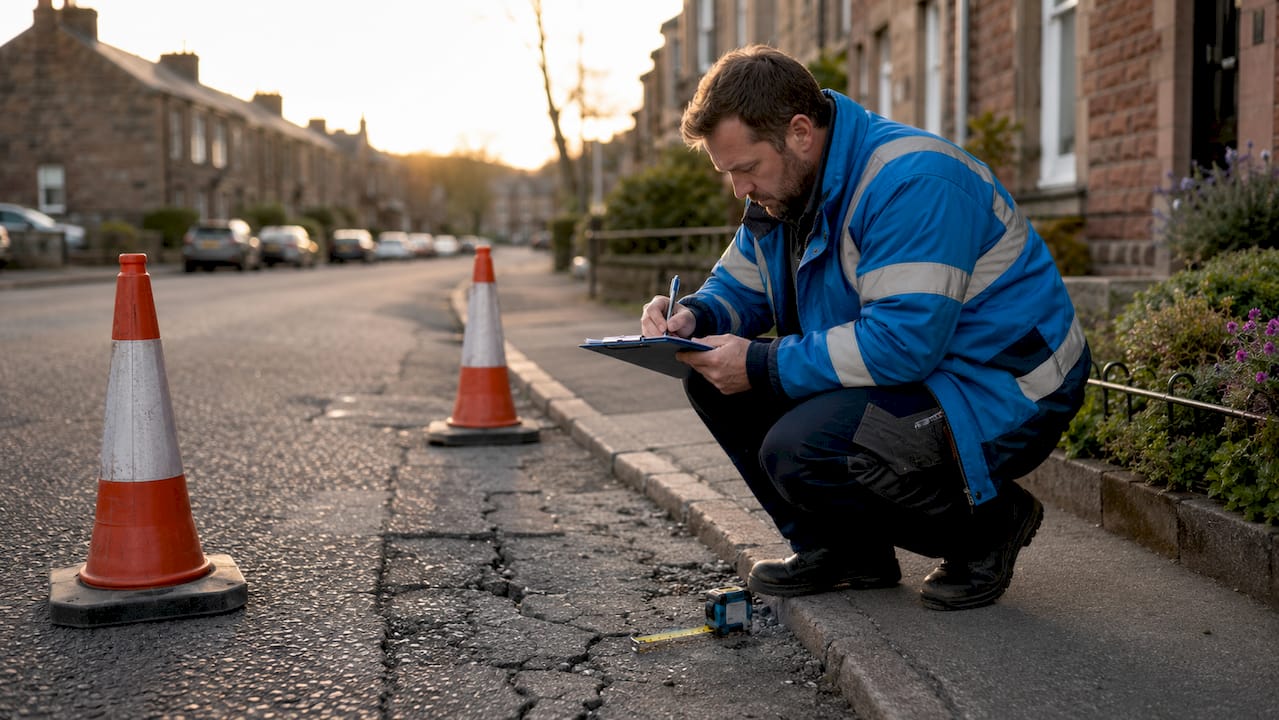
This standard comes from established Scottish case law, including principles discussed in Colledge and Shields, which confirm that liability requires neglected care rather than mere existence of an uneven surface. The absence or failure of a reasonable maintenance system can lead to liability even if the hazard was not repaired immediately. That is a meaningful distinction for your claim.
Liability does not always rest with the council. Occupiers of private premises owe a duty of care to visitors and must keep their property free from hazards they ought to know about. If you tripped on a privately owned car park, shopping centre forecourt, or business entrance, the property owner or occupier may be the responsible party.
Key factors courts consider when assessing liability:
- Whether the council or occupier had a documented inspection schedule
- Whether the defect had been reported or was known before your accident
- How long the hazard had existed before your fall
- Whether weather conditions, such as ice or wet leaves, contributed to the danger
- Whether warning signs or barriers were in place at the time
Pro Tip: If you know of any previous complaints about the same pavement defect, note them down immediately. Prior reports to the council are powerful evidence that the hazard was known and ignored.
Your own behaviour also matters. Courts reduce compensation if you ignored clear warning signs or were not paying reasonable attention to where you were walking. This is called contributory negligence, and it can lower the amount you receive even when the council is clearly at fault.
What evidence do you need for a pavement trip claim?
Strong evidence is the foundation of every successful pavement trip claim. The sooner you gather it after your accident, the stronger your position will be. Here is what you need to collect.
-
Photographs of the defect. Take clear pictures of the uneven surface from multiple angles. Place a 10p coin next to the defect to show its scale. Courts and insurers need objective proof of how significant the hazard was, and a coin provides an instantly recognisable size reference.
-
Medical records and reports. Medical evidence documenting injury severity and its link to the pavement hazard is critical. Attend A&E or your GP as soon as possible after the accident. A gap between the fall and medical treatment gives the other side room to argue your injuries were caused by something else.
-
Witness details. If anyone saw you fall, take their name and contact number at the scene. An independent witness statement carries significant weight, particularly when the council disputes that the defect caused your fall.
-
Accident details in writing. Record the exact location, date, time, and weather conditions as soon as possible. Memory fades quickly, and precise details prevent the responsible party from challenging the basics of your account.
-
Records of prior complaints. If you or anyone else reported the defect to the council before your accident, obtain copies of that correspondence. Council complaint logs are disclosable in legal proceedings and can prove the authority knew about the hazard.
Pro Tip: Return to the scene within a day or two if you can. Councils sometimes repair defects quickly after an accident, and a second set of photographs showing the repair confirms the hazard existed and has since been fixed.
For a broader look at the types of injuries that arise from pavement trips, the common slip and trip examples guide from Scotland Claims Injury Lawyers covers real cases and outcomes across Scotland.
How to file a compensation claim for a pavement trip in Scotland
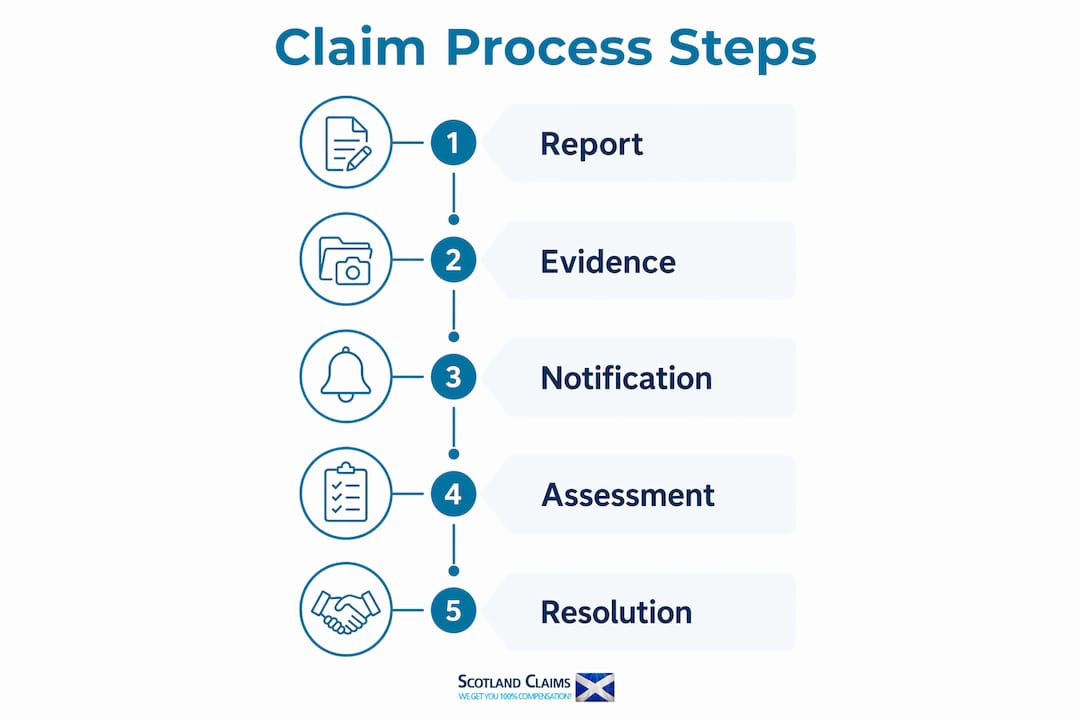
The process of claiming compensation follows a clear sequence. Acting promptly at each stage protects your legal rights and improves your chances of a fair settlement.
-
Seek medical attention immediately. Your health comes first, and your medical records become the backbone of your claim. Do not delay treatment.
-
Report the accident to the responsible authority. Notify the local council or private occupier in writing as soon as possible. Include the location, date, time, and a brief description of what happened. Keep a copy of everything you send.
-
Consult a specialist injury lawyer. A lawyer experienced in Scottish pavement trip claims will assess the strength of your case at no cost to you. Scotland Claims Injury Lawyers offers a free initial consultation and operates on a No Win No Fee basis, meaning you pay nothing if your claim is unsuccessful.
-
Lodge your formal claim within the time limit. In Scotland, personal injury claims must be raised within three years of the date of your injury or the date you became aware of it. Miss this deadline and you lose your right to claim entirely.
-
Be aware that informal steps do not stop the clock. Negotiations or complaints with the council do not pause the three-year prescription period. Only a formally lodged legal claim does that.
| Stage |
Typical timeframe |
| Initial notification to council |
Within days of accident |
| Legal consultation and case assessment |
Within first few weeks |
| Formal claim lodged |
Before three-year deadline |
| Settlement or court resolution |
12–18 months on average |
| Complex cases involving expert witnesses |
Potentially several years |
Claims can take 12 to 18 months to resolve, and some extend further depending on court availability and whether expert witnesses are required. Knowing this from the outset helps you plan accordingly.
Common challenges in pavement trip claims and how to handle them
Pavement trip claims are not always straightforward. Councils and their insurers are experienced at defending these cases, and you should expect some resistance.
The most frequent challenges claimants face include:
- Disputed liability. The council may argue its inspection system was adequate and the defect was not foreseeable. Your lawyer’s job is to obtain the council’s inspection records and demonstrate gaps or failures in that system.
- Contributory negligence allegations. The other side may claim you were distracted, wearing inappropriate footwear, or not watching where you were going. This is a standard defence tactic. Even if some contributory negligence is accepted, you can still recover a significant portion of your compensation.
- Difficulty identifying the responsible party. Some pavements sit on boundaries between council land and private property. A specialist lawyer can identify the correct defendant by checking land registry records and council maintenance maps.
- Insufficient evidence. Claims without photographs, medical records, or witness statements are far harder to win. This is why gathering evidence immediately after your fall is so important.
“Local authorities are not expected to prevent every eventuality, but they must operate a reasonable maintenance system and act upon known hazards. When they fail to do either, the law holds them accountable.”
For practical guidance on avoiding hazards and understanding your rights on Scottish streets, the slip and trip prevention tips guide offers useful context alongside your legal options.
Key takeaways
Pavement trip claims in Scotland succeed when liability is clear, evidence is strong, and the formal claim is lodged within three years of the accident.
| Point |
Details |
| Liability rests on reasonable care |
Councils are liable when their maintenance system fails, not simply because a defect exists. |
| Evidence quality determines outcomes |
Photographs with a 10p coin, medical records, and witness statements are the strongest tools you have. |
| Three-year time limit is absolute |
Miss the prescription period and you lose your right to claim, regardless of how strong your case is. |
| Contributory negligence reduces awards |
Courts lower compensation if you ignored obvious hazards or warning signs at the scene. |
| No Win No Fee removes financial risk |
Scotland Claims Injury Lawyers takes no success fee, so you keep 100% of any compensation awarded. |
Why I think most people wait too long before getting legal advice
Roger here. After years of watching pavement trip cases unfold, the pattern I see most often is this: people wait. They assume the council will do the right thing, or they feel embarrassed about making a claim, or they simply do not realise they have a strong case. By the time they speak to a lawyer, crucial evidence has disappeared and the three-year clock is ticking loudly.
The law in Scotland is genuinely balanced on this issue. Councils are not automatically liable for every crack in a pavement. But when a known defect goes unrepaired, or when an inspection system is shown to be inadequate, the law is firmly on the injured person’s side. The challenge is proving it, and that requires evidence gathered in the days and weeks after your fall, not months later.
One thing that surprises people is how much contributory negligence allegations affect their thinking. Many claimants hear “you should have been watching where you were going” and assume their case is worthless. It is not. Even a finding of partial contributory negligence rarely destroys a claim. Courts are experienced at apportioning responsibility fairly.
My honest advice: speak to a specialist as soon as possible after your accident. Not because the law is complicated, though it can be, but because the evidence window closes fast. A free consultation costs you nothing and tells you exactly where you stand. That knowledge alone is worth the call.
— Roger
How Scotland Claims Injury Lawyers can help with your claim
Scotland Claims Injury Lawyers specialises in slip and trip claims across Scotland, with a No Win No Fee arrangement that means you pay nothing if your case is unsuccessful. Crucially, Scotland Claims Injury Lawyers charges no success fee at all. You keep 100% of your compensation. Other solicitors typically deduct up to 20% of your settlement as a success fee. That difference is significant when you are recovering from an injury. Use the compensation calculator to get an estimate of what your claim could be worth, then speak to the team for a free case evaluation. Whether you suffered a back injury or a knee injury from your fall, specialist legal support is available now.
FAQ
Who is responsible for uneven pavements in Scotland?
Local councils are responsible for maintaining public pavements in Scotland. If a council fails to operate a reasonable inspection and repair system, it can be held liable for injuries caused by defective surfaces.
How long do I have to claim for a pavement trip in Scotland?
You have three years from the date of your injury to lodge a formal personal injury claim in Scotland. Informal complaints or negotiations with the council do not pause this deadline.
Will I receive 100% of my compensation?
With Scotland Claims Injury Lawyers, yes. No success fee is deducted, so you keep every penny of your settlement. Many other solicitors deduct up to 20% as a success fee.
What if the council says the pavement defect was not their fault?
Disputed liability is common. Your lawyer will request the council’s inspection records and maintenance logs to identify failures in their system. Prior complaints about the same defect are particularly useful evidence.
How long does a pavement trip claim take to settle?
Most pavement trip claims in Scotland resolve within 12 to 18 months. Complex cases involving expert witnesses or court proceedings can take longer.
Recommended