Scotland claims injury lawyers over Digby Brown: here’s why

That’s the model Scotland Claims Injury Lawyers offers, and it stands in contrast to firms who take a success fee out of your settlement. Before you sign anything, there are two statutory facts worth knowing: success fees are legally capped, and you generally have a limited time from your accident to raise a claim.
Here’s what to do right now:
- Use the compensation calculator to get a rough sense of what your claim could be worth.
- Request a free claim assessment, no obligation, no upfront cost.
- Check the date of your accident against the three-year limitation period before you delay any further.
Key Takeaways
Choosing a no-success-fee solicitor means the statutory fee caps become irrelevant to you, because there’s nothing deducted from your award at all.
| Point |
Details |
| Statutory fee caps exist |
Success fees are capped at 20% of the first £100,000 (including VAT), 10% on the next £400,000, 2.5% above that. |
| Three-year time limit |
You generally have three years from the accident date to raise a claim. |
| QOCS protects most claimants |
You’re generally shielded from paying the other side’s costs if you lose, barring narrow exceptions like fraud. |
| Check the written agreement |
Ask for the fee agreement in writing before signing, and confirm exactly what’s deducted and what isn’t. |
| Scotland Claims charges no success fee |
You retain 100% of your compensation on qualifying whiplash, road traffic, workplace, and slip or trip claims, with a free assessment to start. |
Table of Contents
Why Scotland claims injury lawyers over Digby Brown matters for your payout
The single biggest factor in what you actually keep from a personal injury claim isn’t the size of your award. It’s the percentage taken off the top before it reaches your bank account. Scotland Claims Injury Lawyers charges no success fee at all, so a whiplash payout, a workplace injury settlement, or a slip and trip award arrives at 100% of what’s agreed or awarded. That’s the lowest possible deduction in Scotland, because there’s nothing to deduct.
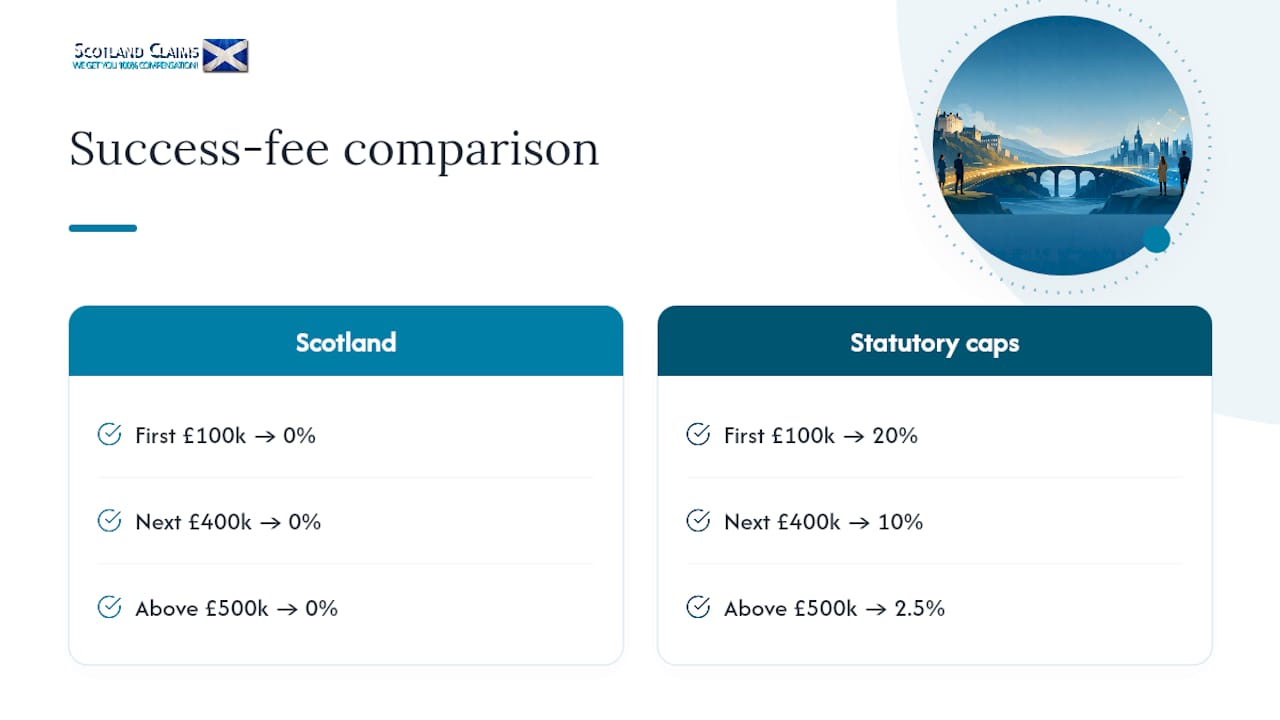
Compare that with the statutory ceiling that applies elsewhere in the market. Under the 2020 Regulations, success fees in personal injury cases are capped at 20% of the first £100,000 of compensation (including VAT), dropping to 10% on the next £400,000 and 2.5% above that. These caps exist because Holyrood recognised that uncapped fee agreements were eating too far into injured people’s damages. A cap is a ceiling, not a target. Firms can and do charge less, but many big-name solicitors charge at or near the maximum permitted.
What should you expect from a Scottish personal injury solicitor?
A solicitor working under a Damages-Based Agreement, sometimes called a speculative fee agreement, is only paid if your claim succeeds. That’s the “no win no fee” promise, and it’s now underpinned by law rather than just marketing. A few things follow from that:
- Fee caps are legal, not just customary. The 20%/10%/2.5% tiered structure under the 2020 Regulations sets the absolute maximum a solicitor can lawfully deduct, including VAT.
- Qualified One-way Cost Shifting (QOCS) protects you from most defender costs. If you lose, you generally won’t have to pay the other side’s legal expenses, subject to narrow exceptions such as fraud, manifestly unreasonable conduct, or abuse of process, which your solicitor should explain before you proceed.
- A compulsory pre-action protocol applies to claims worth £25,000 or less, which sets timescales for how quickly an insurer must respond and pushes early negotiation, according to the Scottish Civil Justice Council.
Statistic to remember: the fee cap tiers mean a £50,000 whiplash settlement handled under a maximum-fee agreement could see a significant deduction before VAT considerations are even factored in. Under Scotland Claims Injury Lawyers’s model, that same £50,000 stays with you in full.
Claims above £25,000 typically run on a longer procedural timetable and often need specialist medical evidence, which is one reason more serious injuries take longer to resolve than straightforward road traffic claims.

How does Scotland Claims’ no-success-fee service work in practice?
The offer is straightforward: no success fee, ever, on qualifying personal injury claims. That covers whiplash and other injuries from road traffic accidents where you were the non-fault driver or passenger, plus workplace accidents and slips, trips, or falls. There’s no upfront cost and nothing deducted from your settlement at the end.
The process runs in four stages:
- Free assessment. You describe what happened, either online or by phone, and a specialist reviews whether you have a viable claim.
- Allocation to a specialist solicitor. Your case is matched to a solicitor experienced in your specific injury type, whether that’s a road traffic claim or a workplace accident.
- Evidence gathering and negotiation. Medical records, witness statements, and correspondence with the at-fault party’s insurer are compiled and used to negotiate a settlement.
- Settlement or court. Most claims settle through negotiation. If court becomes necessary, QOCS protections continue to apply.
Before that first assessment, it helps to run the compensation calculator to set realistic expectations about award ranges for your injury type. It won’t give you a guaranteed figure, but it gives you a sensible starting point for the conversation.
Pro Tip: Gather your accident date, any photos of the scene or injury, and contact details for witnesses before your assessment call. It shaves days off the early evidence-gathering stage.
What should you check before instructing an injury solicitor?
Not every firm explains its fees clearly, and that’s where problems start. Before you sign anything, ask for the written success-fee agreement rather than accepting a verbal summary. Law Society of Scotland guidance provides a style Success Fee Agreement that solicitors should follow, setting out exactly what work is covered, what outlays might arise, and whether the firm retains any recovered expenses on top of its fee. Those details materially change what lands in your account.
A written agreement should tell you, in plain terms, what percentage (if any) comes off your compensation, what happens if you lose, and how QOCS protects you from the other side’s costs. If a solicitor can’t produce this in writing before you sign, that’s a warning sign, not a formality to chase up later.
Look for accreditation too. Membership of the Association of Personal Injury Lawyers (APIL) or specialist personal injury accreditation through the Law Society signals genuine focus on this area of law, a point Citizens Advice Scotland makes when guiding claimants towards specialists rather than generalists.
Red flags worth walking away from:
- No written terms offered before you’re asked to sign.
- Pressure to commit on the first phone call.
- No mention of QOCS or what happens if the claim doesn’t succeed.
- Testimonials with no injury type, no rough award range, and no verifiable detail at all.
How do you start a claim with Scotland Claims?
Getting started takes minutes, and the checklist below covers what happens from first contact through to negotiation.
- Prepare your documents. Note the accident date, gather photos of the scene or injury, collect witness contact details, and pull together any medical notes or GP letters, as Thorntons Law advises for anyone building a personal injury case. If your accident happened at work, our guide to workplace accident claims in Scotland covers what evidence matters most.
- Expect an initial assessment within days, not weeks. Straightforward road traffic and slip claims tend to move fastest.
- Evidence requests follow within a few weeks as your solicitor builds the case and opens contact with the at-fault party’s insurer.
- Negotiation is the norm. Most personal injury claims in Scotland settle without ever reaching a courtroom.
- Court is a last resort. If negotiation stalls, your solicitor will discuss litigation and reconfirm exactly how QOCS limits your exposure to the other side’s costs at that stage.
Good intake at the start genuinely shortens the whole process. It’s a point echoed in guidance on legal intake best practice, which stresses that clear, organised information from a client at the outset speeds up everything that follows.
Why funding transparency actually protects you
Injured people are rarely in a position to negotiate fee terms while they’re still dealing with pain, lost income, or a stalled recovery. That’s exactly why transparent, no-success-fee funding matters more than most people realise at the point they need it. If you’re weighing up who to instruct, get in touch and ask us anything before you commit to anyone.
— Roger
Get your free claim assessment with Scotland Claims Injury Lawyers
Scotland Claims Injury Lawyers takes none. There’s no upfront cost and nothing deducted at the end, which matters most when you’re already dealing with lost income or ongoing treatment.
Start with a free, no-obligation assessment, or run the compensation calculator first to see what your claim might be worth. If you’d rather understand the full funding model before you speak to anyone, our page on no win no fee claims in Scotland sets out exactly how it works, and back injury claims specifically are covered on our dedicated back injury claims page. Either way, get in touch today to find out where you stand.
Sources
FAQ
What is the average payout from Digby Brown?
Average payouts vary widely by injury type and severity, and no single figure applies across all claims. What matters more for your final take-home amount is whether a success fee is deducted from that award, which is where Scotland Claims Injury Lawyers’s no-fee model changes the outcome.
Who is the best personal injury lawyer in Scotland?
The right choice depends on your injury type, but Citizens Advice Scotland recommends checking for specialist accreditation, such as APIL membership, and confirming the fee structure in writing before instructing anyone.
What is Digby Brown’s success rate?
Success rates aren’t independently published in a way that allows direct comparison between firms. A more reliable question to ask any solicitor before instructing them is what percentage of your compensation, if any, they’ll deduct as a success fee.
How quickly do personal injury claims move in Scotland?
Claims worth £25,000 or less follow a compulsory pre-action protocol with set insurer response times, so smaller claims often settle faster than larger ones requiring specialist medical evidence.
Recommended