Why claim for minor injuries in Scotland with no win no fee

Many people assume minor injuries aren’t worth pursuing for compensation, dismissing bumps, sprains, or soft tissue damage as too trivial. This misconception costs individuals in Scotland thousands of pounds annually in unclaimed compensation. Even seemingly small injuries can lead to medical expenses, lost earnings, and lasting discomfort. No Win No Fee agreements allow individuals in Scotland to pursue compensation for minor injuries without upfront legal costs, increasing access to justice. This arrangement removes financial barriers and protects you from paying opponent’s costs if your claim is unsuccessful. Understanding your rights and the streamlined legal process available in Scotland empowers you to claim what you deserve, no matter how minor the injury appears.
Table of Contents
Key takeaways
| Point |
Details |
| No upfront costs |
No Win No Fee agreements eliminate financial barriers to claiming compensation for minor injuries. |
| Three-year time limit |
You must start your claim within three years from the date of injury, with limited exceptions. |
| Cost protection |
Qualified One-way Costs Shifting protects you from paying the opponent’s legal expenses if unsuccessful. |
| Streamlined process |
Claims under £25,000 follow a specific protocol designed to simplify and accelerate resolution. |
| Evidence matters |
Comprehensive documentation including medical records and witness statements strengthens your claim significantly. |
Understanding no win no fee agreements in Scotland
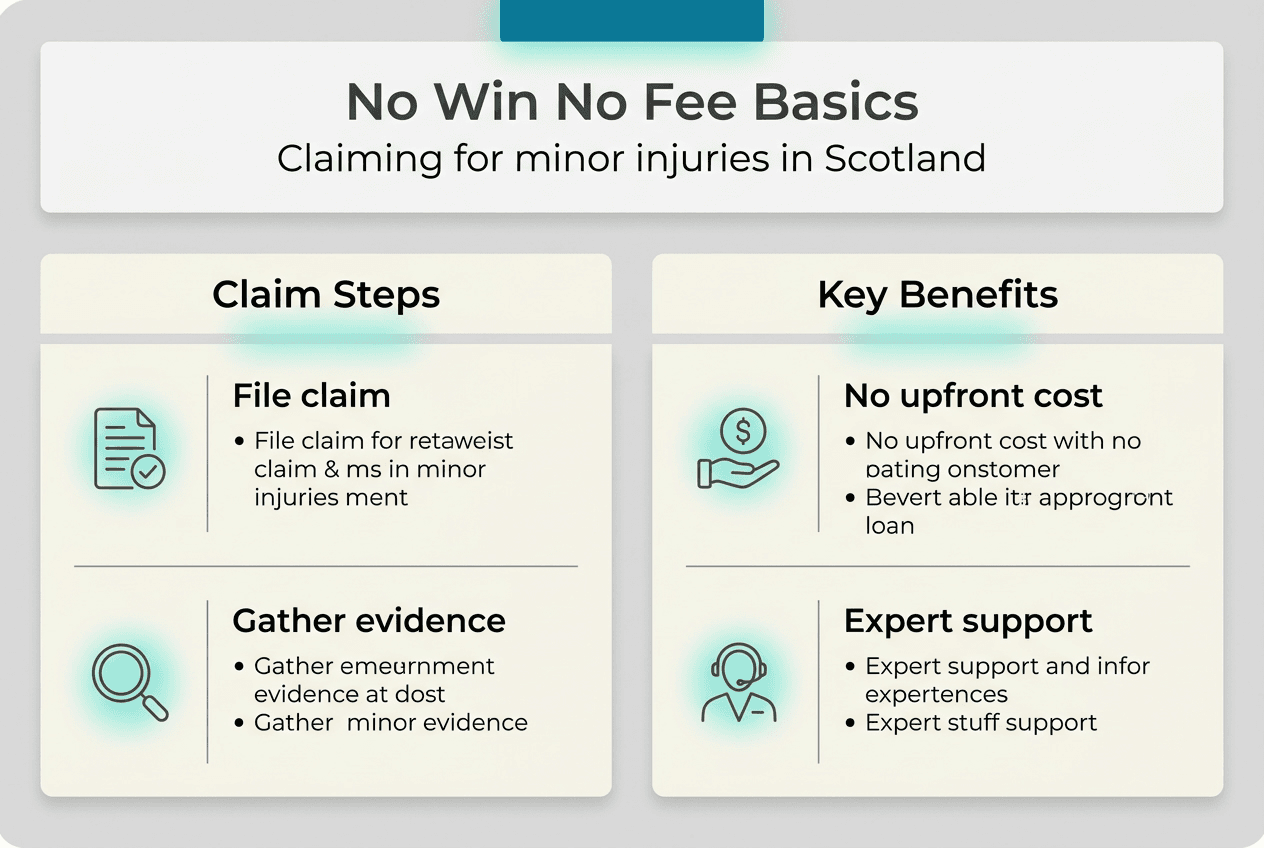
No Win No Fee agreements, formally known as Conditional Fee Agreements, revolutionise access to legal representation for personal injury claims. Under this arrangement, your solicitor receives payment only if your claim succeeds, typically as a percentage of your compensation. You face no upfront legal fees and pay nothing if your claim fails.
This structure removes the primary obstacle preventing many Scots from pursuing legitimate compensation claims. Traditional hourly billing creates financial risk that deters people from seeking justice, especially for injuries they perceive as minor. No Win No Fee agreements allow individuals in Scotland to pursue compensation for minor injuries without upfront legal costs, making legal representation accessible regardless of financial circumstances.
Key terms in these agreements include any success fee and the circumstances under which you might face costs. Most reputable solicitors offer transparent terms with no hidden charges. Scotland Claims charges no success fee at all, meaning you keep 100% of your compensation on every type of claim - whiplash and all others - while most other large or national firms charge up to 20% including VAT.
Common scenarios where No Win No Fee proves especially beneficial include:
- Workplace accidents causing minor but documented injuries
- Road traffic incidents resulting in whiplash or soft tissue damage
- Slips, trips, or falls on poorly maintained premises
- Minor injuries with uncertain liability where investigation is needed
Pro Tip: Always request a written breakdown of all potential costs and the success fee percentage before signing any No Win No Fee agreement, ensuring complete transparency from the outset.
Even for minor injuries, professional legal advice proves invaluable. Solicitors experienced in No Win No Fee injury claims Scotland 2026 understand valuation nuances and negotiation strategies that maximise your compensation. They handle all communication with insurers and opponents, removing stress from an already difficult situation.
The accessibility of No Win No Fee claims in Scotland means you can pursue justice without gambling your savings. This arrangement aligns your solicitor’s interests with yours, as they only profit when you receive compensation.
Legal framework for minor injury claims in Scotland
Scotland operates distinct legal rules governing personal injury claims that differ from English law. Understanding these protections and requirements helps you navigate the claims process confidently.
The Compulsory Pre-Action Protocol applies to personal injury claims in Scotland valued at £25,000 or less. This protocol mandates specific steps before court proceedings begin, encouraging early settlement and reducing litigation costs. Parties must exchange information, medical evidence, and settlement proposals within defined timeframes.
The protocol streamlines claims by requiring transparency from both sides. Defenders must investigate claims promptly and provide reasoned responses. This structure particularly benefits minor injury claimants by accelerating resolution and avoiding protracted legal battles.
There is a three-year time bar for personal injury claims in Scotland, subject to certain exceptions. This limitation period begins from the date of injury or the date you became aware the injury was attributable to someone’s negligence. Missing this deadline typically bars your claim permanently, regardless of merit.
Exceptions to the three-year rule include:
- Claims involving children, where time runs from their 16th birthday
- Cases where the injured party lacks legal capacity
- Situations involving deliberate concealment of facts
- Circumstances where the claimant couldn’t reasonably have known about the injury or its cause
Pro Tip: Never assume you’ve missed the deadline without consulting a solicitor, as exceptions and interruptions to the limitation period may apply to your specific circumstances.
Unsuccessful pursuers in Scotland are generally not liable to pay a defender’s expenses due to QOCS, with certain exceptions. Qualified One-way Costs Shifting represents a significant protection for claimants, ensuring you won’t face crippling legal bills if your claim fails.
QOCS applies automatically to most personal injury claims, including minor injuries. Exceptions exist for fraudulent claims or cases where the claimant acts unreasonably, but these situations are rare. This protection works alongside No Win No Fee agreements to create a virtually risk-free environment for legitimate claimants.
The following table contrasts key legal protections and limits:
| Legal Aspect |
Protection/Limit |
Benefit to Claimant |
| Claim value threshold |
£25,000 or less |
Streamlined protocol reduces delays and costs |
| Time limitation |
Three years from injury |
Clear deadline encourages prompt action |
| Cost protection |
QOCS shields from opponent’s expenses |
Eliminates financial risk of unsuccessful claims |
| Pre-action protocol |
Mandatory information exchange |
Promotes early settlement without litigation |
Understanding how to claim injury compensation Scotland within this framework ensures you meet all procedural requirements whilst maximising your chances of success.
Gathering evidence and proving your minor injury claim
Successful compensation claims rest on solid evidence, regardless of injury severity. Claiming for minor injuries requires gathering evidence such as medical records, witness statements, and documentation of financial losses. Comprehensive documentation transforms a weak claim into a compelling case.
Follow this systematic approach to evidence gathering:
- Seek immediate medical attention and ensure all injuries are documented in medical records, even if treatment seems minimal.
- Photograph injuries at multiple stages of healing, capturing visible damage and any environmental hazards that caused the accident.
- Collect contact details from witnesses who saw the incident occur or can verify your account.
- Retain all receipts for medical expenses, travel costs, prescriptions, and any other injury-related expenditure.
- Document lost earnings with payslips, employer letters, or tax returns showing income reduction due to injury.
- Keep a detailed diary recording pain levels, limitations on daily activities, and emotional impact throughout recovery.
Medical evidence forms the cornerstone of any injury claim. Your GP records, hospital reports, and specialist assessments establish the nature and extent of your injuries. Independent medical examinations arranged by your solicitor provide objective opinions on causation and prognosis.

Witness statements corroborate your version of events and counter any disputed facts. Written statements should be detailed, dated, and signed. Witnesses might include bystanders, colleagues, or anyone who observed the accident or its immediate aftermath.
The success of a claim depends on the ability to prove negligence and causation. You must demonstrate that another party owed you a duty of care, breached that duty, and directly caused your injury through their negligence. This legal test applies equally to minor and severe injuries.
Common pitfalls to avoid include:
- Delaying medical treatment, which opponents may argue indicates minor or non-existent injuries
- Failing to photograph accident scenes before conditions change
- Discarding receipts or financial records that evidence your losses
- Posting on social media in ways that contradict your injury claims
Pro Tip: Begin documenting your injury immediately after the incident, as memories fade and physical evidence disappears quickly, weakening your claim substantially.
Gathering injury claim documents Scotland 2026 requires organisation and attention to detail. Create a dedicated folder for all claim-related paperwork, making it easy to provide information to your solicitor promptly.
Benefits of claiming for minor injuries under a no win no fee arrangement
Pursuing compensation for minor injuries makes practical and financial sense when supported by a No Win No Fee agreement. This structure transforms an otherwise daunting process into an accessible route to justice.
Financial protection stands as the primary advantage. Traditional legal representation requires upfront payments and hourly fees that quickly accumulate into thousands of pounds. No Win No Fee agreements mitigate financial risk, but it’s important to understand the terms and conditions. You pay nothing unless you win, eliminating the gamble inherent in traditional fee structures.
Minor injury claims can recover substantial amounts covering:
- Private medical treatment costs for faster recovery
- Lost earnings during recovery periods, including sick leave and reduced hours
- Travel expenses for medical appointments and legal consultations
- Pain and suffering compensation reflecting the injury’s impact on your quality of life
- Future losses if the injury causes lasting effects or complications
The following comparison illustrates the financial difference:
| Claim Aspect |
With No Win No Fee |
Without No Win No Fee |
| Upfront legal costs |
£0 |
£1,500-£3,000+ |
| Risk if claim fails |
No payment to solicitor |
Full legal fees owed |
| Opponent’s costs if unsuccessful |
Protected by QOCS |
Potentially liable |
| Success fee |
Capped percentage of compensation |
Not applicable |
| Overall financial risk |
Minimal to none |
Substantial |
Many people dismiss minor injuries as not worth claiming, yet these injuries frequently cause hidden impacts. A seemingly minor back strain might require ongoing physiotherapy. Whiplash can cause persistent headaches and concentration difficulties affecting work performance. Soft tissue injuries may take months to heal fully, accumulating significant costs.
Pro Tip: Read your No Win No Fee agreement thoroughly before signing, paying particular attention to the success fee percentage, circumstances triggering payment obligations, and any insurance requirements.
Engaging injury lawyers Scotland through a No Win No Fee arrangement provides expert representation without financial stress. Solicitors handle all aspects of your claim, from initial investigation through settlement negotiations or court proceedings if necessary.
Whether pursuing car accident injury claims Scotland or workplace injuries, the No Win No Fee structure ensures you receive professional legal support regardless of your financial situation. This accessibility democratises justice, ensuring everyone can claim rightful compensation.
Explore no win no fee injury claim services in Scotland
Scotland Claims specialises in connecting individuals with expert solicitors who handle personal injury claims on a No Win No Fee basis. Our platform simplifies the process of finding qualified legal representation for minor injuries, ensuring you receive maximum compensation without upfront costs.
We offer comprehensive support for various injury types, from workplace accidents to road traffic incidents. Our No Win No Fee claims in Scotland service guarantees you retain 100% of your compensation on every type of claim - we never deduct a success fee - with no hidden charges or unexpected costs.
Use our compensation calculator Scotland Claims to estimate potential claim values before proceeding. This tool provides realistic figures based on injury type, severity, and impact, helping you make informed decisions about pursuing compensation.
Our network includes solicitors experienced in specific injury categories, including back injury claims Scotland and other common minor injuries. Expert legal advice ensures your claim is handled professionally from initial consultation through final settlement.
When must I start my claim for a minor injury in Scotland?
There is a three-year time bar for personal injury claims in Scotland, subject to certain exceptions. This limitation period typically runs from the date of your injury or from when you first became aware the injury was caused by another party’s negligence. Missing this deadline usually means losing your right to claim permanently, regardless of how strong your case might be. Act promptly to protect your legal rights.
Will I have to pay legal costs if my claim fails?
Unsuccessful pursuers in Scotland are generally not liable to pay a defender’s expenses due to QOCS, with certain exceptions. This protection means you won’t face the opponent’s legal bills if your claim is unsuccessful, provided you’ve acted honestly and reasonably throughout. Exceptions apply in cases of fundamental dishonesty or where you’ve unreasonably rejected a settlement offer that exceeded the final award. Combined with No Win No Fee agreements, QOCS creates substantial financial protection for legitimate claimants.
What types of evidence do I need to support a minor injury claim?
Claiming for minor injuries requires gathering evidence such as medical records, witness statements, and documentation of financial losses. Medical documentation from your GP, hospital, or specialists establishes the nature and extent of your injuries. Witness statements corroborate your account of how the accident occurred. Financial records including payslips, receipts, and expense logs prove your monetary losses. Photographs of injuries and accident scenes provide visual evidence supporting your claim. Comprehensive evidence gathering significantly strengthens your case and improves settlement prospects.
Recommended