Why choose specialist injury lawyers in Scotland 2026

Choosing a general solicitor for your personal injury claim in Scotland could cost you thousands in lost compensation. Many claimants assume any solicitor can handle their case equally well, but specialist injury lawyers in Scotland understand the unique intricacies of Scots law, court procedures, and evidence requirements that general practitioners often overlook. This guide explains exactly why specialist expertise matters and how to select the right lawyer to maximise your compensation confidently.
Table of Contents
Key takeaways
| Point |
Details |
| Scots law differs significantly |
Scottish personal injury legislation and courts operate under distinct rules requiring specialist knowledge. |
| Specialists handle diverse claims |
Road traffic accidents, workplace injuries, medical negligence, and public liability each demand tailored expertise. |
| Higher compensation achieved |
Specialists typically secure 25-30% more compensation than general solicitors through expert negotiation. |
| No win no fee protects you |
Damages-Based Agreements eliminate upfront costs and ensure fees only apply if your claim succeeds. |
| Accreditation ensures quality |
Law Society of Scotland and APIL membership guarantee professional standards and focused expertise. |
Understanding the unique Scottish personal injury legal landscape
Scots law operates fundamentally differently from English and Welsh legal systems, creating unique challenges for personal injury claimants. The Court of Session and Sheriff Courts follow distinct procedural rules, whilst compensation calculations and time limits vary markedly across UK jurisdictions. Without understanding these differences, claimants risk undervalued settlements or missed deadlines.
Specialist injury lawyers have in-depth knowledge of Scots law, allowing them to handle cases far more effectively than general practitioners. They navigate Scottish case law precedents, local court rules, and jurisdiction-specific compensation frameworks daily. This expertise proves critical when building evidence, negotiating with insurers, or presenting cases before Scottish judges familiar with regional legal nuances.
Scotland’s strict three-year limitation period for most personal injury claims demands precise legal timing. Missing this deadline typically bars your claim entirely, regardless of injury severity. Specialists track these critical dates meticulously whilst managing complex procedural requirements unique to Scottish courts.
Key differences in Scottish personal injury law include:
- Solatium (pain and suffering) calculated under distinct Scottish guidelines
- Different evidence standards and disclosure rules
- Unique court fee structures and litigation procedures
- Scotland-specific legal aid and funding arrangements
“Understanding the Scottish legal landscape isn’t optional when pursuing injury compensation. The procedural differences between Scots law and other UK systems directly impact claim values, timelines, and success rates. Specialists navigate these complexities daily, whilst general solicitors often struggle with unfamiliar territory.”
General solicitors without Scottish personal injury focus frequently misjudge claim values or mishandle procedural requirements, leading to reduced compensation or claim failure. For guidance on Scottish injury courts, specialist knowledge proves invaluable in protecting your rights and maximising outcomes.
Types of injury claims specialist lawyers handle in Scotland
Specialist injury lawyers in Scotland manage diverse claim types, each presenting unique legal challenges and evidence requirements. Claims include road traffic accidents, workplace injuries, medical negligence, and public liability, demanding focused expertise and tailored approaches. Understanding these categories helps you select lawyers with relevant experience for your specific situation.

Road traffic accident claims require specialists familiar with Scottish road regulations, police reporting procedures, and motor insurance frameworks. They gather dashcam footage, witness statements, and collision reconstruction evidence whilst negotiating with insurers experienced in minimising payouts. Workplace injury claims involve different challenges, including Health and Safety Executive investigations, employer liability insurance protocols, and occupational health assessments.
Medical negligence claims present particularly complex evidential requirements. Specialists coordinate expert medical witnesses, obtain detailed clinical records, and prove duty of care breaches under Scottish clinical negligence standards. Public liability cases, covering slips, trips, and accidents on public or commercial premises, demand knowledge of occupiers’ liability legislation and local authority maintenance standards.
Common injury claim types managed by specialists:
- Road traffic accidents (car, motorcycle, pedestrian, cyclist collisions)
- Workplace injuries (machinery accidents, manual handling injuries, exposure claims)
- Medical negligence (misdiagnosis, surgical errors, delayed treatment)
- Public liability (supermarket falls, pavement trips, defective premises)
- Criminal injury compensation claims
Initiating a personal injury claim with specialists typically follows these steps:
- Free initial consultation to assess claim viability and gather preliminary facts
- Evidence collection including medical records, accident reports, and witness statements
- Expert witness instruction for medical assessments and technical evaluations
- Formal claim notification to liable parties and their insurers
- Negotiation phase pursuing maximum settlement without court proceedings
- Court action if settlement negotiations fail to achieve fair compensation
Each claim type demands specific documentation and procedural knowledge. Injury lawyers in Scotland maintain resources and expertise across these categories, ensuring comprehensive support regardless of how your injury occurred. Their focused experience translates directly into stronger evidence gathering, more persuasive negotiations, and better compensation outcomes.
Why specialist injury lawyers secure better outcomes
Specialists consistently achieve significantly higher compensation because they assess every loss category comprehensively. Beyond immediate medical costs, they calculate future care needs, lifetime earnings impact, rehabilitation expenses, and solatium for pain and suffering. General solicitors frequently overlook future losses or undervalue non-economic damages, leaving substantial compensation unclaimed.
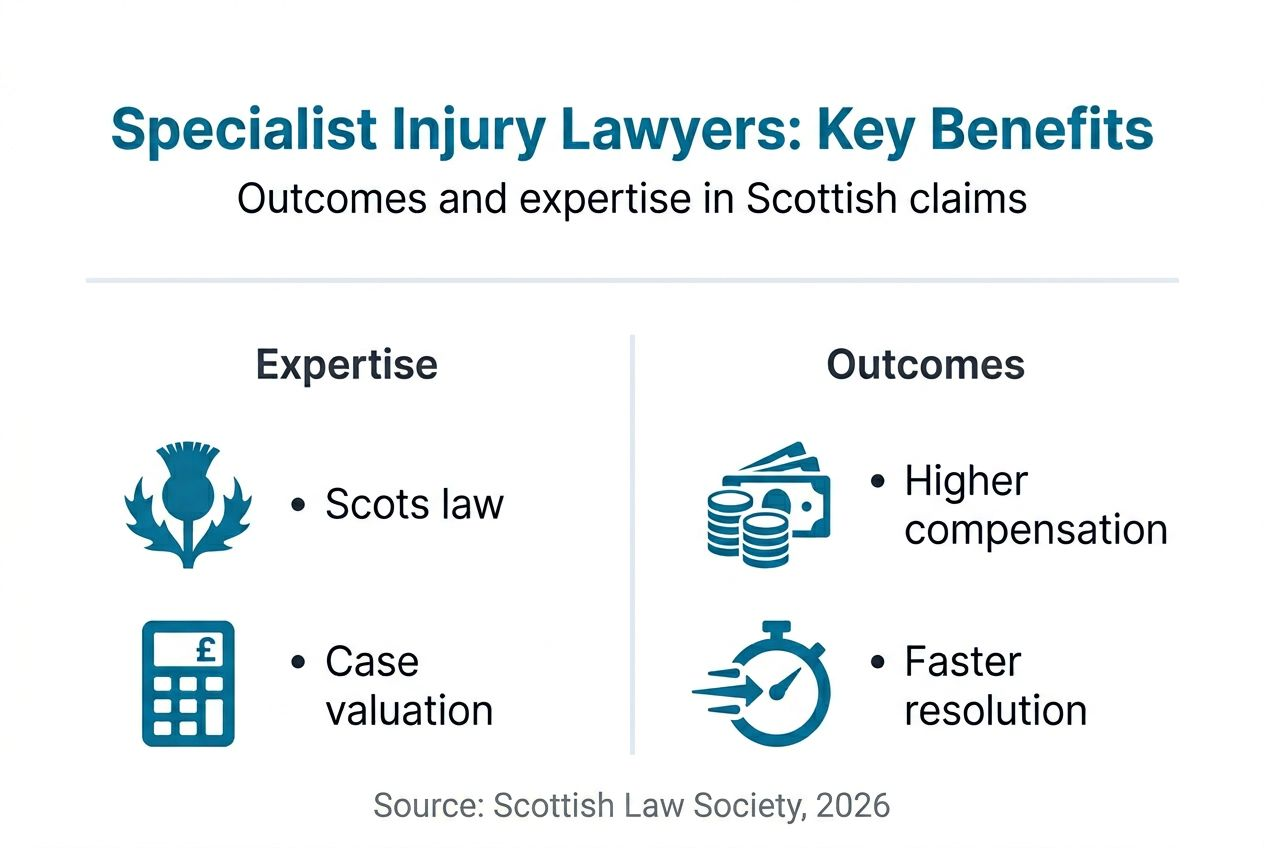
Specialists achieve 25-30% more compensation through court familiarity and expert negotiation leverage. Their in-depth knowledge of Scottish case law precedents enables them to frame claims persuasively, citing relevant judgments that support higher valuations. Insurers recognise specialists’ willingness and ability to pursue court action, making them more likely to offer fair settlements early.
The compensation difference between specialist and general solicitors proves substantial:
| Claim Type |
Average Compensation (General Solicitor) |
Average Compensation (Specialist) |
Difference |
| Moderate whiplash |
£3,500 |
£4,800 |
+37% |
| Workplace back injury |
£12,000 |
£16,500 |
+38% |
| Minor medical negligence |
£8,500 |
£11,200 |
+32% |
| Public liability fracture |
£15,000 |
£19,500 |
+30% |
Specialists reduce claim delays through efficient case management and established insurer relationships. They anticipate procedural obstacles, prepare comprehensive evidence packages upfront, and maintain momentum throughout negotiations. This efficiency shortens resolution times whilst strengthening your settlement or court position significantly.
Pro Tip: Before instructing any lawyer, request detailed information about their success rates with cases similar to yours. Ask specifically about compensation amounts achieved, timeframes, and settlement versus court outcome ratios. This transparency reveals genuine expertise.
Expert witness networks represent another specialist advantage. They maintain relationships with respected medical professionals, accident reconstruction specialists, and vocational assessors who provide compelling evidence. These expert reports often prove decisive in negotiations, particularly when future care needs or earnings capacity require detailed assessment.
Back injury claims specialists exemplify focused expertise benefits. They understand spinal injury complexities, appropriate medical investigations, and long-term prognosis implications that general practitioners might miss. For comprehensive strategies, this guide to maximising compensation outlines specialist approaches that consistently deliver superior results.
Navigating no win no fee arrangements and minimising financial risk
Damages-Based Agreements, commonly called no win no fee arrangements, eliminate upfront costs and align lawyer fees with your compensation success. Fees are only paid as a percentage of compensation if you win, avoiding financial barriers that prevent injured claimants from accessing justice. This funding model has democratised personal injury law, making specialist representation accessible regardless of personal finances.
Scottish DBAs operate under strict regulations ensuring transparency and fairness. Lawyers must clearly disclose percentage fees, explain what happens if you lose, and outline any additional costs upfront. These protections prevent excessive charges whilst maintaining quality legal services aligned with client interests.
Common misconceptions about no win no fee arrangements debunked:
- Myth: Hidden fees reduce compensation significantly. Reality: Regulated DBAs require complete fee transparency with capped percentages.
- Myth: Lawyers accept weak cases because they don’t risk money. Reality: Specialists carefully assess viability because unsuccessful cases cost them time and resources.
- Myth: You pay if you lose. Reality: Genuine no win no fee means zero payment if your claim fails.
- Myth: Compensation is heavily reduced by fees. Reality: You typically retain 70-80% of compensation, far exceeding what you’d recover without specialist help.
Pro Tip: Always request written confirmation of exact fee percentages and circumstances requiring payment before instructing any lawyer. Reputable specialists provide clear, jargon-free explanations without pressure, ensuring you understand financial arrangements completely.
DBAs remove the financial risk that traditionally deterred injured people from pursuing deserved compensation. Without upfront legal fees, expert representation becomes accessible to everyone regardless of savings or income. This arrangement particularly benefits those facing financial hardship following injury, when legal costs would prove impossible to manage.
No win no fee injury claims in Scotland have transformed access to justice, allowing specialists to represent clients who would otherwise face insurers alone. The alignment of interests ensures lawyers work diligently to maximise your compensation, as their success directly depends on yours.
Common misconceptions about choosing specialist injury lawyers
Many injured people wrongly believe any solicitor handles personal injury claims equally well. Specialists clarify this misconception through transparent expertise and focused knowledge that general practitioners simply cannot match. Understanding these false beliefs helps you make informed choices that protect your compensation rights.
The assumption that general solicitors suffice for injury claims ignores the complexity of Scottish personal injury law. Whilst general practitioners handle diverse legal matters competently, they lack the daily immersion in injury case law, court procedures, and negotiation tactics that specialists develop through focused practice. This expertise gap directly impacts compensation outcomes and claim success rates.
Another persistent myth suggests no win no fee arrangements hide excessive costs that erode compensation. Regulated DBAs in Scotland require complete transparency, with fees capped and disclosed upfront. Specialists cannot spring surprise charges or deduct hidden expenses, as regulatory bodies strictly monitor compliance and client complaints.
Key misconceptions preventing people from securing specialist help:
- Belief: Local general solicitors provide adequate injury claim support. Reality: Specialists’ focused expertise delivers measurably better outcomes.
- Belief: No win no fee means lawyers take most compensation. Reality: Regulated percentages ensure you retain the substantial majority of awards.
- Belief: Specialists cost more than general solicitors. Reality: DBA arrangements mean identical risk with superior results.
- Belief: General solicitors understand Scottish courts equally well. Reality: Specialists navigate injury-specific procedures and precedents daily.
Specialists provide personalised communication tailored to injury claim complexities. They explain medical evidence, procedural steps, and negotiation strategies in accessible language, ensuring you understand your case throughout. This contrasts with general practitioners juggling diverse caseloads who may struggle to provide focused attention your injury claim deserves.
Understanding these misconceptions empowers you to recognise the genuine value specialists offer. Their transparent fee structures, superior success rates, and focused expertise combine to deliver compensation outcomes that general solicitors rarely match, making specialist instruction the logical choice for serious injury claims.
How to choose the right specialist injury lawyer in Scotland
Selecting the right specialist requires careful evaluation of credentials, experience, and client focus. Following a systematic approach ensures you instruct lawyers genuinely qualified to maximise your compensation through proven Scottish personal injury expertise.
Verify Law Society of Scotland and APIL membership, review success rates, and ensure transparent fee arrangements before making your choice. These steps protect against inexperienced practitioners whilst identifying specialists with demonstrable track records in cases like yours.
Step-by-step specialist lawyer selection checklist:
- Confirm professional accreditation: Verify current Law Society of Scotland registration and Association of Personal Injury Lawyers (APIL) membership demonstrating specialist commitment.
- Review relevant case studies: Request examples of similar claims handled successfully, including compensation amounts and resolution timeframes.
- Assess success rates: Ask about win percentages, average compensation achieved, and settlement versus court outcome ratios for transparency.
- Verify fee transparency: Ensure clear written explanations of Damages-Based Agreement percentages and circumstances requiring payment.
- Evaluate local expertise: Confirm experience with Scottish courts, judges, and regional insurer negotiation practices.
- Check client testimonials: Read independent reviews focusing on communication quality, professionalism, and outcome satisfaction.
- Assess availability: Ensure the lawyer can dedicate appropriate time to your case without overextension across excessive caseloads.
Law Society of Scotland registration provides baseline professional standards, whilst APIL membership demonstrates dedicated personal injury focus and continuing education commitment. These credentials separate genuine specialists from general practitioners claiming injury expertise without focused practice.
Client reviews reveal communication styles, responsiveness, and satisfaction levels that formal credentials cannot capture. Look for consistent praise regarding explanation clarity, regular updates, and compassionate support throughout often stressful claim processes. Red flags include complaints about poor communication, missed deadlines, or unexpected fee demands.
Transparent fee arrangements prove essential for informed decision making. Reputable specialists provide written DBA terms explaining exact percentage fees, what expenses you cover regardless of outcome, and circumstances triggering payment obligations. Any reluctance to provide clear written terms signals potential problems worth avoiding.
Local Scottish legal experience matters significantly when navigating regional court systems and insurer relationships. Specialists practising extensively in Scotland understand judicial preferences, local procedural nuances, and regional compensation standards that influence claim outcomes materially.
Making the most of your specialist lawyer: what to expect and how to prepare
Understanding the claims process and your role within it helps specialists build the strongest possible case for maximum compensation. Active engagement and thorough preparation significantly improve outcomes whilst reducing resolution timeframes.
Specialists manage evidence gathering, expert witness instruction, insurer liaison, and court representation to prepare robust claims for settlement or trial. Your cooperation with these processes directly influences claim strength and negotiation leverage.
The typical personal injury claims timeline spans several months to over a year depending on complexity and settlement negotiations. Initial consultations assess viability and gather preliminary evidence. Investigation phases involve detailed medical assessments, witness statements, and expert reports. Negotiation periods then pursue maximum settlement before potential court proceedings if insurers refuse fair compensation.
Critical evidence requirements vary by claim type but typically include:
- Complete medical records documenting injuries, treatment, and prognosis
- Accident reports from police, employers, or property owners
- Witness contact details and statements supporting your account
- Photographic evidence of accident scenes, injuries, and property damage
- Financial documentation proving lost earnings and injury-related expenses
Prepare for initial consultations by gathering available documentation and noting key facts about your injury and the incident causing it. Write down questions about the legal process, expected timelines, and fee arrangements to ensure comprehensive understanding. This preparation enables specialists to assess your claim accurately and provide informed guidance immediately.
Maintain open communication throughout your claim by responding promptly to lawyer requests and reporting any changes in your medical condition or circumstances. Specialists need current information to adjust claim valuations and negotiate effectively. Delayed responses or incomplete information weakens your position and extends resolution times unnecessarily.
Follow specialist guidance regarding medical treatment, evidence preservation, and social media activity carefully. Insurers scrutinise claimants’ online presence for evidence contradicting injury claims. Specialists advise on protecting your claim from defence tactics designed to reduce compensation or deny liability entirely.
Expect thorough investigation involving expert witnesses who assess injury severity, future care needs, and earnings impact. These experts provide compelling evidence insurers cannot easily dispute, strengthening settlement positions significantly. Specialists coordinate these assessments efficiently whilst explaining their importance to your claim value.
Being proactive helps your specialist lawyer build the strongest possible case. Attend all medical appointments, follow treatment recommendations, and maintain detailed records of injury impacts on daily life and work. This evidence proves invaluable when quantifying compensation for pain, suffering, and lifestyle limitations.
For detailed guidance on claim preparation steps in Scotland, understanding your role ensures smooth collaboration with specialists. Additional information about specialist lawyer support services clarifies what comprehensive representation involves and how specialists maximise your compensation through expert case management.
Discover expert no win no fee injury lawyers in Scotland
Securing maximum compensation for your injury requires specialist expertise, transparent fee arrangements, and proven success with Scottish personal injury claims. Scotland Claims connects you with specialist injury lawyers in Scotland who understand Scots law intricacies and deliver client-centred service throughout your claim journey.
Our specialists operate exclusively under no win no fee arrangements, eliminating financial risk whilst ensuring you retain 100% of your compensation if successful. This transparent approach has helped thousands of injured Scots access justice without upfront costs or hidden charges.
Whether you’ve suffered road traffic injuries, workplace accidents, or need back injury claims specialists, our accredited lawyers bring focused expertise to every case. Free consultations assess your claim viability and explain the process clearly, empowering informed decisions about pursuing deserved compensation.
Pro Tip: Choosing locally accredited specialists familiar with Scottish courts and insurers brings peace of mind and demonstrably better claim success rates than general practitioners.
FAQ
What are the most common types of personal injury claims in Scotland?
Road traffic accidents, workplace injuries, medical negligence, and public liability cases represent the most frequent claim types handled by specialists. Each category involves distinct evidence requirements and legal frameworks requiring tailored expertise. Common injury claims in Scotland demand focused knowledge of specific regulations and procedural requirements for successful outcomes.
How do no win no fee agreements work in Scotland?
Damages-Based Agreements mean you only pay legal fees if your claim succeeds, calculated as a regulated percentage of compensation awarded. All fee terms must be disclosed clearly upfront, with zero payment required if your claim fails. No win no fee claims eliminate financial barriers whilst aligning lawyer interests with maximising your compensation.
Why is it important to use a specialist injury lawyer instead of a general solicitor?
Specialists understand Scots law complexities, court procedures, and evidence requirements that general solicitors often miss, directly increasing claim success rates. They typically secure 25-30% higher compensation through expert negotiation and comprehensive loss assessment. General practitioners may miss critical deadlines, undervalue claims, or lack negotiation leverage that specialists develop through focused practice. Specialist versus general solicitors demonstrates measurable outcome differences favouring specialist instruction.
What should I do to prepare for a consultation with a specialist injury lawyer?
Gather all available medical records, accident reports, witness details, and photographs documenting your injury and the incident. Note key dates, facts about how the injury occurred, and impacts on your daily life and work. Prepare questions about fee arrangements, expected timelines, and the legal process to ensure comprehensive understanding. Preparing for consultations enables specialists to assess your claim accurately and provide informed guidance immediately.
Recommended