Last updated: November 4, 2026
Quick Summary
To prove road accident liability in Scotland, gather reliable evidence showing what each driver did, whether they failed to take reasonable care, and how that failure caused the collision or injury. The evidence must make your account more likely than the alternative, and may include photographs, witness statements, police records, dashcam footage and relevant medical records.
- A collision alone does not prove fault; evidence must support a clear account of events.
- Keep original photos and footage, and make separate copies for sharing.
- Ask promptly for relevant CCTV to be preserved, as it may be overwritten or deleted.
- Record witness accounts in their own words, including where they stood and what they saw.
- Shared liability depends on the facts; there is no automatic equal split.
Table of Contents
Step 1: Understand how liability is assessed in Scottish road accidents
According to the World Health Organisation road traffic injury fact sheet, about 1.16 million people die in road crashes worldwide each year, while many more suffer non-fatal injuries. For anyone asking how to prove liability in Scottish road accidents, the central issue is evidence: what each driver did, what happened next, and whether the conduct caused harm. This guide explains how to build that picture.
Road accident liability is the legal responsibility for harm caused by a driver’s actions. A claim usually turns on whether a driver failed to take reasonable care and whether that failure caused the injury or loss.
A collision alone does not prove fault. The evidence must support a clear account of events.
- Duty of care: Drivers must take reasonable care on the road.
- Breach of duty: A driver’s actions fell below that standard.
- Causation: The breach led to the collision or injury.
In Scotland, civil claims are assessed on the balance of probabilities. In plain terms, the evidence must show that one account is more likely than the other. The strongest case connects each piece of road accident evidence Scotland can provide to a specific part of that account.
Step 2: Gather road accident evidence in Scotland
Road accident evidence Scotland claimants gather should show the scene, the vehicles, and the conditions around the collision. Take photographs only when it is safe, and keep original files so their source and timing remain clear. A useful record is factual, not an attempt to decide fault at the roadside.
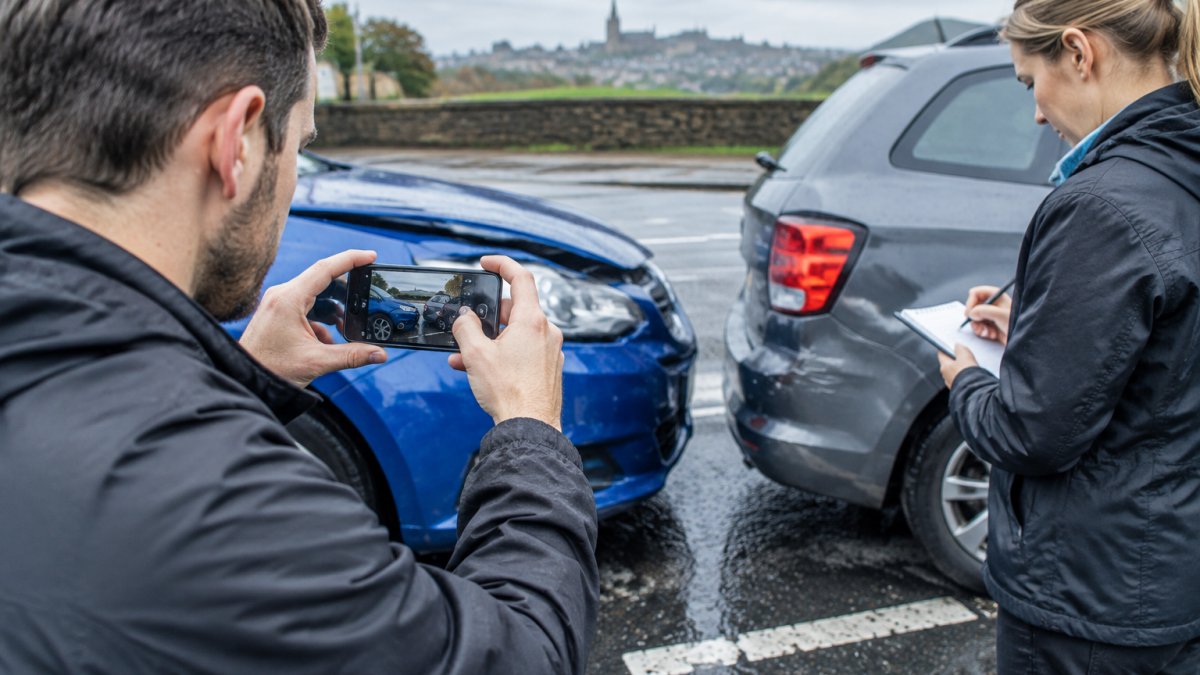 Person photographing a collision scene on wet tarmac to gather evidence for road accident liability claims.
Use police reports, collision records and scene photographs
Police records may help establish what was reported, but they do not automatically decide legal liability. A police report, collision record, scene photographs and an accident scene sketch can each add context.
For guidance on when a report may be needed and how to get one, read when to get a police accident report.
Photograph vehicle positions, damage, road signs, junctions and sight lines, if safe. Note the weather, lighting, road surface and any obstruction. Those details can matter on a wet Glasgow road or a rural route with poor visibility.
Record road conditions and preserve digital evidence
Digital evidence can disappear when devices overwrite files or accounts delete old footage. Keep original photos and videos, note who recorded them, and avoid editing or cropping the source files. Make a separate copy for sharing.
Watch out: Do not put yourself in traffic to take a photograph; safety comes first.
Step 3: Collect Scottish road accident witness statements
Scottish road accident witness statements can support or challenge each driver’s account. Ask witnesses for their names and contact details, then note what they saw in their own words. A clear account of where a witness stood and what they could see is more useful than a guess about who was legally at fault.
A common mistake is to ask leading questions. Instead, record:
- Where the witness was at the time
- Which vehicles they saw before impact
- What they heard or noticed afterwards
- Whether they saw the whole event
Keep the witness’s wording distinct from anyone else’s account. This helps a solicitor assess witness testimony alongside photographs, records and other evidence.
Dashcam footage for a road accident claim in Scotland can help establish vehicle movements, timing, visibility and what happened immediately before and after impact. It is evidence to be considered alongside other material, not an automatic decision on liability. Its usefulness may depend on whether the recording is complete, clear and traceable to the device that captured it. Securing such digital records is a critical step in the broader process of preserving accident evidence, particularly when the circumstances surrounding a collision are contested or involve complex legal liability.
Prevent the recording from being overwritten
Many cameras record on a loop, replacing older files when the memory card fills. If it is safe to do so, stop the recording or remove the card as soon as practicable after the collision. Check the camera’s instructions rather than experimenting with settings that could delete or alter files. If the camera uploads footage to an account or cloud service, check that the relevant clip has finished uploading and save a copy from the original account.
Keep the memory card and the original file where possible. Make a separate working copy for viewing or sharing, and do not edit, rename or convert the original. If a file must be exported into another format, retain the source file as well and note what was done and when.
Write down the date and approximate time of the collision, the camera make or model if known, the vehicle it was fitted in, and who had access to the recording. Note when and how the file was copied, where the original is stored, and whether the camera clock was accurate. A camera’s displayed time may be wrong, so compare it with another reliable time reference rather than silently changing the recording.
Keep the full sequence, including footage before and after impact. A short extract may omit a signal, an approaching vehicle or a change in road conditions that helps explain the event. Preserve any available audio with the video, and avoid adding captions or annotations to the source file. If you need to make notes about what a clip appears to show, keep those notes separate from the recording.
Ask promptly for CCTV or other recordings to be retained
CCTV from a shop, home, car park or other premises may be routinely overwritten or deleted. Identify the camera’s location and the time window as accurately as possible, then ask the owner or operator promptly to preserve the relevant footage. Keep a record of when you made the request and whom you contacted. Do not assume that a request means you will receive a copy; the owner may need to consider privacy and other obligations before disclosing it.
Watch out: Do not post footage publicly or send an edited clip as though it were the complete recording; this can expose private information and make the evidence harder to assess fairly.
Get Started Today →
Keep the original recording secure and share it through an appropriate channel when requested. Scotland Claims Injury Lawyers provides information on why accident evidence matters, including how records can support a claim.
Step 5: Link the evidence to breach of duty and causation
To prove liability, evidence needs to support a connected account: what a driver did or failed to do, why that conduct fell below the care reasonably expected in the circumstances, and how it caused the collision or injury. A photograph or witness account may be relevant without proving every part of that chain. Assess each item for what it shows, what it cannot show and whether another source supports it.
Test breach against the circumstances
A driver’s conduct should be considered in context, including the road layout, visibility, traffic, signs, surface and weather. For example, photographs showing a clear view of a junction may help assess whether a driver could see approaching traffic; marks on the road or the final positions of vehicles may help explain movement, but do not necessarily establish speed or priority by themselves. A witness who saw only the impact may be able to describe the collision but not what either driver did beforehand.
Build a simple timeline from the available evidence. Record the sequence of events in your own words, then compare it with dated photographs, footage, witness accounts and any police collision record. Note disagreements rather than trying to resolve them by assumption. If a camera clock, recollection or record gives a different time, preserve the discrepancy and explain its possible source.
Show the link between the breach and the harm
Causation asks whether the conduct identified as a breach led to the collision or the injury being claimed. Evidence about vehicle movement and the point of impact may help explain how a crash occurred. Records of the injury and its treatment may help document what harm followed, while the person’s account can explain symptoms and their effect on daily activities. Keep the distinction clear: evidence that an injury exists does not, on its own, establish how the collision happened; evidence of a collision does not, on its own, establish the extent of an injury.
Consider whether the evidence supports an alternative explanation. Could a vehicle have been obscured? Does the footage begin too late to show the approach? Is a witness describing something they saw directly or repeating what someone else said? Identifying these limits early makes it easier to see what further records or clarification may be needed.
Use expert reconstruction only where it adds something
An expert may be able to analyse technical questions such as vehicle damage, sight lines or the likely sequence of impact. Reconstruction is not a substitute for reliable source material, and an expert conclusion should be considered alongside the underlying photographs, measurements, records and accounts.
A practical evidence table can help keep the reasoning clear:
| Issue to establish |
Evidence that may help |
Question to check |
| What each driver did |
Dashcam, CCTV, witness accounts |
Does it show the full relevant sequence? |
| Road and visibility conditions |
Scene photographs, records, witness observations |
Were these conditions recorded close to the time of the collision? |
| How the collision occurred |
Vehicle damage, scene layout, footage |
Does the evidence support the proposed sequence, or are there other explanations? |
| Injury and resulting effects |
Relevant medical records and a dated account of symptoms |
Does the material document the harm being attributed to the collision? |
The aim is not to make every item prove the whole case. It is to show how reliable pieces of evidence fit together, where they conflict and what remains uncertain.
Step 6: Assess shared liability in a Scottish road accident
Shared liability road accident Scotland cases arise when evidence suggests more than one person’s actions contributed to the collision or injury. The result depends on the facts, not a default split. A driver’s conduct must be assessed against the available records, statements and footage (Road Traffic Accidents).
A common mistake is to assume that a disputed claim will automatically be settled equally. The research available does not establish a general rule that every unclear case is divided in that way. A careful review may show that one account is better supported, or that responsibility is shared.
For a wider explanation of how disputes are handled, see Scottish personal injury litigation. Where liability is shared, the effect on compensation depends on the case facts and legal assessment.
Step 7: Use an evidence checklist before discussing your claim
A short evidence checklist helps spot gaps before a claim is reviewed. Tick what is available, note what is missing, and keep copies in one place. Do not fill gaps by guessing.
This checklist is a practical filter, not a test of whether a claim will succeed. Scotland Claims Injury Lawyers explains how car accident claims work and what legal support may involve.
Step 8: Ask a Scottish road accident solicitor to review the evidence
A solicitor can assess whether the evidence supports breach of duty, causation and a personal injury claim. The review should identify strong proof, missing information and points the other side may dispute. That is more useful than relying on a single photograph or a confident account alone.
For people searching for road accident liability solicitors near me in Glasgow, the same evidence questions apply across Scotland. Scotland Claims Injury Lawyers connects people with legal support.
The challenge is often not finding evidence, but preserving it and showing how each item fits the events. For support with a Scottish road accident claim, ask about the available legal support.
road accident liabilityhow to prove liability in scottish road accidentsroad accident evidence scotlandscottish road accident witness statements