The Rehabilitation Code 2015: what claimants need to know

The Rehabilitation Code 2015 is the voluntary framework that requires claimant solicitors and compensators (typically insurers) to consider, and where appropriate fund, early rehabilitation so that injured people recover as quickly and as fully as possible. For claimants in Scotland, the practical effect is significant: the Code shifts the conversation from purely financial compensation to restoring your health, function, and ability to work, often before liability is even agreed, as widely recognized. As APIL explains, the 2015 version places the injured client at the centre of the process and requires early collaborative working between claimant representatives and compensators from the outset.
If you or your solicitor are dealing with a personal injury claim right now, the immediate steps are:
- Notify the compensator early and flag that rehabilitation needs should be considered under the Code.
- Request an Immediate Needs Assessment (INA) where the injury warrants one, and ask the compensator to confirm funding availability within the Code’s timescales.
- Ask your solicitor whether a triage report or full INA is appropriate for your claim value and injury type.
- Keep records of every rehabilitation request and every response (or non-response) from the compensator.
Key takeaways
The Rehabilitation Code 2015 gives claimants and their solicitors a clear, enforceable framework for securing early rehabilitation, and using it proactively produces better health outcomes and stronger litigation positions.
| Point |
Details |
| Effective date |
The Code came into substantive effect on 1 December 2015, replacing versions from 1999 and 2007. |
| Lower-value threshold |
Claims valued below the lower-value claims threshold follow a proportionate triage process rather than a full INA. |
| Claimant autonomy |
The claimant is never obliged to accept any recommended treatment; consent must be recorded in writing. |
| Compensator funding |
Compensators must fund agreed reasonable rehabilitation or justify refusal in writing within the Code’s timescales. |
| Scotland Claims Injury Lawyers |
Scotland Claims Injury Lawyers supports Scottish claimants through the rehabilitation and compensation process with no success fee and 100% of compensation retained. |
Table of Contents
What does the Rehabilitation Code 2015 actually cover?
The Code came into substantive effect in December 2015 and is the third iteration of the Rehabilitation Code, replacing earlier versions published in 1999 and 2007. LexisNexis confirms that this version introduced a dedicated lower-value claims pathway for claims valued at no more than the threshold set forth in the Code, a Case Manager’s Guide, and an addendum for claims handled through the Official Injury Claims (OIC) portal.
Scope and the types of claims it applies to
The Code was drafted primarily for personal injury and clinical negligence claims in England and Wales. In Scottish personal injury practice, the Code does not have the same formal pre-action protocol status it carries south of the border, but its principles are widely applied and courts have shown consistent support for the collaborative rehabilitation approach it promotes. Solicitors handling Scottish personal injury claims routinely rely on the Code as the recognised standard for rehabilitation requests, and compensators operating UK-wide are familiar with its requirements.
Key definitions you need to understand
Compensator refers to the party responsible for meeting the claim, most often the defendant’s insurer. Claimant solicitor means the legal representative acting for the injured person. An Immediate Needs Assessment (INA) is the structured evaluation of a claimant’s rehabilitation needs carried out by a suitably qualified assessor. A case manager coordinates the delivery of a rehabilitation plan and monitors progress. A lower-value claim is one valued at no more than £25,000, which attracts a proportionate, triage-based process rather than a full INA.
Voluntary status and how courts treat it
The Code is voluntary. The IUA’s reformatted version of the Code states clearly that parties may agree an alternative framework where it better serves the claimant, and that the Code promotes collaborative early rehabilitation even where liability has not yet been admitted. In practice, however, the Code is so widely referenced in pre-action protocols and so consistently endorsed by courts that departing from it without good reason carries real litigation risk. Parties almost always apply its principles.
Core duties under the Code: who does what?
Each party carries distinct obligations, and understanding them helps claimants and their solicitors know when to push and when to escalate.
Role-by-role responsibilities
| Party |
Core duty |
Practical obligation |
| Claimant solicitor |
Identify rehabilitation needs early |
Notify compensator, provide functional information, request INA or triage |
| Compensator |
Consider rehabilitation on notification |
Respond to INA request, confirm or justify refusal of funding |
| Case manager |
Assess and coordinate rehabilitation |
Produce INA, rehabilitation plan, progress and discharge reports |
| Treating clinicians |
Provide clinical input |
Contribute to INA, support rehabilitation plan goals |
Hill Dickinson’s overview of the Code confirms that compensators are expected to consider rehabilitation from the moment a claim is notified, and that the Code sets response windows of 21 days at key stages. The claimant solicitor’s job is not passive: the Code expects proactive identification of needs and clear communication to the compensator about what is required and why.
How the INA fits into the life of a claim
Once a claimant solicitor notifies the compensator and requests an INA, the compensator should respond within the Code’s timescales to confirm whether it will fund the assessment. The INA report then forms the basis for agreeing a rehabilitation plan. Progress reports follow at agreed intervals, and a discharge report closes the rehabilitation episode. Each document creates a paper trail that supports both the rehabilitation process and any subsequent interim payment application.
Independence of case managers
Case managers must be independent of both parties. For catastrophic injuries, professional registration with a recognised body is expected. Organisations such as CMSUK and BABICM provide professional standards and accreditation frameworks that case managers working under the Code are expected to meet.
Pro Tip: Document every rehabilitation request in writing, even if you have already raised it verbally. If the compensator refuses or fails to respond within the Code’s timescales, that written record becomes evidence of unreasonable conduct and strengthens any subsequent application for an interim payment or court order.
Lower-value claims and the OIC addendum: what changes at £25,000?
The 2015 Code recognised something earlier versions missed: a claim worth less than £25,000 is not necessarily a minor injury. A soft tissue injury that prevents someone from working for months, or a fracture that disrupts daily life, can be life-changing even if the financial value of the claim sits below that threshold. The Code’s inclusion of a proportionate lower-value pathway reflects that reality.
How the triage process works
For lower-value claims, the Code replaces the full INA with a proportionate triage process. An independent triage assessor reviews the claimant’s needs and produces a shorter report focused on whether any intervention is required and, if so, what type. The compensator must indicate whether funding is available or justify any refusal within short timescales. The emphasis is on speed and proportionality: getting the right intervention in place quickly, without the cost and delay of a full case management process.
The Code’s lower-value pathway exists precisely because proportionality should never mean denial. A £15,000 claim can involve a claimant who cannot drive, cannot return to work, and cannot manage daily tasks without support. The triage process is designed to identify that quickly and get help in place before the window for effective early intervention closes.
The OIC addendum
The Official Injury Claims portal handles lower-value road traffic accident claims. The OIC addendum to the Code sets out how rehabilitation is to be handled within that online process. Claimants using the OIC portal retain the right to request rehabilitation assessment, and compensators operating within the portal are expected to apply the Code’s principles. LexisNexis guidance confirms the addendum is a formal part of the Code’s framework. In practice, claimants using the portal without legal representation may not know to request rehabilitation, which is one reason specialist solicitor involvement remains valuable even for lower-value claims.
An INA is not simply a medical report. It is a structured assessment of what the claimant needs to recover function, return to work, and resume daily activities, carried out by a suitably qualified professional who is independent of both parties.
The ten markers assessors consider
The IUA’s version of the Code sets out ten markers that assessors should weigh when conducting an INA:
- Age of the claimant
- Pre-existing conditions or comorbidities
- Return-to-work issues
- Dependants and caring responsibilities
- Geography and access to services
- Mental capacity
- Activities of daily living
- Realistic rehabilitation goals
- Whether the claimant witnessed trauma
- Time elapsed since the accident
These markers ensure the INA captures the full picture of the claimant’s situation rather than focusing narrowly on the physical injury.
What a rehabilitation plan and case management report should contain
| Document |
Core contents |
Purpose |
| INA report |
Needs identified, markers assessed, recommended interventions, cost estimate, timeline |
Basis for funding agreement and rehabilitation plan |
| Rehabilitation plan |
Goals, treatment types, providers, milestones, review dates |
Guides delivery and allows progress to be measured |
| Progress report |
Goals achieved, barriers, revised timeline, updated costs |
Supports interim payment applications and plan adjustments |
| Discharge report |
Outcomes against goals, residual needs, recommendations |
Closes the rehabilitation episode and informs final schedule of loss |
Solicitors should ask to see the INA before agreeing to any rehabilitation plan, and should check that the ten markers have been addressed, that the recommended interventions are evidence-based, and that the cost estimate is realistic. For catastrophic injuries, the Code expects the case manager to hold relevant professional registration, and CMSUK membership is a recognised indicator of competence.
Multidisciplinary working
The Code anticipates that NHS clinicians and private case managers will work alongside each other rather than in parallel silos. In practice, a case manager coordinating a rehabilitation plan for a serious injury will typically liaise with the claimant’s GP, physiotherapist, occupational therapist, and any specialist consultants. That collaboration is not just good clinical practice; it produces better-evidenced reports that are harder for a compensator to challenge.
Who pays for rehabilitation under the Code?
The basic rule is straightforward: where the parties agree that rehabilitation is reasonable and necessary, the compensator funds it. Refusal is permitted, but the Code requires the compensator to justify any refusal in writing.
Interim payments and rehabilitation funding
Rehabilitation costs funded under the Code are treated as an advance against the final settlement. If the claim later fails, the compensator cannot recover those rehabilitation costs unless the claimant has been fraudulent or dishonest. That protection matters: it means a claimant can accept funded rehabilitation without fearing that a failed claim will leave them owing money back to the insurer.
Where the compensator refuses to fund rehabilitation, or where liability is disputed and the compensator declines to proceed, the claimant’s solicitor can apply to the court for an interim payment to cover rehabilitation costs. APIL’s Best Practice Guide sets out the escalation routes in detail: first, request escalation within the insurer’s own structure to a rehabilitation manager; second, seek an interim payment through the court if that fails.
Practical negotiation when the compensator gives a partial response
A partial or conditional funding response is common. The compensator may agree to fund physiotherapy but not case management, or may agree to fund a triage report but not a full INA. In those situations, the solicitor should:
- Provide clear functional evidence of why the refused element is necessary (GP letters, occupational health reports, the claimant’s own account of daily limitations).
- Request a written explanation of the refusal, which can later be put before a court.
- Consider whether the refused element can be funded through an interim payment application, supported by the INA report.
The Code does not require liability to be agreed before rehabilitation begins. The IUA confirms that where liability is disputed, parties can still agree to proceed with rehabilitation, and insurers are encouraged to consider partial admission to avoid denying early intervention that would benefit the claimant.
Rehabilitation funded early in a claim consistently produces better outcomes than treatment arranged late. The Code’s funding model exists to remove cost as a barrier to that early intervention.
Claimant autonomy and consent under the Code
The Code is unambiguous on this point: a claimant is never compelled to undergo any treatment or assessment recommended under it. APIL confirms that the claimant’s representative retains decision-making authority on behalf of clients where appropriate, and that the claimant’s right to refuse treatment is absolute.
Recording consent properly
Consent should be recorded in the INA report and in the claimant’s clinical records. The solicitor should keep a note in the case file confirming that the claimant was advised of their right to accept or refuse each recommended intervention, and that any decision to accept or decline was made freely and with full information.
Protecting the claimant’s position in correspondence
Solicitor correspondence requesting rehabilitation should make clear that the claimant’s participation is voluntary and that any assessment or treatment will proceed only with the claimant’s informed consent. A brief standard paragraph works well:
“Our client is willing to participate in an Immediate Needs Assessment under the Rehabilitation Code 2015, subject to the assessment being carried out by an independent assessor agreed by both parties. Our client’s participation does not constitute an admission of any kind and our client reserves the right to decline any specific treatment recommendation following the assessment.”
That wording protects the claimant’s position, signals cooperation to the compensator, and makes clear that consent to assessment is not consent to every subsequent recommendation. You can read more about personal injury rights in Scotland to understand the broader framework within which these protections sit.
Step-by-step checklist for claimants and solicitors
Getting rehabilitation right under the Code is largely a matter of doing the right things in the right order and keeping clear records at every stage.
The sequence from notification to discharge
- Notify the compensator of the claim and flag rehabilitation needs in the initial letter of claim or notification.
- Provide functional information about the claimant’s injury, daily limitations, work situation, and dependants to support the rehabilitation request.
- Request a triage report or INA depending on claim value: triage for lower-value claims (≤ £25,000), full INA for more serious injuries, as per the framework outlined in the Code.
- Await the compensator’s funding response within the Code’s timescales (21 days at key stages).
- Agree an independent assessor acceptable to both parties; for catastrophic injuries, confirm the assessor’s professional registration.
- Review the INA report before agreeing to any rehabilitation plan; check the ten markers are addressed and the recommendations are evidence-based.
- Agree the rehabilitation plan with the compensator and confirm funding in writing.
- Monitor progress through regular case management reports; request updated reports at agreed intervals.
- Escalate if funding is refused or delayed: first to the insurer’s rehabilitation manager, then to the court for an interim payment if necessary.
- Obtain a discharge report at the end of the rehabilitation episode to close the process and inform the schedule of loss.
For a practical guide to starting a claim in Scotland from the beginning, the step-by-step claim guide covers the full process.
Sample solicitor wording
Initial rehabilitation suggestion to compensator:
“We write to notify you of our client’s claim and to invite you to consider rehabilitation under the Rehabilitation Code 2015. Our client has sustained [describe injury] and we believe an early assessment of rehabilitation needs would be beneficial. Please confirm within 21 days whether you are willing to fund an Immediate Needs Assessment and, if so, your preferred assessor.”
Challenge to refusal and request for escalation:
“We note your refusal to fund rehabilitation in this matter. Please provide your written reasons for refusal within 14 days. If you are unable to agree funding, we reserve the right to apply to the court for an interim payment to cover the cost of an independent assessment and any recommended treatment.”
Pro Tip: When the compensator is slow to respond, send a chaser at day 14 rather than waiting for the 21-day window to expire. Courts take a dim view of avoidable delay in rehabilitation, and a documented chaser strengthens your position considerably if the matter later goes before a judge.
How courts have shaped the Code’s application
The Code is voluntary, but courts have made clear that ignoring it carries consequences. The collaborative rehabilitation approach the Code promotes has received strong judicial endorsement, most notably in cases where claimant solicitors have proactively pursued rehabilitation and compensators have been criticised for obstructing it.
Hadley v Przybylo and the Court of Appeal’s position
APIL’s rehabilitation guidance references Hadley v Przybylo as a case that gave strong encouragement to the collaborative approach the Code envisages and underlined the role of claimant solicitors in proactively obtaining rehabilitation. The Court of Appeal’s commentary in cases of this type consistently treats the Code as persuasive and influential, even where it is not strictly mandatory. Judges have criticised compensators who refuse reasonable rehabilitation requests without adequate justification, and have treated such refusals as relevant to costs decisions.
Practical implications for Scottish personal injury litigation
In Scottish personal injury litigation, the Code does not sit within a formal pre-action protocol in the same way it does in England and Wales. That said, Scottish courts are equally receptive to evidence that a party has acted unreasonably in relation to rehabilitation. A compensator who refuses a well-evidenced INA request without justification, or who delays funding to the point where the window for effective early intervention closes, faces the same reputational and costs risks north of the border as south of it.
The practical advice for Scottish solicitors is to treat the Code as the expected standard, document every request and response meticulously, and be prepared to use the court’s interim payment jurisdiction if the compensator obstructs reasonable rehabilitation. Where liability is disputed, the IUA’s version of the Code explicitly encourages parties to proceed with rehabilitation regardless, and that position has judicial support.
Where to find the Code and authoritative guidance
The primary sources below are the ones practitioners and claimants should consult directly:
Using the Code in Scottish personal injury work
The Rehabilitation Code 2015 is, in my view, one of the most underused tools available to Scottish claimants. The financial compensation at the end of a claim matters, but the months between the accident and settlement matter more to most people. Getting the right physiotherapy, occupational therapy, or psychological support in place early can mean the difference between a full recovery and a permanent reduction in function.
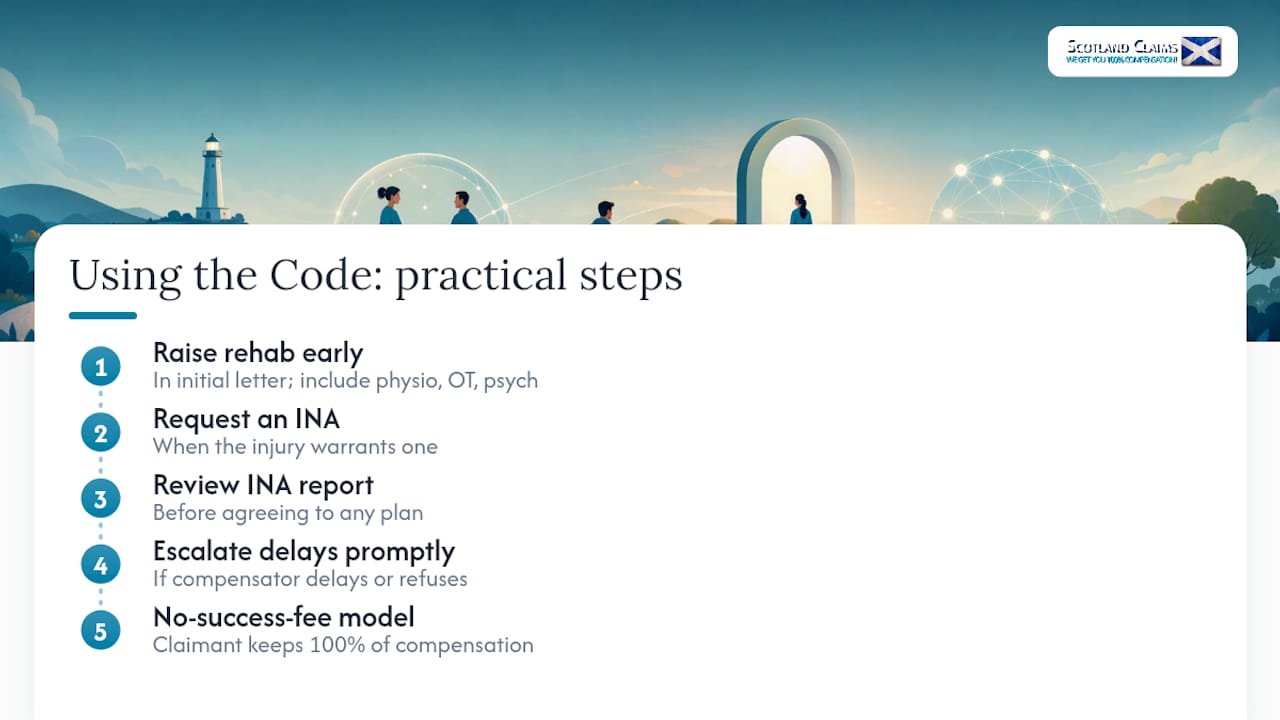
At Scotland Claims Injury Lawyers, the approach to rehabilitation under the Code is practical and proactive. That means raising rehabilitation in the initial notification letter, not waiting to see whether the compensator mentions it. It means requesting an INA where the injury warrants one, reviewing the report carefully before agreeing to any plan, and escalating promptly when a compensator delays or refuses without adequate justification. For workplace injuries, the worker compensation rights guide covers the broader protections that sit alongside rehabilitation rights.
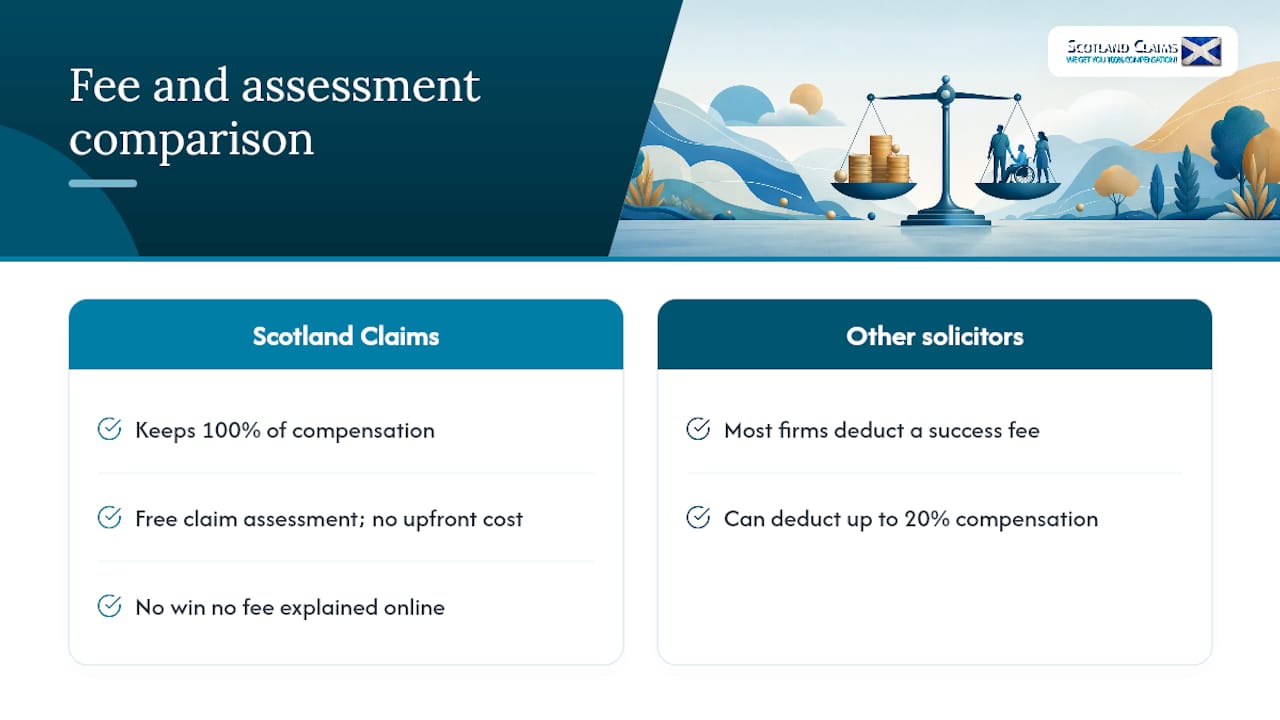
The no-success-fee model Scotland Claims Injury Lawyers operates means claimants keep 100% of their compensation. That financial clarity matters when rehabilitation is ongoing and a claimant needs to know that the money recovered will go entirely to them, not partly to their solicitor.
Free claim assessment for Scottish personal injury claimants
Scotland Claims Injury Lawyers gives Scottish claimants something most firms do not: 100% of the compensation you are awarded, with no success fee taken from your settlement. Other solicitors can deduct up to 20% of your compensation as a success fee. Scotland Claims takes nothing. That is the sharpest financial reason to choose specialist representation for a personal injury claim in Scotland, whether you are dealing with a road traffic accident, a workplace injury, or a slip or trip.
If you have been injured and want to understand whether the Rehabilitation Code 2015 applies to your claim, or whether you are entitled to funded rehabilitation, the first step is a free claim assessment with a specialist personal injury solicitor. Contact Scotland Claims Injury Lawyers today to start your free assessment, with no upfront costs and no risk. You can also use the no win no fee page to understand exactly how the arrangement works before you commit.
This article is general information, not a substitute for advice from a qualified lawyer. Consult a qualified legal professional about your own circumstances before acting on anything here.
Sources
- Rehabilitation Code 2015: Framework for Early Rehabilitation in Personal Injury and Clinical Negligence, Lower-Value and Catastrophic Claims; Duties, INAs, Reports, Funding and OIC Addendum (England and Wales) - Legal Guidance - LexisNexis UK
- Best Practice Guide on Rehabilitation
- The 2015 Rehabilitation Code
- The rebooted Rehabilitation Code, explained
- The Rehabilitation Code 2015 Overview | Hill Dickinson
FAQ
What is the Rehabilitation Code 2015?
The Rehabilitation Code 2015 is a voluntary framework that requires claimant solicitors and compensators to consider and, where appropriate, fund early rehabilitation for injured people in personal injury and clinical negligence claims. It came into substantive effect on 1 December 2015.
Does the Rehabilitation Code 2015 apply to claims in Scotland?
The Code was drafted for England and Wales, but its principles are widely applied in Scottish personal injury practice and courts across the UK have endorsed its collaborative rehabilitation approach. Scottish solicitors routinely use the Code as the recognised standard for rehabilitation requests.
Can a claimant be forced to accept treatment under the Code?
No. The Code is explicit that a claimant is never compelled to undergo any recommended treatment or assessment. Consent must be freely given and should be recorded in writing in both the clinical records and the solicitor’s case file.
Who pays for rehabilitation under the Code?
Where the parties agree that rehabilitation is reasonable and necessary, the compensator funds it. If the compensator refuses, it must justify that refusal in writing. Where funding is blocked, the claimant’s solicitor can apply to the court for an interim payment to cover rehabilitation costs.
What is the lower-value claims threshold under the Code?
Claims valued at no more than £25,000 follow a proportionate triage process rather than a full Immediate Needs Assessment. A triage assessor reviews the claimant’s needs and the compensator must respond to any funding request within short timescales.
Recommended