How to protect worker compensation rights in Scotland

TL;DR:
- Workers in Scotland have legal protections through mandatory Employers’ Liability Insurance, which funds workplace injury compensation. Timely reporting, thorough documentation, and legal support improve claim success and protect against unfair treatment. Consulting a specialist solicitor and acting quickly maximize compensation and safeguard workers’ rights.
Worker compensation protection is defined as the legal right of an injured employee to claim financial redress for workplace injuries, secured through insurance obligations, employment law, and correct claim procedures. In Scotland, knowing how to protect worker compensation is the difference between receiving your full entitlement and losing it through avoidable errors. Employers’ Liability Insurance (ELI), RIDDOR reporting requirements, and the Employment Rights Act 1996 form the backbone of your protection. This guide explains each layer clearly, so you can act with confidence from the moment an injury occurs.
What legal protections and insurance cover workers’ compensation in Scotland?
Employers in Scotland are legally required to hold Employers’ Liability Insurance, which means compensation payments come from the insurer rather than directly from your employer. This matters because it removes the financial pressure on your employer and makes the claims process more straightforward for you. The insurer steps in, handles the correspondence, and funds any agreed settlement.
This insurance framework also means most employers prefer a constructive resolution rather than a drawn-out dispute. Insurance companies manage the claim on the employer’s behalf, which reduces workplace friction and keeps the process professional. You are not fighting your employer personally. You are engaging with an insurer whose job is to assess and settle valid claims.
Key legal protections that safeguard your compensation rights include:
- Employers’ Liability Insurance (ELI): Mandatory for all employers in Scotland. It covers workplace injury claims without putting the business at financial risk.
- Protection from retaliation: An employer cannot legally dismiss or victimise you for making a compensation claim. Doing so may constitute unfair dismissal under employment law.
- Contributory negligence rules: Even if you share some responsibility for the injury, claims can still proceed and compensation is adjusted proportionately rather than cancelled.
- Anti-intimidation law: Employers are prohibited from pressuring you to drop a claim. Any such conduct is an unlawful labour practice and can be challenged.
Pro Tip: If your employer’s attitude changes after you raise a claim, start keeping a written record of every interaction. Dates, times, and exact words matter if you later need to demonstrate victimisation.
How does timely injury reporting and documentation safeguard your workers’ compensation?
Timely reporting is the single most powerful step you can take to protect a compensation claim. Early, precise injury reporting and professional medical documentation greatly increase both claim approval rates and final compensation amounts. Delay creates gaps in the evidence chain that insurers will exploit.
Follow this sequence to build a strong evidential record from day one:
-
Report the injury to your employer immediately. Tell your line manager or supervisor as soon as the incident occurs. Ask for the accident to be entered in the workplace accident book. This creates an official, time-stamped record that is very difficult for an insurer to dispute later.
-
Report through RIDDOR where required. Timely RIDDOR reporting is mandatory for significant injuries causing more than seven days off work. This official report establishes the incident timeline and links your injury to the workplace.
-
Seek medical attention the same day. Visit your GP or an A&E department immediately. Ask the doctor to record that the injury is work-related. A medical note written on the day of injury carries far more weight than one written weeks later.
-
Start a personal injury and recovery log. Record treatment dates, medical opinions, prescribed medication, and any costs you incur. Claimants who keep a detailed log are better placed to counter insurer disputes and demonstrate the full impact of their injury.
-
Document hidden recovery costs. Expenses such as family caregiving, household help during recovery, and travel to medical appointments are legitimate parts of a personal injury claim in Scotland. Keep receipts and written records for all of them.
-
Preserve all communications. Save emails, letters, and text messages between you and your employer or their insurer. These records protect you if the employer later disputes the facts.
Pro Tip: Take photographs of the accident scene, any defective equipment, and your visible injuries as soon as possible. A photograph taken on the day is worth more than a written description taken a month later.
What steps should Scottish workers follow when making a workers’ compensation claim?
Making a compensation claim in Scotland follows a defined process. Understanding each stage helps you avoid the procedural mistakes that cause claims to fail or reduce in value.

Seek medical treatment, report to your employer, and photograph the scene. Do not return to work before you are medically cleared. Returning too early can be used by insurers to argue your injury was not serious.
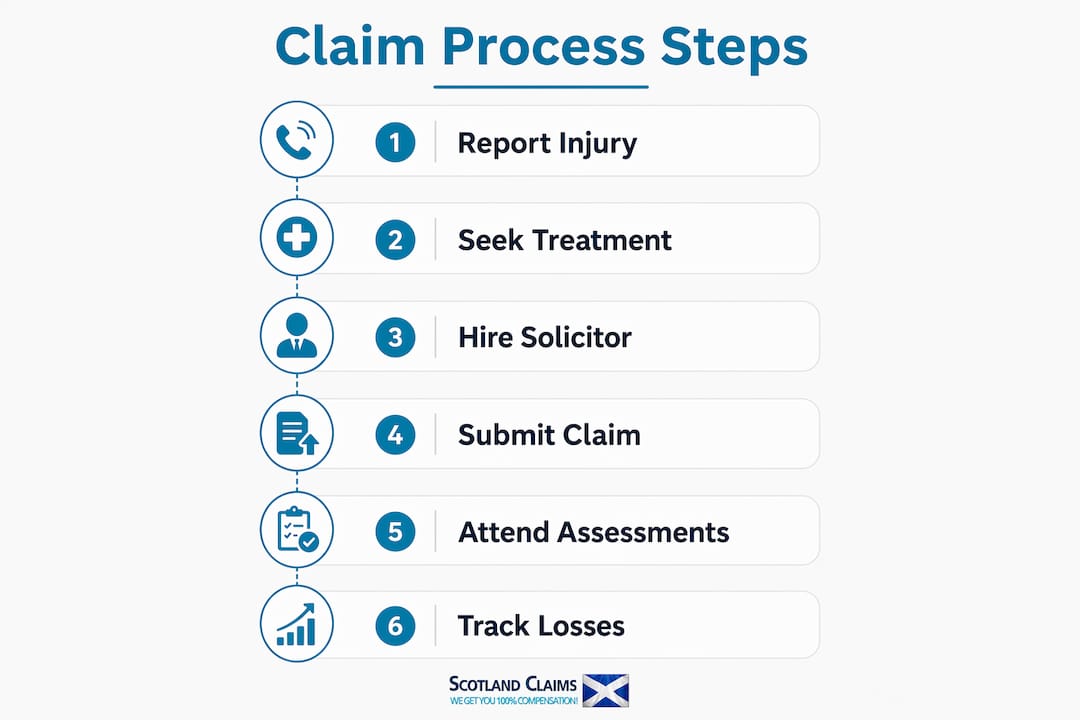
Step 2: Instruct a specialist solicitor
Engage a solicitor who specialises in workplace injury claims in Scotland. A specialist will assess liability, gather evidence, and manage insurer correspondence on your behalf. Attempting to negotiate directly with an insurer without legal support puts you at a significant disadvantage.
Step 3: Submit your claim with full documentation
Your solicitor will notify your employer’s insurer formally. The insurer then has a defined period to respond. Employers must respond within three months of receiving notice of your claim, either admitting fault or disputing it. Knowing this deadline helps you plan your next steps.
Step 4: Comply with medical treatment and assessments
Attend all medical appointments and follow prescribed treatment plans. Insurers monitor compliance. Failing to attend appointments or ignoring medical advice gives them grounds to argue your recovery was self-inflicted or prolonged unnecessarily.
Step 5: Track and submit all financial losses
Lost earnings, future earning capacity, and hidden recovery costs such as household help all form part of your claim. Detailed proof of every cost is critical for maximising the final settlement.
The table below summarises the most common claim pitfalls and how to avoid them:
| Common pitfall |
How to avoid it |
| Delayed injury reporting |
Report to your employer and via RIDDOR on the day of the incident |
| Insufficient medical evidence |
See a GP or A&E immediately and request a written record of the work-related cause |
| Undocumented financial losses |
Keep receipts and a written log of all costs from day one |
| Returning to work too early |
Obtain medical clearance in writing before resuming duties |
| Negotiating directly with insurers |
Instruct a specialist solicitor before any insurer contact |
How can workers protect themselves against unfair treatment during a claim?
Unfair treatment during a compensation claim is more common than many workers expect, but it is also more legally exposed than employers realise. The law is clear on this point.
Key protections you hold as a claimant include:
- Protection from dismissal: Your employer cannot lawfully dismiss you because you made or intend to make a compensation claim. Dismissal in these circumstances is automatically unfair under the Employment Rights Act 1996.
- Protection from demotion or reduced hours: Reducing your pay, hours, or responsibilities in response to a claim is a form of victimisation and is unlawful.
- Protection from intimidation: Employers are prohibited from intimidating or pressuring employees to withdraw claims. Document any such conduct in writing immediately.
“If your employer makes your working life difficult after you raise a claim, that conduct itself may form the basis of a separate legal action for constructive dismissal or discrimination.”
When you experience any of the above, the correct response is to document everything and seek legal advice without delay. Your solicitor can advise on whether to pursue a separate employment tribunal claim alongside your compensation claim. You can read more about your full rights in our guide to accident at work rights in Scotland.
The workplace injury claim process in comparable legal systems confirms that workers who document employer conduct from the outset are significantly better positioned to challenge unfair treatment. The principle holds equally in Scotland.
Key takeaways
Protecting your worker compensation rights in Scotland requires early reporting, thorough documentation, and legal support from a specialist solicitor.
| Point |
Details |
| Employers’ Liability Insurance |
All Scottish employers must hold ELI, so compensation comes from the insurer, not the employer directly. |
| Report immediately |
Report your injury to your employer and via RIDDOR on the day it occurs to establish a clear evidence trail. |
| Document all costs |
Record every expense including household help and lost earnings, as these form a legitimate part of your claim. |
| Legal protection from retaliation |
Dismissal or intimidation for making a claim is unlawful and can be challenged through employment law. |
| Instruct a specialist solicitor |
A solicitor manages insurer correspondence and maximises your settlement, especially within the three-month response window. |
What I have learned from watching workers navigate compensation claims in Scotland
Roger here. After years of working alongside injured workers and the legal teams who represent them, one pattern stands out above all others: the workers who protect their compensation most effectively are not the ones with the most serious injuries. They are the ones who act quickly and keep records.
The most common mistake I see is workers waiting to report an injury because they feel embarrassed, do not want to cause trouble, or assume the injury will resolve itself. That delay costs them. Insurers treat a gap between the incident and the first medical record as evidence that the injury was not serious or was not work-related. A few days of hesitation can reduce a claim by thousands of pounds.
The second thing I would say is this: do not be intimidated by the process. Most employers are not your enemy in a claim. Their insurer is handling it, and insurers settle valid claims every day. The system is designed to work. What it requires from you is accuracy, consistency, and professional support.
If you are worried about the cost of legal advice, the No Win No Fee model exists precisely for this situation. You pay nothing unless you win. That removes the financial barrier that stops too many workers from pursuing what they are legally owed.
— Roger
How Scotlandclaims helps you secure your full compensation
Scotlandclaims connects injured workers across Scotland with specialist injury lawyers who handle workplace compensation claims on a No Win No Fee basis. You pay nothing upfront and nothing if your case is unsuccessful. For workplace injury claims such as accidents at work and slips or trips - and indeed every type of claim - Scotland Claims deducts no success fee whatsoever, meaning you keep 100% of your compensation. That compares very favourably with other large and national firms, which can charge up to 20% including VAT. Whether you have suffered a back injury at work or a knee injury caused by unsafe conditions, Scotlandclaims gives you access to experienced legal representation without financial risk. Start your claim today through a simple callback request or online form.
FAQ
What is Employers’ Liability Insurance and why does it matter?
Employers’ Liability Insurance is a mandatory policy that all Scottish employers must hold. It means compensation payments for workplace injuries are funded by the insurer, not the employer directly, making the claims process more straightforward for workers.
How long do I have to make a workers’ compensation claim in Scotland?
The standard time limit for personal injury claims in Scotland is three years from the date of the injury. Acting sooner is always advisable, as early evidence is stronger and easier to gather.
Can my employer dismiss me for making a compensation claim?
No. Dismissing or victimising an employee for making a compensation claim is automatically unfair under the Employment Rights Act 1996 and can be challenged through an employment tribunal.
Does contributory negligence cancel my claim?
No. If you share some responsibility for the accident, your compensation is reduced proportionately rather than cancelled. You can still make a valid claim and receive a fair settlement.
What costs can I include in a workers’ compensation claim in Scotland?
You can claim for lost earnings, medical expenses, travel to appointments, and hidden recovery costs such as household help or family caregiving. Keep receipts and a written record of every cost from the day of the injury.
Recommended