£25,000 Rule: Does Scotland’s Pre-Action Protocol Apply to Your Claim?

The Compulsory Personal Injury Pre-Action Protocol applies to your claim if it is worth £25,000 or less, the accident happened on or after 28 November 2016, and you have instructed a solicitor. If those three conditions are met, mandatory stages, strict timescales, and potential court sanctions for non-compliance apply. Your first move should be to preserve evidence and get specialist legal advice before any deadline starts running.
TL;DR:
- Claims exceeding £25,000 or involving clinical negligence, disease, or unrepresented claimants are not subject to the compulsory protocol and follow different procedures.
- The protocol’s strict deadlines, like the five-week period for settlement offers and expenses, can lead to interest charges if missed, incentivizing prompt payment.
- Evidence including medical records, witness statements, and photos must be ready early, as the protocol emphasizes early, transparent information exchange.
- If a claim’s value surpasses £25,000 during the process, the solicitor must notify the defender to decide whether to continue under the protocol or proceed accordingly.
- Non-compliance by insurers or claimants with protocol steps can result in sanctions or adverse expenses orders, highlighting the importance of timely, proper conduct throughout.
Table of Contents
What is the pre action protocol in Scotland, and when does it apply?
The £25,000 threshold is the figure that decides everything. It refers to the value of the claim exclusive of interest and expenses, meaning the raw compensation figure for pain, injury, and financial losses, not any interest accrued or legal costs on top. If your solicitor’s realistic estimate sits at or below that figure, the Act of Sederunt (Sheriff Court Rules Amendment) (Personal Injury Pre-Action Protocol) 2016 applies automatically, not by choice.
Timing matters just as much as value. The Protocol took effect on 28 November 2016, and it only applies where the accident or incident itself occurred on or after that date. An accident from 2015, for example, sits outside the statutory scheme entirely because the rules did not exist when the harm happened.
Claim values shift constantly as medical evidence develops, and the Protocol accounts for that. If your injury turns out worse than first thought and the estimated value creeps past £25,000 partway through the process, you (or rather your solicitor) must notify the defender. At that point, both sides have a choice: step outside the compulsory framework and proceed to ordinary court procedure, or agree to continue voluntarily under the same Protocol structure anyway. Many parties choose the latter, because the stages, timescales, and information exchange already in motion tend to be more efficient than starting again from scratch under different rules.
This is worth checking early, not late. A claim that looked like a straightforward £15,000 whiplash case at the outset can grow substantially once an orthopaedic report comes back showing ongoing pain, lost earnings, or a need for future treatment. Reassessing value at each stage, rather than assuming the original estimate still holds, avoids awkward procedural surprises further down the line.
Which claims fall outside the compulsory protocol?
Four categories sit outside the compulsory scheme, and knowing which one might apply to you saves wasted time chasing the wrong procedure.
Clinical negligence claims are excluded outright, as are professional negligence claims and disease claims (think industrial illness or long-latency conditions like asbestos-related disease). The fourth exclusion is different in kind: claimants who are not represented by a solicitor during the relevant stages fall outside the compulsory Protocol too, regardless of what type of injury they have suffered. Scotland Claims Injury Lawyers deals specifically with the categories the Protocol does cover, principally road traffic accident, workplace injuries, and slips or trips, so this exclusion list matters mainly for ruling things in or out rather than as a comprehensive guide to every excluded claim type.
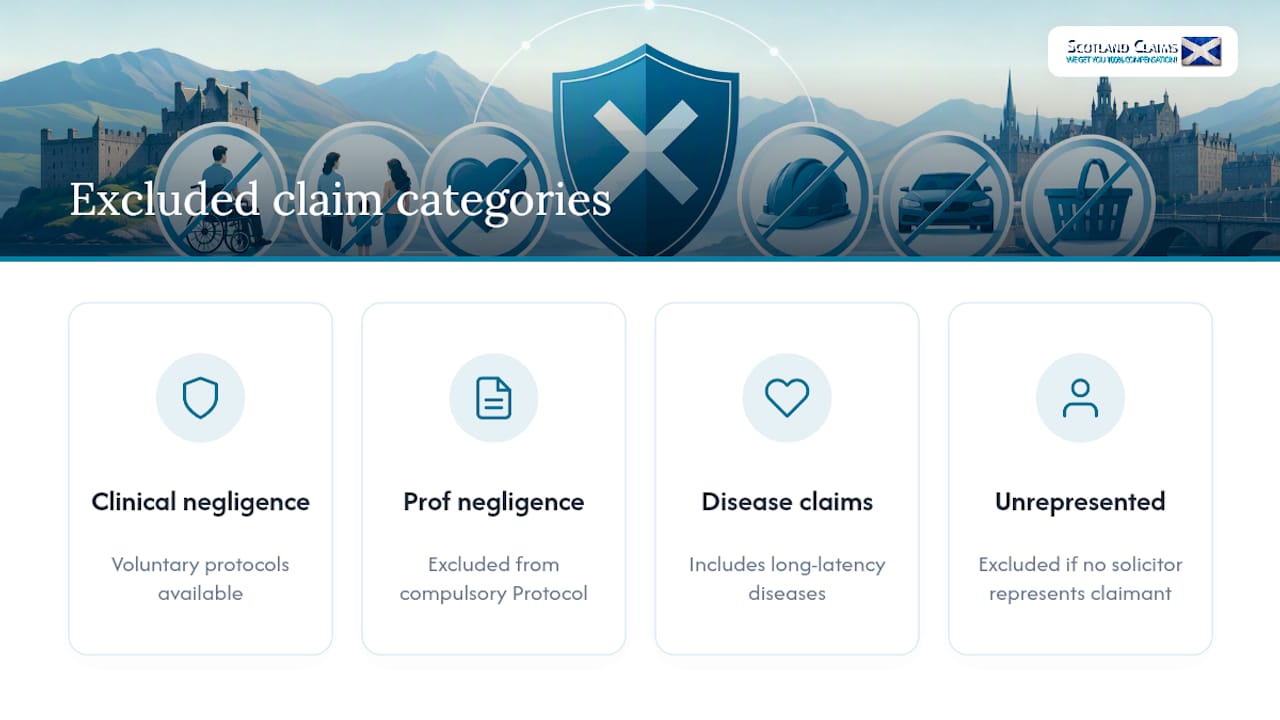
None of this means clinical negligence or disease claimants are left without any structure. Voluntary protocols exist for those categories, and parties can agree to follow similar early exchange principles even where the statutory scheme does not force it. The difference is enforceability: voluntary cooperation relies on goodwill, while the compulsory Protocol carries real timescales and sheriff court sanctions behind it.
Practically, being excluded changes your procedural path rather than your entitlement to compensation. A clinical negligence claim still proceeds, just through different pre-litigation steps with different expected timescales and evidential requirements. If you are unsure which category your case falls into, particularly where an injury has both an accident element and a treatment-related complication, get advice before assuming either way. Getting the category wrong at the outset can cost weeks.
What are the protocol stages and key deadlines?
The Protocol runs through a defined sequence, and missing a step out of order tends to create friction that slows the whole claim down. Here is how it actually unfolds:
- The Claim Form or letter of claim. Your solicitor issues a formal Claim Form setting out the facts of the accident, the injuries sustained, and the losses claimed to date. The statutory appendices to the Act of Sederunt set out the expected contents and format, so solicitors work from the prescribed template rather than an open-ended letter.
- The defender’s investigation period. The defender (usually an insurer acting for the at-fault party) has up to three months from receiving the Claim Form to investigate and reply. That reply must state clearly whether liability is admitted or denied, give reasons for the position taken, and disclose any documents relied upon in reaching it.
- Medical evidence. Once liability is addressed, medical evidence gets instructed and exchanged. Offers under the Protocol generally cannot be made until formal medical evidence has been submitted, unless the pursuer sought no formal treatment at all, so this stage is rarely skippable in practice.
- The Statement of Valuation. Your side prepares a formal valuation, using the prescribed form referenced in the statutory annex, setting out damages sought under each head of claim (pain and suffering, loss of earnings, and so on) with supporting evidence attached.
- The settlement offer. The defender may make a settlement offer within five weeks of receiving the Statement of Valuation and its supporting evidence. That five-week clock is one of the more commonly misunderstood parts of the Protocol, because it runs from receipt of the valuation, not from the original Claim Form.
- Response windows. Once an offer or a request for further information lands, the rules build in short response windows, typically 14 or 21 days depending on what is being asked. Miss one without good reason and you risk being seen as the party slowing things down, which matters later if a sheriff looks at conduct.
- Raising proceedings. If the parties cannot reach settlement within the Protocol’s structure, either side can raise court proceedings once the process has run its course. That is the fallback, not the goal. The Protocol’s core purpose is to secure “early, full and transparent exchange” of information precisely so that most claims settle without ever reaching a courtroom.
Each stage has a knock-on effect on the next. A delayed medical report pushes back the valuation, which pushes back the five-week offer window, which pushes back everything after it. Keeping your own side of the paperwork moving is one of the few things you can directly control in a process largely driven by the defender’s insurer.
What documents and evidence does the protocol expect?
The Protocol works on the principle that both sides show their hand early, and that only functions if you actually have the paperwork ready when it is asked for.
- Medical records covering the injury, treatment, and any pre-existing conditions relevant to causation.
- Witness statements from anyone present at the time of the accident.
- Payslips or accounts showing lost earnings, particularly for the self-employed where income proof is less straightforward.
- Receipts or invoices for treatment costs, care, or equipment bought as a direct result of the injury.
- A police report, where one exists, for road traffic accident.
- Photographs of the accident scene, vehicle damage, or the hazard involved in a slip, trip, or workplace injury.
Expert evidence, usually a medical report from a relevant specialist, gets instructed once liability discussions are underway and disclosed to the other side as part of the valuation stage. There is no single national portal for exchanging any of this; documents pass directly between solicitors and insurers under the statutory framework rather than through a shared digital system, so keeping your own organised file matters more than it might in other jurisdictions.
Not everything needs to be handed over. Legally privileged correspondence between you and your solicitor, and sensitive medical records unconnected to the injury being claimed for, generally stay out of the disclosure obligation. If you’re ever unsure whether something is fair game, ask before sending it.
Pro Tip: Start a single folder, physical or digital, the day of the accident. Photograph everything before it gets cleared away, and keep a written note of dates and conversations while they’re still fresh, not three weeks later when the Claim Form is being drafted.
Practical guidance on organising accident paperwork for a Scottish claim covers this in more depth if you want a fuller checklist before you start.
How do settlement offers and expenses actually work?
Once your Statement of Valuation and supporting evidence land with the defender, a limited period starts during which they may put forward a settlement offer. That offer, if it comes, should factor in Protocol expenses where they apply, not just the headline damages figure.
Accepting the offer triggers another limited period: the defender must pay both the agreed damages and the Protocol expenses within that timeframe. Missing this deadline causes interest to start running on the unpaid sum, providing financial incentive for insurers to pay promptly.
Protocol expenses themselves follow a stepped scale rather than a flat fee, made up of two parts. Part 1 is a fixed element that applies regardless of claim size, and Part 2 adds a percentage on top, calculated against bands of damages recovered, as set out in practitioner guidance summarising the statutory scale. Reasonable disbursements and VAT sit on top of both elements.
| Component |
What it covers |
How it is calculated |
| Part 1 (fixed element) |
Base pre-litigation expenses |
Fixed fee, regardless of damages amount |
| Part 2 (percentage bands) |
Scaled expenses reflecting claim value |
Percentage applied per damage band recovered |
| Disbursements |
Costs like medical report fees |
Reasonable amounts, added separately |
| VAT |
Tax on chargeable expenses |
Added on top of the above |
One detail deserves emphasis: the five-week payment rule is a genuine statutory deadline, not a target. If the deadline is missed, interest becomes payable on the outstanding damages and expenses, which is precisely why this article’s central figure, that five-week window, appears at two separate stages: once for the offer itself, and again for payment after acceptance.
Because Scotland Claims Injury Lawyers operates on a No Win No Fee basis with no success fee deducted, expenses recovered through this scale are recovered from the defender’s insurer, not taken from your compensation, so the mechanics above affect the paying party’s costs rather than what lands in your pocket.
What happens if the other side doesn’t play by the rules?
Sheriffs are not passive observers of Protocol compliance. Under the Act of Sederunt, a sheriff has discretion to take a party’s conduct during the Protocol into account when deciding how expenses are awarded in any later court proceedings, and that discretion has teeth.
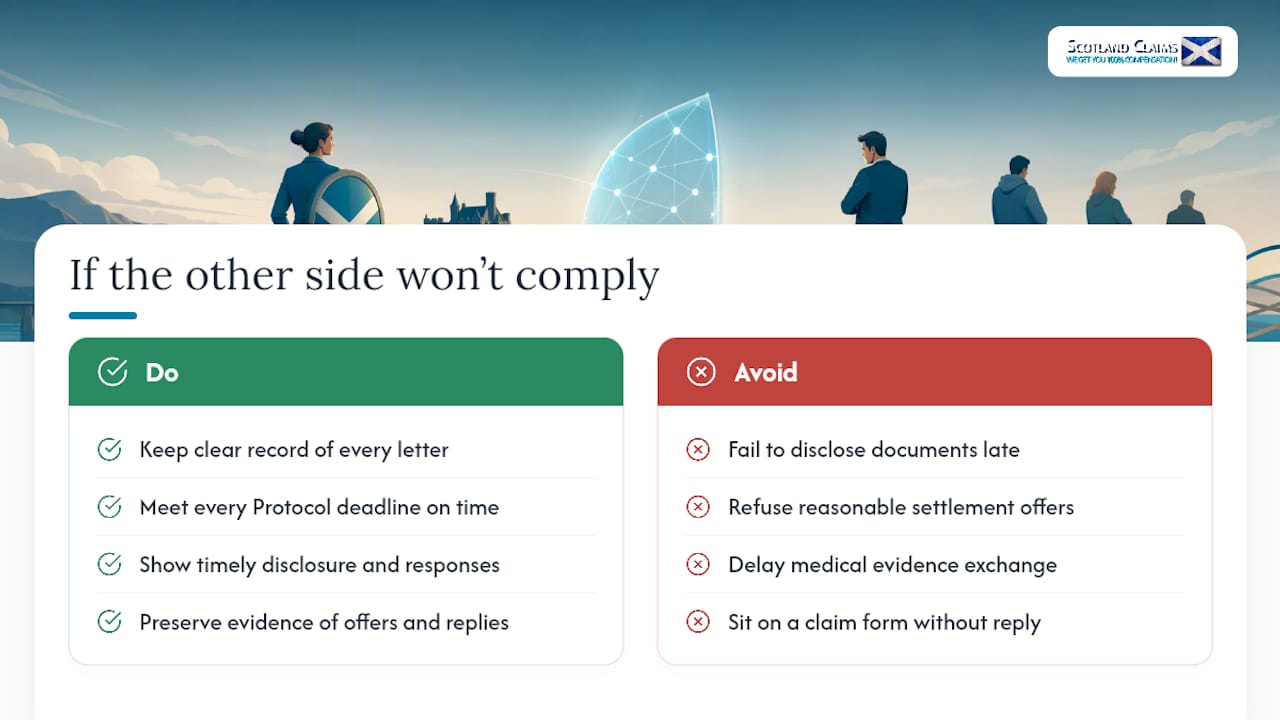
Common breaches include failing to disclose documents within the required timescale, refusing settlement offers that later turn out to be reasonable given the eventual court outcome, or dragging out medical evidence exchange without a good reason. The likely consequence is not a slap on the wrist. A sheriff can adjust the expenses award against the non-compliant party, effectively penalising them financially for conduct that slowed the process down or forced unnecessary litigation.
This cuts both ways, which is exactly the point of the Protocol. An insurer who sits on a Claim Form for months without a substantive reply risks an adverse expenses order later. Equally, a pursuer’s side that refuses a genuinely reasonable offer, only to recover a similar or lower sum after full litigation, can find that refusal reflected in the expenses decision too.
The practical lesson is straightforward: keep a clear record of every letter sent, every deadline met, and every response received. If your case does end up before a sheriff on the question of conduct, being able to demonstrate that you complied with each stage on time, while the other side did not, is often the single most persuasive piece of evidence in the room.
What should you do right now to protect your claim?
Getting the groundwork right in the first few days shapes how smoothly everything else runs. Here is the practical order of operations:
- Preserve evidence immediately. Photograph the scene, injury, or hazard, note down witness contact details, and keep any correspondence with employers, insurers, or the police in one place.
- Write a timeline while it’s fresh. Dates, times, and sequence of events matter far more once weeks have passed and memory has softened the details.
- Contact a solicitor to issue the formal Claim Form. This is not a step to attempt without representation, since the Protocol only applies to claims where a solicitor is instructed, and the form itself follows a prescribed statutory format.
- Let your solicitor manage medical report timing. Reports are typically instructed once liability discussions are underway, and disclosed as part of the valuation stage, not before you or your solicitor judge the injury has stabilised enough to assess properly.
- Prepare the Statement of Valuation with full supporting evidence. Every head of loss claimed, whether pain and suffering, lost earnings, or treatment costs, needs a document behind it.
- Flag any change in estimated value straight away. If your claim looks like it may exceed £25,000 as evidence develops, tell your solicitor immediately so a decision can be made about continuing under the Protocol voluntarily or shifting to ordinary procedure.
Pro Tip: If the defender asks for more time beyond the standard three-month investigation period, get the reason in writing. A vague request for “more time to investigate” without a stated reason is exactly the kind of conduct a sheriff may later scrutinise.
The full step-by-step guide to the Scottish personal injury claims process covers how these steps fit into the wider claim beyond the Protocol stages themselves.
How Scotland Claims Injury Lawyers approaches protocol cases
Cases under the compulsory Protocol reward precision more than aggression. The firm’s approach leans on getting the Claim Form right the first time, chasing medical evidence promptly rather than letting the three-month investigation window drift, and building a Statement of Valuation that holds up rather than one that invites a low counter-offer.
Handling evidence and valuation well under this Protocol is less about legal theatre and more about discipline: correct forms, accurate figures, and deadlines met on time so the defender’s insurer has no procedural excuse to delay or dispute what should be a straightforward claim. When a settlement tender does arrive, checking it against the Part 1 and Part 2 expenses scale properly, rather than accepting the first figure quoted, is where real value gets protected.
None of that costs you anything upfront. Scotland Claims Injury Lawyers works on a genuine No Win No Fee basis, and clients keep 100% of their awarded compensation, compared with the up to 20% (including VAT) that many larger solicitor firms deduct as a success fee. That distinction is the whole point of choosing carefully who represents you through a process this procedural.
— Roger
Get help with your Scotland pre-action protocol claim
If you’re staring down a Claim Form deadline or trying to work out whether your accident even falls within the £25,000 threshold, that is exactly the kind of question worth putting to a specialist rather than guessing. Scotland Claims Injury Lawyers offers a free assessment of your claim, checking value, exclusions, and timescales against the statutory rules before anything formal gets issued.
Unlike solicitor firms that take up to 20% (including VAT) of your settlement as a success fee, Scotland Claims Injury Lawyers takes nothing from your compensation. Whiplash, road traffic accidents (as driver or passenger, provided you were not at fault), workplace injuries, and slips or trips all qualify for 100% compensation with no upfront cost and no success fee.
If your claim might sit near the £25,000 threshold, the compensation calculator gives a quick estimate before you commit to anything. When you’re ready to move, visit the injury lawyers Scotland page to start your claim form or request a callback from a specialist solicitor today.
Where to check the statutory rules yourself
The primary legal text is the Act of Sederunt (Sheriff Court Rules Amendment) (Personal Injury Pre-Action Protocol) 2016, which sets out the scope, exclusions, and sanctions in full statutory language. For the exact appendices, prescribed forms, and the detailed wording of timescales, the PDF version of the Act of Sederunt is the more useful working document, since it includes the annexed templates referenced throughout the rules.
For context on why the Protocol was introduced, the Scottish Civil Justice Council’s announcement explains the policy reasoning behind encouraging early settlement over litigation. Practitioner-level explanation, useful if you want the statutory language translated into plainer procedural steps, is available through LexisNexis’s guidance on the Scottish Pre-Action Protocol, which walks through scope, stages, and sanctions in sequence.
Broader background on the personal injury claims process in Scotland, including how the Protocol fits within the wider claims journey, is covered in this guide to personal injury claims in Scotland. None of these sources replace tailored advice on your specific case, but they are the right starting point if you want to read the statutory wording rather than take a summary on trust.
This article is general information, not a substitute for advice from a qualified lawyer. Consult a qualified legal professional about your own circumstances before acting on anything here.
Sources
FAQ
Is the pre-action protocol mandatory in Scotland?
Yes, for claims valued at £25,000 or less where the incident happened on or after 28 November 2016 and the claimant has a solicitor. Clinical negligence, professional negligence, disease claims, and unrepresented claimants fall outside the compulsory scheme.
How much does the pre-action protocol cost?
The Protocol itself imposes no separate fee; costs arise through legal representation and are governed by the stepped expenses scale (a fixed Part 1 element plus Part 2 percentage bands). With Scotland Claims Injury Lawyers, there is no success fee and no upfront cost, since the firm operates on a No Win No Fee basis.
What is a pre-action protocol?
It is a statutory set of pre-litigation stages, forms, and timescales, set out in the Act of Sederunt, designed to encourage early exchange of information between claimant and defender so that a personal injury claim settles before court proceedings are needed.
What happens after the pre-action protocol concludes?
If settlement is reached, damages and expenses must be paid within five weeks of acceptance, with interest applying if that deadline is missed. If no settlement is reached within the Protocol’s structure, either party can raise formal court proceedings, and a sheriff may consider each side’s conduct during the Protocol when awarding expenses.
Recommended