
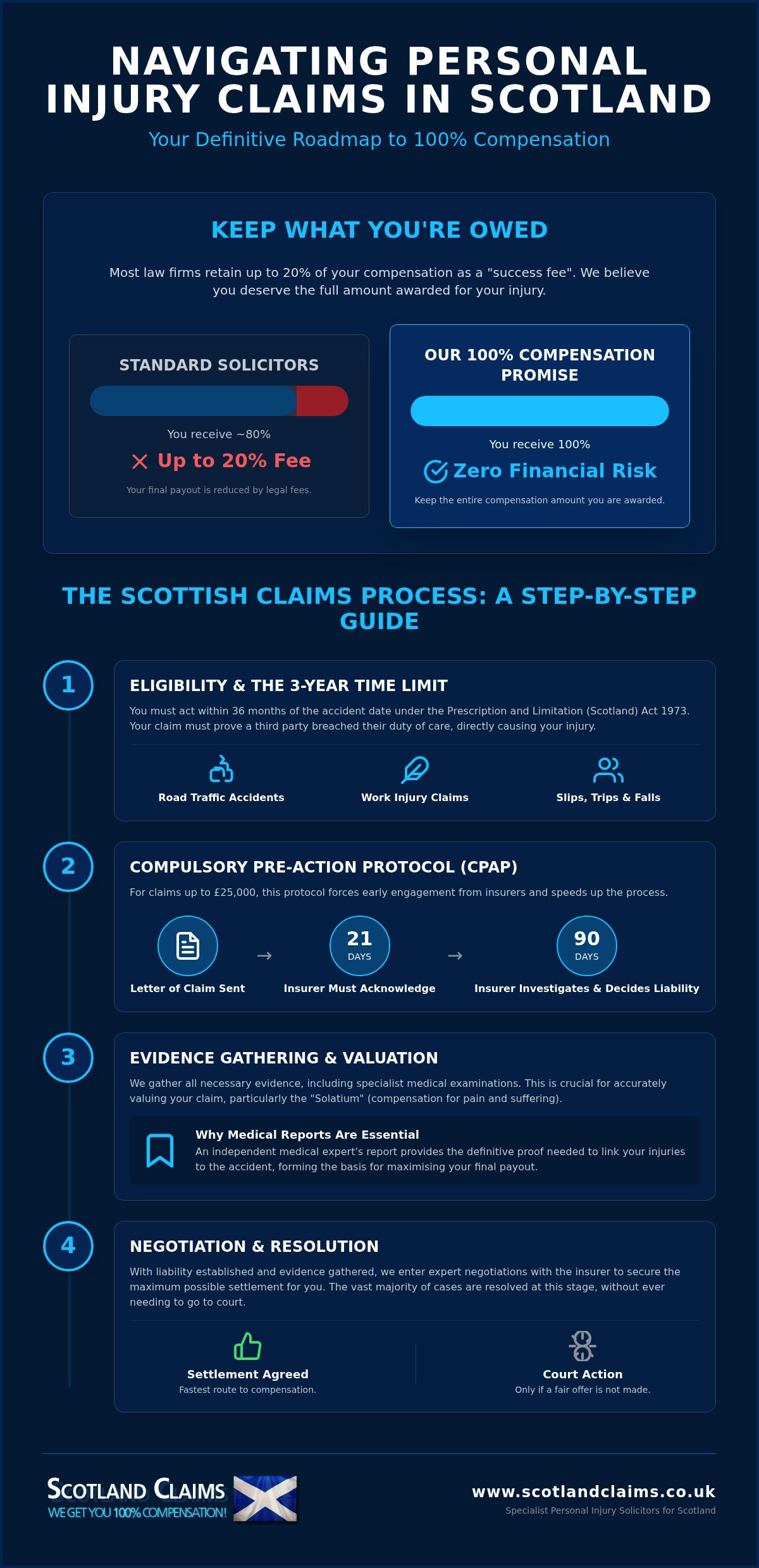
Most law firms in Scotland will pocket up to 20% of your hard-earned compensation as a success fee, but you shouldn't have to pay for your own justice. You deserve the full amount awarded for your injury. Understanding the personal injury claims scotland process is the first step toward protecting your financial future. It's a structured journey designed to settle most cases out of court, yet many people still feel intimidated by the legal jargon and the strict three-year time limit.
We know you want a clear path forward without the fear of hidden costs or the risk of losing your settlement to legal bills. You need a transparent alternative that puts your interests first. This guide simplifies the entire Scottish legal system, giving you a definitive roadmap from your first enquiry to the final payout. You'll learn how to navigate the compulsory protocols and specialist courts with confidence, ensuring you recover 100% of your compensation with zero financial risk.
Key Takeaways
- Act quickly to stay within the three-year limitation period and ensure your claim remains valid under Scottish law.
- Master the personal injury claims scotland process by following the compulsory pre-action protocols to secure a faster settlement.
- Learn why specialist medical examinations are essential for accurately valuing your "Solatium" and maximising your final payout.
- Understand how expert negotiation often leads to a resolution without ever stepping foot inside a courtroom.
- Discover how to bypass the standard 20% success fee and retain 100% of your compensation award.
Determining Your Eligibility: Can You Start a Personal Injury Claim in Scotland?
You've been hurt through no fault of your own. Now you need to know if the law is on your side. The personal injury claims scotland process starts with a rigorous assessment of eligibility. It isn't enough to simply be injured. You must prove that another party failed in their legal obligations to you. This foundation is built upon the Scots law of delict, which governs civil wrongs and the resulting liability. To succeed, your case must demonstrate that a duty of care existed, that this duty was breached, and that the breach directly caused your injuries.
Most successful claims in Scotland fall into specific categories. We focus on:
- Road Traffic Accident Claims involving cars, cyclists, or pedestrians.
- Work Injury Claims where safety standards were ignored.
- Slip or Trip Claims caused by poorly maintained public or private spaces.
Don't be discouraged if you think you were partially at fault. This is common and is legally termed contributory negligence. For example, if you were injured in a car accident but weren't wearing a seatbelt, your compensation might be reduced by a certain percentage. It doesn't mean you lose your right to a claim. It just means the valuation changes. Understanding the personal injury claims scotland process allows you to navigate these nuances with confidence.
The Three-Year Time Limit in Scotland
Under the Prescription and Limitation (Scotland) Act 1973, you generally have 36 months from the accident date to raise court proceedings. This "clock" starts the moment you become aware of your injury. Whilst exceptions exist for children or those without legal capacity, the deadline is usually absolute. We recommend starting within the first 12 months to ensure all evidence remains fresh and accessible.
Establishing a Duty of Care
A duty of care exists when a relationship creates a legal responsibility for your safety. An employer owes this to an employee; a local council owes it to pedestrians. We prove a breach by applying the "reasonable person" standard. If a sensible party would have acted differently to prevent the hazard, the law holds them accountable. Linking this breach to your physical or psychological harm is the final, vital step.
The Compulsory Pre-Action Protocol: How the Process Officially Begins
Once eligibility is confirmed, the formal personal injury claims scotland process moves into a strictly regulated phase. This is governed by the Compulsory Pre-Action Protocol (CPAP). It applies to most claims valued up to £25,000. This framework is designed to keep cases out of the All-Scotland Sheriff Personal Injury Court by forcing insurers to engage early. It prevents the "wait and see" tactics often used by large corporations to wear claimants down.
The protocol follows a rigid timeline. First, your solicitor sends a formal Letter of Claim to the at-fault party and their insurer. This document details the accident, the specific negligence involved, and the nature of your injuries. The insurer has exactly 21 days to acknowledge receipt. If they miss this deadline, the protocol is breached, allowing us to raise court proceedings immediately. This pressure ensures your claim doesn't sit at the bottom of an adjuster's pile.
Following the acknowledgement, the insurer has a maximum of 90 days to investigate. During this window, they must either admit or deny liability. This structure is a major benefit for you. It provides a clear deadline for a decision, speeding up the path to your settlement. You can get an immediate estimate of your potential award by using our personal injury compensation calculator.
The Letter of Claim and Initial Response
Precision is vital at this stage. Specialist injury lawyers in Scotland draft these letters to satisfy strict legal standards. We include every necessary detail to prevent insurers from requesting "further information" to stall the process. If the 21-day window passes without a response, it's a clear signal that the insurer is failing their obligations. We don't wait around; we take the next legal step to protect your interests.
Liability Decisions: Admission vs. Denial
An admission of liability is a significant win. It means the insurer agrees their client was at fault. We then focus entirely on valuing your claim. A denial is different. The insurer must provide a detailed explanation and evidence for their position. They can't just say "no" without proof. If they offer a "partial admission," they're suggesting you share some blame. We negotiate these percentages aggressively to ensure your final payout isn't unfairly slashed.
Evidence Gathering and Valuation: Proving the Extent of Your Loss
Once liability is established, the personal injury claims scotland process shifts focus to valuation. You can't just guess a figure. You need hard evidence to ensure you recover every penny you're owed. This stage is about turning your physical and financial suffering into a robust legal argument. We look at two main areas: Solatium and Special Damages.
Solatium is the specific Scottish legal term for pain, suffering, and the loss of your usual lifestyle. If your injury prevents you from enjoying hobbies or playing with your children, the law recognises this as a loss that requires compensation. Special Damages cover your tangible, out-of-pocket expenses. This includes everything from prescription costs and travel to hospital to the wages you lost whilst unable to work. Using our compensation calculator helps set realistic expectations for these figures early in the process.
The Role of Expert Medical Evidence
Your GP is vital for your recovery, but their records aren't enough for a high-value claim. We instruct independent medical specialists, such as orthopaedic surgeons or neurologists, to examine you. They provide a detailed report that links your injuries directly to the accident. We wait for your recovery to "plateau" before settling. This ensures your final award covers any long-term complications or future treatment needs. Quantum is the total financial value of a personal injury claim.
Documenting Financial Losses
Insurers will only pay for what you can prove. To maximise your settlement, you need a clear paper trail of your financial setbacks. We recommend gathering the following evidence immediately:
- Wage Slips: Provide copies from the 13 weeks prior to the accident to calculate your average loss of earnings.
- Tax Returns: Essential if you are self-employed to prove your typical income.
- Receipts: Keep every ticket for public transport or receipt for medical equipment.
- Accident Diary: Record the daily impact of your pain and the activities you can no longer perform.
You can also make a "Services" claim if family members had to provide extra care during your recovery. Their time has a financial value under Scottish law. Documenting these hours ensures your loved ones are also recognised for their support.
Negotiation and Resolution: Reaching a Settlement or Raising Court Action
You have your medical reports. You know your financial losses. Now, the personal injury claims scotland process moves to the negotiation table. This is the "Offer and Counter-Offer" phase. We present our valuation to the insurance company and wait for their response. They will likely come back with a lower figure. This is standard practice. We don't accept these initial "low-ball" offers. We use the evidence gathered in the previous stages to justify why you deserve the full amount.
Most people worry about appearing in front of a judge, but you can rest easy. Verified data shows that over 90% of personal injury claims in Scotland are settled out of court. Litigation is expensive and risky for insurance companies. They usually prefer the certainty of a negotiated settlement over the unpredictability of a trial. However, if an insurer refuses to accept liability or won't offer a fair sum, we take the next step. We move the battle to the courtroom to protect your interests.
Check how much your claim could be worth
Settling Out of Court
Negotiating a settlement offers speed and certainty. You get your money faster and avoid the stress of a formal hearing. We identify a "fair" offer by comparing your case to Judicial Expenses guidelines and recent Scottish case law. Be aware that a settlement is final. Once you sign the discharge form and accept the money, you cannot re-open the claim. This is why we ensure your injuries have fully stabilised before agreeing to any figure.
When Court Action Becomes Necessary
If negotiations stall, we raise a formal action by serving a summons on the defender. Most specialist cases are heard at the All-Scotland Sheriff Personal Injury Court (ASSPIC) in Edinburgh. This court was established in 2015 to handle complex injury litigation with greater consistency. If your case reaches a "Proof" hearing, a Sheriff will listen to the evidence and make a final decision. Even at this stage, your No Win No Fee protection remains in place. You won't face financial ruin just for seeking justice in court.
Securing 100% Compensation: Why Your Choice of Solicitor Matters
The final stage of the personal injury claims scotland process is where the financial reality of your choice becomes clear. After the hard work of proving liability and valuing your injuries, many firms will deduct a "success fee" from your award. This can be as much as 20% of your total compensation. We believe that after suffering an injury, you shouldn't have to pay for your own justice. The money awarded is meant to support your recovery, not to pad a law firm's profit margins.
Whether you are dealing with a road traffic incident or an accident at work, Scotland Claims Injury Lawyers operates on a foundation of absolute transparency. We recover our legal fees directly from the at-fault party's insurer. This ensures that the compensation calculated for your pain and losses stays entirely in your pocket. This protective approach distinguishes us from traditional, profit-heavy entities that penalise victims for seeking help.
Understanding Cost Recovery in Scotland
The Scottish legal system uses a mechanism called "Judicial Expenses" to ensure fairness. These are the costs that an insurer is required to pay to cover your legal representation. We focus on "Party-Party" costs, which are billed to the insurer, rather than "Solicitor-Client" costs, which are billed to you. By working efficiently, we ensure our expertise is funded by the opposition. You are never left with a surprise bill for the professional representation you received.
The 100% Compensation Guarantee
The financial impact of our model is best seen through a simple comparison. If your claim is valued at £10,000, a firm charging a success fee might leave you with only £8,000. With our 100% Compensation Guarantee, you keep every penny of that £10,000 award. We promise no hidden deductions, no admin fees, and no surprise charges at the end of the personal injury claims scotland process. Start your risk-free journey today by contacting our 24-hour freephone helpline for an expert assessment.
Take Control of Your Compensation Journey
Navigating the personal injury claims scotland process doesn't have to be a source of stress. You now have a clear roadmap from the initial Letter of Claim to the final valuation of your Solatium. By acting within the three-year limit and choosing a specialist who rejects the industry-standard success fee, you protect your financial future. You deserve a professional advocate who simplifies the system and prioritises your results.
We are regulated by the Law Society of Scotland and bring over 100 years of combined legal expertise to your case. Our model ensures you receive 100% of your compensation with 0% success fees. We recover our costs from the at-fault party's insurer; not from your settlement. This transparency is our commitment to fairness for every victim of a road, work, or public place accident.
Start your 100% compensation claim online today
Your recovery is the priority. Let us handle the legal complexity whilst you focus on getting your life back on track with the full financial support you deserve.
Frequently Asked Questions
How long does the personal injury claims process take in Scotland?
Most straightforward claims settle within 6 to 12 months. The specific timeline depends on the complexity of your injuries and whether the at-fault party admits liability within the mandatory 90-day investigation window. If your case requires court action to secure a fair result, the process will naturally take longer. We strictly enforce protocol deadlines to move your claim toward a resolution as quickly as possible.
Will I have to go to court for my personal injury claim?
You are very unlikely to attend court as over 90% of Scottish personal injury cases settle through negotiation. Court proceedings are usually a last resort used only when an insurer refuses to offer a fair settlement or disputes liability without evidence. Even when an action is raised in court, most cases are resolved before a formal hearing takes place. We handle all the legal formalities so you can focus on your recovery.
Can I still claim if the accident was partly my fault?
You can still recover compensation even if you share some responsibility for the incident. This is legally known as contributory negligence. Your final settlement is simply reduced by a percentage that reflects your portion of the blame. For instance, if you are found 20% responsible, you will still receive 80% of the total claim value. We negotiate aggressively to ensure any reduction is kept to an absolute minimum.
What is the difference between Scottish and English personal injury law?
The personal injury claims scotland process is governed by the law of delict, which is distinct from the English law of tort. Scotland has its own court system, specific pre-action protocols, and different rules regarding the recovery of legal fees. Crucially, the Scottish system allows for models where the solicitor's costs are recovered entirely from the insurer, meaning you don't have to lose a percentage of your award to success fees.
How much compensation will I receive for my injury?
Your compensation is calculated based on the severity of your physical pain and the total of your financial losses. We assess "Solatium" for your suffering and "Special Damages" for costs like lost wages and medical expenses. Because every injury affects a person differently, we use independent medical reports and Judicial Expenses guidelines to ensure your claim is valued at its maximum potential.
What happens if I lose my No Win No Fee case in Scotland?
You are protected by Qualified One-Way Costs Shifting (QOCS), which was introduced in June 2021. This means that if your claim is unsuccessful, you won't be held liable for the defender's legal costs. This protection applies as long as you have acted honestly and reasonably throughout the process. It effectively removes the financial risk of pursuing a claim, ensuring justice is accessible to everyone.
Can I claim for a road accident if the other driver was uninsured?
You can still secure compensation by making a claim through the Motor Insurers' Bureau (MIB). The MIB is a body funded by the insurance industry specifically to compensate victims of uninsured or untraced "hit and run" drivers. The personal injury claims scotland process for an MIB claim follows specific rules, but our expertise ensures you still receive the full value of your settlement regardless of the other driver's status.
Do I need to see a doctor chosen by the insurance company?
You should be examined by an independent medical expert instructed by your own solicitor. Whilst the insurance company might request their own assessment, your solicitor's independent report is the primary evidence used to value your claim. This ensures the medical assessment is unbiased and accurately reflects the long-term impact of your injuries. We arrange these specialist appointments at a time and location that suits you.