
Table of Contents
Last Updated: August 14, 2026
Personal Injury Claim Payout Time: What to Expect
Understanding how long a personal injury claim payout time takes is one of the first questions injury victims ask when considering legal action. Timelines vary dramatically depending on whether your case settles quickly or proceeds through the courts. The difference between a straightforward settlement and complex litigation can be months or even years.
The critical thing to understand upfront: patience is often rewarded. Rushing to accept an early settlement offer frequently means accepting far less compensation than you're entitled to. This guide breaks down what actually happens from the moment you contact a solicitor to the day funds arrive in your account.
The Three-Year Limitation Period and Why It Matters
The limitation period for personal injury claims in Scotland is three years from the date of the accident or, in cases involving children, three years from their eighteenth birthday. This is a hard legal deadline. Once three years have passed, you lose the right to claim entirely, regardless of the strength of your case.
The clock starts from the "date of knowledge," which is when you knew (or reasonably should have known) that you had an actionable injury. For most road traffic accidents or workplace injuries, this is straightforward. For some injuries, particularly occupational diseases or delayed-onset conditions, the date of knowledge might be when you received a diagnosis, not when the exposure occurred.
Missing this deadline has catastrophic consequences. You cannot claim at all. This is precisely why contacting a solicitor quickly matters, not because claims need to rush through the system, but because the three-year window is absolute. Scotland Claims Injury Lawyers advises getting legal advice as soon as possible after an injury, even if you're not certain whether you'll pursue a claim.
 Solicitor and client meeting in modern office, reviewing documents and discussing claim progress with a calendar visible on the desk
Stages of a Personal Injury Claim Explained
Understanding the distinct phases of a personal injury claim, and the realistic timeline for each, is essential for managing expectations. The journey from instruction to payout typically follows a predictable structure, though the duration of each stage varies depending on case complexity and external factors like court capacity.
Pre-litigation phase: Instruction to Pre-Action Protocol
The pre-litigation phase begins when you instruct a solicitor and is where the foundation of your case is built. This phase typically lasts between three and nine months for straightforward claims, though complex cases can extend to 12 months or longer.
Months 1-2: Evidence gathering and initial investigation
Your solicitor will obtain medical records from your GP and any consultants who've treated you, request accident reports from police or employers, gather witness statements, and photograph the accident scene if relevant. For workplace injuries, they'll request health and safety records and incident reports. You'll provide a detailed account of the accident, your injuries, and the impact on your daily life.
Months 2-3: Liability assessment and initial contact
Once evidence is gathered, your solicitor assesses liability and makes initial contact with the defendant's insurer. For clear-cut cases, the insurer often admits liability at this stage. For disputed liability cases, the insurer may request further information or indicate they'll defend the claim.
Months 3-6: Pre-Action Protocol letter and response period
If liability isn't immediately admitted, your solicitor sends a formal Pre-Action Protocol letter to the defendant's insurer. This detailed document outlines the accident, injuries sustained, legal basis for the claim, and the quantum (financial value). The insurer then has a set response period, typically 21 days for straightforward claims, 28 days or longer for complex ones.
The insurer's response can take three forms: they admit liability and make a settlement offer; they admit liability but dispute the quantum; or they deny liability entirely. If they admit liability and make a reasonable offer, settlement negotiations begin immediately. If they deny liability or the offer is inadequate, you move toward the next phase.
Months 6-9: Settlement negotiation or decision to litigate
If both parties have admitted liability, your solicitor and the insurer's legal team negotiate the settlement figure. Many cases settle during this phase without ever reaching court. If settlement is reached, you move to the payout phase (typically two to four weeks for funds to arrive).
If settlement negotiations stall or the insurer refuses to engage meaningfully, your solicitor will advise whether to proceed to litigation. This is a critical decision point. Litigation is more expensive, takes longer, and carries the risk of an unfavourable judgment, but it may be necessary if the insurer's position is unreasonable.
Litigation phase: Court proceedings to judgment
Litigation begins when your solicitor raises a court action. From this point forward, the case is governed by strict procedural rules and court timetables. The duration of this phase ranges from 12 months for straightforward cases to three years or more for complex claims.
Months 1-3 after raising proceedings: Exchange of written statements and evidence
Both your solicitor and the defendant's legal team exchange written statements, medical reports, accident reports, and documentary evidence. The court sets strict deadlines for these exchanges. Failure to meet a deadline can result in sanctions, including dismissal of the claim or striking out of the defendant's defence.
Months 3-6: Procedural hearings and case management
The court will schedule case management conferences where the judge reviews progress and sets further deadlines. These hearings are often brief and conducted by telephone or video. If both parties indicate they're willing to settle, the judge may schedule a "hearing for settlement," a confidential discussion aimed at reaching agreement.
Months 6-24+: Court backlogs and waiting for trial
Once the procedural phase is complete, the case is ready for trial, but court capacity in Scotland is severely constrained. Cases frequently wait 12 to 24 months for a trial date, particularly in Glasgow and Edinburgh. A case that should take 18 months from raising proceedings to judgment often takes 30 to 36 months due to lack of available court time.
During this waiting period, very little happens from a claimant's perspective. Your solicitor is preparing evidence and liaising with medical experts, but you won't see visible progress. This is the most frustrating phase for many claimants because the outcome is determined, the evidence is gathered, but the court simply cannot accommodate the trial date.
Trial and judgment: Days to weeks
Once a trial date is reached, the hearing typically lasts one to three days, depending on case complexity. The judge hears evidence from you, medical experts, and witnesses, then reserves judgment. Judgment is usually delivered within weeks. If the judge awards damages in your favour, the defendant's insurer must pay within a set period (usually 14 days).
Settlement vs. litigation: A realistic comparison
For a straightforward claim with admitted liability and clear medical evidence, the entire process from instruction to payout typically takes 6 to 12 months. Most of this time is spent in the pre-litigation phase gathering evidence and negotiating settlement.
For a complex claim with disputed liability, ongoing medical treatment, or multiple parties involved, the timeline extends significantly. Pre-litigation can take 12 months or longer, and if litigation is necessary, add a further 24 to 36 months due to court backlogs. Total timeline: 3 to 4 years or more.
Rushing through the pre-litigation phase rarely saves time overall. Insurers won't settle fairly until medical evidence is complete and the case is properly prepared. Once litigation begins, delays are largely outside your solicitor's control and are driven by court capacity.
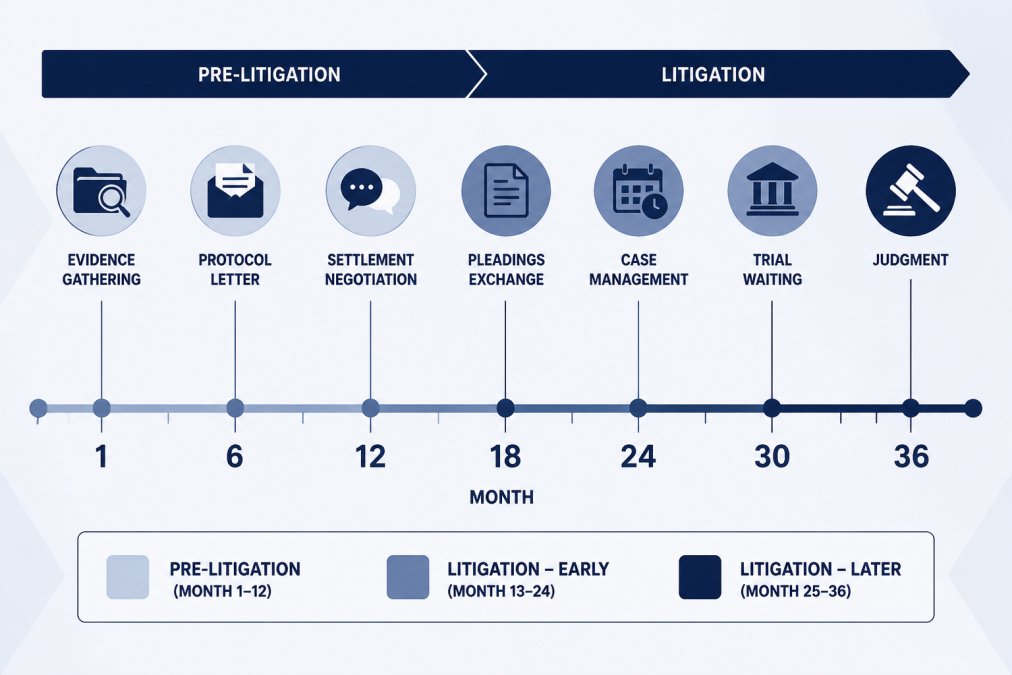 Timeline infographic showing Month 1 through Month 36, with key milestones marked for pre-litigation (evidence gathering, protocol letter, settlement negotiation) and litigation phases (pleadings exchange, case management, trial waiting, judgment), colour-coded by phase
Factors Affecting Compensation Settlement Time
Several variables determine how quickly your personal injury claim payout time moves through the system.
Admission of liability is the single biggest accelerator. If the defendant admits fault immediately, you skip months of dispute and move straight to valuation. Road traffic accidents are usually faster because liability is often clear-cut. Workplace injuries can be slower because employers frequently dispute negligence.
Injury severity also matters. Simple injuries often settle quickly because the quantum is small and predictable. Complex injuries requiring ongoing treatment, multiple surgeries, or resulting in permanent disability take longer because the valuation is harder to pin down.
Medical evidence quality directly affects settlement speed. If your GP has documented your injuries thoroughly and a consultant has provided a clear prognosis, settlement discussions can proceed. If medical records are sparse or contradictory, the insurer will demand further investigation, delaying the process.
Number of parties involved compounds delays. A two-vehicle road traffic accident is simpler than a multi-vehicle pile-up. Each additional party brings additional lawyers and additional opportunities for disagreement.
Interim payments can accelerate practical relief even while the full claim progresses. If you're facing financial hardship while waiting for settlement, your solicitor can apply to court for an interim payment, a partial award on account of damages.
How Long Do Insurance Companies Take to Pay Out?
Once settlement is agreed, the insurer doesn't immediately transfer funds. There's a final administrative phase that typically takes two to four weeks.
Get Started Today →
After your solicitor and the insurer's legal team agree on a settlement figure, the insurer issues a formal settlement authority. Your solicitor then sends a release document, a legal agreement confirming that you accept the settlement and won't pursue further claims. Once the insurer receives the signed release, they process payment.
Bank transfers typically arrive within three to five working days once the insurer has processed the settlement. Cheques take longer, sometimes two weeks or more. Your solicitor will usually request a bank transfer to speed things up.
The solicitor's costs are deducted from the settlement before you receive it. If you've instructed a solicitor on a No Win No Fee basis, which Scotland Claims Injury Lawyers offers, there's no upfront cost to you, and you keep 100% of your compensation. The solicitor recovers their costs from the opposing party's insurer as part of the settlement negotiation.
Simple vs. Complex Cases: Timeline Differences
A simple case, a clear-cut road traffic accident with minor injuries, no dispute over liability, and straightforward medical evidence, can move from instruction to final payout in six to twelve months. The insurer admits liability quickly, medical evidence is gathered within weeks, and settlement discussions conclude within a few months.
A complex case follows a completely different trajectory. A workplace accident involving multiple injuries, disputed liability, ongoing medical treatment, and an uncertain prognosis might spend six months gathering evidence, another six months in Pre-Action Protocol correspondence, and then face court backlogs that delay litigation by a further 18 months. The final payout could easily take three to four years.
In simple cases, there's little benefit to rushing; the insurer will likely settle fairly once liability is admitted and medical evidence is in. In complex cases, rushing is counterproductive. You need time to allow your injuries to stabilise, to gather comprehensive medical evidence, and to build the strongest possible case for maximum compensation.
Court Backlogs and Procedural Delays
Court backlogs have become the single most significant factor affecting personal injury claim timelines in Scotland. Understanding the scale of the problem and what strategies exist to manage it is essential for setting realistic expectations.
The scale of court backlogs post-pandemic
The Scottish court system experienced severe disruption during the pandemic, with many cases postponed and court capacity reduced. Although courts have resumed normal operations, the backlog of cases awaiting trial remains substantial. Cases that would historically have reached trial within 18 to 24 months from raising proceedings now frequently wait 24 to 36 months or longer.
This isn't a reflection of the quality of your case or your solicitor's competence. It's a systemic issue affecting all civil litigation in Scotland. The courts are under considerable pressure, and the volume of cases exceeds available court time.
Regional variations: Glasgow, Edinburgh, and beyond
Court backlogs are not evenly distributed across Scotland. The most severe delays occur in Glasgow and Edinburgh, where case volumes are highest and court capacity is most strained. Cases in these centres frequently wait 30 to 36 months from raising proceedings to trial.
Rural areas and smaller centres sometimes move faster simply because there's less volume. The Court of Session (the higher court for more complex cases) has its own backlogs, typically longer than the Sheriff Court. If your case is complex enough to warrant Court of Session proceedings, expect delays of 36 months or more from raising proceedings to trial.
Procedural delays within the court system
Beyond the headline issue of trial waiting times, procedural delays accumulate throughout litigation.
Extension requests: Either party can request extensions to file evidence or obtain medical reports. Multiple extensions compound quickly.
Medical expert delays: Obtaining an independent medical examination or expert report can take two to three months. If the defendant disputes the expert's findings and requests a second opinion, add another two to three months.
Interlocutory hearings: The court may schedule preliminary hearings to resolve procedural disputes. Each hearing requires both parties to prepare written submissions and attend court.
Strategies to mitigate delays
While your solicitor cannot eliminate court backlogs, several strategies can help manage them.
Expedite applications: Your solicitor can apply to the court to expedite the case if you're facing exceptional hardship. These applications are not automatic and are granted only in genuinely exceptional circumstances.
Settlement focus: The most effective way to avoid court delays is to settle before trial. Your solicitor should prioritise settlement negotiations throughout the litigation phase.
Early case management: At the first case management conference, your solicitor should work with the court and the defendant's legal team to set realistic timescales and avoid unnecessary extensions.
Mediation: If settlement negotiations stall, mediation can sometimes break deadlock and achieve settlement without trial.
What you can expect: Realistic timelines
For a straightforward case that settles during pre-litigation, you'll receive your payout within 6 to 12 months of instruction.
For a case that proceeds to litigation but settles before trial (the most common outcome), expect 18 to 30 months from instruction to payout.
For a case that proceeds to trial, expect 30 to 48 months from instruction to payout.
These timelines assume no exceptional complications. Cases involving multiple parties, serious injuries requiring ongoing treatment, or novel legal issues can take significantly longer.
Understanding that court delays are systemic, not personal, helps manage frustration during the waiting period. Your solicitor is not delaying your case; the court system is. Accepting this reality and focusing on what can be controlled, thorough case preparation, active settlement negotiation, and compliance with court deadlines, is the most effective approach to moving your claim forward as quickly as possible.
No Win No Fee and Your Payout Timeline
The personal injury claim payout time isn't affected by whether you've instructed a solicitor on a No Win No Fee basis or a traditional fee arrangement. However, the financial outcome is dramatically different.
Scotland Claims Injury Lawyers operates on a No Win No Fee basis, meaning you pay nothing upfront and nothing if the case is unsuccessful. If you win, you keep 100% of your compensation, the solicitor's costs are recovered from the opposing party's insurer as part of the settlement. This is fundamentally different from solicitors who charge a success fee, which reduces your final payout substantially.
The distinction is crucial. With a No Win No Fee arrangement, your solicitor is motivated to secure the best possible settlement because their costs are recovered from the opposing party, not from your compensation. There's no financial pressure to settle quickly for a lower amount; the solicitor's interest is in maximising your award, not rushing the process.
What Happens If You Miss the Limitation Period
Missing the three-year deadline is effectively a permanent bar to claiming. The courts have discretion to extend the limitation period in exceptional circumstances, for instance, if you were a child when the injury occurred, or if you lacked mental capacity to bring a claim, but these exceptions are narrow and rarely granted.
The practical consequence is stark. A claim worth £50,000 that's filed one day before the deadline is valid. The same claim filed one day after the deadline is worthless. There's no partial credit, no negotiation, no appeal. The right to claim simply ceases to exist.
This is why acting quickly, even if you're uncertain about pursuing a claim, is essential. Instructing a solicitor on a No Win No Fee basis costs you nothing and preserves your legal rights. You can always decide later not to proceed, but you cannot recover a right once it's expired.
For claimants reading this months or years after an injury, the question is whether the limitation period has passed. If you're unsure of the exact date, contact a solicitor immediately. If the deadline is approaching (within weeks), don't delay. If the deadline has passed, you've likely lost the right to claim, unless very specific circumstances apply.
Understanding personal injury claim timelines helps set realistic expectations and protects your legal rights. The three-year limitation period is absolute, settlement timelines vary based on case complexity and court capacity, and the choice of solicitor directly affects your final compensation. Scotland Claims Injury Lawyers specialises in maximising your payout through No Win No Fee arrangements, meaning you keep 100% of your compensation. If you've been injured through negligence, contact the team for a free, impartial consultation. There's no obligation, no upfront cost, and no risk to you.
Frequently Asked Questions
How long does a personal injury claim payout typically take from start to finish?
Most straightforward personal injury claims settle within 6-12 months, though this varies significantly. Simple cases with clear liability and minor injuries often resolve faster through out-of-court settlement. Complex cases involving serious injuries, disputed liability, or court proceedings can take 2-3 years or longer. The personal injury claim payout time depends on case complexity, insurance company responsiveness, and court availability. Medical evidence gathering and quantum valuation also influence the timeline substantially.
What is the three-year limitation period for personal injury claims?
You have three years from the date of the accident (or date of knowledge if injury wasn't immediately apparent) to start a personal injury compensation claim. This is the statutory limitation period under Scottish law. Missing this deadline means losing your right to claim, with very limited exceptions. The clock starts from the date of the incident, not from when you seek legal advice. Understanding this deadline is critical for protecting your legal position.
How long do insurance companies typically take to pay out a settlement?
Once a settlement is agreed in principle, insurers typically process payment within 7-14 days, though some take up to 28 days. The exact timeframe depends on the insurer's internal procedures and whether all documentation is complete. Delays can occur if the settlement terms require clarification or if the insurer disputes any aspect of the agreed amount. Your solicitor can chase the insurer for updates if payment is delayed beyond the expected timeframe.
What factors most affect how long my personal injury claim payout takes?
Key factors include injury severity, liability clarity, medical evidence availability, insurance company cooperation, and court backlogs. Cases with straightforward negligence and minor injuries settle quickly. Serious injuries requiring ongoing treatment or complex medical reports take longer to value. Disputed liability significantly extends timelines. Court proceedings add 12-24 months. Insurance company responsiveness and administrative efficiency also play major roles in settlement speed.