
Table of Contents
Last Updated: August 29, 2026
Why You Need a Motorbike Accident Solicitor
Motorcyclists face disproportionate risk on the roads. In 2025, motorcyclist deaths in the UK rose by 13% to 384, despite motorcycles representing less than 1% of traffic (gov.uk). Motorcyclists are 40 to 50 times more likely to be killed in a collision than car occupants travelling the same distance (peer-reviewed research). When an accident happens, the injuries are often severe, and navigating a personal injury claim without specialist legal support can leave you significantly out of pocket. 🏍️
This is where a motorbike accident solicitor becomes invaluable. Unlike general personal injury solicitors, specialists in motorcycle claims understand the unique challenges riders face: the assumption that bikers are reckless, the complexity of proving liability when a car driver claims they didn't see you, and the medical evidence needed to support claims for life-altering injuries. Scotland Claims Injury Lawyers has helped countless motorcyclists secure full compensation for injuries sustained through no fault of their own.
A specialist motorbike accident solicitor handles everything from gathering evidence at the scene to negotiating with insurers and, if necessary, taking your case to court. The best part? Most operate on a no win, no fee basis, meaning you pay nothing unless your claim succeeds, and you keep 100% of your compensation. Unlike many competitors who charge a 20% success fee, Scotland Claims Injury Lawyers doesn't take a cut from your payout.
How to Make a Motorcycle Accident Claim
Making a motorcycle accident claim involves several critical steps. The actions you take in the hours and days after an accident directly influence whether you'll secure full compensation or find your claim disputed by insurers.
Step 1: Gather Evidence at the Scene
The moment after an accident, adrenaline and shock make clear thinking difficult. Still, what you do immediately affects your entire claim. Take photographs of the accident scene from multiple angles: the position of both vehicles, road markings, traffic signals, weather conditions, and any visible damage to your motorcycle and protective equipment. If your helmet or leathers are damaged, photograph them, this visual evidence supports claims about the force of impact and the severity of your injuries.
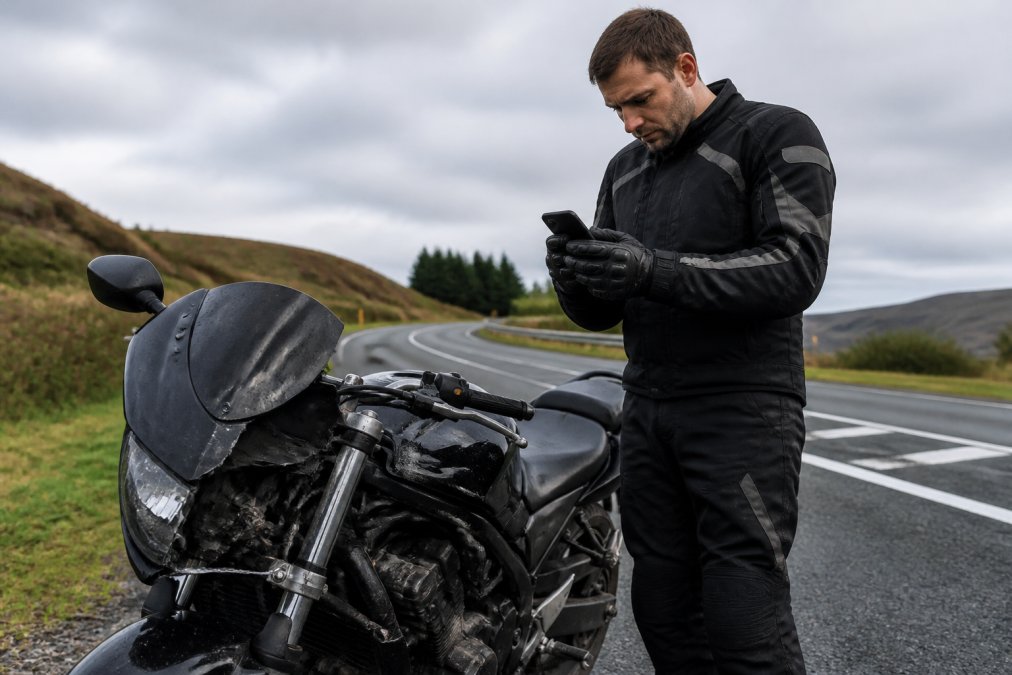 Motorcyclist in protective gear standing beside a damaged motorcycle on the roadside, examining damage with smartphone in hand, grey overcast sky, with road markings visible
Get contact details from any witnesses, other road users, pedestrians, nearby shopkeepers, or residents. Write down their names, phone numbers, and what they saw. Note the other driver's insurance details, registration number, and any dash cam footage they may have. If there are CCTV cameras nearby (on buildings, traffic lights, or nearby shops), note their locations. This information helps your motorbike accident solicitor reconstruct events later.
Step 2: Seek Medical Attention and Documentation
Even if you feel relatively unharmed, seek medical assessment. Adrenaline masks pain; injuries that seem minor at the scene often develop into serious conditions within hours or days. Whiplash, internal injuries, and head trauma can take time to manifest. Request a full medical report documenting all injuries, treatment received, and prognosis. This medical evidence forms the foundation of your compensation claim, without it, proving the extent of your injuries becomes nearly impossible.
Keep every receipt and document related to your treatment: GP appointments, physiotherapy sessions, hospital visits, prescriptions, and any time off work. These records create an audit trail that supports your claim for special damages (the quantifiable costs of your accident).
Step 3: Report the Accident to Police
Report the accident to Police Scotland, especially if there are injuries or significant vehicle damage. Request a police incident number and ask for a copy of the accident report once it's completed. The police report carries significant weight in personal injury claims, it's an independent record of what happened, including statements from the other driver and any witnesses.
If the other driver was at fault, the police report often reflects this. If liability is disputed, the report becomes crucial evidence your motorbike accident solicitor will use when negotiating with the other party's insurer.
Contact a specialist motorbike accident solicitor as soon as possible after the accident. The sooner you instruct a solicitor, the sooner they can secure evidence, obtain witness statements while memories are fresh, and begin investigating liability. Many firms, including Scotland Claims Injury Lawyers, offer free initial consultations where they assess your claim's strength and explain your options.
During this consultation, ask about their no win, no fee terms. Understand exactly what costs you might face if your claim fails, and confirm that you'll retain 100% of your compensation if successful. A reputable solicitor will be transparent about these terms and won't pressure you into proceeding if your case is weak.
Types of Injuries Covered in Motorcycle Accident Claims
Motorcycle accidents produce injuries across a spectrum of severity. Understanding what injuries are covered helps you recognise the full extent of your claim.
Spinal cord injuries represent some of the most serious outcomes. Damage to the spine can result in partial or complete paralysis, requiring lifelong care, mobility aids, and home modifications. These claims typically attract substantial compensation due to the permanent nature of the injury and ongoing care costs.
Traumatic brain injuries (TBI) range from concussions to severe cognitive impairment. Even a seemingly minor head injury can have lasting effects on memory, concentration, personality, and ability to work. Brain injury claims often require specialist neurological assessment and can justify compensation for rehabilitation, ongoing support, and loss of earnings.
Fractures and crush injuries are common in motorcycle accidents. Broken bones, crushed limbs, and soft tissue damage require surgery, physiotherapy, and extended recovery periods. Depending on the severity, these injuries can prevent return to work for months or permanently alter earning capacity.
Road rash and scarring occur when a rider slides across the road surface. While less life-threatening than spinal or brain injury, extensive scarring affects appearance and can cause psychological distress, particularly for younger riders. Compensation covers surgical scar revision, camouflage treatments, and damages for disfigurement.
Internal injuries including organ damage, internal bleeding, and ruptured organs may not be immediately obvious at the scene. These injuries often emerge during hospital assessment and can have life-altering consequences. Compensation reflects both immediate medical costs and long-term health impacts.
Post-traumatic stress and mental health conditions frequently follow serious accidents. Many riders develop anxiety, depression, or PTSD after surviving a collision. These psychological injuries are legitimate grounds for compensation, though they require supporting medical evidence from a mental health professional.
Your motorbike accident solicitor will work with medical experts to quantify the full extent of your injuries and calculate appropriate compensation across all these categories.
Understanding No Win No Fee Solicitors in Glasgow
The no win, no fee arrangement has transformed access to justice for injury victims in Glasgow and across Scotland. This model removes the financial barrier to pursuing legitimate claims.
Here's how it works: you pay nothing upfront for your solicitor's services. If your claim fails, you owe the solicitor nothing. If your claim succeeds, the solicitor recovers their fees from the compensation awarded. This arrangement aligns the solicitor's interests with yours, they only profit if you win, creating strong incentive to build the strongest possible case.
However, not all no win, no fee arrangements are equal. Many solicitors charge a success fee, typically 20% of your compensation, as their payment when you win. This means if your claim is worth £10,000, you receive £8,000 and the solicitor takes £2,000. Scotland Claims Injury Lawyers operates differently. We don't charge a success fee, meaning you retain 100% of your compensation. This distinction matters enormously when your claim is substantial.
When evaluating a motorbike accident solicitor offering no win, no fee terms in Glasgow, ask these questions:
- Will I pay anything if my claim fails?
- What percentage success fee, if any, will be deducted from my compensation?
- Are there any other costs I might face (court fees, expert witness fees)?
- Is the solicitor regulated by the Law Society of Scotland?
- Can they provide references from previous motorcycle accident clients?
The best no win, no fee solicitors are transparent about their terms and confident enough in their expertise to offer competitive arrangements. If a solicitor seems evasive about fees or success percentages, that's a warning sign.
What Compensation Can You Claim?
Personal injury compensation in motorcycle accident claims divides into two categories: general damages and special damages.
General damages (also called solatium in Scotland) compensate you for pain, suffering, and loss of amenity, the non-financial impact of your injuries. This includes physical pain during recovery, emotional distress, loss of enjoyment of life, and permanent disability. The Judicial College Guidelines, updated in April 2026, set benchmark amounts for different injury types. An approximate 8.26% inflation uplift was applied across all injury categories, reflecting the Retail Prices Index (RPI) as of August 2025.
A minor fracture might attract £2,000-£5,000 in general damages, whilst a spinal cord injury resulting in permanent paralysis could justify £100,000 or more. Your motorbike accident solicitor uses the Judicial College Guidelines and comparable case law to calculate appropriate general damages for your specific injuries.
Special damages cover quantifiable financial losses: medical treatment costs, physiotherapy, private healthcare if NHS waiting times are unacceptable, travel costs for appointments, care assistance, home modifications, vehicle repair or replacement, and loss of earnings. If your injuries prevent you from working, special damages include the income you've lost and will continue to lose.
For example, if you earned £30,000 annually and your injuries prevent you from working for 12 months, special damages include that £30000 in lost earnings plus any treatment costs incurred during that period. If your injuries are permanent and reduce your earning capacity long-term, your solicitor can claim for loss of future earnings as well.
Rehabilitation packages are increasingly recognised in motorcycle accident claims. These cover the cost of physiotherapy, occupational therapy, psychological counselling, and vocational rehabilitation, helping you return to work or adapt to permanent disability. The courts recognise that structured rehabilitation often reduces long-term disability and improves quality of life.
Your motorbike accident solicitor will quantify all these elements and present them to the other party's insurer as part of your claim. The total compensation you receive reflects the full financial and personal impact of your accident.
Personal Injury Claim Time Limits in Scotland
Time limits for personal injury claims in Scotland are strictly enforced. Missing a deadline can mean losing your right to claim entirely, regardless of how strong your case is.
The standard limitation period for personal injury claims in Scotland is three years from the date of the accident. This means you have three years to raise court proceedings if an out-of-court settlement cannot be reached. However, this doesn't mean you should wait three years to instruct a solicitor.
In practice, you should contact a motorbike accident solicitor as soon as possible after your accident, ideally within weeks rather than months. Early instruction allows your solicitor to:
Get Started Today →
- Secure evidence whilst memories are fresh
- Obtain witness statements before people move away or forget details
- Gather medical evidence and establish the full extent of your injuries
- Begin negotiations with the other party's insurer, often leading to settlement without court proceedings
- Preserve your legal rights by issuing a claim before the three-year deadline
There are exceptions to the three-year rule. If you were under 16 at the time of the accident, the three-year period doesn't begin until your 16th birthday. If you lack legal capacity (due to severe brain injury, for example), the time limit may be extended. However, these exceptions are narrow, and relying on them is risky.
Scotland Claims Injury Lawyers emphasises the importance of acting quickly. The sooner you instruct a solicitor, the stronger your position and the greater likelihood of securing full compensation.
Using a Motorcycle Accident Compensation Calculator
Many people wonder whether their claim is worth pursuing. A motorcycle accident compensation calculator provides a rough estimate of potential compensation based on your injury type and circumstances.
Scotland Claims Injury Lawyers provides a compensation calculator on its website. You input details about your injuries, treatment, time off work, and ongoing impacts. The calculator cross-references these details against the Judicial College Guidelines and comparable case law to estimate a compensation range.
The calculator is a useful starting point, but it's important to understand its limitations. It provides an estimate, not a guarantee. Actual compensation depends on factors the calculator may not fully account for: the specific circumstances of your accident, the strength of evidence proving liability, any contributory negligence on your part, and the particular judge or jury assessing your case if it proceeds to court.
A calculator showing a potential £8,000 payout doesn't mean you'll receive exactly £8,000. You might receive more if your case is particularly strong or your injuries more severe than initially apparent. You might receive less if liability is disputed or if evidence of your injuries is weaker than expected.
Use the calculator as a screening tool. If it suggests your claim is worth pursuing, contact a motorbike accident solicitor for a detailed assessment. A solicitor can review your specific circumstances, examine evidence, and provide a more accurate estimate of your claim's value.
Evidence Required for a Successful Claim
Winning a motorcycle accident claim requires compelling evidence that proves liability (the other party was at fault) and quantifies your losses.
 Hands holding a smartphone displaying dashcam footage of a road traffic accident, with a notebook and pen on desk nearby for documenting claim details, natural office lighting
Liability evidence establishes who caused the accident. This includes:
- Police accident report documenting the other driver's actions and any traffic violations
- Witness statements from independent observers who saw what happened
- Dashcam footage from your motorcycle or nearby vehicles showing the collision
- CCTV footage from nearby businesses, traffic lights, or street cameras
- Photographs of the accident scene, vehicle positions, and damage patterns
- Expert accident reconstruction reports (in complex cases)
- Evidence of the other driver's traffic violations (speeding, running a red light, failing to check mirrors)
In Glasgow, where 60% of motorcycle collisions occur at junctions, junction-related evidence is particularly important (gov.uk). Dashcam footage showing a car driver failing to check for motorcycles or turning without indicating is powerful proof of liability.
Injury evidence quantifies the harm you've suffered. This includes:
- Medical reports from your GP and hospital documenting all injuries, treatment, and prognosis
- Physiotherapy records showing your recovery progress and ongoing limitations
- Psychological assessment if you've developed PTSD or other mental health conditions
- Imaging scans (X-rays, CT scans, MRI) showing structural damage
- Expert medical reports from specialists (neurologists for brain injury, spinal surgeons for spinal injury)
- Photographs of visible injuries and scarring
- Records of time off work and any reduction in hours upon return
Financial evidence supports claims for special damages:
- Payslips and employment contracts proving your earnings
- Medical invoices and receipts for treatment
- Receipts for travel costs, care assistance, and home modifications
- Vehicle repair quotations or replacement valuations
- Prescriptions and medication costs
Your motorbike accident solicitor will identify which evidence is most important for your specific claim and guide you in gathering it. In many cases, solicitors have relationships with expert witnesses, medical consultants, accident reconstruction specialists, and vocational experts, who can provide professional reports strengthening your claim.
The Claims Process: From Notification to Settlement
Understanding the claims process removes uncertainty and helps you know what to expect as your case progresses.
Stage 1: Initial Consultation and Investigation
You contact a motorbike accident solicitor and provide details of your accident and injuries. The solicitor assesses whether your claim is viable and explains the no win, no fee terms. If you proceed, the solicitor begins investigating: obtaining the police report, identifying witnesses, gathering medical evidence, and reviewing photographs and any dashcam footage.
Stage 2: Letter of Claim
Once investigation is complete, your solicitor sends a formal letter of claim to the other party's insurer. This letter outlines what happened, explains why the other party is liable, details your injuries and losses, and quantifies your compensation demand. The insurer has a set period (typically 30 days) to respond.
Stage 3: Negotiation and Settlement
The insurer may accept liability and make a settlement offer, dispute liability entirely, or accept liability but dispute the compensation amount. Your solicitor negotiates on your behalf, exchanging correspondence and evidence. Many claims settle during this stage without court proceedings.
If the insurer's offer is below what you and your solicitor believe your claim is worth, you can reject it and proceed to court. Your solicitor will advise whether accepting the offer or pursuing litigation is in your best interest.
Stage 4: Court Proceedings (if necessary)
If settlement negotiations fail, your solicitor raises a formal court action. This involves exchanging detailed written statements (called pleadings), disclosing evidence, and potentially attending court for a hearing before a judge. Most motorcycle accident claims settle before trial, but some proceed to judgment.
Throughout this process, your motorbike accident solicitor handles all correspondence, negotiations, and legal procedures. You're kept informed of progress and consulted on major decisions, but the solicitor manages the technical and procedural aspects.
The entire process, from initial consultation to settlement, typically takes 6-18 months, depending on complexity and whether settlement is reached quickly or litigation is necessary.
Motorcycle accidents cause life-changing injuries, and pursuing compensation shouldn't add to your stress. A specialist motorbike accident solicitor handles the complexity, negotiates with insurers, and fights for the maximum compensation you deserve. Scotland Claims Injury Lawyers offers no win, no fee representation with no success fee deducted from your payout, you keep 100% of your compensation when you win. If you've been injured in a motorcycle accident, contact Scotland Claims Injury Lawyers for a free consultation. Our team will assess your claim, explain your options, and guide you through every step toward securing the compensation that reflects your injuries and losses.
=== FAQ ANSWERS (audit these too, same rules) ===
[1] Q: What is the time limit for making a personal injury claim in Scotland after a motorbike accident?
A: In Scotland, you have three years from the date of your motorcycle accident to raise a claim for personal injury. This deadline is strict, and claims submitted after this period will typically be rejected by the courts. If your accident involved a child, the three-year period begins when they turn 16. Acting quickly protects your right to claim and ensures evidence remains fresh and witnesses are still contactable.
[2] Q: How does a No Win No Fee arrangement work with solicitors in Glasgow?
A: A No Win No Fee agreement means you pay nothing upfront and no legal fees if your claim is unsuccessful. You only pay if you win your case. Unlike many firms charging a success fee, Scotland Claims Injury Lawyers doesn't take a percentage of your compensation, you keep 100% of your award. This removes the financial risk from pursuing your claim and ensures your solicitor is fully motivated to secure the best outcome for you.
[3] Q: What types of compensation can I claim after a motorcycle accident?
A: You can claim general damages (compensation for pain, suffering, and loss of amenity) and special damages (financial losses such as medical expenses, loss of earnings, rehabilitation costs, and vehicle damage). The Judicial College Guidelines, updated in April 2026, determine general damages awards. An approximate 8.26% inflation uplift was applied across all injury categories, reflecting the Retail Prices Index (RPI) as of August 2025. A specialist motorbike accident solicitor will assess your specific injuries and losses to calculate a realistic settlement figure.
[4] Q: Why should I use a specialist motorbike accident solicitor rather than a general personal injury lawyer?
A: Specialist motorbike accident solicitors understand the unique vulnerabilities of riders, the severity of typical injuries, and how insurers defend motorcycle claims. They know the tactics used to deny liability and can counter arguments about protective gear or rider behaviour. Motorcyclists account for approximately 20% of all road deaths despite making up less than 1% of traffic, making specialist expertise invaluable in securing fair compensation and navigating complex liability disputes.
Frequently Asked Questions
What is the time limit for making a personal injury claim in Scotland after a motorbike accident?
In Scotland, you have three years from the date of your motorcycle accident to raise a claim for personal injury. This deadline is strict, and claims submitted after this period will typically be rejected by the courts. If your accident involved a child, the three-year period begins when they turn 16. Acting quickly protects your right to claim and ensures evidence remains fresh and witnesses are still contactable.
How does a No Win No Fee arrangement work with solicitors in Glasgow?
A No Win No Fee agreement means you pay nothing upfront and no legal fees if your claim is unsuccessful. You only pay if you win your case. Unlike many firms charging a success fee, Scotland Claims Injury Lawyers doesn't take a percentage of your compensation—you keep 100% of your award. This removes the financial risk from pursuing your claim and ensures your solicitor is fully motivated to secure the best outcome for you.
What types of compensation can I claim after a motorcycle accident?
You can claim general damages (compensation for pain, suffering, and loss of amenity) and special damages (financial losses such as medical expenses, loss of earnings, rehabilitation costs, and vehicle damage). The Judicial College Guidelines, updated in April 2026, determine general damages awards. An approximate 8.26% inflation uplift was applied across all injury categories, reflecting the Retail Prices Index (RPI) as of August 2025. A specialist motorbike accident solicitor will assess your specific injuries and losses to calculate a realistic settlement figure.
Why should I use a specialist motorbike accident solicitor rather than a general personal injury lawyer?
Specialist motorbike accident solicitors understand the unique vulnerabilities of riders, the severity of typical injuries, and how insurers defend motorcycle claims. They know the tactics used to deny liability and can counter arguments about protective gear or rider behaviour. Motorcyclists account for approximately 20% of all road deaths despite making up less than 1% of traffic, making specialist expertise invaluable in securing fair compensation and navigating complex liability disputes.