Motorcycle accident claims in Scotland: Your complete guide
TL;DR:
- Motorcyclists in Scotland face unique road risks, and evidence gathering is vital to successful claims.
- Official casualty figures underestimate the true number of injuries, so every accident should be thoroughly documented promptly.
Motorcyclists across Scotland are vulnerable on the roads in ways that car drivers simply are not, yet many riders assume that if someone else caused their accident, a payout will follow automatically. The reality is far more complicated. Evidence gathering, legal deadlines, and the quality of your initial steps all determine whether your claim succeeds or collapses. With 16,000 motorcyclists seriously injured or killed across Great Britain in a single recent year, understanding exactly how to protect and pursue your rights is not optional. It is essential.
Table of Contents
Key Takeaways
| Point |
Details |
| Act quickly after accident |
Swift action helps protect your legal rights and improves your claim’s success rate. |
| Understand statutory deadlines |
Claims must be made within three years, but waiting can weaken your evidence and compensation. |
| No Win No Fee can be a lifeline |
This arrangement allows you to pursue claims without upfront costs, but check terms carefully. |
| Official statistics under-report injuries |
Many accidents and injuries go unreported, so don’t assume you’re ineligible based on published numbers. |
| Choose expert solicitors |
Reputable Scottish injury lawyers will guide your claim skillfully and increase your chances of a fair outcome. |
Understanding motorcycle accident statistics in Scotland
Before discussing claims, it helps to understand just how frequently motorcyclists are injured and why the numbers matter to your case.
In Great Britain in 2024, 340 motorcyclists were killed, 5,468 were seriously injured (adjusted figure), and a further 10,152 sustained slight injuries (adjusted). These figures come from police-reported collisions, which means they represent only the incidents that were formally recorded at the scene. Thousands more injuries go undocumented every year.
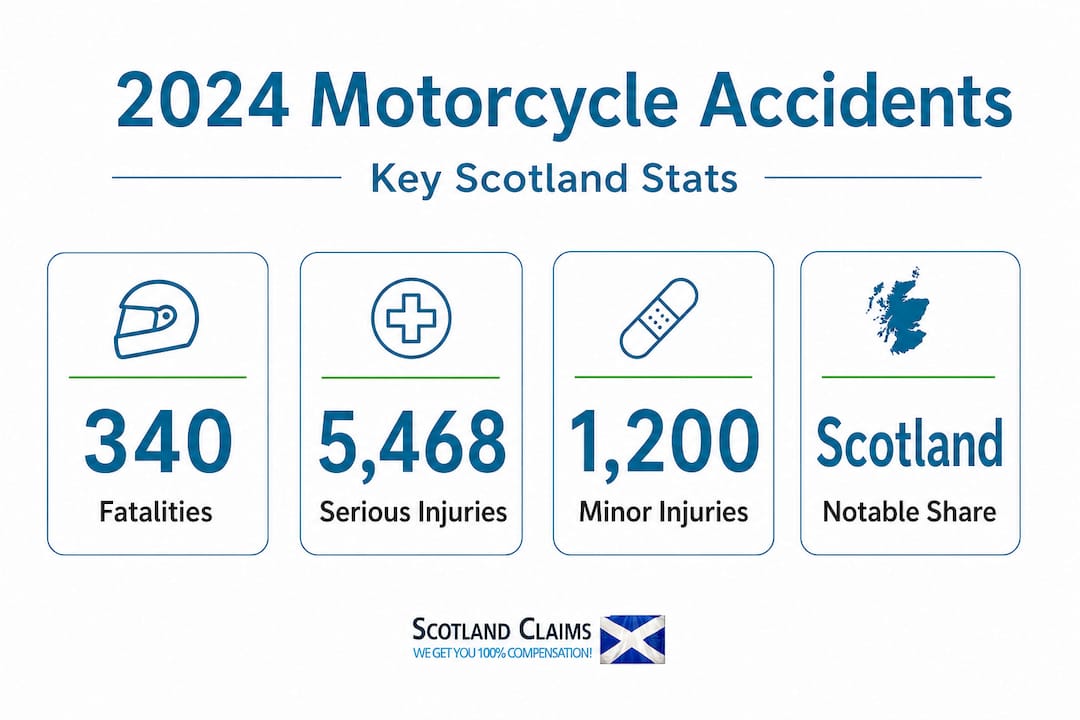
Scotland contributes a notable share of those numbers. Transport Scotland conducted an in-depth study of motorcycle fatalities covering January 2015 to August 2024, identifying recurring patterns including rural single-carriageway roads, junctions, and loss-of-control scenarios as dominant factors. Understanding these patterns helps solicitors argue causation and liability more effectively in your claim.
| Casualty type |
2024 GB figure (adjusted) |
| Fatalities |
340 |
| Serious injuries |
5,468 |
| Slight injuries |
10,152 |
| Total |
15,960 |
One critical point: police-reported statistics do not capture every casualty. Riders who leave the scene feeling shaken but not visibly wounded, or those who avoid hospital, frequently never appear in any official record. This matters enormously when you consider how many motorcyclists may be entitled to compensation but never realise it. For a fuller picture of what these figures mean for your rights, the overview of Scottish motorcycle claims outlines what types of accidents typically give rise to valid compensation claims.
“Official casualty figures are a floor, not a ceiling. The true number of injured motorcyclists eligible for compensation is almost certainly higher than any government dataset reflects.”
The decisions you make in the minutes and hours following an accident are the foundation of your entire claim. Lawyers can only work with the evidence that exists. If that evidence is thin or absent, even a clear-cut case becomes difficult.
Here are the steps every motorcyclist should follow at the scene and immediately afterwards:
- Stay safe first. Move out of traffic if you can do so without aggravating injuries. Switch on hazard lights if your bike is still functional.
- Call 999 if anyone is injured. Even if you feel fine, adrenaline masks pain. Always request an ambulance. This also creates a formal record of the incident.
- Report the collision to police. You must report any collision involving injury. Failing to do so can complicate your claim significantly, since not all incidents are reported to police.
- Gather evidence before leaving. Photograph the scene, the position of vehicles, road markings, tyre marks, any damage to your bike and gear, and the other driver’s number plate, insurance details, and licence.
- Collect witness details. Independent witnesses are gold in disputed liability cases. Get names and phone numbers from anyone who saw what happened.
- Seek medical attention the same day. A GP or A&E visit creates a contemporaneous medical record linking your injuries to the accident.
- Keep damaged gear and clothing. A shredded jacket or cracked helmet is physical evidence of impact. Do not throw it away.
- Write down your account. Memory fades quickly. Record your recollection of the accident, the road conditions, and any contributing factors within 24 hours.
A detailed accident checklist in Scotland can help you cover every step methodically. You should also familiarise yourself with the claim process timeline early on so you understand what lies ahead.
Pro Tip: Never apologise at the scene, even as a reflex. An apology can be interpreted as an admission of fault and used against you during negotiations with the other party’s insurer.
Legal requirements and time limits for claims
Many motorcyclists lose their right to compensation not because they had a weak case, but because they waited too long to act. Scotland follows a strict statutory framework for personal injury claims.
- Understand the three-year limitation period. Under the Prescription and Limitation (Scotland) Act 1973, you generally have three years from the date of the accident to raise court proceedings. Miss this deadline and your claim is almost certainly extinguished.
- Identify exceptions carefully. The three-year clock starts differently in some situations. For claims involving children, time begins running from their 16th birthday. For cases where injuries only became apparent later, the “date of knowledge” rule may extend the period, but this is complex and requires specialist advice.
- Act before the deadline, not at it. Building a strong claim takes time: obtaining medical reports, gathering evidence, negotiating with insurers. Starting your claim six months before the deadline leaves little room for complications.
- Notify insurers promptly. You should notify your own insurer of the accident even if you were not at fault. Failure to do so can affect your own policy and complicate matters for your solicitor.
- Contact a solicitor early. The sooner you engage legal support, the more evidence can be preserved and the stronger your case will be.
Research into motorcycle fatality patterns in Scotland shows that many serious accidents involve complex causation, including road surface defects, junction design, and third-party negligence. These multi-factor cases require thorough investigation that simply cannot happen if you delay. Full details on claim time limits explain every nuance of the Scottish rules, and you can read more about acting quickly after accidents to understand why timeliness is so critical.
Pro Tip: Even if you think you were partly at fault, you may still be entitled to compensation. Scotland operates a contributory negligence framework, meaning you can recover a proportion of damages even if you bore some responsibility for the collision.

No win no fee agreements: How they work for motorcyclists
Cost is one of the biggest barriers that stops injury victims from pursuing legitimate claims. No Win No Fee agreements, formally known as Conditional Fee Arrangements, remove that barrier entirely.
Under a genuine No Win No Fee arrangement, your solicitor takes on your case without charging you any upfront fees. If your claim is unsuccessful, you pay nothing. If you win, your solicitor is paid from the compensation awarded, usually capped at a percentage agreed in advance. You keep the remainder of your settlement.
Here is how the two main options compare:
| Feature |
No Win No Fee |
Traditional hourly billing |
| Upfront costs |
None |
Payable immediately |
| Financial risk if claim fails |
None |
Full legal costs owed |
| Access to specialist solicitors |
Yes |
Dependent on budget |
| Motivation for solicitor to succeed |
High |
Fees paid regardless |
| Suitable for motorcyclists without savings |
Yes |
Rarely practical |
Given that thousands of motorcyclists are seriously injured each year across Great Britain, No Win No Fee has become the standard access route for riders who would otherwise be unable to fund complex litigation.
What to look for in a solicitor:
- Specialist experience in road traffic accident claims, not just general personal injury work.
- Clear written explanation of the success fee percentage before you sign anything.
- Transparent handling of after-the-event (ATE) insurance, which protects you against the other side’s legal costs if your claim fails.
- Realistic assessment of your claim’s prospects from the outset, rather than false promises.
You can explore No Win No Fee claims in detail to understand exactly what to expect, and find experienced injury lawyers for accidents who practise under these arrangements in Scotland.
Estimating compensation: Types of claims and typical injuries
One of the first questions every client asks is: how much could I receive? The honest answer is that it depends on several factors, but understanding the structure of a claim helps you set realistic expectations.
Compensation for motorcycle accidents falls into two broad categories:
- General damages cover the pain, suffering, and loss of amenity caused by your injuries. These are calculated using Judicial College Guidelines and case precedents. A moderate back injury, for example, might attract general damages of between £12,000 and £38,000 depending on severity and prognosis.
- Special damages cover your financial losses. These include lost earnings, medical expenses, the cost of replacing damaged equipment, travel costs to medical appointments, and the cost of care or assistance you required during recovery.
Common injuries in motorcycle accidents that regularly give rise to claims include:
- Spinal and back injuries, including disc prolapse, fractures, and nerve damage. These are among the most serious and high-value claims. Detailed information on back injury claims explains the range of awards typically made.
- Head and brain injuries, from concussion through to acquired brain injury.
- Limb fractures, particularly to legs, arms, and collarbones, which are extremely common in motorcycle impacts.
- Knee injuries, including ligament damage and patella fractures.
- Psychological trauma, such as post-traumatic stress disorder, which can be as debilitating as a physical injury and is equally compensable.
- Road rash and soft tissue injuries, which, while less dramatic, can cause lasting scarring and significant pain.
Several factors influence the final figure: the permanence of the injury, your age and occupation, whether you required surgery, and the quality of the medical evidence your solicitor gathers. Following the legal consultation workflow helps ensure that all relevant evidence is captured at the right time. For a rough initial estimate, the compensation calculator gives you an indication based on injury type, though a solicitor’s assessment will always be more accurate.
With over 15,000 motorcyclist casualties recorded across Great Britain in 2024, the variety of injury presentations is enormous. No two claims are identical, which is precisely why specialist legal advice matters far more than any online estimate.
Why official statistics can mislead accident victims in Scotland
Here is a perspective that does not get discussed enough: official road casualty statistics are useful for safety policy, but they can actively mislead individual accident victims about their own situation.
When a motorcyclist reads that there were around 15,000 recorded casualties in Great Britain last year, they might assume that their case, if it does not resemble the “typical” serious accident, is somehow less valid. That is exactly the wrong conclusion to draw. Police-reported casualty figures capture only incidents formally recorded at the scene, and numerous studies have confirmed that real injury numbers are considerably higher.
This under-reporting has a direct psychological effect on victims. Riders who sustained injuries in lower-severity collisions, or in incidents where police were not called, frequently assume they have no claim. They compare themselves to the statistics, conclude their accident “was not serious enough,” and never seek legal advice. In many of those cases, they would have had a perfectly valid claim worth thousands of pounds.
There is also a second, more subtle problem. Because statistics focus on reported incidents, they tend to skew towards the most severe cases, creating an unconscious bias in how victims perceive their own injuries. A knee ligament injury that will affect your ability to work for 18 months does not make the headlines, but it can be worth a substantial compensation award.
Our advice is straightforward: do not use statistics to decide whether you have a claim. Use them to understand road safety trends, nothing more. What determines your eligibility is the specific facts of your accident, the evidence available, and whether another party’s negligence caused your loss. Following best practices for accident victims and getting specialist legal advice are the only reliable ways to assess your position.
How Scotland Claims supports motorcyclists after accidents
If you have been injured in a motorcycle accident in Scotland and you are not sure where to start, Scotland Claims exists specifically to help you take that first step without any financial risk. We connect injured riders with specialist personal injury lawyers who operate entirely on a No Win No Fee basis. You pay nothing upfront, and if your claim does not succeed, you pay nothing at all. Our team of experienced injury lawyers in Scotland handles motorcycle accident claims of every severity, from fractures and soft tissue injuries through to complex spinal and psychological trauma cases. Use our compensation calculator, review your rights, or simply request a callback to get started today.
Frequently asked questions
What is the deadline for making a motorcycle accident claim in Scotland?
The statutory time limit is three years from the date of the accident, but acting sooner significantly improves your chances of a successful claim by preserving evidence and witness recollections.
Are No Win No Fee arrangements safe for motorcycle accident claims?
No Win No Fee agreements give accident victims access to specialist legal support without any upfront costs, but you should always read the contract carefully to understand the success fee percentage and any after-the-event insurance implications.
What types of injuries qualify for motorcycle accident compensation?
Common qualifying injuries include back and spinal injuries, fractures, knee ligament damage, head injuries, road rash, and psychological conditions such as post-traumatic stress disorder arising from the collision.
Can compensation estimates be calculated before starting a claim?
The compensation calculator provides a useful starting estimate, but the actual award depends on detailed medical evidence, legal assessment of injury severity, and the specific financial losses you have incurred.
Why are official statistics not the full picture for accident claims?
Police-reported figures only capture incidents formally recorded at the scene, meaning many injured motorcyclists who could claim compensation never appear in any official dataset and may wrongly assume they have no valid case.
Recommended