Medical legal advice in Scotland: your 2026 guide

TL;DR:
- Medical legal advice helps individuals understand their legal rights after personal injuries caused by negligence. In Scotland, the three-year limit to raise court claims is strictly enforced, and missing it means losing the right to compensation permanently. Prompt evidence collection and early legal guidance are crucial to securing a successful claim within the deadline.
Medical legal advice is the formal guidance a qualified solicitor provides to help you understand your legal rights after a personal injury or accident caused by someone else’s negligence. In Scotland, this guidance is governed by distinct Scottish law, including the Prescription and Limitation (Scotland) Act 1973, which sets a strict three-year window to raise court proceedings. Miss that deadline and you lose your right to compensation, regardless of how strong your case is. Scotland Claims Injury Lawyers helps people across Scotland understand exactly where they stand, with no upfront costs and no success fee taken from your settlement.
What is medical legal advice and when do you need it?
Medical legal advice covers the legal guidance you receive when an injury or accident has left you worse off through no fault of your own. The term is commonly used to describe advice relating to personal injury claims, where a solicitor assesses whether another party’s negligence caused your harm. In Scotland, this sits within the broader framework of personal injury law, and the correct industry term for the legal process is a personal injury claim or, where clinical care is involved, a clinical negligence claim.

You need this type of advice when you have suffered a physical injury and believe someone else is responsible. Common situations include road traffic accidents where you were not at fault, slips and trips on poorly maintained premises, and accidents in the workplace. The sooner you seek patient rights legal guidance after an incident, the stronger your position.
A solicitor’s role at this stage is not to start a lawsuit immediately. Solicitors first perform a fact-finding exercise during initial consultations to assess whether a claim has a viable chance of success. That distinction matters, because many people delay seeking advice because they fear committing to legal action before they are ready.
What are the strict time limits for personal injury claims in Scotland?
The three-year limitation period is the single most critical fact in Scottish personal injury law. Failure to raise court proceedings within three years generally extinguishes your right to legal redress entirely. The clock starts from the date of your injury or, in some cases, the date you first became aware that negligence caused your harm.
That second trigger, known as the “date of knowledge,” is where things get complicated. Legal limitation calculations often depend on complex considerations of when the date of knowledge occurs, and courts can dispute it. This means you cannot simply count three years from the day you were injured and assume you are safe.
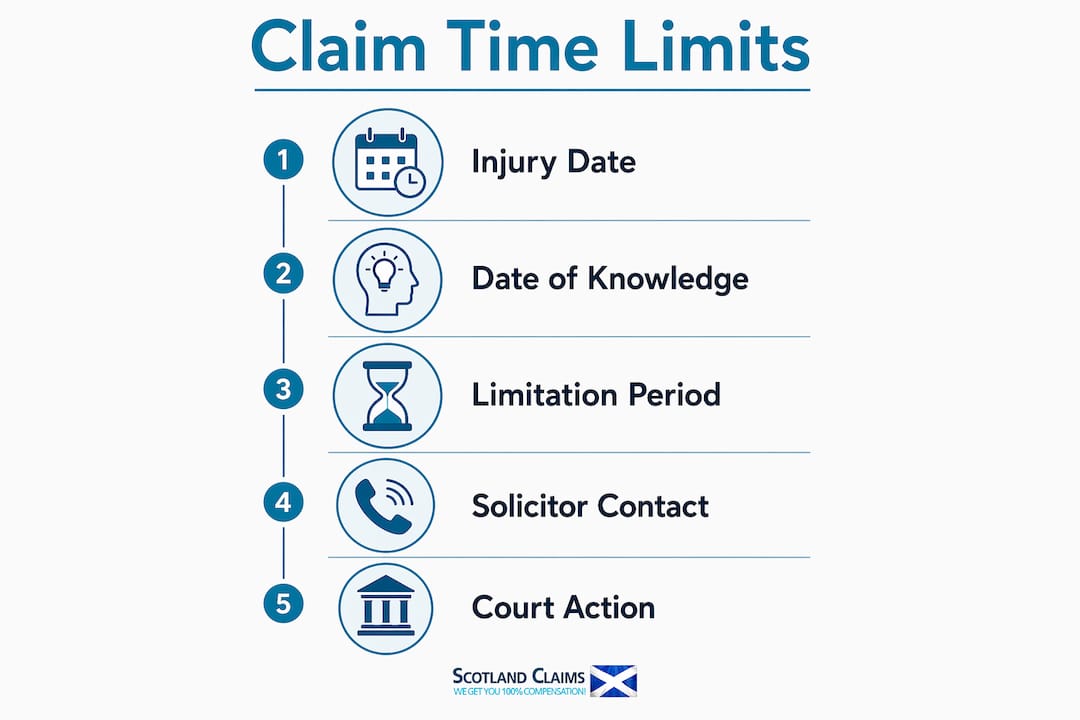
Scottish courts interpret the three-year limitation period with extreme strictness. A miscalculation can render your claim time-barred with no recourse, even when the medical evidence is compelling. That is why legal practitioners consistently emphasise immediate action.
There are important exceptions worth knowing:
- Children injured before age 16. The three-year limitation period is suspended until they turn 16, meaning a claim can be raised up until their 19th birthday.
- Claimants who lack mental capacity. The limitation period may not run while incapacity continues.
- Injuries with delayed discovery. Where harm only became apparent later, the date of knowledge rule applies, but this requires careful legal analysis.
You can read more about how claim time limits work in Scotland to understand how these rules apply to your specific situation.
Pro Tip: Do not wait until you feel certain about your claim before contacting a solicitor. The three-year clock runs whether you are ready or not. A free initial consultation costs you nothing and protects your position.
How to gather evidence when seeking legal advice for an injury
Strong evidence is the foundation of any successful personal injury claim. The actions you take in the days and weeks after an incident directly affect the strength of your case. Solicitors can only work with what exists, so your early efforts matter enormously.
The most useful evidence types include:
- A written account of the incident. Write down exactly what happened as soon as possible, including the date, time, location, and the names of any witnesses. Memory fades quickly, and a contemporaneous account carries significant weight.
- Photographs and video. Images of the scene, your injuries, and any hazards involved provide objective evidence that is difficult to dispute.
- Medical records. Request your full medical records from your GP, hospital, or any treating clinician. These establish the nature and extent of your injuries.
- Formal complaints. Complaints to NHS or private healthcare providers are a critical evidence-gathering tool that claimants often overlook. The formal complaint response often becomes a cornerstone document for solicitors assessing claim viability.
- Financial records. Keep receipts for all expenses caused by your injury, including travel to appointments, prescription costs, and any care you have paid for.
Understanding how class action case management works for claimants can also help you appreciate how evidence is used across different types of legal proceedings.
Pro Tip: Keep a daily diary of how your injury affects your life, including pain levels, tasks you cannot perform, and the impact on your work. Solicitors use this to quantify general damages for pain and suffering.
What to expect when you consult a solicitor in Scotland
The initial consultation with a solicitor is a fact-finding meeting, not a commitment to legal action. This early stage determines if the claim has a viable chance of success by examining whether another party breached their duty of care to you and whether that breach directly caused your injury. You are under no obligation to proceed after this meeting.
During the consultation, a solicitor will typically cover the following:
- The facts of your incident and the injuries you sustained
- Whether the circumstances suggest a breach of duty by another party
- The relevant limitation period and how much time you have left to act
- The funding options available to you, including no win, no fee arrangements
- The likely steps involved if you choose to proceed with a claim
Funding is a practical concern for most people. Funding options for claims include Conditional Fee Agreements and Before the Event Legal Expenses Insurance, both of which can minimise your financial risk during proceedings. A no win, no fee arrangement means you pay nothing if your claim is unsuccessful.
You can learn more about what negligence means in law and how Scottish courts assess it before your consultation.
Pro Tip: Bring every document you have to your first consultation, including photographs, medical letters, and any correspondence with the other party. The more your solicitor sees at the outset, the more accurate their initial assessment will be.
What compensation can you receive for a personal injury claim?
Compensation in personal injury claims covers general damages for pain and suffering and special damages for financial losses such as care costs and loss of earnings. These two categories together reflect the full impact your injury has had on your life.
General damages are assessed by reference to established legal guidelines and judicial precedent. Special damages require documentary evidence, which is why keeping financial records from the outset is so important. Solicitors gather expert valuations for past and future losses to quantify the full claim value.
| Compensation type |
What it covers |
| General damages |
Pain, suffering, and loss of amenity caused by the injury |
| Special damages (past) |
Medical expenses, travel costs, and lost earnings already incurred |
| Special damages (future) |
Ongoing care costs, future loss of earnings, and rehabilitation |
| Interim payments |
Early payments to ease financial pressure before the final settlement |
Interim payments may be available early in proceedings to help with expenses before the final compensation figure is calculated. This can ease financial pressure during what can be a lengthy process. Most claims resolve within twelve to eighteen months, though complex cases can take longer.
Key takeaways
In Scotland, the three-year limitation period under the Prescription and Limitation (Scotland) Act 1973 is the most critical factor in any personal injury claim, and missing it ends your right to compensation permanently.
| Point |
Details |
| Act within three years |
The limitation period starts from the date of injury or date of knowledge; missing it bars your claim. |
| Children have extra time |
Injured children have until their 19th birthday to raise a claim under Scottish law. |
| Evidence gathering starts immediately |
Write accounts, photograph scenes, and request medical records as soon as possible after an incident. |
| Initial consultation is fact-finding |
A first meeting with a solicitor assesses viability; you are not committing to legal action. |
| No success fee with Scotland Claims |
Scotland Claims Injury Lawyers takes no success fee, so you keep 100% of your compensation. |
Roger’s view: what most people get wrong about personal injury advice
The biggest mistake I see is people waiting too long before picking up the phone. They spend weeks, sometimes months, deciding whether their situation is “serious enough” to warrant legal advice. By the time they act, a significant portion of their three-year window has gone, and the evidence that would have been easy to gather at the start has faded or disappeared entirely.
The second misunderstanding is about what an initial consultation actually is. People assume that calling a solicitor means they are starting a lawsuit. They are not. That first conversation is simply a structured way of understanding what happened and whether the law can help. There is no pressure and no obligation.
What I have also observed is that the complaints process is genuinely underused. Raising a formal complaint with an NHS board or private provider does two things simultaneously. It creates a documented record of your concerns, and it generates a formal written response that solicitors find extremely useful when evaluating a claim. People who skip this step often hand their solicitor a harder job.
My consistent advice is this: seek healthcare legal counsel early, document everything, and do not let uncertainty about the outcome stop you from understanding your options. The law in Scotland is strict, but it is also clear. A specialist solicitor familiar with Scottish personal injury law will tell you exactly where you stand, at no cost to you.
— Roger
How Scotland Claims Injury Lawyers can help you
Scotland Claims Injury Lawyers supports people across Scotland who have been injured through no fault of their own. Whether you have suffered a road traffic accident injury, a workplace accident, or a slip or trip, the team provides specialist personal injury legal support from the first consultation through to settlement.
The key difference is the fee structure. Scotland Claims Injury Lawyers charges no success fee, meaning you keep 100% of your compensation. Most law firms take up to 20% of your settlement as a success fee. That is money that stays in your pocket when you choose Scotland Claims Injury Lawyers.
Use the compensation calculator to get an estimate of what your claim could be worth, then request a free callback to speak with a specialist. There are no upfront costs and nothing to pay if your claim does not succeed.
FAQ
What is the time limit for a personal injury claim in Scotland?
The limitation period is three years from the date of your injury or the date you became aware that negligence caused your harm. Missing this deadline permanently bars your right to compensation under the Prescription and Limitation (Scotland) Act 1973.
Does a free consultation mean I have to proceed with a claim?
No. An initial consultation is a fact-finding exercise where a solicitor assesses whether your claim has merit. You are under no obligation to proceed after that meeting.
What types of compensation can I claim for a personal injury in Scotland?
You can claim general damages for pain and suffering, and special damages for financial losses including lost earnings, medical costs, and future care expenses. Interim payments may also be available before your final settlement is reached.
How does no win, no fee work in Scotland?
Under a no win, no fee arrangement, you pay nothing if your claim is unsuccessful. Scotland Claims Injury Lawyers also charges no success fee, so you retain 100% of your compensation if your claim succeeds.
Can a child make a personal injury claim in Scotland?
Yes. The three-year limitation period is suspended for children until they turn 16, giving them until their 19th birthday to raise a claim. A parent or guardian can also raise a claim on a child’s behalf before that point.
Recommended