Keep 100% in Scotland: Irwin Mitchell Alternatives Verified by the Law Society

For Scottish claimants, Scotland Claims Injury Lawyers is the strongest alternative to Irwin Mitchell because it charges no success fee and keeps claimants on 100% of their compensation, backed by Scottish-specialist handling. Other names worth knowing include Clarke Willmott, DAC Beachcroft and DLA Piper, plus smaller firms like Cheetham Jackson and Ivey & Eggleston. The sections below explain how they compare on funding, specialism and Scottish coverage, and what to check before you sign anything.
TL;DR:
- Scotland Claims Injury Lawyers offers a no-success-fee service, ensuring claimants keep 100% of their compensation, unlike many larger firms that deduct up to 20%.
- Verifying a firm’s Scottish credentials through the Law Society’s directory and confirming relevant claim experience are crucial, especially for complex or disputed injury cases.
- Many firms like Clarke Willmott and DLA Piper charge varying fees and may lack transparency; always request detailed written funding agreements and ask about VAT and outlay costs.
- Timelines depend more on case complexity than firm size, with straightforward claims settling within months and disputed or complex claims taking over a year.
- Avoid relying solely on reviews or automated listings, and instead verify regulatory registration and claims expertise, especially for smaller or non-specialist firms.
Scotland Claims Injury Lawyers
scotlandclaims.co.uk
Keep More Of Your Compensation
Connect with specialist injury lawyers in Scotland about your claim, with no upfront costs and 100% of your compensation if successful.
Discuss your injury claimTable of Contents
Best Irwin Mitchell alternatives in Scotland compared
Anyone searching for law firms like Irwin Mitchell tends to find the same problem: most comparison lists mix genuine personal-injury solicitors with financial-services groups, corporate advisers and firms that don’t practise in Scotland at all. That matters because a Scottish claim runs under Scots law, with its own rules on success-fee agreements and its own limitation period. Picking a firm that only operates in England and Wales can cost you time you don’t have.
Scotland Claims Injury Lawyers is built specifically for Scottish claims, covering road traffic accidents, workplace injuries, slips and trips, and whiplash, with no success fee taken from the claimant’s settlement. That’s the headline difference against the wider market, where the norm among large-brand solicitors involves deducting a success fee including VAT from compensation. Beyond Scotland Claims, the shortlist splits into three groups: national firms with Scottish offices, insurer-facing firms, and smaller or non-legal entities that show up in automated competitor lists but need checking before you go any further.
| Firm |
Best for |
Standout |
Operates in Scotland |
Funding model |
How to contact |
| Scotland Claims Injury Lawyers |
Scottish claimants wanting no-win-no-fee with no deduction from compensation |
0% success fee, free assessment and compensation calculator |
Yes |
No win no fee, 0% success fee |
Online form or callback request |
| Clarke Willmott |
Claimants wanting a national firm with local offices |
National reaches across multiple practice areas |
Some offices |
Typically fee-based, varies by office |
Firm website enquiry form |
| DAC Beachcroft |
Complex claims involving insurer interactions |
Strong insurance-law presence |
Limited |
Case dependent; often acts for insurers |
Firm website enquiry form |
| DLA Piper |
High-value or cross-border matters |
Large international firm with wide resources |
Limited |
Case dependent |
Firm website enquiry form |
| Cheetham Jackson |
Varied professional-services enquiries |
Appears in competitor aggregations |
Unconfirmed |
Unconfirmed |
Verify directly before instructing |
| Ivey & Eggleston |
Local or niche instructions if Scottish-qualified |
Smaller-firm profile in aggregators |
Unconfirmed |
Unconfirmed |
Verify directly before instructing |
| Equiom Group |
Corporate or fiduciary services |
Business support rather than claimant representation |
Unconfirmed |
Not a claimant solicitor in many cases |
Verify directly before instructing |
| Legal & General |
Insurance or financial-advice matters |
Large financial-services presence |
Not a law firm |
Not applicable |
Not a claimant law firm |
| Alpha LSG |
Not a personal-injury alternative |
Non-law professional services listing |
No |
Not applicable |
Not a claimant law firm |
A few of these need a plain warning attached. Alpha LSG and Legal & General are not law firms in any sense a personal-injury claimant needs. They surface in automated competitor databases because those tools group anything tagged “professional services” together, not because they handle whiplash or workplace injury claims. Equiom Group leans towards corporate and fiduciary work rather than routine claimant representation. If a name on a comparison list doesn’t obviously specialise in claimant-side personal injury, that’s your cue to check before you enquire, not to assume it belongs there.
- Scotland Claims Injury Lawyers: Scottish specialist, 0% success fee, free assessment
- Clarke Willmott, DAC Beachcroft, DLA Piper: national or insurer-facing firms, fee terms vary by office
- Cheetham Jackson, Ivey & Eggleston: smaller names needing direct verification of Scottish practice
- Equiom Group, Legal & General, Alpha LSG: not straightforward claimant solicitors for Scottish personal injury
How do you choose between these Irwin Mitchell alternatives?
Comparing firms on name recognition alone misses the details that actually decide how much compensation you keep and how smoothly your claim runs. Work through this in order.
- Confirm Scottish qualification and location. Search the Law Society of Scotland’s Find a Solicitor directory by area of work, not just by name, to see whether a firm genuinely practises personal injury in Scotland.
- Ask who actually handles your case. A named solicitor with relevant experience in road traffic, workplace or slip-and-trip claims matters more than a well-known brand on the letterhead.
- Check the track record on injuries like yours. A firm that mostly does commercial litigation is not the same bet as one built around personal-injury claims.
- Request the entire written funding agreement, not a summary. Scottish legislation under the Civil Litigation (Expenses and Group Proceedings) (Scotland) Act 2018 sets specific requirements for success-fee agreements, and one that doesn’t comply can be unenforceable to that extent.
- Confirm whether VAT and outlays are included in any success fee, and ask what future-loss elements are calculated into it.
- Ask for your worst-case personal cost in pounds, not a percentage, if the claim is lost or the agreement ends early.
- Check APIL accreditation alongside Law Society registration, which Citizens Advice Scotland recommends as a marker of genuine personal-injury specialism.
- Get a realistic timeline for your specific claim type before you sign anything, and confirm your limitation date immediately.
Pro Tip: Don’t judge a funding agreement by its headline percentage alone. The 2020 Regulations standardise disclosure terms precisely because the real differences between firms sit in the fine print, things like whether outlays are deducted before or after the success fee is calculated.
What Scotland Claims Injury Lawyers offers as an alternative
Scotland Claims Injury Lawyers focuses entirely on personal-injury claims within Scotland, covering road traffic accidents (as driver or non-fault passenger), workplace injuries, slips and trips, and whiplash. Claimants who aren’t at fault, or who suffer more serious injuries in these categories, keep 100% of their compensation because no success fee is deducted, a sharp contrast with the up-to-20%-including-VAT model common among larger brand solicitors.
The site backs that positioning with practical tools:
- A compensation calculator to estimate potential payout before you commit to anything
- Free claim assessments with specialist solicitors, with no upfront cost
- Clear callback and online enquiry routes for a fast first response
- Dedicated guidance pages covering no win no fee arrangements and how the process works from first contact to settlement
For anyone comparing law firms like Irwin Mitchell, the funding model is the detail that actually changes what lands in your bank account.
Typical costs and fees across the shortlisted alternatives
Fee structure is where these alternatives genuinely diverge. Scotland Claims Injury Lawyers takes no success fee at all, so a successful claimant keeps every pound of their settlement. Many large-brand solicitors deduct a success fee including VAT from the compensation itself, which can reduce the amount you receive.
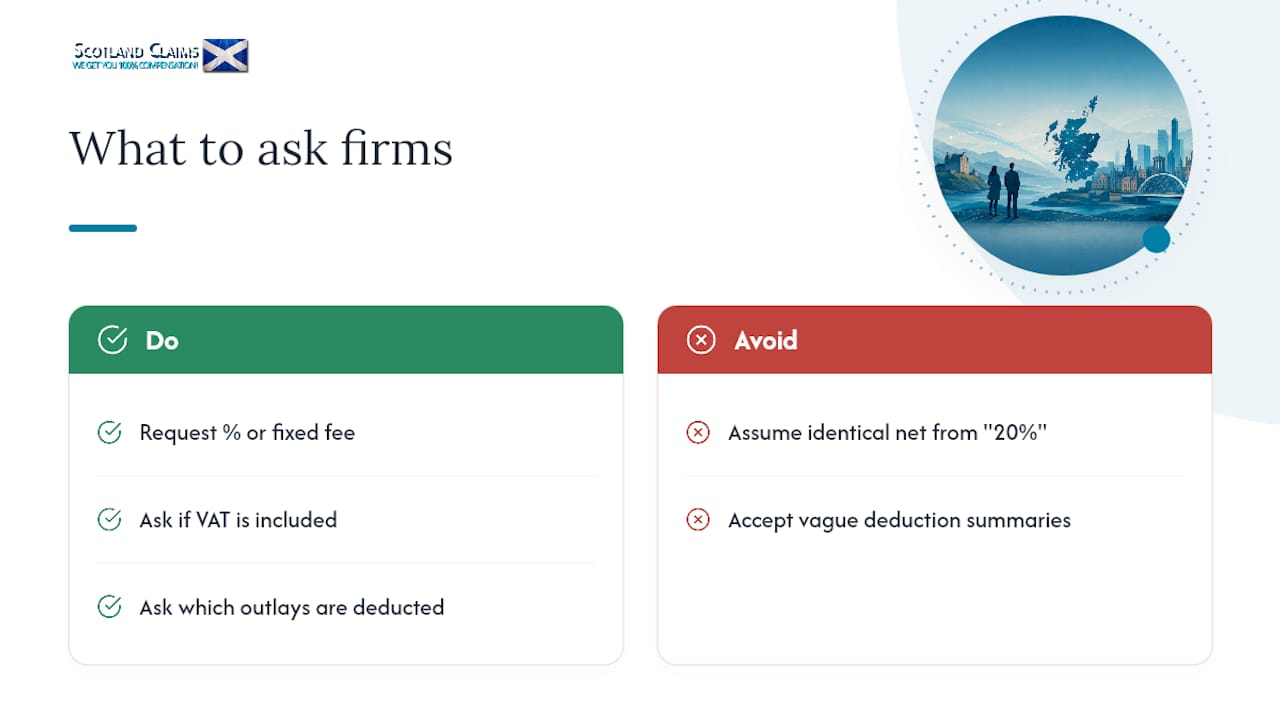
National and insurer-facing firms such as Clarke Willmott, DAC Beachcroft and DLA Piper don’t publish standard fee scales for claimant work, because terms vary by office and case complexity. That’s exactly why the Style Success Fee Agreement guidance from the Law Society of Scotland exists: to standardise the terms so claimants can actually compare like with like, rather than relying on a firm’s own marketing summary. Ask every firm on your shortlist for the same three figures: the percentage or fixed fee, whether VAT is included in that figure, and what outlays (medical reports, court fees) get deducted separately. Two firms quoting “20%” can still leave you with very different amounts once outlays are settled.
How long does each type of alternative typically take?
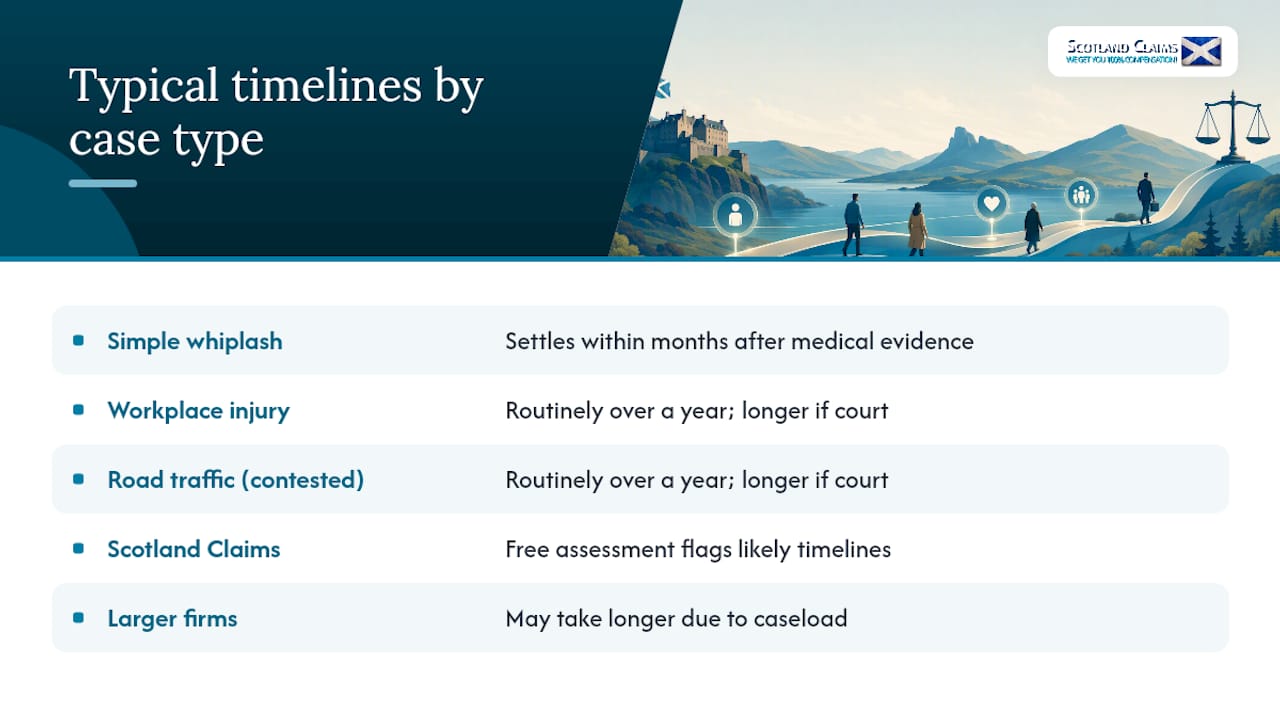
Timelines depend far more on claim complexity than on which firm’s name is on the file. A straightforward whiplash claim with clear liability can settle within months once medical evidence is in. A workplace injury claim involving disputed liability, or a road traffic claim with contested fault, routinely takes over a year, sometimes longer if court proceedings become necessary.
Scotland Claims Injury Lawyers structures its intake around a free assessment stage specifically to flag likely timelines early, so claimants know roughly what to expect before committing. Larger national firms like Clarke Willmott or insurer-facing practices like DAC Beachcroft may take longer simply because of caseload volume or because their processes are built around larger, multi-party litigation rather than individual claimant turnaround. Whichever firm you choose, ask directly for a realistic timeline for your specific injury type, and get it in writing rather than a vague estimate. A firm that can’t give you a rough range for a case like yours likely hasn’t handled many similar to it.
What do reviews and reputation actually tell you?
Client reviews are useful for gauging communication and responsiveness, but they’re a weak substitute for verifying whether a firm is actually regulated and specialised in Scottish personal injury. A five-star review tells you a firm returned calls promptly; it doesn’t tell you whether its success-fee agreement complies with the 2018 Act, or whether the solicitor handling your case has relevant claim experience.
That’s precisely why Citizens Advice Scotland and Scottish Government guidance both point claimants towards checking Law Society registration and APIL accreditation rather than relying on review aggregators or automated comparison sites. Some names that appear in competitor listings, including Alpha LSG and Legal & General, generate no meaningful claimant reviews at all because they aren’t personal-injury solicitors in the first place. Treat reputation as one input alongside regulatory verification, not as the deciding factor on its own.
When does a Scottish specialist matter most?
A workplace injury with a disputed liability chain, or a road traffic claim involving Scottish court procedure, benefits from a firm that lives in that system daily rather than one applying English-law instincts to a Scottish file. The three-year limitation period doesn’t pause for you to shop around, so verify a firm’s credentials quickly rather than comparing indefinitely. Evidence fades and witnesses move; delay is the one cost none of these firms can fix for you afterwards.
— Roger
Get a free assessment from Scotland Claims Injury Lawyers
Unlike the big-brand solicitors that deduct a success fee of up to 20% including VAT from your settlement, Scotland Claims Injury Lawyers takes no success fee at all, so a successful claim leaves you with 100% of your compensation. Whether your case involves a road traffic accident, a workplace injury, a slip or trip, or whiplash, a free assessment costs nothing upfront and puts a specialist Scottish team on your file from the start. If you’re not sure what your claim might be worth, run it through the compensation calculator first. When you’re ready to move, start your claim through the no-win-no-fee claim page or request a callback, and a specialist will talk you through your options and your likely timeline before you commit to anything.
Sources
This article is general information, not a substitute for advice from a qualified lawyer. Consult a qualified legal professional about your own circumstances before acting on anything here.
FAQ
Are Irwin Mitchell good solicitors?
Irwin Mitchell is a large, well-established firm with a wide range of practice areas, but “good” depends on what you need. For a Scottish personal-injury claim specifically, a Scotland-focused specialist with a transparent, no-deduction funding model may serve you better than a large multi-service firm.
What is the most feared law firm in the UK?
There’s no verified ranking of “most feared” firms; reputation in this sense is subjective and varies by practice area and opposing party. For personal-injury claimants, the more useful measure is a firm’s track record with claims like yours and the transparency of its funding agreement.
Is Irwin Mitchell a top law firm?
Irwin Mitchell is a recognised national brand with broad practice coverage across the UK. Whether it’s the “top” choice for a specific Scottish personal-injury claim depends on local specialism and funding terms, which is exactly what this comparison is designed to help you check.
Are Irwin Mitchell expensive?
Costs depend on the specific funding agreement offered, and large-brand solicitors commonly deduct a success fee of up to 20% including VAT from a claimant’s settlement. Scotland Claims Injury Lawyers takes no success fee at all, so claimants keep 100% of their compensation.
How do I know if an alternative firm actually practises in Scotland?
Search the firm by name in the Law Society of Scotland’s directory and filter by area of work. If a firm doesn’t appear there for personal injury, verify its Scottish standing directly before instructing it.
Recommended