Replace Digby Brown in Scotland: No Success Fee, Keep 100%

Scotland Claims Injury Lawyers is the strongest alternative to Digby Brown for anyone who wants to keep every penny of their settlement, because the standard success fee charged by most big-brand solicitors runs up to 20% of compensation. Other credible names worth a call include Bakers Solicitors, Thompsons Scotland LLP, Balfour+Manson, Watermans Solicitors, and Lindsays. If you need a niche specialism, such as complex spinal injury litigation, a firm with a dedicated accreditation may still be the better fit.
TL;DR:
- Scotland Claims Injury Lawyers offers a no success fee arrangement, allowing claimants to keep 100% of their settlement paid by the insurer, unlike most large firms.
- Larger firms like Digby Brown and Lindsays typically charge success fees deducted from awards, which can amount to 20% or more of the compensation.
- Fee structures are rarely publicly published; claimants should ask directly about success fee percentages, VAT inclusions, and whether their solicitor holds Accredited Specialist status for complex injuries.
- Matching the firm’s specialism to the injury type is more important than size, and verified credentials through the Law Society of Scotland ensure legal quality and regulation.
- For straightforward claims with clear liability, no success fee firms are generally more cost-effective, but contested or complex cases benefit from firms with deep litigation expertise.
Scotland Claims Injury Lawyers
Keep 100% Of Your Compensation
Connect with specialist injury lawyers through a No Win No Fee arrangement, with no upfront costs and 100% of successful compensation retained.
Explore your claim optionsTable of Contents
Digbybrown.co.uk alternatives: profiles worth comparing
Digby Brown Solicitors is the name most people search against, largely because it’s the firm Scottish claimants encounter first when they look up personal injury representation. That doesn’t make it the only option, and it doesn’t make it the cheapest. The alternatives below cover the same ground, from road traffic accidents to workplace injuries, with different fee structures and different sizes of operation behind them.
Scotland Claims Injury Lawyers
Scotland Claims Injury Lawyers connects claimants with specialist personal injury solicitors through a no win no fee arrangement. That’s the detail that separates it from almost everyone else on this list. Most large firms, including Digby Brown, deduct a success fee from whatever you’re awarded. Scotland Claims Injury Lawyers doesn’t take that cut. Fees are recovered from the losing party’s insurer, not from your settlement.
- Best for: claimants who want to keep 100% of their compensation and a straightforward, claim-first contact process, particularly for whiplash, road traffic accidents (driver or passenger, not at fault), workplace injuries, and slips or trips.
- Fee model: no success fee charged to the claimant; the firm states clients keep 100% of what they’re awarded.
- Specialism: road traffic accident claims, injury at work claims, slip and trip claims, whiplash claims, and motorcycle accident claims.
- Availability: free claim assessment with a callback request or online form; you can check current pricing and the success fee structure before instructing anyone.
- Standout: the fee model itself. There’s no success fee to negotiate down, because there isn’t one.
If your case falls outside personal injury (criminal injuries compensation or medical negligence, for example), this isn’t the right route. Scotland Claims Injury Lawyers deals exclusively in personal injury claims within Scotland.
Bakers Solicitors
Bakers Solicitors appears regularly in regional shortlists of Scottish personal injury firms. It’s a reasonable option for claimants who want an established practice without the scale (or the marketing budget) of the biggest names.
- Best for: general personal injury claimants who want established firm representation without a national brand.
- Fee model: not published in detail; ask directly about success fee percentages and whether VAT is included before signing anything.
- Specialism: general personal injury work; confirm specific accreditation for your injury type.
- Availability: contact via the firm’s own site; verify current opening hours and case-taking capacity directly.
- Standout: frequently listed alongside larger firms in independent roundups, though you should verify its current standing through the Law Society of Scotland’s Find a Solicitor tool rather than take a roundup’s word for it.
Digby Brown Solicitors
Digby Brown is the UK personal injury practice most people are trying to find an alternative to when they land on this article, and it’s worth understanding why it’s such a common reference point. It’s large, well known, and handles a high volume of claims. That scale brings resources, but it also brings the standard industry fee structure: a success fee deducted from your compensation, the exact percentage varying by case type and firm policy.
- Best for: claimants who specifically want a large-firm network and don’t mind a success fee deduction in exchange.
- Fee model: standard no win no fee arrangement with a success fee taken from the claimant’s compensation. Confirm the exact percentage and whether VAT is included before instructing.
- Specialism: broad personal injury caseload across Scotland.
- Availability: multiple offices; check current contact routes on the firm’s own site.
- Standout: brand recognition. It’s the name that shows up first in most searches, which is precisely why so many claimants are now comparing it against smaller-fee alternatives.
Thompsons Scotland LLP
Thompsons has a long history in Scottish personal injury and trade union related claimant work. It’s a name that carries weight, particularly for workplace injury cases.
- Best for: claimants who want an established specialist practice with a track record in workplace and industrial injury claims.
- Fee model: not published in granular detail; ask at the first call what percentage, if any, is deducted from your settlement.
- Specialism: personal injury with a historical emphasis on workplace and industrial claims.
- Availability: contact via the firm’s website; confirm current case intake.
- Standout: longstanding presence in the field, though that alone doesn’t tell you what you’ll actually keep from a settlement. Ask.
Balfour+Manson
Balfour+Manson is a Scottish firm offering personal injury work as part of a wider legal services portfolio, which can suit claimants whose case touches on more than one area of law.
- Best for: claimants who want a firm with local offices and broader legal resources behind the personal injury team, useful if your case has any overlap with another legal matter.
- Fee model: not published; confirm success fee percentage and inclusions directly.
- Specialism: personal injury alongside other legal disciplines, useful for multi-faceted cases.
- Availability: office-based contact; check current capacity.
- Standout: the breadth of the firm means you’re not just talking to a personal injury specialist in isolation, which can help if your claim intersects with, say, an employment dispute.
Watermans Solicitors
Watermans turns up in public “best of” lists for Scottish personal injury representation, which tends to mean decent visibility rather than any particular fee advantage.
- Best for: claimants prioritising an established local reputation in personal injury work.
- Fee model: not published in detail; confirm before signing.
- Specialism: personal injury claims; verify accreditation for your specific injury type.
- Availability: contact via the firm directly.
- Standout: consistent appearance in independent roundups of Scottish PI firms, though a roundup mention isn’t the same as verified accreditation. Check that separately.
Lindsays
Lindsays is one of the larger multi-office Scottish firms, with personal injury sitting alongside a wide range of other legal services.
- Best for: claimants with more complex claims who want a firm with multi-office reach and the resources that come with scale.
- Fee model: not published; ask directly.
- Specialism: personal injury among broader legal capabilities; confirm accredited specialist status for your case.
- Availability: multiple offices across Scotland.
- Standout: scale. If your claim is genuinely complicated, a firm with more resources behind it might be worth the trade-off against a fee.
None of the firms above other than Scotland Claims Injury Lawyers publish their exact success fee percentage in an easily comparable way, and that’s deliberate on the part of the wider industry. It means the only way to compare like for like is to ask the direct question at your first conversation, which the next section covers.
Which alternative fits your case type and priorities?
Choosing between these firms comes down to four things: what you’re claiming for, how much you want to keep, how quickly you need things moving, and whether the firm can prove its credentials. The grid below lines up each firm against those priorities.
A few things worth unpacking from that grid. The “fee model” column is the one that actually changes your outcome the most, because a 20% deduction on a £15,000 settlement is £3,000 you never see. Scotland Claims Injury Lawyers is the only firm here stating no success fee, meaning what the insurer pays is what you keep.
Specialism matters more than firm size for most claims. A whiplash claim from a rear-end collision doesn’t need the same expertise as a serious spinal injury from a workplace fall. Match the firm to the injury type, not the other way round.
Regulation and credentials should never be taken on trust from a website’s own claims. Every solicitor practising in Scotland must hold a current practising certificate, and you can check that instantly using the Law Society of Scotland’s Find a Solicitor tool. For more complex or contested injuries, look specifically for a solicitor holding the Law Society’s Accredited Specialist status in personal injury, which marks sustained demonstrated competence in that area rather than a general practice licence.
Here’s what each row of that grid should prompt you to actually do before you sign anything:
- Search the firm and the named solicitor on the Law Society’s register, not just the firm’s own “about us” page.
- Ask what percentage, if any, comes out of your compensation, and whether that figure includes VAT.
- Confirm whether the solicitor handling your file holds Accredited Specialist status if your injury is complex or contested.
- Check the firm’s stated specialism actually matches your injury type, rather than assuming general PI experience covers everything.
The Law Society itself is clear that it cannot recommend a specific firm, but it does encourage contacting more than one firm before deciding. That’s sound advice regardless of which name you’re starting from.
How to choose a solicitor and what to ask first
Picking the right firm isn’t about finding the biggest name. It’s about matching four criteria to your specific case: genuine specialism in your injury type, clarity on who actually does the work, how the firm communicates, and exactly how fees are handled if you win.
Specialism first. A firm that handles hundreds of whiplash claims a year isn’t automatically the right choice for a severe workplace injury involving long-term disability. Ask directly whether the solicitor holds Accredited Specialist status for your injury category, particularly for anything beyond a straightforward road traffic claim.
Who does the work matters more than who you meet first. The person who takes your initial call or runs the free assessment often isn’t the person who manages your file day to day. Ask who that will be, and what level of experience they have with cases like yours, before you agree to anything.
Communication is a leading indicator of how the whole case will run. If a firm can’t clearly explain the plan, the next steps, and the costs at your first conversation, treat that as a warning sign rather than a minor gap. Scotland’s own government guidance on using a solicitor is explicit that this clarity should be there from the first meeting, and its absence is a red flag worth acting on.
Here’s exactly what to ask when you speak to any firm, Scotland Claims Injury Lawyers included:
- Who will manage my case day to day, and what’s their experience with this type of injury?
- Who signs the retainer, and what does it actually commit me to?
- What’s the realistic timescale from instruction to likely settlement for a case like mine?
- How will evidence be gathered, and who’s responsible for chasing medical reports or witness statements?
- How are fees recovered if I win, and what percentage, if any, comes out of my compensation?
- Is the firm and the named solicitor currently registered and in good standing with the Law Society of Scotland?
- Who do I contact if I have concerns partway through the case?
Pro Tip: Ask question 5 before question 1. If a firm hesitates or gives you a vague answer about fees, you’ve learned everything you need to know before wasting time on the rest of the conversation.
Red flags worth walking away from: a firm that won’t confirm who’s handling your file, vague answers about fee percentages, no clear timeline even as a rough estimate, and any pressure to sign on the spot without time to consider other firms. Citizens Advice Scotland points out that firms genuinely do vary in specialism and charging practice, which is exactly why comparing more than one before instructing is standard, sensible practice rather than excessive caution.
On timelines: a straightforward whiplash or minor RTA claim that settles without court proceedings might resolve in a matter of months once liability is admitted. A workplace injury claim with contested liability, or one involving ongoing medical treatment, can run well beyond a year, simply because you can’t settle until the medical picture is stable enough to value the claim accurately. Any firm quoting an exact date at the first meeting is guessing. Ask for a realistic range instead.
How this comparison was put together
This comparison was built around firms that consistently appear in searches for Digby Brown alternatives across Scotland, cross-checked against publicly visible information about specialism, structure, and size. The seven firms named here represent a genuine spread: from a no success fee claims service to large multi-office practices with broad legal portfolios.
A few limitations are worth being upfront about. Success fee percentages for most firms other than Scotland Claims Injury Lawyers aren’t published in a directly comparable format on public websites, which is why this article uses neutral phrasing (“not published; ask directly”) rather than guessing at a figure. Firms also change staff, accreditation status, and case-taking capacity over time, so any snapshot goes stale. That’s precisely why verification through the Law Society of Scotland’s Find a Solicitor tool matters more than any list, including this one.
The publisher’s own credentials are worth stating plainly rather than assuming. Scotland Claims Injury Lawyers specialises specifically in personal injury claims within Scotland, covers road traffic accidents, workplace injuries, and slips or trips, and operates on a no win no fee basis that takes no success fee from the client’s compensation. Author Roger’s comparative work on this site includes closer looks at Digby Brown’s fee structure against alternatives and a detailed breakdown of success fees compared across firms, both worth reading if you want the numbers behind the general fee model discussed here.
Selection criteria for inclusion: consistent presence in Scottish personal injury search results, genuine relevance to Scottish claimants specifically (rather than UK-wide firms with no Scottish specialism), and visible, checkable credentials rather than marketing claims alone. Firms that failed on the last point simply weren’t included, regardless of visibility elsewhere.
- Firms selected for consistent appearance in Scottish personal injury searches rather than paid placement.
- Fee claims verified against public statements only; unpublished figures are flagged as such rather than estimated.
- Regulatory status should be re-checked at the point of instruction, not taken from this article alone.
When a no success fee firm makes the most sense
The claimants who gain the most from a no success fee model are the ones with straightforward liability. Think a rear-end shunt where the other driver’s insurer has already accepted fault, or a slip on an unsalted car park where the occupier’s negligence is fairly clear cut. In those cases, the legal work is largely about valuing the injury correctly and processing the claim efficiently. There’s less need for a firm to absorb significant litigation risk, which is exactly the scenario where taking a 20% cut from the client feels hardest to justify.
I’d argue the industry’s habit of treating a success fee as simply the cost of doing business has gone unchallenged for too long. A fee structure that removes money from an accepted, straightforward claim isn’t really pricing risk. It’s pricing convenience, and it’s the claimant who pays for it.
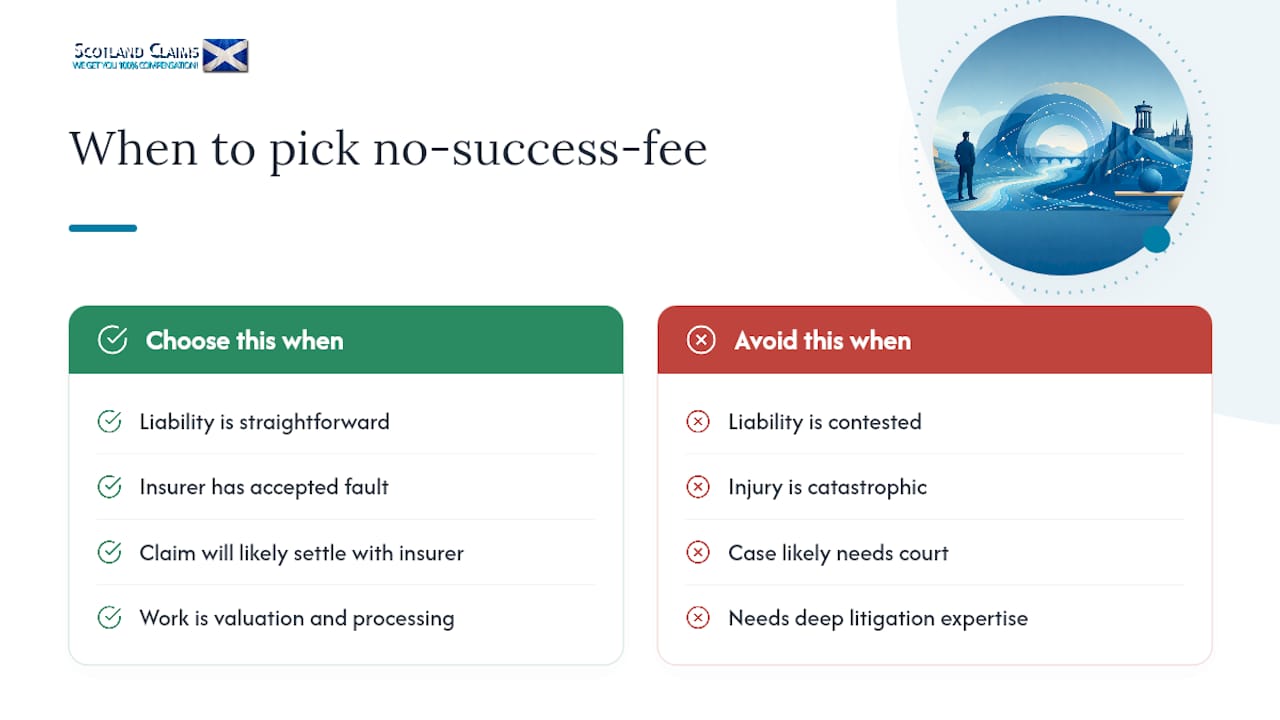
Where I’d genuinely point someone towards a different type of firm instead is contested liability, catastrophic injury, or anything likely to end up in front of a court rather than settling with an insurer directly. Those cases benefit from a solicitor with deep, specific litigation experience and, ideally, Accredited Specialist status in the relevant injury category. That’s not a knock against a no success fee model. It’s simply recognising that some cases need a different kind of firepower, and paying for that expertise can be the right call when the claim’s complexity genuinely demands it.
Either way, don’t take any firm’s word for its own standing. Run the check yourself through the Law Society’s Find a Solicitor tool before you sign anything, whichever firm you’re leaning towards.
— Roger
Ready to start your claim with Scotland Claims Injury Lawyers?
Scotland Claims Injury Lawyers operates a no success fee model for claimants in Scotland, meaning there is no deduction from your compensation if your claim succeeds. There’s no upfront cost and no success fee.
Starting is straightforward. Request a free claim assessment through a callback or the online form, and a specialist will review whether your case qualifies, whether it’s a road traffic accident, a workplace injury, a slip or trip, whiplash, or a motorcycle accident claim. If you want to see exactly how the fee model works before you call, the no win no fee claims page sets it out in full. Get your free assessment started today and find out where you stand.
Where to verify any firm before you instruct them
Before instructing any firm named in this article, or any firm you find elsewhere, run your own check using these sources rather than relying on a firm’s own marketing.
The Law Society of Scotland’s Find a Solicitor tool confirms whether a solicitor holds a current practising certificate and which areas of law they’re registered to practise in. The Law Society’s Accredited Specialist scheme page lists which solicitors have demonstrated sustained specialist competence in personal injury specifically, useful for complex or contested claims.
For general guidance on choosing a solicitor and what to expect at first contact, mygov.scot’s guide to using a solicitor and Citizens Advice Scotland’s page on using a solicitor both cover practical next steps. If you’re researching how firms present their credentials online more broadly, resources on law firm marketing can help explain what to look for. And if you’d rather skip the research and get a direct assessment, Scotland Claims Injury Lawyers remains the fallback starting point.
Sources
FAQ
What is the average payout from Digby Brown?
There’s no single published average payout figure for Digby Brown or any firm, because compensation depends entirely on injury severity, recovery time, and loss of earnings. What matters more for your final take-home amount is the success fee deducted from your settlement, which is why comparing fee models across firms, including Scotland Claims Injury Lawyers’s 0% success fee, is more useful than chasing an average payout figure.
Are Digby Brown any good?
Digby Brown is a large, well established Scottish personal injury practice with genuine scale and resources. Whether it’s “good” for your specific case depends on your injury type, the fee structure you’re offered, and whether the solicitor handling your file holds relevant Accredited Specialist status; verify current standing through the Law Society rather than reputation alone.
Are Digby Brown no win no fee?
Digby Brown, like most large Scottish personal injury firms, operates on a no win no fee basis but typically deducts a success fee from the client’s compensation if the claim succeeds. This differs from Scotland Claims Injury Lawyers, which charges no success fee at all, meaning clients keep 100% of their settlement.
What is the most feared law firm in the UK?
There’s no verified, sourced ranking of law firms by how “feared” they are, and reputation of that kind is largely subjective and case-specific. What’s more useful for a personal injury claimant is checking a firm’s genuine specialism and regulatory standing through the Law Society’s Find a Solicitor tool rather than informal reputation.
How do I know if a solicitor is properly regulated in Scotland?
Search the solicitor’s name and firm on the Law Society of Scotland’s Find a Solicitor tool, which confirms a current practising certificate and registered areas of law. For personal injury specifically, also check whether they hold Accredited Specialist status if your case is complex.
Recommended