Keep 100% in Scotland: Alternatives to Lawfordclaims.com
Scotland Claims Injury Lawyers stands out among genuine Lawfordclaims.com alternatives because it charges no success fee at all, letting successful claimants keep 100% of their compensation. Ireland Personal Injury Advice, Slater & Gordon and Thompsons Scotland are also worth comparing, but none match that fee structure. Start with a free claim assessment before you sign anything.
TL;DR:
- Scotland Claims Injury Lawyers offers a no win no fee service with no success fee, allowing claimants to keep 100% of their compensation without deductions.
- Other options like Slater & Gordon and Thompsons Scotland typically operate on success fee models, which can reduce the final payout by up to 20%.
- Confirm that any solicitor is regulated by the Law Society of Scotland and provides a clear, written success fee agreement before instructing them.
- Be cautious of firms that do not specify the success fee percentage or rely solely on general advice not tailored to Scottish law.
- Switching providers is simple if you haven’t signed a binding agreement, but always verify the fee structure and file transfer process beforehand.
Scotland Claims Injury Lawyers
Keep More Of Your Compensation
Connect with specialist Scottish injury lawyers through a no win no fee service with no success fee deducted from successful compensation.
Table of Contents
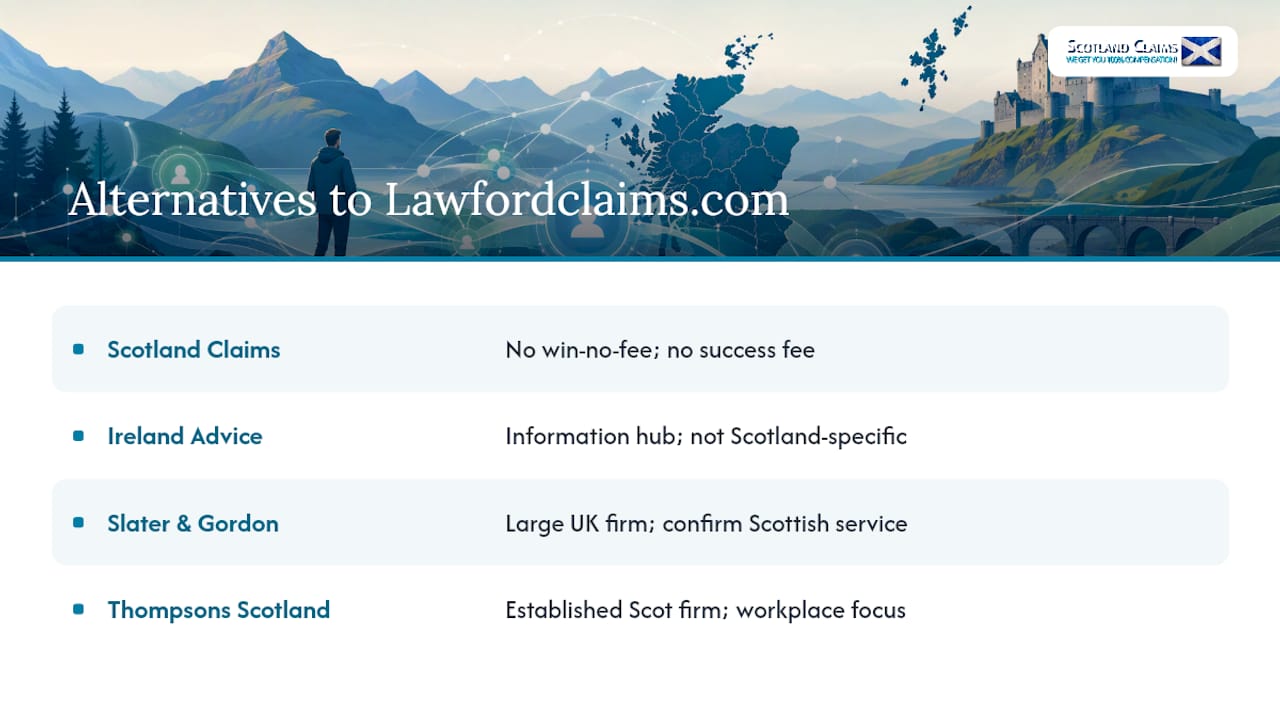
Anyone searching for lawfordclaims.com similar websites is usually trying to work out one thing fast: who else handles Scottish personal injury claims properly, and who takes the smallest cut of the payout. Below are four options that come up repeatedly when people compare lawfordclaims.com competitors, along with what each one actually does.
Scotland Claims Injury Lawyers connects claimants in Scotland with specialist solicitors through a no win no fee arrangement, and its central claim is that clients keep the full amount of their compensation with no success fee deducted. That covers road traffic accidents, workplace injuries, slips and trips, and whiplash claims. The site runs a compensation calculator so you can get a rough figure before speaking to anyone, and you can start with a free callback request or an online form. It suits someone who has been hurt in Scotland and wants a straightforward, jurisdiction-specific route without wading through a UK-wide generalist site first.
Ireland Personal Injury Advice is an information hub rather than a solicitor firm in its own right. It publishes guidance on injury claims and, for some users, acts as a first port of call before they instruct a solicitor. If you are in Scotland, treat this one with a note of caution: personal injury law and claims procedure in Ireland differ from Scotland’s system, so any advice sourced there needs checking against Scottish rules, ideally through a solicitor regulated by the Law Society of Scotland, before you rely on it for a Scottish claim.
Slater & Gordon is one of the larger, more established personal injury practices operating across the UK, with the resources of a national firm behind it. That scale can matter for complex or high-value claims that need significant investigative work. Its Scottish presence and case handling should be confirmed directly with the firm, since large UK-wide practices don’t always run identical services in every jurisdiction.
Thompsons Scotland has a long history representing claimants in Scotland, with particular strength in workplace and industrial disease cases built through decades of trade-union-linked litigation. If your injury happened at work, or involves an industrial exposure claim, a firm with that specific track record is worth a call. It tends to suit claimants whose case sits squarely in the workplace injury category rather than a straightforward road traffic claim.
None of these four is a bad option on paper. The differences that matter come down to fee structure, Scotland-specific expertise, and how clearly each one explains what you will owe if you win.
How do the alternatives compare side by side?
The single biggest fork in the road for most Scottish claimants isn’t which firm has the flashiest website. It’s whether a success fee comes off your compensation at the end, and how much.
| Provider |
Fee model / success fee |
Keep 100% of compensation |
Best for |
How to start a claim |
Regulation |
| Scotland Claims Injury Lawyers |
No win no fee, 0% success fee |
Yes |
Scottish claimants wanting to keep the full settlement |
Free callback or online form |
Regulated by the Law Society of Scotland |
| Ireland Personal Injury Advice |
Not specified for Scottish claims |
Not stated |
Claimants wanting general advice before instructing a solicitor |
Online resource, no direct claim intake |
Not applicable to Scottish jurisdiction |
| Slater & Gordon |
Success fee model (check terms directly) |
Not stated |
Claimants needing a large firm’s resources for complex cases |
Phone or online enquiry |
Regulated by relevant UK legal bodies |
| Thompsons Scotland |
Success fee model (check terms directly) |
Not stated |
Workplace and industrial disease claims |
Phone or online enquiry |
Regulated by the Law Society of Scotland |
Most claimants comparing these options are really deciding between two things: a firm that publishes a clear, zero-deduction fee promise, or a firm chosen for a specific track record in one type of case, such as workplace injury. Either can be the right call, but you need the fee basis in writing before you sign.
Pro Tip: Watch how a firm treats “future loss” elements of your settlement, such as ongoing care costs or lost future earnings. Under section 6 of the 2018 Act, certain future damages are protected from being used to calculate a success fee. If a solicitor’s agreement is vague on this point, ask them to clarify it in writing before you sign anything.
How do I choose the right Scottish injury solicitor?
Picking between Lawfordclaims.com alternative services shouldn’t feel like guesswork. A short checklist and a scripted first call cut through most of the confusion.
What to check before you sign:
- The solicitor or firm is regulated by the Law Society of Scotland, not just a UK-wide generalist body.
- You get a written success fee agreement (SFA), following the format the Law Society’s SSFA guidance sets out.
- You receive a cooling-off notice, giving you time to reconsider before the agreement is binding.
- The firm can explain, in plain terms, whether Qualified One-Way Costs Shifting (QOCS) protects you from the other side’s expenses if the claim doesn’t succeed, as the Law Society explains.
Questions worth asking on the first call:
- What percentage, if any, is the success fee, and does it apply to the whole settlement or only part of it?
- Will you accept QOCS protection on my behalf, so I’m not liable for the other side’s costs if I lose?
- Are there any outlays or disbursements I’ll need to cover regardless of outcome?
- What’s the realistic timeline for a claim like mine?
- Who specifically will handle my case, and what’s their experience with this type of injury?
Red flags to walk away from: no written agreement offered upfront, fee wording that’s deliberately vague, no clear experience with Scottish claims, or a reluctance to explain exactly what comes off your compensation.
Most straightforward claims that fall within Scotland’s compulsory personal injury pre-action protocol settle without ever reaching court, often within months rather than years, because the protocol pushes early disclosure between both sides. Formal instruction usually begins once you sign the SFA and confirm you want the firm to proceed.
How does Scotland Claims Injury Lawyers match this criteria?
Scotland Claims Injury Lawyers is built directly around the checklist above, not as an afterthought.
- No win no fee, with a 0% success fee, so claimants keep the full amount of their compensation on a successful claim.
- A compensation calculator that gives an estimate before you commit to anything.
- Solicitors regulated by the Law Society of Scotland, working within the same framework covered by Scotland’s success fee rules.
- Free claim assessment and a callback process, so the first conversation costs you nothing.
That structure answers most of the first-call questions from the buying guide before you even ask them: the fee basis is stated upfront, and the no win no fee arrangement is explained in plain terms rather than buried in small print. If you’ve suffered a whiplash injury, a road traffic accident, or an injury at work through no fault of your own, requesting a free assessment costs nothing and commits you to nothing.
What does each alternative actually cost you?
This is where “no win no fee” can be misleading if you don’t read the fine print. Every firm on this list operates on a no win no fee basis in some form, meaning there’s no upfront bill. The real cost difference shows up only when a claim succeeds.
Firms charging a success fee typically take a percentage of the final settlement, commonly up to 20% including VAT, once the case is won. On a modest whiplash settlement, that can mean a four-figure sum leaving your pocket before you see the rest. Scotland Claims Injury Lawyers charges 0% success fee, so a successful claimant keeps the entire settlement figure quoted by the insurer.
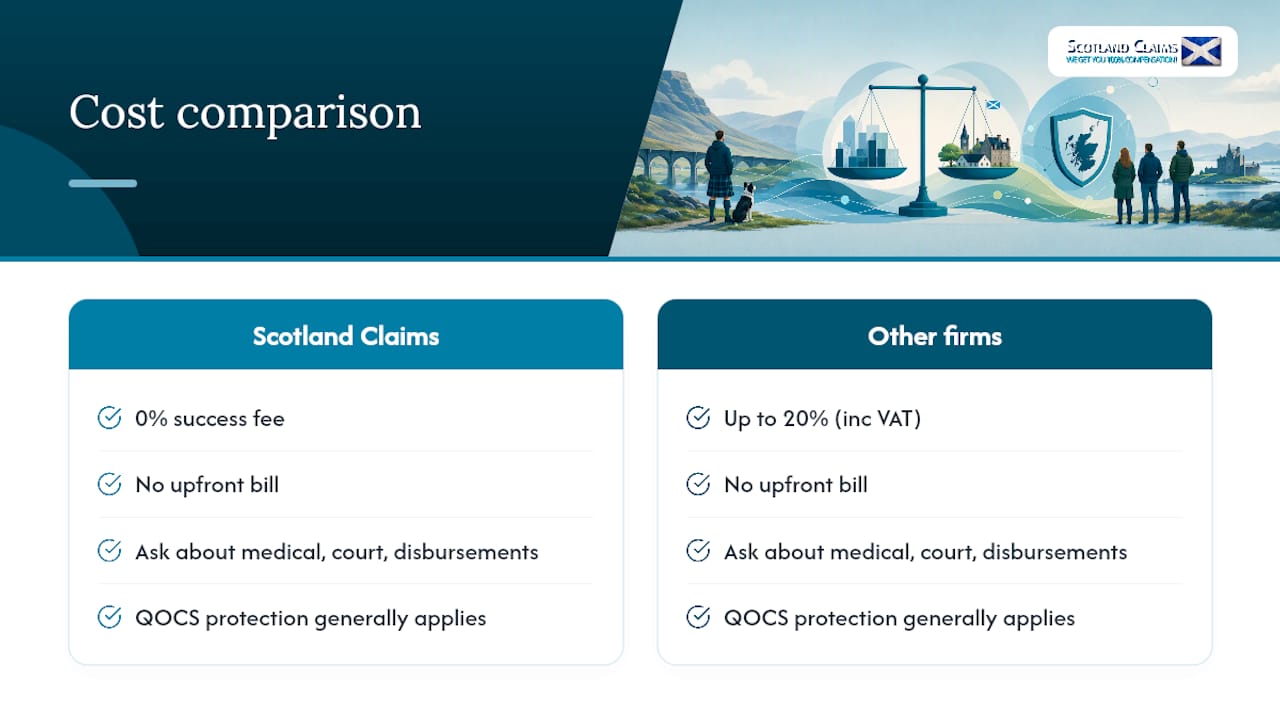
Hidden costs to ask about with any provider include outlays for medical reports, court fees if litigation becomes necessary, and whether disbursements are recoverable from the losing side. QOCS protection, confirmed by the Law Society, generally shields pursuers from the other side’s expenses when a claim is conducted properly, which is one reason genuine no win no fee models are viable in Scotland at all. Always ask for the total cost picture in writing, not just the headline fee percentage.
Are the reviews and reputations actually trustworthy?
Reviews matter, but they tell you less than people assume. A high star rating confirms a firm answers the phone and communicates reasonably well. It says almost nothing about whether the fee structure is competitive or whether the solicitor has genuine Scottish claims experience.
When you’re checking Lawfordclaims.com reviews or reviews for any alternative, look past the star count to what reviewers actually describe: was the fee explained clearly from the start, did the settlement match expectations, was the process as fast as promised? Firms with decades of case history, like Thompsons Scotland in workplace injury litigation, build reputational trust through outcomes in specific case types rather than review volume alone.
The most reliable trust signal isn’t a rating at all. It’s regulatory status. Confirming a firm is regulated by the Law Society of Scotland, and that it will provide a written success fee agreement in the SSFA format, tells you more about reliability than a review page ever will. Citizens Advice Scotland makes the same point, recommending claimants check regulation and specialist status before instructing anyone, rather than relying purely on reputation.
Do the alternatives specialise in different injury types?
Not every firm handles every kind of claim equally well, and that’s worth factoring into your choice.
Scotland Claims Injury Lawyers covers a broad spread of everyday claim types: road traffic accidents (as driver or passenger, not at fault), workplace injuries, slips and trips, whiplash, and motorcycle accidents. That breadth suits the majority of straightforward claims arising from someone else’s negligence.
Thompsons Scotland’s strength sits specifically in workplace and industrial disease claims, built on trade-union-linked litigation experience stretching back decades. If your injury involves long-term industrial exposure or a complex employer liability dispute, that specialist history is genuinely relevant. Slater & Gordon’s national scale can suit complicated, high-value, or multi-party claims where extensive investigative resource matters more than local knowledge. Ireland Personal Injury Advice functions as general guidance rather than a specialist claims handler for any particular injury category, and its relevance to Scottish claimants specifically is limited.
Match the specialism to your injury type before you match on price. A firm with the right experience for a road traffic claim isn’t automatically the right fit for an industrial disease case, and vice versa.
Yes, and it’s more straightforward than most people expect. If you haven’t signed a binding success fee agreement, you’re free to approach a different provider at any point with no obligation to continue.
If you have signed an agreement, check first whether you’re still inside the cooling-off period the Law Society’s guidance requires; during that window you can withdraw without penalty. Once that period has passed, contact the original firm in writing to formally end instruction, and ask them to confirm in writing that your case file will be released to a new solicitor. Most firms will transfer files without dispute, though you should ask about any costs already incurred before the switch, since these can sometimes be recoverable from the new claim’s settlement rather than charged separately.
Before switching, get a free assessment from your chosen alternative first, so you know the new fee basis and can compare it against whatever you originally signed. Scotland Claims Injury Lawyers offers this free assessment with no obligation, which makes it a low-risk way to check whether switching actually improves your position before committing to anything in writing.
What actually matters when you make this call
The keep-100% promise only means something if it’s backed by a written agreement you can point to later. That’s the part people skip past when they’re in pain, stressed, and just want someone to say yes. A written success fee agreement in the SSFA format, and confirmation that QOCS protection applies to your case, turn a marketing claim into something enforceable.
Take a claimant with a straightforward road traffic whiplash injury, not at fault, modest but real damages. For that person, a Scotland-focused, zero-deduction fee model removes the one variable that most affects what actually lands in their bank account. That’s not true for every case. Complex industrial disease claims, for instance, often benefit more from Thompsons Scotland’s specific litigation history than from fee structure alone.
— Roger
Ready to start your claim with no success fee to pay
Scotland Claims Injury Lawyers charges no success fee, so a successful claimant keeps every penny of the compensation awarded. Whether you’re dealing with a whiplash injury, a road traffic accident as a driver or passenger who wasn’t at fault, or a workplace slip or trip, the process starts with a free claim assessment and no obligation to proceed. You can start by requesting a free callback or completing the online no win no fee claim form, and if your injury happened at work, the dedicated injury at work claims page covers what to expect. Before that first call, gather what you can: dates of the incident, any medical letters or reports, photos of the scene if you have them, and details of anyone else involved. It makes the first conversation quicker and gets your assessment moving the same day.
Sources
FAQ
What percentage do no win no fee companies take?
Some firms charge a success fee that can be a significant percentage of the compensation awarded, under limits set by the 2020 Regulations. Scotland Claims Injury Lawyers charges a 0% success fee, so successful claimants keep the full settlement.
What is the hardest injury to prove?
Injuries without clear physical evidence, such as chronic soft tissue damage, psychological injury, or long-term industrial disease, tend to be harder to prove than a visible fracture or documented accident. Medical evidence and early reporting make the biggest difference to how straightforward a claim is to establish.
Is Fletchers Solicitors no win no fee?
Fletchers Solicitors operates on a no win no fee basis for personal injury and clinical negligence work, in line with the wider industry standard. Terms and success fee percentages vary between firms, so always ask for the exact figure in writing before instructing anyone.
What is the average payout for a whiplash claim in the UK?
Whiplash payouts vary widely depending on severity and recovery time, and no single average figure applies fairly across all cases. A compensation calculator can give a rough estimate specific to your injury before you speak to a solicitor.
If no binding agreement has been signed, you can approach a new provider immediately with no obligation. If you have signed, check the cooling-off period first, then request your file be transferred in writing once you’ve confirmed a new firm’s fee basis.
Recommended