Inheritance claim in Scotland: your 2026 guide
TL;DR:
- Inheritance claims in Scotland involve Legal Rights and Prior Rights, which protect spouses, civil partners, and children irrespective of wills or intestacy. Acting quickly, gathering evidence, and lodging a Caveat are essential steps to preserve claims, while challenging a will requires strong proof and legal expertise. Cohabitants and other dependants have limited timeframes for applications, making timely legal advice crucial in inheritance disputes.
An inheritance claim is the legal process by which eligible individuals assert their entitlement to a share of a deceased person’s estate under Scots law, irrespective of a will’s provisions or absence thereof. Scotland operates a distinct succession system from England and Wales, built around three core mechanisms: Legal Rights, Prior Rights, and court-based financial provision. Each carries different eligibility rules, deadlines, and evidentiary requirements. Whether you are a surviving spouse, a child, or a cohabitant left without adequate provision, understanding which route applies to your situation is the first and most consequential step you can take.
What are Legal Rights and Prior Rights in Scottish inheritance law?
Legal Rights are automatic statutory entitlements that protect moveable estate shares for surviving spouses, civil partners, and children, regardless of what a will says. No executor or testator can remove these rights through a will. That makes them fundamentally different from the discretionary claims available under English law.
The shares work as follows. If both a spouse or civil partner and children survive the deceased, each group receives one-third of the net moveable estate. If only one group survives, that group receives one-half. Moveable estate covers assets such as savings, investments, and personal property. It does not include heritable property such as houses, which means children can be entirely excluded from a family home even when Legal Rights apply.
Pro Tip: Legal Rights claims carry a 20-year limitation period, which is far longer than most people expect. Do not assume you have missed your window without first taking legal advice.
Prior Rights operate differently. They apply only on intestacy, meaning when a person dies without a valid will. Prior Rights entitle a surviving spouse or civil partner to the family home up to £473,000, furniture up to £29,000, and a cash sum of £50,000 if children also survive, or £89,000 if no children survive. These figures are set by statute and reviewed periodically.
The table below summarises the key differences between Legal Rights and Prior Rights.
| Feature |
Legal Rights |
Prior Rights |
| Applies when |
Will exists or intestacy |
Intestacy only |
| Who benefits |
Spouse, civil partner, children |
Spouse or civil partner only |
| Estate covered |
Moveable estate only |
Home, furniture, and cash |
| Limitation period |
20 years |
Not separately time-limited |
| Can will override it? |
No |
N/A (no will exists) |
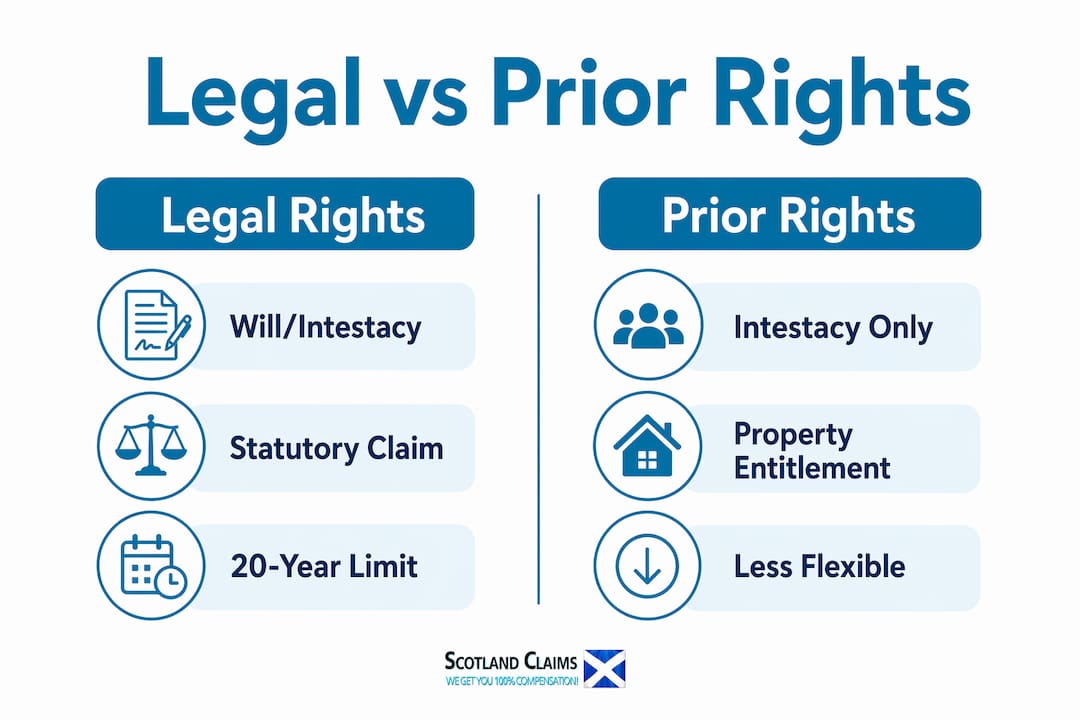
Legal Rights are automatic entitlements independent of the will and can be discharged voluntarily before or after death. Executors carry a legal duty to inform potential claimants of their rights before distributing the estate. If an executor fails to do this, claimants may have grounds to challenge the distribution.
How can you challenge the validity of a will in Scotland?
Challenging the validity of a will is a separate legal process from asserting Legal Rights. The two are frequently confused, but the evidentiary burdens and procedures differ significantly. A Legal Rights claim does not require you to prove anything about the will itself. A validity challenge requires you to prove that the will should never have been made or should not stand.
There are five main grounds for challenging a will in Scotland:
- Lack of testamentary capacity. The testator did not understand what they were signing or the extent of their estate at the time of signing.
- Undue influence. A third party pressured or manipulated the testator into making the will.
- Fraud or facility and circumvention. The testator was deceived or their weakened state was exploited.
- Improper execution. The will does not comply with the Requirements of Writing (Scotland) Act 1995, such as missing a valid signature or witness.
- Revocation. A later will or act by the testator cancelled the document in question.
The legal process for challenging a will is called an “action of production and reduction.” This is raised in the Sheriff Court or the Court of Session, depending on the value and complexity of the estate. A successful challenge sets the will aside entirely, meaning the estate is distributed as if the person had died intestate.
Evidence is everything in a will challenge. Retrospective memories rarely satisfy the court. You need contemporaneous medical records, witness accounts from around the time of signing, and professional legal advice to navigate the proof requirements. Courts apply a high evidential standard precisely because the testator is no longer alive to speak for themselves.
Pro Tip: Act quickly after a death if you suspect a will is invalid. Gathering evidence swiftly after the testator’s death gives you the best chance of securing the medical and witness testimony you need.
DIY wills are a frequent source of disputes. Common problems include improper subscription, ambiguous language, failure to cover the whole estate, and the absence of independent legal advice. A poorly drafted will is far easier to challenge than one prepared by a qualified solicitor.
What is financial provision for family members and dependants in Scotland?
The Inheritance (Provision for Family and Dependants) Act 1975 does not apply in Scotland. Scotland uses Legal Rights instead as its primary protection for spouses and children. This distinction matters enormously for anyone who has received advice based on English law and is now dealing with a Scottish estate.
However, certain groups still have access to court-based financial provision in Scotland. Unmarried cohabitants are the most significant category. Under the Family Law (Scotland) Act 2006, a cohabitant can apply to the court for a capital sum from the deceased’s estate if they were not adequately provided for. The strict deadline for this application is six months from the date of death. Missing that deadline extinguishes the right entirely.
The categories of people who may seek financial provision in Scotland include:
- Surviving cohabitants under the Family Law (Scotland) Act 2006
- Children who have not received adequate provision through Legal Rights or the will
- Dependants who relied financially on the deceased
Courts exercise discretion when deciding these applications. Relevant factors include the length of the relationship, the financial contributions of each party, and the needs of any children. Outcomes can include a lump sum payment or a transfer of specific assets.
| Claimant type |
Legal route |
Deadline |
| Spouse or civil partner |
Legal Rights |
20 years |
| Children |
Legal Rights |
20 years |
| Cohabitant |
Family Law (Scotland) Act 2006 |
6 months from death |
| Dependant (other) |
Court application |
Varies by circumstance |
The contrast between the 20-year window for Legal Rights and the six-month window for cohabitants is stark. Cohabitants face the most urgent timeline of any claimant group in Scotland.
What practical steps should you take to make or contest a claim?
The single most important early step in any inheritance dispute is lodging a Caveat against Confirmation. A Caveat costs £3, lasts six months, is renewable, and ensures you receive notification before an executor is formally granted authority to distribute the estate. Without a Caveat, the estate can be distributed before you have had any opportunity to object.
Follow these steps to protect your position:
- Lodge a Caveat immediately. Contact the relevant Sheriff Court as soon as you become aware of a potential dispute.
- Gather evidence without delay. Collect medical records, correspondence, and witness contact details while memories are fresh.
- Identify which type of claim applies. Determine whether you are asserting Legal Rights, challenging will validity, or applying under the Family Law (Scotland) Act 2006.
- Seek specialist legal advice. The procedural requirements differ significantly between claim types. A solicitor experienced in Scots succession law will identify the correct route and deadline.
- Consider mediation before litigation. Mediation provides timely, amicable resolutions and costs far less than court proceedings.
Key deadlines to keep in mind:
- 20 years for Legal Rights claims by spouses, civil partners, and children
- 6 months from death for cohabitant applications under the Family Law (Scotland) Act 2006
- 6 months renewable for each Caveat lodged against Confirmation
Pro Tip: Mediation is not a sign of weakness. Scottish legal experts consistently recommend it as the preferred route for inheritance dispute resolution. It preserves family relationships and produces binding outcomes without the cost and unpredictability of a court hearing.
Understanding the role of court proceedings in any legal claim helps you make informed decisions about when to litigate and when to negotiate. Litigation should be the last resort, not the first instinct. For those who have had a claim denied at an earlier stage, knowing how to appeal denied claims in Scotland is equally valuable.
Key takeaways
An inheritance claim in Scotland succeeds or fails on knowing which legal right applies, acting within the correct deadline, and gathering evidence before the trail goes cold.
| Point |
Details |
| Legal Rights are automatic |
Spouses, civil partners, and children cannot be disinherited from the moveable estate by a will. |
| Prior Rights apply on intestacy |
Surviving spouses receive the family home up to £473,000, furniture up to £29,000, and a cash sum. |
| Will challenges need strong evidence |
Courts require contemporaneous medical records and witness testimony; retrospective accounts rarely succeed. |
| Cohabitants face a six-month deadline |
Applications under the Family Law (Scotland) Act 2006 must be made within six months of death. |
| Lodge a Caveat early |
A £3 Caveat against Confirmation prevents estate distribution before your claim is heard. |
What I have learned from watching inheritance disputes unfold in Scotland
The single biggest mistake I see people make is treating an inheritance dispute as one problem with one solution. It is not. Claiming Legal Rights and challenging a will’s validity are entirely different legal processes with different courts, different evidence standards, and different outcomes. Conflating them wastes time and money, and sometimes costs people their legitimate entitlement.
The second mistake is waiting. People wait out of grief, out of reluctance to appear grasping, or simply because they do not know the clock is running. For cohabitants, six months passes faster than anyone expects. For will challenges, the evidence that would have won the case deteriorates with every passing week.
I have also seen the damage that DIY will kits cause. A will that fails to comply with the Requirements of Writing (Scotland) Act 1995 is not just invalid. It creates years of litigation, family breakdown, and legal costs that dwarf what a solicitor would have charged in the first place. The same principle applies to estate planning broadly. Professional advice on tax and legal matters at the planning stage prevents disputes at the distribution stage.
Mediation deserves more credit than it gets. I have seen families reach fair, durable agreements in a single mediation session that would otherwise have spent two years in the Court of Session. The legal costs saved are significant. The preservation of relationships is priceless.
If you are facing an inheritance dispute in Scotland, the most useful thing you can do today is speak to a solicitor who specialises in Scots succession law, lodge a Caveat if distribution has not yet occurred, and start gathering every document you can find.
— Roger
Scotland Claims Injury Lawyers: legal support when it matters most
Scotland Claims Injury Lawyers specialises in helping people across Scotland access legal support without financial risk. If you or a family member has suffered a personal injury through an accident that was not your fault, including road traffic accidents, workplace injuries, or slips and trips, you keep 100% of your compensation. There is no success fee to pay, unlike many other firms that deduct up to 20% from your settlement. You pay nothing if your case does not succeed. To find out what your claim could be worth, speak to the team at Scotland Claims Injury Lawyers today, or explore the no win no fee claims service for full details.
FAQ
What is a Legal Rights claim in Scotland?
A Legal Rights claim is a statutory entitlement for surviving spouses, civil partners, and children to receive a share of the deceased’s moveable estate, regardless of what the will states. If both a spouse and children survive, each group receives one-third of the net moveable estate.
How long do I have to make an inheritance claim in Scotland?
Legal Rights claims carry a 20-year limitation period. Cohabitant applications under the Family Law (Scotland) Act 2006 must be made within six months of the date of death.
What grounds can I use to challenge a will in Scotland?
The five main grounds are lack of testamentary capacity, undue influence, fraud or facility and circumvention, improper execution under the Requirements of Writing (Scotland) Act 1995, and revocation by a later will or act.
What is a Caveat against Confirmation and why does it matter?
A Caveat against Confirmation is a formal objection lodged at the Sheriff Court that prevents an executor from being granted authority to distribute the estate without notifying you first. It costs £3, lasts six months, and is renewable.
Does the Inheritance (Provision for Family and Dependants) Act 1975 apply in Scotland?
No. The 1975 Act applies in England and Wales only. Scotland uses Legal Rights as its primary protection for spouses and children. Unmarried cohabitants in Scotland can apply under the Family Law (Scotland) Act 2006 within six months of death.
Recommended