Get expert help with car accident claims in Scotland

TL;DR:
- After a car accident in Scotland, you can pursue a claim through civil legal aid or ‘No Win No Fee’ arrangements, depending on your financial situation and case prospects. Preparing strong evidence quickly, understanding eligibility criteria, and consulting a solicitor early increase your chances of a successful claim and timely compensation. Utilizing specialized injury lawyers ensures you receive guidance without upfront costs, maximizing your recovery while minimizing financial risks.
A car accident turns your life upside down in seconds. Beyond the physical pain and emotional shock, you quickly face a wall of questions: who pays, what are your rights, and can you actually afford to pursue a claim? For many people across Scotland, the worry about legal costs stops them from seeking the help they deserve. This guide cuts through the confusion, explaining exactly what support is available, how to access it without paying upfront, and what steps to take to give your claim the best possible chance of success.
Table of Contents
Key Takeaways
| Point |
Details |
| Help with solicitors |
You can only get legal aid for car claims through a Scottish solicitor. |
| Compare funding options |
‘No Win No Fee’ and legal aid each suit different circumstances, so check both. |
| Act quickly |
There is usually a three-year time limit, so collect evidence and seek advice without delay. |
| Gather evidence early |
Medical reports, witness details, and receipts make your case stronger and quicker. |
| Assess eligibility |
Legal aid is means-tested and based on the case’s legal strength and available alternatives. |
Understanding your options for car accident claims in Scotland
When you start looking into legal help after a car accident, two main routes come up: civil legal aid and ‘No Win No Fee’ arrangements. Knowing the difference matters enormously, because choosing the wrong route can slow your claim or leave you exposed to unexpected costs.
Civil legal aid is a government-funded scheme that can cover your solicitor’s fees if you cannot afford to pay them yourself. Scottish civil legal aid can help pay for solicitor work if you cannot afford your legal costs, but you can only access it through a solicitor, and eligibility depends on your financial circumstances and the strength of your case. It is not automatic, and not everyone qualifies.
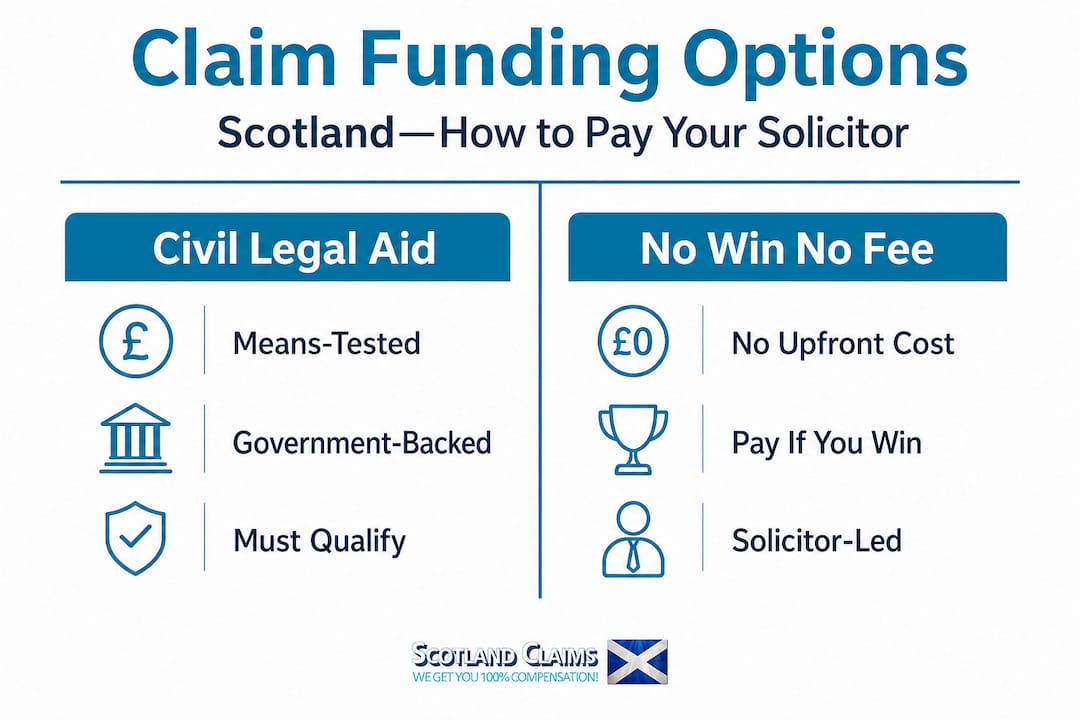
‘No Win No Fee’ (formally known as a Conditional Fee Agreement, or CFA) works differently. Your solicitor takes on your case without charging you upfront. If you win, a success fee is deducted from your compensation. If you lose, you pay nothing. Funding choice depends on your situation: for many road accident personal injury claims, ‘No Win No Fee’ is designed to remove the financial risk of pursuing an unsuccessful case.
Here is a quick comparison of the two options:
| Feature |
Civil legal aid |
No Win No Fee |
| Upfront cost |
None if approved |
None |
| Eligibility test |
Means-tested and merit-tested |
Based on case prospects |
| Who applies |
Through a solicitor |
Agreed with your solicitor |
| If you lose |
Possible contributions may apply |
You pay nothing |
| Best suited for |
Lower-income claimants |
Most road accident claims |
Before committing to either route, consider these key eligibility factors:
- Your household income and savings (for legal aid)
- Whether your case has a reasonable prospect of success
- Whether alternative funding exists, such as legal expenses insurance
- The complexity of liability (who was at fault)
- The severity and documentation of your injuries
Pro Tip: Always discuss both funding options with a solicitor before deciding. Some cases qualify for both, and a specialist can advise which route maximises your recovery. You can get a clearer picture of what to expect by reading a claim process overview before your first appointment.
What to prepare before making your car claim
Once you understand your funding options, preparation becomes your most powerful tool. A well-documented claim moves faster, faces fewer challenges, and typically results in better compensation. Solicitors and insurers alike respond to evidence, not just accounts of what happened.

Here are the key documents and pieces of evidence you should gather:
| Document or evidence |
Why it matters |
| Police report or incident number |
Confirms the accident was recorded officially |
| Photographs of the scene and vehicles |
Establishes facts about damage and road conditions |
| Medical records and GP letters |
Proves the nature and extent of your injuries |
| Witness names and contact details |
Provides independent corroboration of events |
| Insurance details for all parties |
Needed to initiate any claim |
| Receipts for out-of-pocket expenses |
Supports your claim for financial losses |
| Wage slips or employer letters |
Evidence of lost earnings if you missed work |
Take these steps as soon as possible after the accident:
- Call the police if anyone is injured or if there is a dispute about what happened.
- Exchange insurance and contact details with all drivers involved.
- Take photographs of the scene, vehicle positions, damage, and any visible injuries.
- Seek medical attention immediately, even if you feel fine. Some injuries, such as whiplash, appear hours or days later.
- Note the names and contact details of any witnesses.
- Report the accident to your own insurer, even if you do not intend to claim through them.
- Begin a written record of symptoms, appointments, and any expenses from that day forward.
Timing is critical. Edge cases to flag early with a solicitor include disputes about liability, valuation and quantum evidence such as medical reports and financial losses, and timing-related exceptions to the three-year limitation period. Missing the deadline, which is generally three years from the date of the accident, can mean losing your right to claim entirely.
Important: The three-year rule sounds generous, but gathering strong medical evidence, witness statements, and financial records takes time. Starting your claim early gives your solicitor the best chance of building a robust case.
Pro Tip: Keep a dedicated folder, physical or digital, for every receipt, letter, and note related to your accident. Expenses such as travel to medical appointments, prescription costs, and care from family members can all form part of your claim. Thorough collecting evidence from the outset makes a measurable difference to the final settlement. Be aware too of the accident time limits that apply in Scotland and act before they become a problem.
How eligibility for free legal help is assessed
Many people assume they will not qualify for legal aid and never apply. Others assume they will qualify and are surprised when they do not. Understanding how the Scottish Legal Aid Board (SLAB) assesses applications removes the guesswork.
For civil legal aid in Scotland, SLAB assesses ‘probable cause’ (the legal basis for your claim) and whether spending public money is reasonable, including whether help is available elsewhere. The four main criteria are:
- Financial means: Your disposable income and capital must fall below set thresholds. If you receive certain benefits, you may qualify automatically.
- Probable cause: There must be a reasonable legal basis for your claim. A speculative or very weak case will not meet this test.
- Reasonableness: SLAB considers whether it is reasonable to fund the case with public money, taking into account the likely costs and the potential benefit to you.
- Alternatives: If you have legal expenses insurance through your car insurance policy or a home insurance policy, SLAB may consider that alternative funding is available.
Common reasons applications are refused include income or savings above the threshold, a case that lacks sufficient legal merit at the initial review stage, or the existence of legal expenses insurance that was not disclosed. It is also worth noting that even if you are granted legal aid, you may be asked to make a contribution towards costs depending on your financial assessment.
The application process itself must go through a solicitor. You cannot apply directly to SLAB. Your solicitor will assess your case, advise whether legal aid is appropriate, and submit the application on your behalf. This is why finding the right legal representative early is so important. Understanding the role of personal injury representatives in Scotland can help you make a more informed choice.
Pro Tip: Engage a solicitor as early as possible, ideally within days of your accident. Legal aid applications can take time to process, and your solicitor cannot formally begin funded work until approval is granted. Starting early avoids delays that could affect your claim.
Step-by-step: What happens when you start a car accident claim
Knowing what to expect at each stage of the process reduces anxiety and helps you stay in control. Here is a practical walkthrough of the typical journey from first contact to resolution.
-
Contact a solicitor. Your first step is to speak with a solicitor who specialises in personal injury claims in Scotland. Many offer a free initial consultation, so there is no cost to getting an opinion on your case.
-
Initial case review. The solicitor will assess the facts: how the accident happened, who was at fault, the extent of your injuries, and what evidence you have. They will advise whether your claim has a reasonable prospect of success and which funding route suits your situation.
-
Funding arrangement confirmed. If ‘No Win No Fee’ is appropriate, you will sign a Conditional Fee Agreement. If legal aid is being pursued, your solicitor will submit the application to SLAB and await approval before proceeding with funded work.
-
Evidence gathering. Your solicitor will request medical records, commission an independent medical report, and gather supporting documents such as wage slips, receipts, and witness statements. This stage can take several weeks depending on how quickly third parties respond.
-
Letter of claim sent. A formal letter is sent to the at-fault driver’s insurer, setting out the basis of your claim and the losses you have suffered. The insurer has a set period to respond and either admit or dispute liability.
-
Negotiations. If liability is admitted, your solicitor will negotiate a settlement figure with the insurer. Most car accident claims in Scotland are resolved at this stage without going to court.
-
Court proceedings if necessary. If the insurer disputes liability or the settlement offer is inadequate, your solicitor may raise court proceedings. SLAB checks include whether help is available elsewhere, such as through insurance or settlement attempts, before approving continued funding for litigation.
-
Settlement or judgment. Once a figure is agreed or awarded by the court, your compensation is paid. Under ‘No Win No Fee’, the success fee is deducted at this point. Under legal aid, any applicable contributions are settled.
Claims can stall at the evidence-gathering stage if medical reports are delayed, or during negotiations if the insurer disputes the value of your losses. Staying in regular contact with your solicitor and responding promptly to requests for information keeps things moving. For a fuller picture of what the journey looks like, read this step-by-step claim process guide, and understand how proving your claim with solid evidence shapes the outcome.
Pro Tip: Keep a log of every phone call, email, and letter you receive from insurers or your solicitor. Note the date, the name of the person you spoke with, and what was said. This record can be invaluable if there is ever a dispute about what was agreed or communicated.
What most guides miss about car claim help in Scotland
Most articles about car accident claims present a reassuringly tidy picture: gather your evidence, find a solicitor, sign a ‘No Win No Fee’ agreement, and wait for your cheque. The reality is messier, and the gaps in that picture are where people get hurt.
Here is what we have seen repeatedly: people assume that ‘No Win No Fee’ means entirely risk-free. It significantly reduces financial risk, but it does not eliminate it. Success fees, after-the-event insurance premiums, and disbursements can all affect your final figure. The arrangement is still far better than paying upfront, but you should ask your solicitor to explain every potential deduction before signing anything.
Timing is another area where people consistently underestimate the risk. Three years sounds like a long time until you realise that a strong medical prognosis often takes 12 to 18 months to establish, that witnesses become harder to trace, and that evidence degrades. We strongly recommend acting quickly on claims not because of the deadline itself, but because early action produces better evidence, clearer liability assessments, and stronger settlements.
There is also a tendency to treat the first solicitor meeting as a formality, a box to tick before the real process begins. Treat it as a diagnostic appointment instead. Come with your documents, your questions, and a clear account of every loss you have suffered, including the non-financial ones. A good solicitor will use that meeting to identify weaknesses in your case before the insurer does.
Finally, do not assume that because another driver was clearly at fault, liability will be admitted quickly. Insurers have their own processes and financial incentives. Disputes about the extent of your injuries, the value of your losses, or even the basic facts of the accident are common. Specialist legal scrutiny at the outset, not after problems arise, is what separates well-prepared claims from difficult ones.
Get tailored legal help for your car claim
If you have been injured in a car accident in Scotland, you do not have to navigate the claims process alone or worry about upfront legal costs. Scotland Claims connects you with specialist injury lawyers Scotland who understand the Scottish legal system and work exclusively on a no win no fee basis, meaning you keep 100% of your compensation if your claim succeeds. Use our compensation calculator to get an early estimate of what your claim could be worth, then request a free callback to speak with a specialist. There are no hidden charges, no pressure, and no upfront costs whatsoever.
Frequently asked questions
Can I get legal aid for a car accident claim in Scotland?
Yes, if you meet the means-tested financial criteria and your case has sufficient legal merit, but only through a solicitor who submits the application to SLAB on your behalf.
What is the time limit for making a car claim?
The typical time limit is three years from the date of the accident, but timing-related exceptions can apply in certain circumstances, such as claims involving children or cases where injuries were not immediately apparent.
What documents should I gather for my car accident claim?
You should collect accident details, medical evidence, witness statements, and keep all receipts for expenses, as quantum evidence including financial losses forms a critical part of your claim valuation.
Is ‘No Win No Fee’ available for car accident claims in Scotland?
Yes, ‘No Win No Fee’ is widely used for personal injury claims in Scotland, and for road accident claims it is often the most practical funding route, allowing you to proceed without any upfront financial risk.
Recommended