Forklift accident claim Scotland: your rights explained
Yes, you can bring a forklift accident personal injury claim in Scotland, provided you act within the legal time limit. That limit is three years from the date of the accident, known as the “triennium” under section 17 of the Prescription and Limitation (Scotland) Act 1973. In some cases, the clock starts later, from your “date of knowledge”, if you didn’t immediately realise your injury was linked to the incident.
Do this now:
- Get medical treatment and keep every record, even for injuries that seem minor at first.
- Report the accident through your employer’s official channels and ask for a copy of the report.
- Note names and contact details of anyone who saw what happened.
Scotland Claims Injury Lawyers offers a free claim assessment if you want to know where you stand.
Key Takeaways
Most forklift accident claims in Scotland must be raised within three years of the injury, and choosing a no success fee solicitor keeps your full compensation intact.
| Point |
Details |
| Three-year triennium applies |
You must normally raise a claim within three years of the accident under the 1973 Act. |
| Date of knowledge can shift the deadline |
If you didn’t realise the injury was linked to the accident straight away, the clock may start later. |
| Multiple parties can be liable |
Employers, hire companies, manufacturers, and contractors can all share responsibility. |
| Evidence disappears fast |
CCTV, witness memories, and maintenance logs fade or vanish, so act quickly. |
| Scotland Claims Injury Lawyers charges no success fee |
Clients keep all of their compensation, unlike firms charging a percentage fee including VAT. |
Table of Contents
Who can bring a forklift injury compensation claim in Scotland
Forklift accidents rarely stay confined to the person driving the machine. Scots law recognises this, and the right to claim extends well beyond the operator.
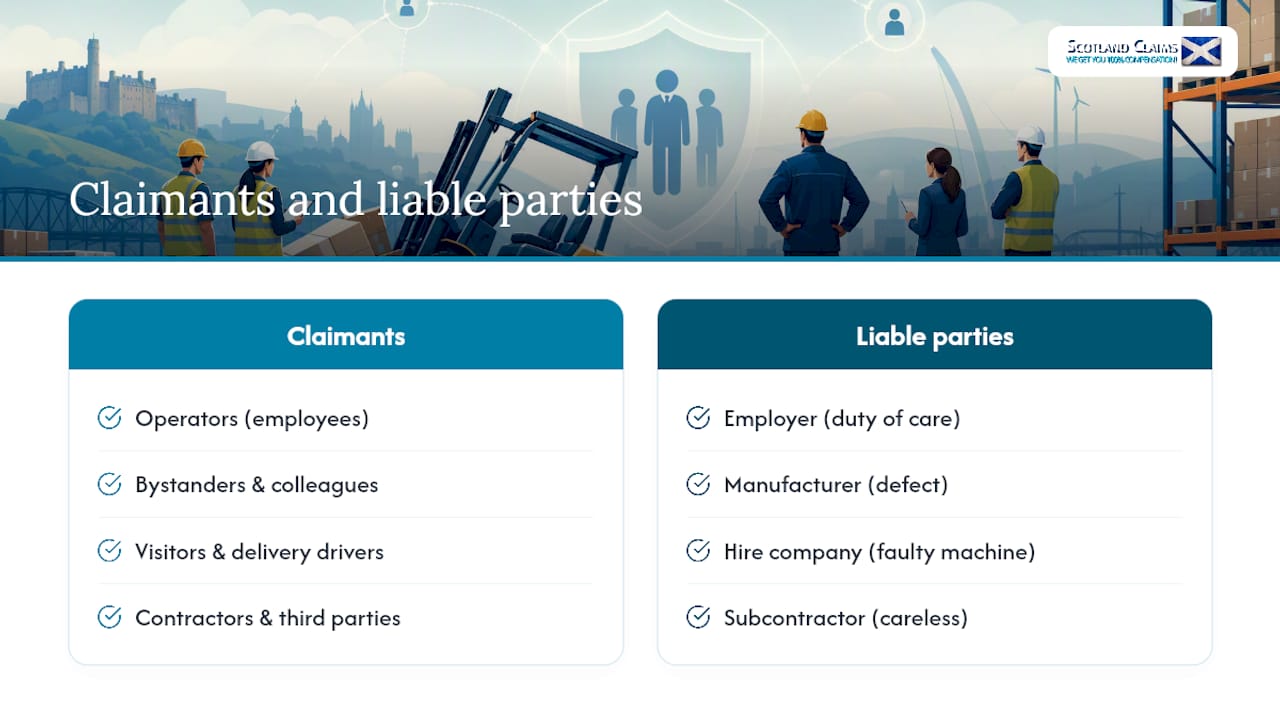
Employees injured while operating a forklift, or working near one, have the clearest route to a claim, particularly where training, maintenance, or supervision fell short. Bystanders and colleagues in the wrong place at the wrong time, struck by a reversing forklift or falling stock, have equally valid grounds if negligence caused their injury. Warehouse and yard environments create constant near-misses during loading and unloading, and a moment’s distraction from an operator often becomes someone else’s serious injury.
Visitors and third parties, including delivery drivers, contractors, and members of the public on-site, can also claim if a business failed in its duty of care. Liability doesn’t always sit with one party either. A forklift manufacturer, a hire company that supplied a faulty machine, or a subcontractor operating carelessly on a shared site can all share responsibility alongside an employer.
What matters in every scenario is proving someone else’s fault, whether that’s poor site layout, inadequate training, defective equipment, or a breach of workplace safety duties. A complete guide to workplace accident rights in Scotland sets out how these duties apply more broadly across industrial settings, not just forklift incidents specifically.
How a Scotland forklift accident claim actually proceeds
The process starts with a free initial assessment, where a solicitor listens to what happened and checks whether you have a viable case within the triennium. This conversation costs nothing and commits you to nothing.
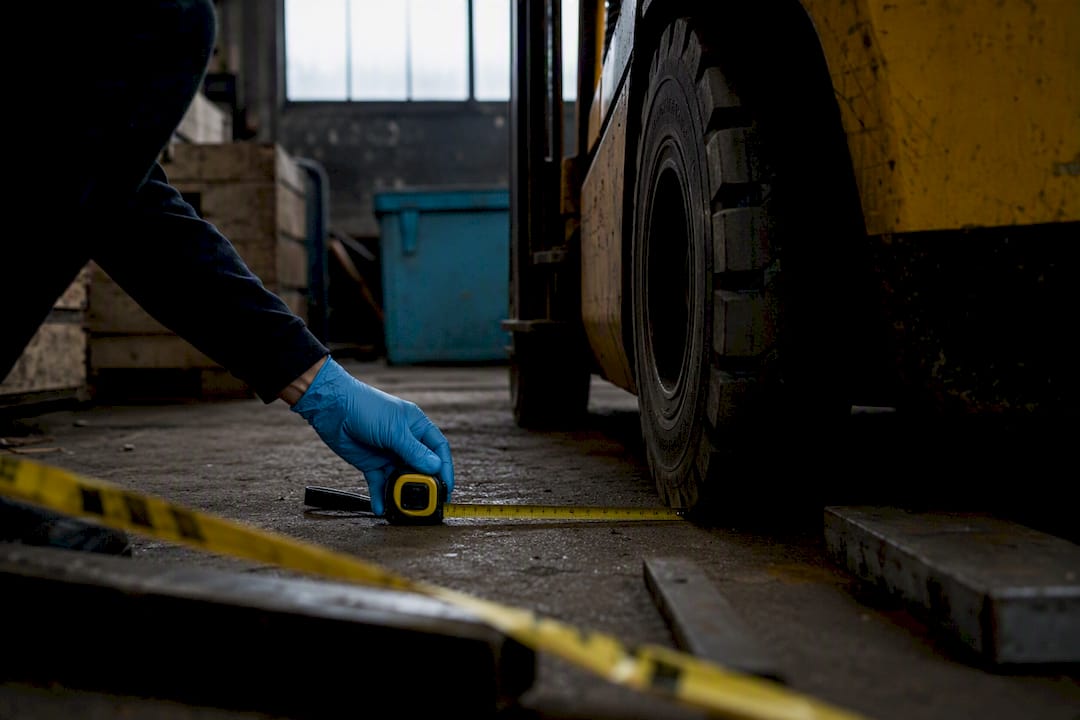
If the case looks solid, investigation begins. Your solicitor will gather the accident report, CCTV footage where it exists, witness statements, training records, and maintenance logs for the forklift involved. This is where early evidence-gathering pays off. A workplace that “loses” its CCTV six months after an accident is not unheard of, so the sooner details are locked down, the stronger your position.
Medical evidence comes next. An independent medical report establishes the extent of your injuries, the likely recovery timeline, and whether you’ll face any lasting impact. This report shapes the value of your claim as much as the accident itself does.
Most Scottish personal injury claims, including workplace and forklift cases, are raised in the sheriff court under simple or ordinary procedure, depending on value and complexity, according to Simplicity Legal. Many claims settle before ever reaching a courtroom, once liability and medical evidence are clear enough for insurers to negotiate. Court action remains the fallback when liability is disputed or an insurer refuses a fair offer. Throughout, you should expect regular updates rather than radio silence for months at a time. A guide on how to claim injury compensation in Scotland walks through each stage in more detail.
Choosing a lawyer for your Scotland forklift accident lawyer search
Not every solicitor who handles personal injury work understands industrial machinery cases. Forklift accidents involve specific evidence, from LOLER inspection records to operator certification, and a lawyer unfamiliar with warehouse operations may miss details that make or break your claim.
Ask direct questions before instructing anyone. How many workplace or industrial accident claims have they handled? Will a named solicitor manage your case, or does it get passed between junior staff? What exactly happens to your compensation if you win, and is there a success fee?
That last question matters more than most people realise. On a £30,000 payout, that’s £6,000 gone before you see a penny.
Watch for red flags too: pressure to sign immediately, vague answers about fees, or reluctance to put the no win no fee terms in writing. A lawyer confident in your case will explain the three-year time limit clearly and won’t rush you into a decision you haven’t had time to consider.
Why we built our approach around Scotland’s claims process
We specialise in Scottish personal injury claims, and forklift accidents come through our door regularly, from warehouse operatives to delivery drivers caught in loading-bay incidents. Expect a fast, free assessment, hands-on help gathering evidence, and support with interim payments where your circumstances need it.
Get your free forklift accident claim assessment
Scotland Claims Injury Lawyers takes a different position: we charge no success fee, so if your forklift accident claim succeeds, the full amount comes to you.
Our specialist solicitors handle everything from evidence collection and medical report coordination to negotiation and, where necessary, court representation. There’s no upfront cost and no financial risk to starting a conversation. Use our compensation calculator to get a rough estimate of what your claim could be worth, then request a callback or complete the online form to speak with a solicitor who understands industrial accident claims in Scotland. The assessment is free, and there’s no obligation to proceed afterwards.
Sources
This article is general information, not a substitute for advice from a qualified lawyer. Consult a qualified legal professional about your own circumstances before acting on anything here.
FAQ
Can I claim if I wasn’t the forklift operator?
Yes. Bystanders, colleagues, and visitors injured by a forklift’s operation can claim if negligence caused their injury, regardless of who was driving.
What if I didn’t report the accident straight away?
You can still claim, but a delayed report weakens your evidence. Get medical treatment and document what happened as soon as possible.
Does the three-year limit ever change for children?
Yes. Under Scots law, the three-year limit for a child doesn’t begin until they turn 16, giving families more time to bring a claim.
How much does it cost to start a claim with Scotland Claims Injury Lawyers?
Nothing upfront.
What if my employer says the accident was my fault?
An employer’s opinion doesn’t decide liability. A solicitor investigates the evidence independently, including training records and site conditions, before any conclusion is reached.
Recommended