Lawyer for work accident in Scotland: your free claim guide

If you have been injured at work in Scotland, contact Scotland Claims Injury Lawyers now for a free assessment and no win no fee representation. You pay nothing upfront, nothing if the case is lost, and nothing from your compensation if you win. That last point matters more than most people realise: most solicitors in Scotland charge a success fee of up to 20% of your settlement. Scotland Claims charges none.
The three-year limitation period under Scots law means time is not on your side. Start with these three steps:
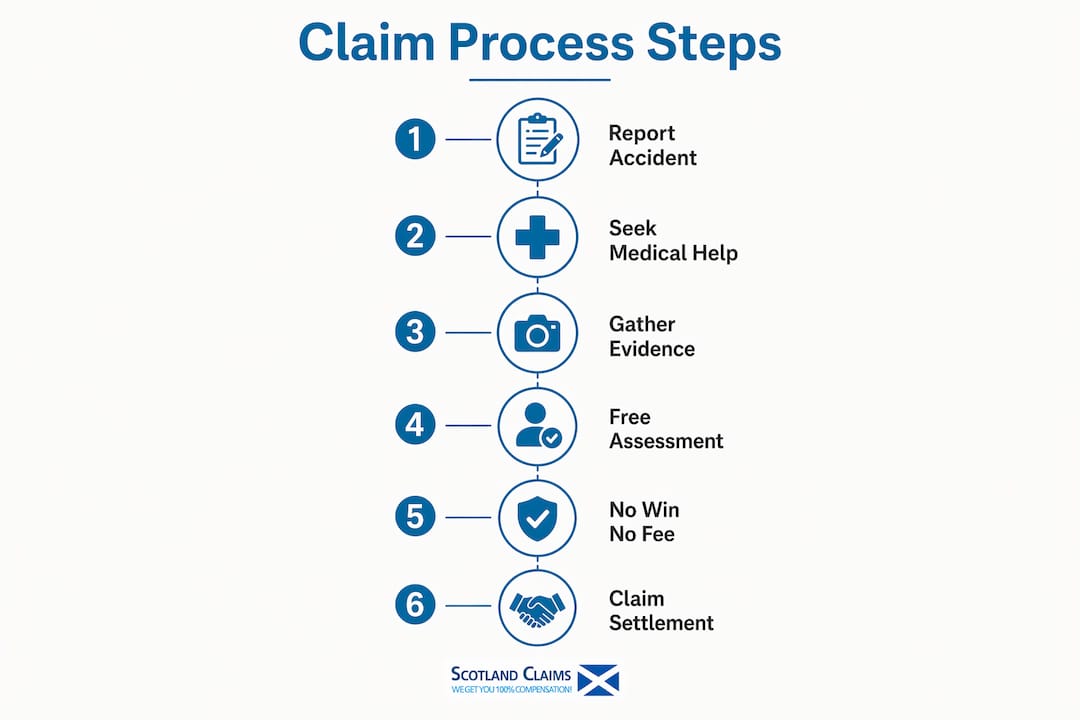
- Report the accident to your employer and ask for it to be recorded in the accident book.
- Seek medical attention immediately, even if injuries feel minor, to create an independent medical record.
- Save evidence now: photographs, witness names, payslips, and any damaged equipment or clothing.
Pro Tip: Use the Scotland Claims compensation calculator to get a rough estimate of your claim’s value before your free assessment. It takes two minutes and gives you a realistic starting point for your conversation with a solicitor.
Table of Contents
What counts as an accident at work, and what does your employer owe you?
An accident at work, in personal injury law, is any incident that causes physical or psychological harm while you are carrying out duties connected to your employment. That covers factory floors and office desks, construction sites and care homes, delivery routes and client premises. The location matters less than whether you were working at the time.

Under Scots law, a workplace injury claim is a delict claim. You must show that your employer owed you a duty of care, that they breached it, and that the breach caused your injury. The Health and Safety at Work etc. Act 1974 codifies that duty: employers must provide safe premises, safe plant and equipment, safe systems of work, competent colleagues, and adequate training. A breach of any one of those obligations can found a claim.
Common breaches include failing to fix a known hazard, skipping mandatory risk assessments, providing inadequate personal protective equipment, or failing to train staff on manual handling. The employer does not need to have acted maliciously. Negligence is enough.
Who pays if you win? Employers are legally required to hold employer’s liability insurance. When liability is established, the insurer pays your compensation, not your employer personally. That means a successful claim rarely threatens a small business’s survival, which is a concern many injured workers quietly carry.
Coverage extends beyond permanent employees. Many agency workers, apprentices, and some contractors working under the employer’s direction are also protected. If you are unsure whether your working arrangement qualifies, a free assessment with Scotland Claims Injury Lawyers will clarify it quickly.
Common workplace accidents that lead to successful claims
The Health and Safety Executive records hundreds of thousands of non-fatal workplace injuries in Great Britain each year. The categories below account for the vast majority of personal injury claims in Scotland:
- Slips, trips, and falls on the same level — wet floors, uneven surfaces, poor lighting, and trailing cables are the most frequent causes.
- Manual handling and lifting injuries — back injuries, herniated discs, and shoulder strains from moving loads without proper training or equipment.
- Falls from height — scaffolding, ladders, mezzanine floors, and roof work; these tend to produce serious injuries and higher-value claims.
- Machinery and equipment accidents — crush injuries, lacerations, and amputations caused by unguarded machinery or inadequate maintenance.
- Vehicle incidents at work — forklift accidents, delivery vehicle collisions, and incidents in car parks or loading bays.
- Occupational disease and repetitive strain — vibration white finger, noise-induced hearing loss, carpal tunnel syndrome, and work-related upper limb disorders that develop over time.
- Assaults at work — physical attacks by a third party where the employer failed to provide adequate security or risk assessment.
Psychological injuries, including PTSD and clinical depression following a traumatic incident, are also claimable where a causal link to the workplace event can be established. For serious brain or spinal injuries, specialist handling is essential: these cases involve complex medical evidence, long-term care projections, and often higher settlement values that require experienced negotiation.
The actions you take in the first 24–48 hours after an accident can make or break a claim. Follow this checklist:
- Get medical attention first. Go to A&E, a minor injuries unit, or your GP as soon as possible. This creates a contemporaneous medical record that is independent of your employer.
- Report the accident to your employer and ask them to record it in the accident book. Employers with more than ten employees are legally required to maintain one. Ask for a copy of the entry.
- Photograph everything. The hazard that caused the accident, your injuries, any damaged clothing or equipment, and the wider scene. Do this before anything is cleaned up or moved.
- Collect witness details. Names and contact numbers of anyone who saw the accident or its immediate aftermath. Written statements gathered early carry significant weight.
- Keep your payslips and employment contract. These confirm your employment status and earnings, both of which affect the special damages calculation.
- Report to external bodies if required. Certain serious injuries must be reported to the HSE under RIDDOR. Your employer should do this, but knowing it applies protects you if they do not.
- Start an injury diary. A daily note of your symptoms, pain levels, and how the injury affects your daily life. Courts and insurers take these seriously.
Pro Tip: Request your NHS medical records using a Data Subject Access Request as soon as possible. The NHS typically processes these within 30 days and usually at no charge. Having your records ready when you first speak to a solicitor can speed up the viability assessment significantly and sometimes removes the need for a separate solicitor-led records request.
Who can bring a claim, and what complicates eligibility?
Most people injured at work in Scotland can bring a claim, but the specifics of your working arrangement matter. Those who may claim include:
- Employees on permanent or fixed-term contracts.
- Agency workers, where the host employer controlled the working environment.
- Apprentices and trainees.
- Some self-employed people, where the engaging business directed how and where they worked.
Complications arise in several situations. Contributory negligence applies when you were partly at fault: your compensation may be reduced proportionally, but a partial contribution does not bar a claim entirely. Pre-existing conditions do not prevent a claim either; if the accident aggravated a prior condition, you can recover for that aggravation. Offshore and cross-border incidents involve additional jurisdictional questions and should be discussed with a specialist.
The single most important complication is time. In Scotland, the limitation period for personal injury claims is three years from the date of the accident, or three years from the date you became aware that your injury was caused by your employer’s negligence. Miss that window and the court will almost certainly refuse to hear the case. Early legal advice is not just helpful; it is often the difference between a valid claim and a lost one.
Documents that help confirm eligibility: employment contract or written statement of terms, payslips, P60, any correspondence about the accident, and the accident book entry.
How much compensation could you receive?
Compensation in a workplace injury claim divides into two categories.

General damages cover pain, suffering, and loss of amenity. These are assessed against the Judicial College Guidelines, which set indicative ranges for different injury types and severities. A minor soft-tissue injury and a serious spinal injury sit at very different points on that scale.
Special damages cover actual and future financial losses. These include:
- Lost earnings to date and projected future loss of earnings.
- Medical expenses: private treatment, physiotherapy, prescription costs.
- Care costs: paid carers or the value of care provided by family members.
- Travel costs to medical appointments.
- Adaptations to your home or vehicle if the injury is permanent.
| Damages type |
What it covers |
Key factors affecting value |
| General damages |
Pain, suffering, loss of amenity |
Injury severity, prognosis, impact on daily life |
| Past special damages |
Financial losses already incurred |
Actual receipts, payslips, care logs |
| Future special damages |
Projected ongoing losses |
Age, prognosis, career trajectory, care needs |
Several factors push a claim’s value up or down: the severity and permanence of the injury, your age and pre-accident earnings, whether you can return to your previous role, and the quality of the medical evidence. There is no fixed sum for any injury type, which is why a solicitor’s assessment matters.
Use the Scotland Claims compensation calculator to get an indicative range before your free assessment. It is a starting point, not a promise, but it gives you a realistic frame of reference.
No win no fee: what it means and what Scotland Claims guarantees
A no win no fee arrangement, formally called a conditional fee agreement in Scotland, means your solicitor takes on the financial risk of the case. If the claim fails, you pay nothing. If it succeeds, legal costs are recovered from the defendant’s insurer, not from your compensation.
The critical detail most claimants miss: many solicitors also charge a success fee deducted from your settlement. The Law Society notes that fee structures vary, and the maximum success fee under a conditional fee agreement is 25% of damages in England and Wales. In Scotland, the position differs, but many firms still charge a percentage of your award.
Scotland Claims Injury Lawyers charges no success fee. None. You keep 100% of your compensation. Most solicitors in Scotland take up to 20% of your settlement as a success fee. On a typical award, that can amount to a significant portion of your compensation. With Scotland Claims, that £4,000 stays with you.
Questions to ask any solicitor about costs before you sign:
- Is there a success fee, and if so, what percentage?
- Are there any disbursements (medical report fees, court fees) I might have to pay?
- What happens to costs if the case settles early?
- Is the no win no fee agreement in writing?
Pro Tip: Always get the fee arrangement in writing before instructing a solicitor. A verbal assurance is not enforceable. Scotland Claims provides a clear written agreement from the outset, so you know exactly where you stand before the claim begins.
How a work accident claim actually progresses
Understanding the process removes a lot of the anxiety. Here is how a typical workplace injury claim in Scotland moves from first contact to resolution:
- Free initial assessment. You speak to a specialist solicitor who reviews the facts, confirms eligibility, and advises on likely value and timescales. No charge, no obligation.
- Evidence gathering and letter of claim. The solicitor collects medical records, accident book entries, witness statements, and employment records, then sends a formal letter of claim to the employer or their insurer.
- Insurer response. The insurer has a defined period to investigate and respond, admitting or denying liability.
- Medical evidence. An independent medical expert examines you and produces a report on your injuries, prognosis, and any ongoing limitations. This report is central to the valuation.
- Negotiation and settlement offers. Most claims settle at this stage through negotiation. The solicitor advises whether any offer is fair relative to the evidence.
- Court proceedings if necessary. If liability is disputed or an offer is unreasonably low, the solicitor raises court proceedings. Most cases still settle before a proof (trial) date is reached.
Timescales vary considerably. Minor soft-tissue injuries with clear liability can settle in a few months. Serious injuries involving complex medical evidence and disputed liability may, as the Law Society notes, take two to four years or longer. The key is building a credible case file early: strong contemporaneous evidence improves settlement prospects and reduces the likelihood of having to go to court at all.
Why Scotland Claims Injury Lawyers handles workplace claims differently
Scotland Claims Injury Lawyers focuses exclusively on personal injury claims in Scotland. That geographic and subject-matter focus matters: Scots law has its own procedural rules, its own limitation periods, and its own court structure. A solicitor who handles Scottish personal injury claims every day knows the local courts, the local insurers, and the arguments that work.
The Scotland Claims guarantee: No win no fee. No success fee. No upfront costs. You keep 100% of your compensation. Specialist workplace injury solicitors handle your case from free assessment through to settlement or court. The compensation calculator gives you an indicative value before you even pick up the phone.
What the free assessment includes:
- A review of the facts by a specialist workplace injury solicitor.
- An honest opinion on whether the claim has merit and its likely value.
- Explanation of the process, timescales, and what evidence you need.
- No obligation to proceed, and no charge regardless of the outcome.
Scotland Claims also handles the procurement of independent medical reports, manages all correspondence with the employer’s insurer, and advises at every stage on whether settlement offers are fair. For back injuries specifically, the back injury claims service covers the full range from soft-tissue strains to serious spinal damage.
To begin, visit the injury lawyers in Scotland page, use the compensation calculator, or request a callback. The assessment is free and there is no pressure to proceed.
Key takeaways
A specialist no win no fee lawyer for work accident claims in Scotland gives you the best chance of recovering 100% of your compensation without paying a success fee.
| Point |
Details |
| Three-year time limit |
Scotland’s limitation period runs from the accident date; missing it bars your claim entirely. |
| Evidence from day one |
Accident book entry, photographs, and witness details gathered early materially strengthen your case. |
| Two types of compensation |
General damages cover pain and suffering; special damages cover lost earnings, care, and medical costs. |
| No success fee |
Scotland Claims Injury Lawyers charges no success fee, so you keep 100% of your settlement. |
| Scotland Claims Injury Lawyers |
Offers a free assessment, a compensation calculator, and specialist workplace injury solicitors across Scotland. |
The part most people get wrong about instructing a solicitor
There is a widespread assumption that all no win no fee solicitors are essentially the same, that the fee arrangement is the only variable worth checking. That assumption costs injured workers thousands of pounds every year.
The success fee is the obvious difference, and Scotland Claims Injury Lawyers removes it entirely. But the less-discussed variable is specialisation. A solicitor who handles workplace injury claims in Scotland daily understands the specific obligations under the Health and Safety at Work etc. Act 1974, knows how Scottish courts approach contributory negligence, and has established relationships with the medical experts whose reports carry weight in negotiation. A generalist who occasionally handles a workplace claim does not bring that depth, and the difference shows in settlement values and timescales.
The other thing people consistently underestimate is how much the quality of early evidence affects the outcome. Insurers assess claims on the strength of the file presented to them. A claim supported by a contemporaneous accident book entry, independent medical records, and clear witness statements settles faster and for more. A claim reconstructed months later from memory settles for less, or not at all. The checklist in this article is not procedural box-ticking. It is the difference between a strong file and a weak one.
If you have been injured at work, the single most useful thing you can do today is request a free assessment. Not next week. Today.
Scotland Claims Injury Lawyers: start your free assessment now
Scotland Claims Injury Lawyers offers injured workers in Scotland a genuinely different proposition: specialist workplace injury solicitors, a no win no fee arrangement, and a guarantee that you keep every penny of your compensation. No success fee. No upfront costs. No deductions.
The free assessment is exactly that: free, with no obligation to proceed. You can start online using the no win no fee claims page, request a callback, or use the compensation calculator to get an indicative figure before you speak to anyone. For back injuries, knee injuries, or any other workplace injury, specialist solicitors are ready to assess your case.
Request your free assessment today at Scotland Claims Injury Lawyers.
This article provides general information about workplace injury claims in Scotland and does not constitute legal advice. For advice specific to your situation, speak to a qualified solicitor.
Useful sources and further reading
Official guidance and Scotland Claims resources used in preparing this article:
- Health and Safety Executive — workplace injury statistics: Annual data on non-fatal and fatal workplace injuries across Great Britain; useful for understanding how common different accident types are.
- Health and Safety at Work etc. Act 1974: The primary legislation setting out employer duties; essential reading for understanding the legal basis of a claim.
- HSE RIDDOR guidance: Explains which workplace injuries must be reported to the HSE and by whom.
- Citizens Advice — accidents at work: Plain-language guidance on reporting accidents, the accident book, and initial steps.
- The Law Society — getting a personal injury lawyer: Guidance on choosing a solicitor, fee arrangements, and what to expect from the claims process.
- LegalClarity — personal injury claims in Scotland: Detailed explanation of the delict framework, evidence requirements, and Data Subject Access Requests.
- Scotland Claims — injury at work claims: Scotland Claims’ primary workplace injury page covering rights, timescales, and how to start a claim.
- Scotland Claims — compensation calculator: Interactive tool for estimating claim value; best used alongside a free solicitor assessment.
FAQ
Can I sue my employer for a workplace accident in Scotland?
Yes. If your employer breached their duty of care under the Health and Safety at Work etc. Act 1974 and that breach caused your injury, you can bring a personal injury claim. In practice, compensation is paid by the employer’s liability insurer, not the employer directly.
How much compensation can I get for a workplace accident?
There is no fixed amount. Compensation depends on the severity of your injury, your financial losses (including lost earnings and care costs), and your prognosis. Use the Scotland Claims compensation calculator for an indicative range, then speak to a solicitor for a bespoke assessment.
What type of solicitor do I need for a work accident claim?
You need a personal injury solicitor with specific experience in employer’s liability and workplace injury claims in Scotland. Scotland Claims Injury Lawyers specialises exclusively in Scottish personal injury claims and offers a free initial assessment with no obligation to proceed.
Report the accident to your employer and ask for it to be recorded in the accident book, seek medical attention the same day, photograph the scene and your injuries, and collect witness contact details. Early evidence gathering is the single most important factor in building a strong claim.
How long does a work accident claim take to settle?
Minor claims with clear liability can settle within a few months. Serious injuries involving complex medical evidence may take two to four years or longer, as the Law Society notes. Starting early and building a strong evidence file from the outset gives the best chance of an earlier resolution.
Recommended