Start a Foreign Driver Claim in Scotland, 3 Year Limit, MIB and No Win No Fee
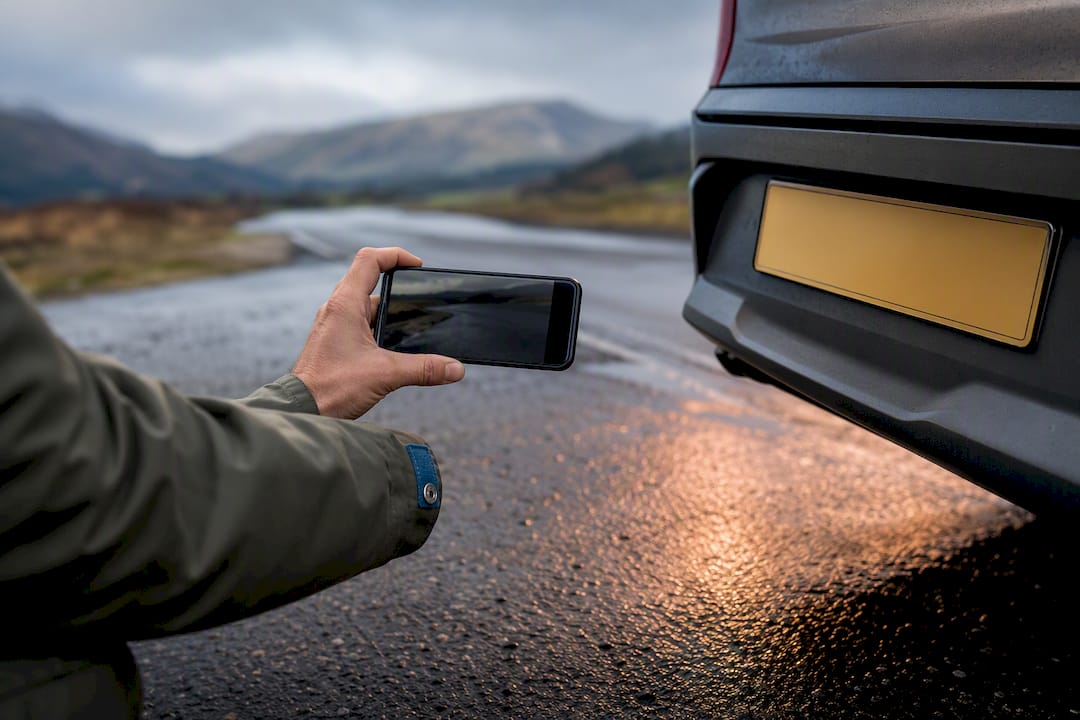
Yes, you can claim compensation in Scotland after a crash caused by a foreign, uninsured or untraced driver. The two main routes are a claim through the Motor Insurers’ Bureau (MIB) or, where the other driver’s insurer can be identified, a direct claim against its UK representative. Act quickly: collect evidence at the scene, report to police and your own insurer, and remember Scotland’s three-year limitation rule.
TL;DR:
- Claimants should prioritize collecting detailed scene evidence, including registration numbers, Green Card photos, and police references, to speed up insurance tracing.
- Promptly reporting the crash to police and your own insurer within the three-year limit is crucial to preserving your claim rights.
- If injured abroad, obtaining local police and medical reports, along with translations, can simplify cross-border insurance claims through the Green Card system.
- Most claims involving untraced or foreign drivers are resolved faster when claimants act quickly rather than waiting weeks to gather evidence or seek legal advice.
- Starting with a free assessment from a specialist solicitor offers the best chance of navigating complex foreign or MIB claims within Scottish time limits.
Scotland Claims Injury Lawyers
Get Help With Your Foreign Driver Claim
Scotland Claims Injury Lawyers connects Scottish injury victims with specialist lawyers for foreign, uninsured and untraced driver claims.
Start your claimTable of Contents
How to make a claim with the Motor Insurers’ Bureau
The MIB steps in where ordinary insurance routes break down. It handles claims involving untraced drivers, uninsured drivers, and vehicles registered abroad, provided the accident happened in the UK, the Crown Dependencies, or Gibraltar.
Before you check eligibility, know that MIB deals with exactly these three scenarios: the driver fled the scene and cannot be identified, the driver had no valid insurance, or the vehicle carried foreign plates and the insurer needs tracing. If your case fits one of these, you can make a claim via the MIB portal, which handles uninsured, untraced and foreign vehicle cases through a single online system.
The process itself follows a fairly consistent pattern:
- Register on the MIB claims portal and complete the online claim form with accident details.
- Upload supporting evidence, including the police reference number, photographs, and any documents from the other vehicle.
- Provide medical records and details of any financial losses linked to the injury.
- Wait for MIB to begin its own investigation, which may involve tracing the foreign insurer or its UK representative.
Once you submit a claim, MIB works to identify who is actually liable. If the vehicle turns out to have valid foreign insurance after all, MIB may pass the case to that insurer’s UK representative instead of handling it directly. That’s why the quality of your scene evidence, registration number, Green Card details, and police reference, matters so much before you even open the portal.
Before filing, gather everything you can: the other vehicle’s registration, any Green Card shown at the scene, your police reference number, contact details for witnesses, and copies of your medical notes. Missing pieces slow everything down.
What to do at the scene and the evidence that supports a foreign driver claim
What happens in the first ten minutes after a crash often decides how smoothly your claim runs months later. A few actions matter far more than others.
- Photograph the registration plate and any insurance documents. If the driver shows you a Green Card, photograph it in full. MIB notes that collecting the registration number, Green Card details and photos at the scene is one of the strongest steps you can take to help trace the foreign vehicle’s insurer.
- Photograph the damage and any visible injuries before vehicles are moved, where it’s safe to do so.
- Take witness names and phone numbers. Note anything the other driver said at the scene, including admissions of fault.
- Report the accident to the police and to your own insurer as soon as possible. Delayed reporting can complicate or weaken a later MIB or insurer claim.
A clear photograph of a Green Card number can be the single detail that identifies the correct UK representative and cuts weeks off your claim.
If the accident happened abroad: jurisdiction and the Green Card system
Cross-border crashes work differently, and this is where the Green Card system earns its keep. If you’re injured abroad by a foreign driver, the Green Card system and UK correspondents provide the established framework for tracing insurers and managing the claim across borders, meaning you don’t always need to pursue the case entirely in the country where it happened.
In many cases, you can bring a claim through your own insurer or against the foreign insurer’s UK representative rather than navigating a foreign court system. Scottish courts will hear a case where jurisdiction rules allow it, though enforcement of any foreign judgment can add complexity if the matter does end up abroad.
Practical steps if you’re injured overseas:
- Get a police report at the scene, even if it feels like a formality on holiday.
- Obtain local medical records and keep certified translations if they’re not in English.
- Contact your UK insurer as soon as you’re able.
- Keep every receipt and travel document; they often support losses claimed later.
Eligibility and time limits in Scotland you must not miss
Scotland runs a strict clock on personal injury claims, and missing it can end a valid case before it starts. You must normally begin a personal injury claim within three years of the date of the accident, whether the claim runs through MIB, a foreign insurer’s representative, or your own insurer.
There’s one significant exception. If the injured person was under 16 at the time of the accident, the three-year clock doesn’t start immediately, they can bring a claim at any point up until they turn 19.
- The three-year rule applies from the date of the accident, not the date symptoms appeared or worsened.
- Children injured before turning 16 have until age 19 to start a claim.
- Reporting late to police or your insurer can weaken evidence and, in some cases, jeopardise the claim entirely.
If you’re unsure how close you are to a deadline, get advice sooner rather than later; our guide on personal injury claim time limits in Scotland sets out the detail.
Costs, funding and no win no fee: what to expect
Money worries shouldn’t stop anyone pursuing a legitimate claim, and Scottish guidance backs that up directly. Official advice states you shouldn’t have to pay for an initial meeting with a solicitor, and many firms operate on a no win, no fee basis as standard.
That said, not every provider structures fees the same way. Many big-brand solicitors and claims firms deduct a success fee from compensation awarded, often a portion including VAT. Some firms deduct a success fee from compensation awarded, often a portion including VAT, but others do not.
- Ask upfront whether the solicitor charges any success fee or deduction.
- Ask who handles direct contact with MIB or the foreign insurer.
- Ask for a realistic timescale before you commit to anything.
Pro Tip: Complex foreign-insurer or MIB cases usually benefit from a solicitor rather than a claims management company alone; a solicitor typically holds the direct authority to negotiate with MIB and enforce a settlement if it stalls.
How Scotland Claims Injury Lawyers can help you get started
Starting a claim shouldn’t mean weeks of uncertainty before you know where you stand. Scotland Claims Injury Lawyers offers a free claim assessment, a compensation calculator for an early estimate, and a referral to specialist solicitors who work on a no win no fee basis.
For your free assessment, have ready: the date and location of the accident, any police reference number, photos or documents from the scene, and details of your injuries and any time off work. Most claimants hear back with an initial response within a short timeframe of submitting their details, giving you a clear steer on whether MIB, a foreign insurer’s representative, or another route fits your case, before you commit to anything.
The gap between the official process and what claimants actually experience
The official guidance on MIB and Scottish limitation rules reads cleanly on paper. In practice, most claimants I’d expect to see in this situation are dealing with shock, a language barrier with the other driver, or a foreign insurance document they can’t read, all while trying to remember to photograph a Green Card. That gap between the tidy checklist and the messy reality is where claims quietly fall apart.
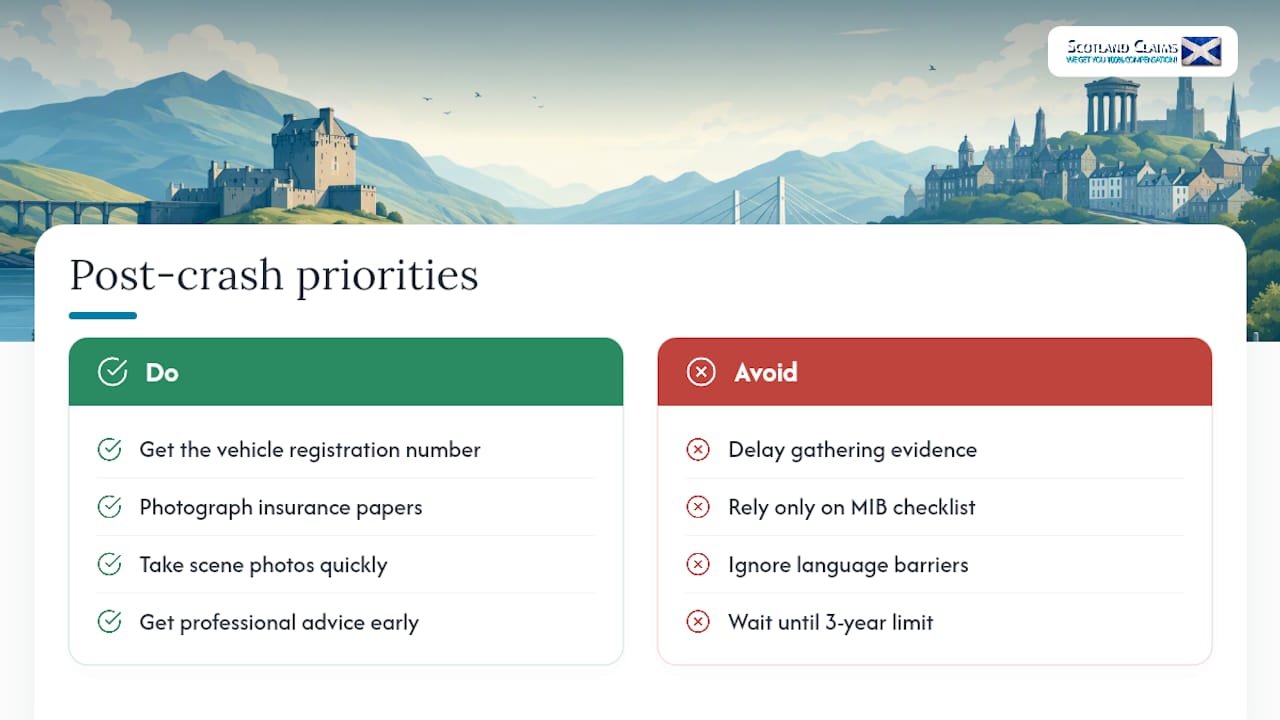
The conventional advice tends to focus almost entirely on the MIB process itself and underplays the scene evidence that makes that process work. A well-run MIB claim is often decided in the first ten minutes after the crash, not in the weeks of correspondence that follow. Get the registration number and a photograph of any insurance paperwork, and half the battle is already won.
If there’s one thing worth prioritising above everything else in this guide, it’s speed on two fronts: gathering evidence before it disappears, and getting professional advice before the three-year clock creeps closer than you’d like. Waiting rarely helps a claim like this. It just narrows your options.
— Roger
Start your claim with Scotland Claims Injury Lawyers
If you want a quick estimate first, try the compensation calculator. If you want to understand exactly how funding works before you commit, read through the no win no fee claims page. And if you’re ready to get a specialist solicitor looking at your case, request a free callback and we’ll match you with an injury lawyer in Scotland who can pick up MIB or foreign insurer contact on your behalf.
This article is general information, not a substitute for advice from a qualified lawyer. Consult a qualified legal professional about your own circumstances before acting on anything here.
Sources
FAQ
Can I add a foreign driver to my car insurance in the UK?
Many UK insurers allow you to add a foreign licence holder as a named driver, sometimes for an extra premium, though policies vary, so check directly with your insurer before assuming cover applies.
What is the average payout for whiplash in Scotland?
Whiplash payouts in Scotland vary widely depending on severity and recovery time, so there’s no single average figure; a free assessment against a compensation calculator gives a more realistic personalised estimate than a general figure.
How much will I get for an injury claim?
Compensation depends on the injury’s severity, its impact on your work and daily life, and any financial losses you can evidence, which is why a free case assessment matters more than a generic figure.
How long does a personal injury claim take in Scotland?
Timescales vary by complexity, straightforward cases with clear liability settle faster, while MIB investigations or foreign insurer tracing can extend the process, so ask your solicitor for a realistic estimate at the outset.
Do I have to pay upfront to start a foreign driver claim in Scotland?
No. Official guidance states you shouldn’t pay for an initial solicitor meeting, and Scotland Claims Injury Lawyers offers a free claim assessment with no success fee deducted from any compensation you receive.
Recommended