Workplace accident documentation workflow: UK guide

TL;DR:
- A proper workplace accident documentation workflow captures, preserves, and securely manages incident details to protect both workers and employers.
- In the UK, employers with ten or more employees must keep an accident book, and certain incidents must be reported to the HSE within strict deadlines regardless of investigations.
A solid documentation workflow for workplace accidents is not a box-ticking exercise. It is a structured process that captures every relevant detail immediately after an incident, preserves evidence before memories fade, and maintains records securely enough to satisfy UK regulators and support any future compensation claim. Get it right and you protect both the injured worker and the organisation. Get it wrong and you risk breaching RIDDOR, losing critical evidence, and undermining any claim that follows.
The core components are:
- Immediate recording of who was involved, what happened, where, and when
- Evidence collection covering photographs, CCTV footage, witness statements, and physical items
- Timely reporting to the HSE under RIDDOR where the incident meets the threshold
- Secure, accessible storage of all records with confidentiality maintained
- Regular review of documentation to identify trends and drive safety improvements
- Training for both employees and managers so the process runs correctly every time
The accident book sits at the centre of all of this. It is the foundational fact log that everything else builds on.
Table of Contents
What UK law actually requires you to document
The legal framework is clear, though it catches many organisations off guard in the detail.
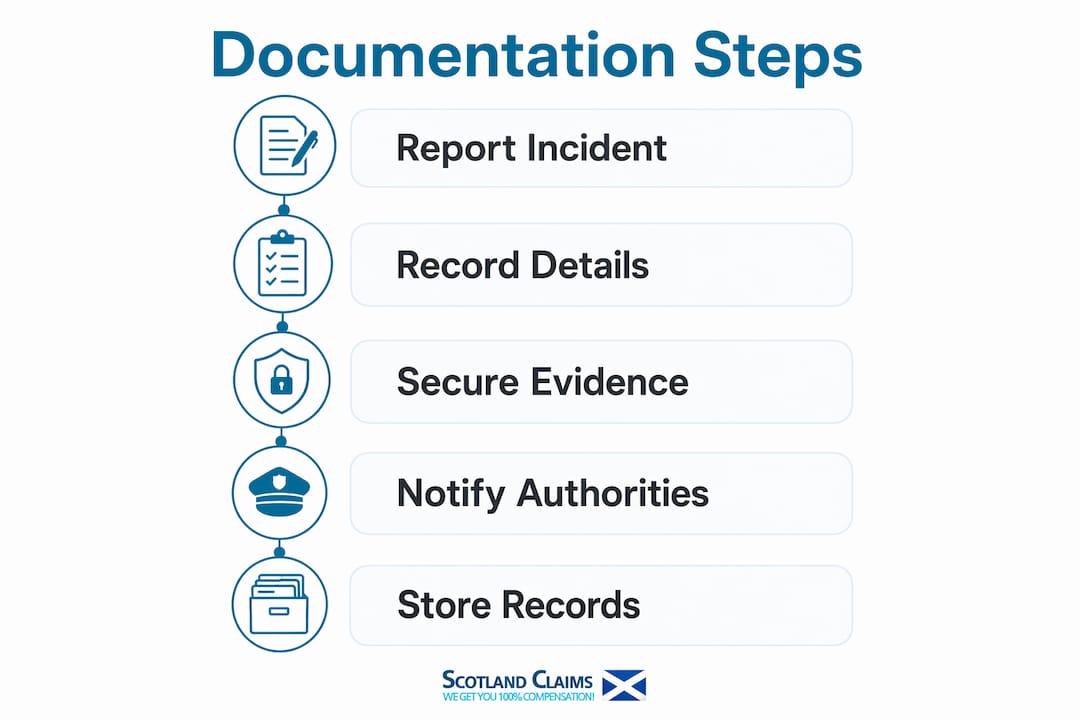
Under social security law, any employer with 10 or more employees must keep an accident book. Smaller businesses are not legally compelled to maintain one, but most do as a matter of risk management, and rightly so. The accident book must record the injured person’s details, the nature of the injury, the date and location, and the circumstances of the incident.
RIDDOR sits on top of that. The Reporting of Injuries, Diseases and Dangerous Occurrences Regulations 2013 require employers to report certain incidents to the HSE:
- Fatal accidents and specified serious injuries must be reported within 10 days
- Incapacitation lasting more than seven consecutive days must be reported within 15 days of the accident
- Incapacitation of more than three consecutive days must be recorded in the accident book, though a RIDDOR report is not required at that threshold
One point that trips up managers: RIDDOR reporting is not contingent on the completion of an internal investigation. The duty to report is independent. Waiting for your investigation to conclude before notifying the HSE constitutes a breach of legal duty and exposes the organisation to regulatory penalties.
Records kept under RIDDOR must be retained for at least three years from the date of the entry. They must be stored at the workplace or the responsible person’s usual place of business, and produced on request by HSE, local authority, or Office of Rail and Road inspectors.
The practical case for thorough documentation goes beyond compliance. Records help identify accident patterns, support insurance dealings, and form the evidential backbone of any personal injury claim. Confidentiality matters too: personal data within accident records must be stored securely, not left accessible to anyone who wanders past.
How to document a workplace accident: step by step
Follow this sequence every time, regardless of how minor the incident appears at first.
-
Secure the scene and arrange first aid. Nobody documents anything useful from a hospital bed. Attend to the injured person first, then prevent others from disturbing the scene before evidence is gathered.
-
Record initial facts immediately. Open the accident book and capture the who, what, where, and when while details are fresh. Include the injured person’s name and job role, the exact location, the time and date, and a plain description of what occurred.
-
Collect physical evidence. Photograph the scene from multiple angles before anything is moved or cleaned. Retrieve CCTV footage promptly as many systems overwrite within 24–72 hours. Preserve relevant documents such as risk assessments, method statements (RAMS), and permits to work.
-
Take witness statements. Speak to witnesses as soon as possible and record their accounts in their own words. Ask them to sign and date their statements. Memory degrades quickly, and comprehensive witness accounts form a critical part of any subsequent investigation or claim.
-
Determine RIDDOR reportability. A manager or health and safety lead should assess whether the incident meets a reporting threshold. Do not delay this decision. If it is reportable, submit the notification to the HSE online at hse.gov.uk/riddor or by telephone for fatal and specified injuries, within the statutory deadline.
-
Conduct a structured causal analysis. Work through immediate causes (the direct trigger), underlying causes (the conditions that allowed it), and root causes (the systemic failures). Involve relevant stakeholders, including the injured worker where appropriate. The HSE’s accident investigation guidance recommends a multidisciplinary approach with SMART corrective actions monitored by senior management.
-
Assign corrective actions. Every identified cause should generate a corrective action with a named owner, a realistic deadline, and a priority rating. Vague actions with no owner get ignored.
-
Track progress. Maintain a log of each action’s status, the evidence of completion, and any follow-up review dates. This is where many organisations fall short: the investigation is thorough, but the actions quietly stall.
-
Close and communicate. Once actions are verified as complete, formally close the investigation with a sign-off from a senior manager. Share the lessons learned with the wider workforce, not just the team directly involved.
Pro Tip: Never delay CCTV retrieval or scene photography. Physical evidence degrades within hours, and footage is routinely overwritten. Treat the first 60 minutes after an incident as the most evidence-critical window in the entire process.

Best practices for keeping records that actually hold up
Good documentation does not end when the accident book is filled in. How you manage those records over time determines whether they serve you when it matters.
- Store records securely but accessibly. Physical accident books belong in a designated location such as a health and safety office or staff room, accessible to authorised personnel but not left open to general access. Digital records should be password-protected and backed up regularly.
- Standardise your formats. A consistent template for accident reports removes ambiguity and makes records far easier to review during an investigation or claim. Free-form notes introduce gaps that are difficult to defend later.
- Train employees and managers. Staff who know what to record, and why, produce better records. Training should cover the accident book procedure, RIDDOR thresholds, evidence preservation, and confidentiality obligations. This is not a one-off exercise; refresh it annually and whenever procedures change.
- Review documentation regularly. Periodic reviews of accident records reveal patterns that individual incident reports cannot. A cluster of near-misses in one area, for example, often precedes a more serious injury.
- Avoid the most common mistakes. Delayed reports, incomplete facts, insecure storage, and failure to update records after corrective actions are the errors that most frequently undermine compliance and claims. Build a checklist into your process so nothing is left to memory.
Accurate, prompt documentation significantly increases the likelihood of a successful personal injury claim. When a worker is injured through no fault of their own, the quality of the records created in the hours and days after the incident can be the difference between a claim that succeeds and one that stalls. For a practical overview of the documents you will need, the injury claim documents guide covers the full list relevant to Scottish claims.
Knowing why documenting accident evidence matters goes beyond the statutory minimum. Well-maintained records protect the employer from unsubstantiated claims and give the injured worker the factual foundation their solicitor needs.
Scotland Claims Injury Lawyers: a capped success fee
If you have been injured at work in Scotland and the accident was not your fault, the documentation you have gathered is the starting point for your claim. Scotland Claims Injury Lawyers specialises in personal injury claims for workplace accidents, slips, trips, and road traffic incidents across Scotland, on a no win no fee basis.
The difference that matters: most solicitors deduct a success fee of up to 20% from your compensation settlement. Scotland Claims Injury Lawyers caps its success fee at 18% including VAT, below the Scottish statutory maximum. The percentage is agreed in writing before your claim starts, with no hidden extras.
Getting started is straightforward. Use the online form or request a callback to speak with a specialist. If you want an early sense of what your claim could be worth, the compensation calculator gives you an estimate based on your injury type. For specialist legal advice on a workplace injury claim, contact Scotland Claims Injury Lawyers today.
Key takeaways
A thorough documentation workflow for workplace accidents, completed promptly and stored securely, is the single most important step an organisation can take to protect both its legal position and its injured workers.
| Point |
Details |
| Accident book is mandatory |
Employers with 10 or more employees must keep an accident book under UK social security law. Smaller businesses are not legally required to keep one, but most adopt this best practice for risk management. |
| RIDDOR deadlines are strict |
Fatal accidents and specified serious injuries must be reported within 10 days, and incidents causing incapacitation for more than seven consecutive days must be reported within 15 days of the accident. |
| Report before investigation concludes |
RIDDOR reporting is independent of your internal investigation; delaying it breaches legal duty. |
| Records must be kept for three years |
RIDDOR records must be retained for at least three years and produced on request by inspectors. |
| Scotland Claims Injury Lawyers |
Injured workers in Scotland pay a success fee capped at 18% including VAT, with no hidden extras. |
FAQ
What must an accident book record in the UK?
The accident book must capture the injured person’s name and job role, the date, time, and location of the incident, a description of what happened, the injuries sustained, and any actions taken. This satisfies both social security law and RIDDOR recording requirements.
When does a workplace accident need to be reported to the HSE?
Fatal accidents and specified serious injuries must be reported within 10 days. Incidents causing a worker to be incapacitated for more than seven consecutive days must be reported within 15 days of the accident.
Can I wait until my investigation is finished before reporting to the HSE?
No. RIDDOR reporting duties are not contingent on a completed investigation. Delaying a report while waiting for investigation conclusions constitutes a breach of legal duty and can expose the organisation to regulatory penalties.
How long must workplace accident records be kept?
Under RIDDOR, records must be kept for at least three years from the date of the entry and must be available for inspection by HSE, local authority, or Office of Rail and Road inspectors on request.
How does good documentation help a workplace injury claim in Scotland?
Accurate, prompt records, including witness statements, photographs, and the accident book entry, provide the factual foundation a solicitor needs to pursue a claim. Scotland Claims Injury Lawyers uses this evidence to support workplace injury claims with a success fee capped at 18% including VAT.
Recommended