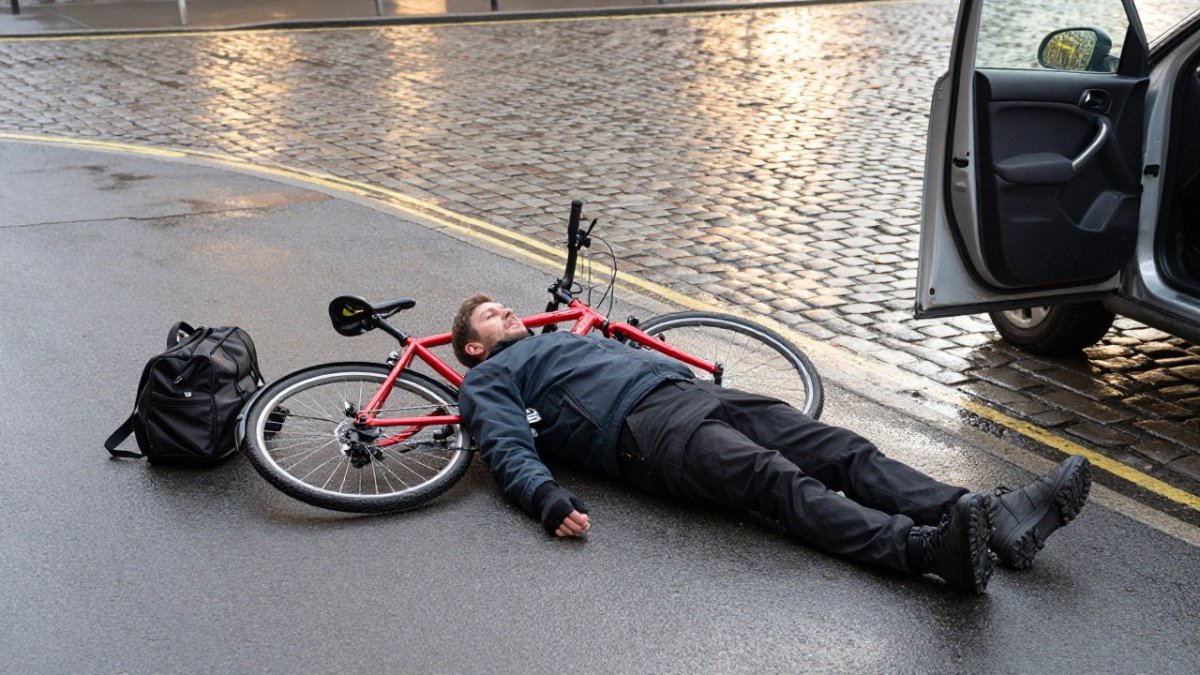
Last Updated: November 21, 2026
Quick Summary
After a cycling dooring accident in Glasgow, stop and move clear of traffic, check yourself for injury, and call 999 if you are hurt or the road is blocked. Ask the driver to stay and exchange details, then photograph the open door, the car and your bike, and note the time, street and weather.
- Photograph the open car door's angle, as it tells the story of the collision.
- Report any injury collision to Police Scotland promptly and ask for an incident reference number.
- Get checked by a medical professional even if you feel fine, as adrenaline hides pain.
- Write your own account the same day while memory is fresh.
- Scotland Claims Injury Lawyers handles these cases on a No Win No Fee basis.
Doored in Glasgow? Know your next step.Scotland Claims Injury Lawyers connects injured cyclists with specialist solicitors on a No Win No Fee basis.
Start Your ClaimTable of Contents
Doored While Cycling: What to Do in the First Ten Minutes
A cycling dooring accident happens when someone opens a car door into your path and you hit it or swerve to avoid it. In Glasgow, the first ten minutes after a dooring decide how strong your evidence will be later. This guide from Scotland Claims Injury Lawyers walks through exactly what to do, in order, so nothing important is missed. (Source: The Highway Code)
The clock matters. A driver can drive off. A witness can walk away. A bruise that looks minor can stiffen into something worse by evening.
Here is the short version of what to do first:
- Stop and move clear of traffic if you can.
- Check yourself for injury before anything else.
- Call 999 if you are hurt or the road is blocked.
- Ask the driver to stay and exchange details.
- Photograph the open door, the car, and your bike.
- Note the time, the street, and the weather.
Most people skip step five. Don't. An open door photographed within minutes is hard to argue with later.
Here is the short version of what to do first, in order.
| Step |
What to do |
| 1 |
Stop and move clear of traffic if you can |
| 2 |
Check yourself for injury before anything else |
| 3 |
Call 999 if you are hurt or the road is blocked |
| 4 |
Ask the driver to stay and exchange details |
| 5 |
Photograph the open door, the car, and your bike |
| 6 |
Note the time, the street, and the weather |
Your Cycling Accident Evidence Checklist for the Scene
Scene evidence is what separates a claim that settles from one that stalls. Collect it calmly, in this order.
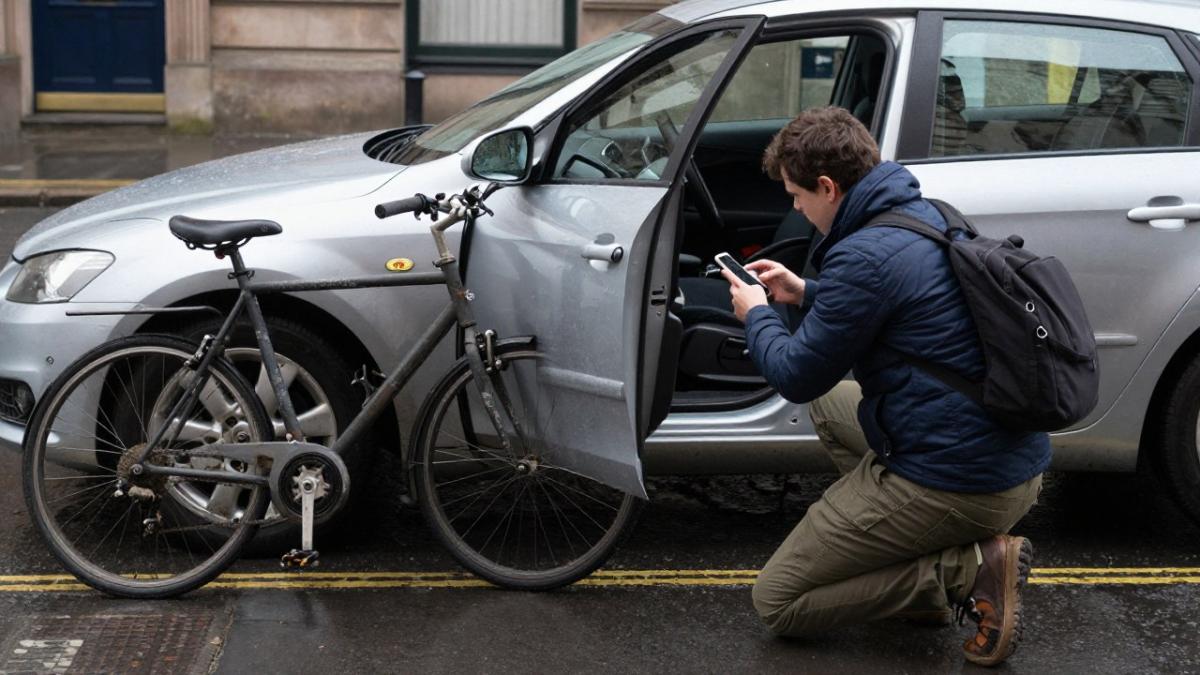 Cyclist photographing a damaged bike after a cycling dooring accident on a wet Glasgow street near an open car door.
A common mistake is photographing the car but not the door position. The door's angle tells the story.
How to Report a Cycling Accident in Scotland
Reporting a cycling accident in Scotland means contacting Police Scotland, and for any collision involving injury you should do it promptly. You can report a non-emergency collision to Police Scotland by calling 101 or through their online reporting facilities. If anyone is hurt, the road is blocked, or the driver fails to stop, call 999.
When you report, have the following ready so the call is quick and the record is accurate:
- The exact location, including street name and nearest junction or landmark
- The time and date of the collision
- The vehicle registration, make, colour and model if you have it
- The driver's name and address if details were exchanged
- A short factual account of what happened
- Whether anyone was injured and whether an ambulance was called
Ask the call handler for an incident reference number and write it down, as it helps identify the official record later.
If the driver left the scene, tell the police explicitly that it was a fail-to-stop collision and give the registration or partial registration if you have it.
Watch out: a verbal report is not the same as a recorded incident. Always confirm that an incident reference has been created and keep a note of the officer's shoulder number if one is given.
Reporting also creates an official record that supports any later cycling dooring accident claim. For the full process, see this guide to reporting an accident to Police Scotland.
Seeking Medical Attention and Documenting Your Injuries
Get checked by a medical professional even if you feel fine. Adrenaline hides pain, and dooring injuries often include head injury and facial injury from going over the door.
Keep every record:
- A&E discharge notes and appointment letters
- GP visits and any prescriptions
- Photographs of bruising taken on day one, day three, and day seven
- A simple diary of pain, sleep, and missed work
Symptoms can appear hours or days later. Neck stiffness, headaches, and dizziness after a dooring collision all deserve a medical review. Document them from the first moment you notice them.
What to Do When the Driver Leaves or Details Are Unavailable
A driver who leaves the scene without stopping makes things harder, but not hopeless. Write down everything you remember immediately: the registration, the car colour and make, and which direction it went.
If details were never exchanged, this guide on what to do when the other driver won't swap details covers your options. Where the driver cannot be traced at all, the Motor Insurers' Bureau can step in, and this Motor Insurers' Bureau claims guide explains how that route works.
Watch out: never confront a driver who has left. Report it to Police Scotland and let them handle it.
Evidence Beyond Photographs: Building a Stronger Record
Photographs are the start, not the finish. A stronger record includes your own written account, made the same day while memory is fresh.
Write down the sequence of events in plain language: where you were, your speed, the door opening, and what happened next. Keep it factual.
Then gather the supporting paper trail:
- Helmet or bike camera footage, saved before it overwrites
- Strava or GPS data showing your route and time
- Witness statements in their own words
- Repair quotes for the bicycle damage
- Payslips if you lost income
This article on why documenting accident evidence matters explains how each piece strengthens a file.
Making a Cycling Dooring Accident Claim in Scotland
A cycling dooring accident claim in Scotland rests on showing that the driver or passenger was negligent. Opening a door without checking is the classic example. Civil claims in Scotland are generally decided on the balance of probabilities, so a good evidence record matters.
Scotland has its own time limits for bringing a personal injury claim, so take Scottish legal advice early rather than relying on generic guidance. Check the official Scottish legislation for the current position.
Claims of this kind are often directed at the driver's motor insurer. Where the driver cannot be traced or is uninsured, the Motor Insurers' Bureau may be relevant, and a solicitor can advise which route applies. A solicitor can tell you which route applies to your case.
A specialist solicitor can assess liability, gather medical records, and value your financial losses. Scotland Claims Injury Lawyers handles these cases on a No Win No Fee basis, so there is no upfront cost.
For a closer look at how a claim works, see cycling accident compensation.
Preventing Dooring: The Dutch Reach and the Door Zone
Prevention advice matters as much as aftercare. The Dutch Reach is simple: use your far hand to open a car door, which forces your body to turn and your eyes to check the mirror and blind spot. Drivers and passengers who adopt it catch approaching cyclists far more often.
For cyclists, stay out of the door zone. That is roughly the width of an open car door beside parked vehicles. Ride a metre clear of parked cars where the road allows, and watch for brake lights and movement inside vehicles.
A parked vehicle with someone inside is a warning sign. Slow down and give it room.
Getting Specialist Legal Advice for Your Glasgow Case
A cycling dooring accident in Glasgow is a road traffic accident with a clear liability question, and specialist legal advice makes the process simpler. Scotland Claims Injury Lawyers connects injured cyclists with personal injury solicitors and offers a callback to discuss your case.
The firm works on a No Win No Fee basis, so you keep all compensation when you win.
If you were doored while cycling, get the advice early, while the evidence is still fresh.
Being doored on a Glasgow street is frightening, and the paperwork that follows can feel like a second burden. You do not have to work it out alone. Scotland Claims Injury Lawyers offers a No Win No Fee service, a 100% Compensation Guarantee, and a free callback to talk through your options with no obligation. Get started with Scotland Claims Injury Lawyers and keep more of the compensation you are owed.
cycling dooring accidentwhat to do after a cycling dooring accident in glasgowdoored while cycling what to docycling accident evidence checklistreport a cycling accident scotland