A minor scrape on a Scottish road can quickly turn into a criminal prosecution if you assume exchanging mobile numbers is always enough. Understanding the statutory thresholds for reporting a car accident to Police Scotland is essential to protect your licence and keep yourself on the right side of the law. Following a collision, it is entirely normal to feel shaken, confused by differing rules for property damage versus injuries, or anxious about missing strict statutory deadlines.
You shouldn't have to second-guess the law while dealing with the stress of a crash. This guide details precisely when, how, and within what legal deadlines you must report an incident under Scots law. We examine the exact procedures for using 999, 101, or presenting in person at a Scottish police station, ensuring you know how an official police incident reference protects your legal rights and secures your position for any future compensation claim.
Key Takeaways
- Learn when Section 170 of the Road Traffic Act 1988 legally compels you to report a collision, protecting you from penalty points, fines, and potential prosecution.
- Master the exact protocols for reporting a car accident to Police Scotland, identifying when to dial 999 and when an in-person report at a local station is required.
- Discover how investigating officers categorise road traffic incidents, inspect collision scenes, and document critical physical evidence.
- Understand why securing an official police incident reference provides essential corroboration under Scots law to protect your entitlement to non-fault personal injury compensation.
- Follow vital post-collision steps regarding medical assessments and insurer notifications to ensure you preserve your full legal and financial rights.
When Must You Report a Collision to Police Scotland?
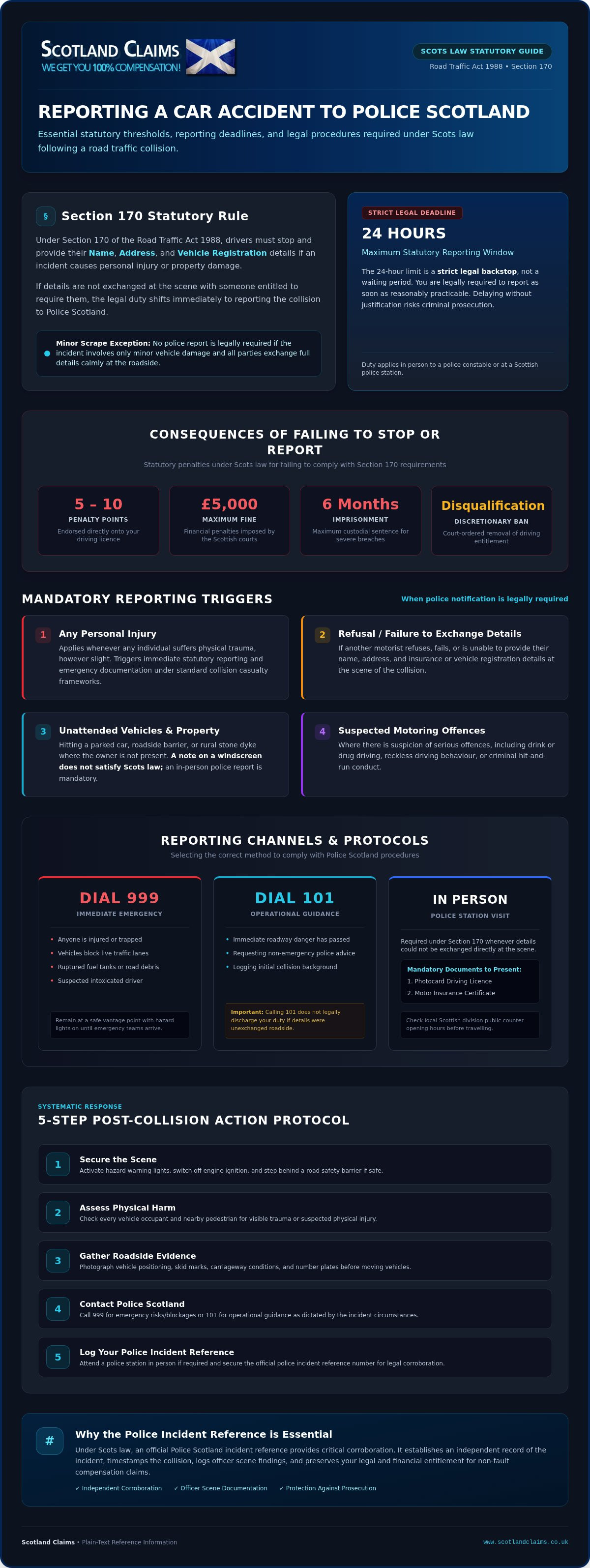
Scots law sets strict, unambiguous boundaries for motorists following a crash. Under Section 170 of the Road Traffic Act 1988, a driver must stop and provide their name, address, and vehicle registration details if a collision causes personal injury or property damage. If you do not provide these details at the scene to someone who reasonably requires them, the duty shifts immediately: you must report the incident to the police as soon as reasonably practicable, and strictly within 24 hours.
That 24-hour statutory window is a legal backstop, not a waiting period. Delaying without justification risks criminal penalties. You do not need to contact the police if the incident involves only minor vehicle damage and both parties exchange full details calmly roadside. However, mandatory reporting triggers apply whenever:
- Any individual suffers physical injury, however slight.
- A driver fails or refuses to exchange their personal and insurance details.
- Damage occurs to roadside infrastructure, walls, or unattended parked vehicles.
- You suspect a serious motoring offence, such as drink or drug driving.
If you suffered injuries due to another driver's negligence, speaking to dedicated injury lawyers in Scotland ensures your legal position remains fully protected from the outset.
Collisions Involving Personal Injury or Road Blockages
Physical injuries immediately trigger statutory reporting requirements. If anyone is hurt, dial 999 without delay. The same urgency applies when vehicles obstruct live traffic lanes, rupture fuel tanks, or scatter debris across the carriageway. Scottish officers document these details under the standard collision frameworks recorded within the national Reported Road Casualties Great Britain framework. You must remain at a safe vantage point near the scene, switch on your hazard warning lights, and render reasonable assistance until emergency crews arrive.
Unattended Vehicles, Property Damage, and Hit-and-Run Incidents
Hitting a stationary vehicle or a stone dyke on a rural road demands deliberate action. Leaving a windscreen note does not satisfy your statutory duty if the owner isn't present. When you cannot trace the owner immediately, reporting a car accident to police scotland becomes mandatory. You must present yourself to an officer or visit a police station in person. The consequences of failing to stop or report under Section 170 are severe; offenders face between 5 and 10 penalty points, discretionary disqualification, fines up to £5,000, and up to six months imprisonment.
Step-by-Step: Reporting an Accident to Police Scotland
Shock clouds judgement after a collision. You need a straightforward system to protect yourself and preserve evidence immediately. Follow this five-step protocol to meet your statutory duties:
- Secure the scene: Turn on hazard lights, switch off the engine, and step behind a safety barrier if safe.
- Assess physical harm: Check every vehicle occupant and pedestrian for visible or suspected trauma.
- Gather roadside evidence: Photograph vehicle positioning, skid marks, road conditions, and number plates before moving anything.
- Contact Police Scotland: Call 999 for emergencies or 101 for operational guidance.
- Log your reference: Attend a police station in person if required and secure an official incident reference number.
Once you secure your police reference, using a personal injury compensation calculator helps you assess the financial support you could recover without giving up a single penny of your compensation.
Calling 999 vs Dialling 101: Assessing the Situation
Dial 999 immediately if anyone is injured, someone appears intoxicated, or damaged vehicles block a carriageway. Use 101 when the immediate danger has passed and you need non-emergency guidance. Remember that dialling 101 does not legally discharge your reporting duty if you were unable to exchange details at the scene. Under Section 170 of the Road Traffic Act 1988, you must report in person to a police constable or station as soon as practicable.
Visiting a Local Scottish Police Station
Not all police stations across Scotland operate 24-hour public service counters. Check local division opening times before travelling. When presenting yourself, bring your photocard driving licence, your certificate of motor insurance, and your vehicle registration document. The counter officer takes your statement, inspects your documents, and enters the incident into the national database, providing you with a formal incident number.
Critical Information to Provide to the Call Handler
Accuracy matters when reporting a car accident to police scotland. Provide precise details to ensure an accurate record:
- Exact location: Reference junction numbers, Scottish trunk road markers, or What3words coordinates.
- Vehicle records: Supply registration numbers, colours, makes, and models for all involved transport.
- Witness accounts: Share names, mobile numbers, and initial remarks from independent passers-by.
What Happens After Reporting: The Police Scotland Investigation Process
Submitting your report initiates a formal operational review. Police Scotland categorises every collision into one of three classifications: slight, serious, or fatal. This grading dictates the resources deployed to investigate the incident. While slight collisions often involve routine administrative logging, serious collisions trigger attendance from specialist Road Policing Units and collision investigation teams.
Investigating officers rely on systematic technical procedures to determine what happened. Roadside breathalyser screening is standard practice for every involved driver. Officers also map the tarmac using laser scanning tools, measure braking marks, evaluate vehicle crush profiles, and secure nearby council or private CCTV footage before systems overwrite it.
These inquiries serve a distinct purpose: identifying statutory motoring offences. Under Scots criminal law, police officers assemble evidence to determine whether any driver breached road traffic regulations. If the evidence demonstrates criminal conduct, officers submit a Standard Prosecution Report to the Crown Office and Procurator Fiscal Service (COPFS). Unlike in England, the police in Scotland do not decide whether to prosecute; that decision rests entirely with the Procurator Fiscal.
Securing Your Police Scotland Incident Reference Number
Every incident logged via 101 or attending officers receives a unique Storm log or incident reference number. Always request this number alongside the attending officers' names, shoulder collar numbers, and local police division. This reference code is your master key. Your personal injury solicitors need it to request the official Police Collision Report Form (abstract), which contains independent findings, statements, and road layout diagrams essential for your compensation claim.
Dealing with Criminal Allegations and Procurator Fiscal Reports
Civil compensation claims operate on an entirely separate legal track from criminal prosecutions. If the other driver faces charges such as careless driving under Section 3 or dangerous driving under Section 2 of the Road Traffic Act 1988, the COPFS controls the prosecution timeline. While Police Scotland will not release full collision abstracts until criminal proceedings conclude, a criminal conviction provides powerful, irrefutable evidence of fault that significantly strengthens your civil case for financial recovery.
Properly completing the process of reporting a car accident to police scotland establishes a clear official record. That record protects innocent motorists from false counter-claims and ensures no vital physical evidence disappears before liability is determined.
How Police Accident Reports Protect Your Right to Personal Injury Compensation
Contemporaneous evidence wins disputed compensation claims. An official police investigation provides an objective, professional record captured before memories fade or vehicles are moved. Under Scots civil law, proving liability requires credible evidence demonstrating that another road user breached their duty of care. While English civil law does not require formal corroboration, Scottish legal tradition places heavy weight on independent supporting proof when accounts clash.
A Police Collision Report Form delivers exactly that. It transforms a vulnerable "he-said, she-said" disagreement into a documented factual record. When liability is disputed, this official abstract establishes crucial details: vehicle points of impact, lighting conditions, road layout, and officer assessments regarding who caused the collision. Completing the formal steps for reporting a car accident to police scotland directly underpins this evidentiary framework, ensuring your personal injury compensation rights remain secure.
Instructing specialist solicitors guarantees that you retain the full value of your award. Unlike many traditional claims firms that take significant success fee deductions from your settlement, our approach ensures you receive 100% of your compensation without losing a penny.
Overcoming Disputed Liability with Corroborated Evidence
At-fault drivers often apologise profusely roadside, only to reverse their position once speaking with their insurers. When opposing insurers attempt to shift blame, officer notes, breathalyser confirmations, and contemporaneous witness statements dismantle manufactured defences. Review our comprehensive guide to road traffic accident claims to understand how robust evidence directly influences settlement speed and value.
Hit-and-Run Collisions and the Motor Insurers' Bureau (MIB)
Collisions involving untraced or uninsured motorists operate under distinct, rigid frameworks. The Motor Insurers' Bureau (MIB) handles compensation for victims injured by hit-and-run drivers, but their rules require absolute statutory compliance. You must report the incident to the police without delay. If you fail to notify Police Scotland promptly, the MIB can reject your claim outright, permanently barring your financial recovery. Securing prompt legal guidance from specialist injury lawyers in Scotland ensures all MIB notification criteria are satisfied from day one.
Protect your rights and secure 100% of your compensation with Scotland Claims Injury Lawyers today.
Next Steps: Protecting Your Legal and Financial Rights After the Collision
Discharging your statutory duty of reporting a car accident to police scotland is only the initial hurdle. Next comes safeguarding your health and your financial future. Your motor insurance policy contains strict notification clauses, usually demanding an accident report within 24 to 48 hours regardless of fault. Notify your insurer to comply with your policy terms, but state clearly that you are providing details for notification purposes only while liability is investigated.
Third-party insurers often reach out within days, offering quick cash settlements before you understand the full severity of your symptoms. Never accept these early offers. Insurers make premature offers to protect their profits, not your welfare. Accepting early cash extinguishes your right to claim further funds if your condition worsens.
Seeking Medical Treatment and Creating a Clinical Paper Trail
Adrenaline frequently masks acute trauma, especially soft-tissue damage and whiplash symptoms that intensify days later. Visit an NHS minor injuries unit or your GP surgery without delay. Under Scots law, an immediate clinical entry establishes direct causation between the impact and your physical symptoms. Opposing insurers routinely dispute injuries without contemporaneous medical records. You can gauge the potential value of your claim using our personal injury compensation calculator once a medical baseline is recorded.
Securing Independent Legal Representation with 100% Compensation
Under the Prescription and Limitation (Scotland) Act 1973, injured parties have a strict three-year limitation period from the collision date to commence court proceedings. Waiting jeopardises crucial witness testimony and physical evidence. Most Scottish personal injury firms operate under agreements that deduct 20% or more from your final compensation payout as a success fee.
Scotland Claims operates differently. Led by Kerr Brown Solicitors and regulated by the Law Society of Scotland, we recover our costs directly from the at-fault driver's insurer. You benefit from a 100% Compensation Guarantee with zero success fee deductions. You retain every single penny awarded for your pain, suffering, and rehabilitation costs. Check your standing today by completing a free online compensation assessment with our independent team.
Secure Your Legal Position and Protect Your Settlement
Navigating post-collision requirements under Scots law demands swift, decisive action. Knowing the precise legal thresholds for reporting a car accident to police scotland shields you from statutory penalties while building an objective, corroborated evidentiary record. From securing an incident reference log to documenting timely clinical assessments, every action you take roadside and immediately afterwards safeguards your position against disputing insurers.
You don't have to manage this process alone or surrender a percentage of your rightful award. Scotland Claims operates through Kerr Brown Solicitors, regulated by the Law Society of Scotland. We deliver an unwavering 100% Compensation Guarantee with zero success fee deductions, backed by 24-hour freephone assistance across all Scottish regions.
Take the step today to protect your recovery, assert your legal rights, and ensure you retain every penny of the compensation you deserve.
Frequently Asked Questions
Do I need to report a minor car scrape to Police Scotland if nobody was injured?
No, provided you exchange full details at the roadside with the other driver. Under Section 170 of the Road Traffic Act 1988, formal police involvement isn't mandatory for damage-only incidents where names, addresses, and registration details are swapped. However, if third-party street property is damaged and the owner isn't present, or if the other motorist leaves without providing information, you are legally obligated to make a report immediately.
What is the strict time limit for reporting a road accident to Police Scotland?
You must report the incident as soon as reasonably practicable, and always within 24 hours. Many drivers wrongly treat 24 hours as a standard grace period. In Scots law, it serves as a strict outer backstop. If you are capable of reporting a car accident to police scotland earlier but delay without a valid medical or safety justification, you risk committing a statutory motoring offence.
Can I report a road traffic accident to Police Scotland online?
No, not to discharge your statutory legal duty under road traffic legislation. While Police Scotland maintains an online contact form for general non-emergency enquiries, statutory reporting requires presenting yourself in person at a police station or speaking directly to a police constable. Telephone calls via 101 offer operational guidance, but formal collision logging under Section 170 demands an in-person attendance to verify identification and documentation.
Will I be prosecuted if I did not report a car accident within 24 hours?
You face potential prosecution if statutory criteria compelled you to report and you failed to do so. In Scotland, the Procurator Fiscal reviews police reports to determine whether to raise criminal charges. Penalties for failing to report include between 5 and 10 penalty points on your driving licence, discretionary disqualification, and fines up to £5,000. Genuine incapacity, such as hospitalisation, serves as a recognised legal defence.
How do I obtain a copy of the official Police Scotland accident report?
You can request an official collision abstract directly from Police Scotland's Collision Records section by submitting a formal request alongside the statutory fee. Alternatively, your personal injury solicitor can obtain this documentation on your behalf using your incident reference log number. Reports involving ongoing criminal investigations remain restricted until the Crown Office and Procurator Fiscal Service concludes any prosecution proceedings.
What happens if the other driver refuses to give their details after a collision in Scotland?
A driver who refuses to provide their name, address, or vehicle registration commits a criminal offence under Section 170. Do not confront an uncooperative motorist. Note their vehicle registration, make, model, and physical description immediately. You are then under a legal obligation regarding reporting a car accident to police scotland, as the statutory requirement to notify officers triggers whenever details are not exchanged at the scene.
Does reporting an accident to Police Scotland affect my car insurance policy?
Reporting an incident to the police does not directly change your premium, but your insurance contract requires disclosure of any collision regardless of fault. Insurers review police logs to establish fault and settle claims. Provided you were not at fault, your no-claims discount should remain intact once liability is resolved, especially when supported by an objective Police Scotland incident log confirming the other driver's responsibility.
Can I claim injury compensation if the police did not attend the accident scene?
Yes, you can still claim personal injury compensation even if officers did not physically attend. You still need evidence to satisfy Scottish civil standards, such as witness contact details, dashcam footage, photographs of vehicle damage, and prompt medical examination records. Scotland Claims helps injured road users pursue their rights under Scots law, guaranteeing 100% compensation with zero success fee deductions from your final award.