Your step-by-step guide to negligence claim procedure

Starting a negligence claim can feel overwhelming, especially when you’re already dealing with injury and recovery. Many people in Scotland struggle to understand where to begin, what evidence they need, and how the legal process actually works. This confusion often delays claims and reduces compensation outcomes. The good news is that the negligence claim procedure follows clear, manageable steps. This guide walks you through the entire process, from understanding your legal rights to finalising your compensation award. Whether you’ve been injured at work, in a road accident, or through medical negligence, you’ll discover exactly what to do, when to do it, and how to maximise your chances of success.
Table of Contents
Key Takeaways
| Point |
Details |
| Prove four elements |
You must prove four essential elements to succeed in a negligence claim: duty of care, breach, causation, and damages. |
| Gather evidence early |
Collect medical records, witness statements, and incident reports promptly because memories fade and evidence weakens with time. |
| Limitation period |
The three year limitation period starts from the date of injury or when you first knew about it, so act promptly. |
| Seek legal representation |
Engaging specialised legal representation can improve claim outcomes and guide you through the steps from notification to settlement or court. |
| Contemporaneous diary |
Keep a contemporaneous diary of symptoms, medical appointments, and daily impact to strengthen your claim and help accurate compensation. |
Understanding negligence claims in Scotland
Negligence in Scottish law occurs when someone fails to take reasonable care, causing you harm. This legal concept underpins most personal injury claims. To succeed, you must prove four essential elements: the defendant owed you a duty of care, they breached that duty, their breach directly caused your injury, and you suffered quantifiable damages. These elements work together to establish liability.
Common negligence scenarios include workplace accidents where employers fail to provide safe equipment, road traffic collisions caused by careless drivers, medical errors by healthcare professionals, and slips or trips on poorly maintained premises. Each situation shares the same legal foundation but requires specific evidence tailored to the circumstances. Negligence at work in Scotland follows established legal processes that apply across all injury types.
Proving causation often presents the biggest challenge. You must show a direct link between the defendant’s actions and your injury. Medical evidence becomes crucial here, demonstrating that your injuries resulted from the incident rather than pre-existing conditions. Expert reports, diagnostic scans, and treatment records all contribute to building this connection.
Timely evidence collection makes or breaks your claim. Memories fade, witnesses become harder to trace, and physical evidence disappears. Photographs of accident scenes, contact details of witnesses, and immediate medical assessments preserve vital information. The longer you wait, the weaker your evidence becomes.
Pro Tip: Keep a detailed diary of your symptoms, medical appointments, and how the injury affects your daily life. This contemporaneous record strengthens your claim and helps solicitors calculate accurate compensation.
Understanding these fundamentals prepares you for the procedural steps ahead. Scottish courts apply strict standards when assessing negligence claims. Your evidence must meet these standards to secure compensation. Without grasping these core concepts, navigating the formal procedure becomes significantly harder.
Preparing to start your negligence claim
Before launching your claim, gather essential documentation that proves your case. Medical records form the cornerstone of any injury claim, showing the extent and nature of your injuries. Request copies from your GP, hospital, and any specialists who treated you. These records establish the medical foundation of your damages.

Witness statements provide independent verification of how the accident occurred. Collect names, addresses, and contact details of anyone who saw the incident. Written statements should describe what they observed, when, and from what position. Independent witnesses carry more weight than friends or family members.
Accident reports create official records of the incident. Workplace accidents require employers to complete accident books under health and safety regulations. Road traffic collisions generate police reports. Slip and trip incidents on commercial premises should be logged in incident registers. Obtain copies of all relevant reports.
The three-year limitation period starts from the date of injury or when you first knew about it. Missing this deadline bars your claim permanently, regardless of its merits. Some exceptions exist for children and individuals lacking mental capacity, but relying on exceptions creates unnecessary risk. Start your claim promptly.
| Document type |
When to obtain |
Purpose in claim |
| Medical records |
Immediately after treatment |
Proves injury extent and causation |
| Witness statements |
Within days of accident |
Confirms how incident occurred |
| Accident reports |
Within 24 hours |
Creates official incident record |
| Photographs |
At accident scene |
Documents hazards and conditions |
| Financial records |
Ongoing throughout claim |
Evidences losses and expenses |
Contact potential legal representatives early in the process. Specialist personal injury solicitors offer free initial consultations to assess your claim’s viability. They review your evidence, explain the procedure, and outline likely compensation ranges. Most operate on a no win no fee basis, eliminating financial risk.
Pro Tip: Organise your documents chronologically in a dedicated folder, both physical and digital. Label everything clearly with dates and descriptions. This organisation saves time when your solicitor requests information and demonstrates your claim’s credibility.
Keep all receipts related to your injury, including travel to medical appointments, prescription costs, and any equipment or adaptations needed. These out-of-pocket expenses form part of your compensation claim. Even small amounts add up over months of treatment and recovery.
Step-by-step negligence claim procedure in Scotland
The formal procedure begins when your solicitor sends a letter of claim to the defendant or their insurer. This notification outlines the accident circumstances, injuries sustained, and legal basis for the claim. It triggers the defendant’s duty to investigate and respond within a specified timeframe, typically three months.
- Your solicitor drafts and sends the letter of claim containing full accident details, injury description, and preliminary damages estimate.
- The defendant acknowledges receipt and confirms their insurer’s details, usually within 21 days of receiving the notification.
- The defendant investigates by reviewing evidence, interviewing witnesses, and consulting their own experts before admitting or denying liability.
- If liability is admitted, negotiations begin immediately on compensation amount based on medical evidence and financial losses.
- If liability is denied, your solicitor gathers additional evidence and may initiate court proceedings to compel a fair settlement.
- Medical examinations by independent experts assess your injuries, prognosis, and any ongoing treatment needs to value your claim accurately.
- Both parties exchange evidence and expert reports in a process called disclosure, ensuring transparency and enabling informed settlement discussions.
- Settlement negotiations occur through written offers and counteroffers, with most claims resolving at this stage without court hearings.
- If negotiations fail, court proceedings commence with formal legal documents filed at the appropriate Scottish court based on claim value.
- Court hearings involve presenting evidence, examining witnesses, and legal arguments before a sheriff who determines liability and compensation.
Medical examinations play a crucial role throughout the procedure. Independent medical experts appointed by your solicitor assess your injuries objectively. Their reports detail your current condition, treatment received, future prognosis, and any permanent impairments. These assessments directly influence compensation calculations.
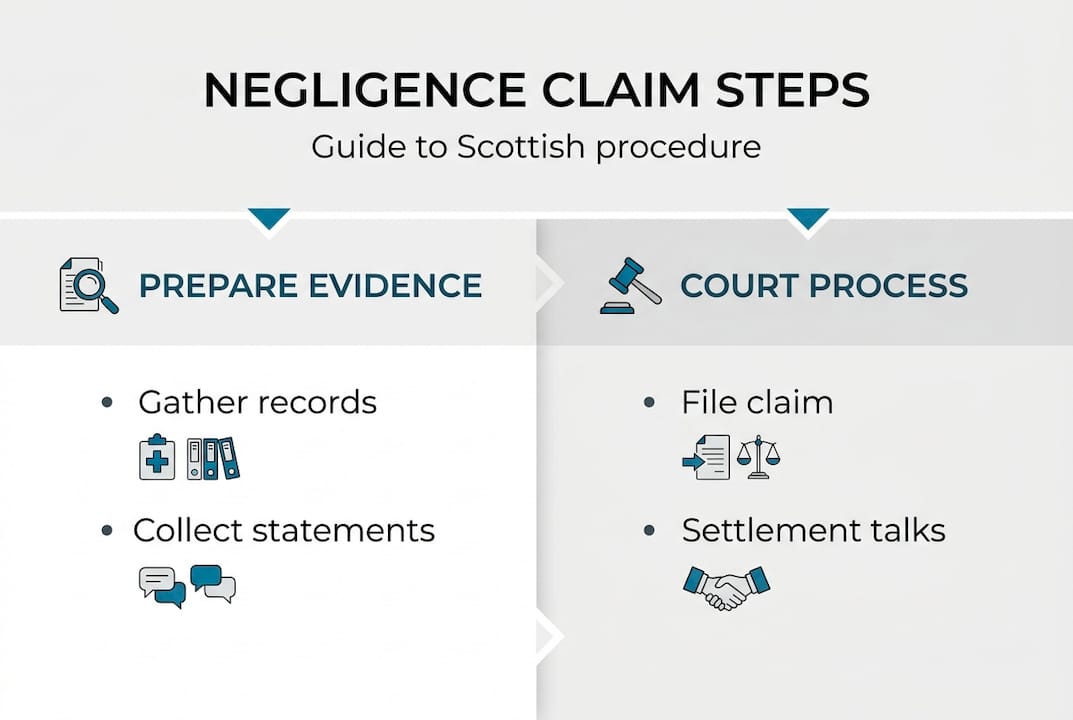
The court process for negligence claims involves formal procedures and strict deadlines. Court proceedings add time and complexity but sometimes become necessary when defendants refuse reasonable settlements. Your solicitor handles all court filings, representations, and procedural requirements.
| Settlement route |
Typical timeline |
Advantages |
Disadvantages |
| Out-of-court settlement |
6-12 months |
Faster resolution, lower stress, guaranteed outcome |
May accept slightly lower amount |
| Court trial |
18-36 months |
Potential for higher award, formal judgment |
Longer wait, higher stress, uncertain outcome |
Pro Tip: Most defendants prefer settling before court to avoid legal costs and adverse publicity. Your solicitor uses this leverage during negotiations to secure fair compensation without the stress and delay of formal proceedings.
Negotiation strategies vary based on claim strength and defendant behaviour. Strong evidence and clear liability often produce quick, fair settlements. Disputed liability or complex injuries require more extensive negotiations and expert evidence. Your solicitor guides you through each stage, explaining options and recommending strategies.
Settlements typically occur in stages for serious injuries. Interim payments cover immediate expenses whilst final settlement awaits full recovery assessment. This approach ensures you receive support during treatment whilst preserving your right to full compensation once the injury’s long-term impact becomes clear.
Verifying and finalising your negligence claim
Understanding your compensation award requires breaking down its components. General damages compensate for pain, suffering, and loss of amenity caused by your injuries. Special damages cover quantifiable financial losses including medical expenses, lost earnings, travel costs, and care needs. Your settlement letter itemises these amounts clearly.
Payment timelines depend on settlement terms negotiated by your solicitor. Most compensation arrives within 14 to 28 days of accepting the final offer. Court-ordered awards may take slightly longer as administrative processes complete. Your solicitor monitors payment and chases delays promptly.
Confirming case closure involves reviewing and signing settlement documentation. This typically includes a discharge form releasing the defendant from further liability and confirming you accept the compensation as full and final settlement. Read these documents carefully before signing. Once signed, you cannot pursue additional compensation for the same incident.
Keep comprehensive records even after settlement. Store copies of all medical reports, correspondence, settlement agreements, and payment confirmations. These documents may prove necessary for tax purposes, benefits assessments, or related claims. Organise them securely for future reference.
If you disagree with the outcome, appeal options exist but face strict limitations. Court judgments can be appealed to higher courts on legal grounds, not simply because you wanted more compensation. Your solicitor advises whether appeal grounds exist and the likelihood of success. Appeals add significant time and cost, so consider carefully.
Claiming injury compensation in Scotland follows established procedures that protect your rights whilst ensuring fair outcomes. Understanding verification steps prevents last-minute surprises and confirms you receive everything you’re entitled to.
Pursuing related claims requires careful consideration of limitation periods and legal connections. If your injury leads to subsequent medical complications, you may have grounds for additional claims. Discuss any new developments with your solicitor promptly to preserve your rights.
Legal advice during the verification phase ensures you understand settlement terms fully. Solicitors explain tax implications, benefits effects, and any ongoing obligations. This final consultation confirms you make informed decisions about accepting or challenging the proposed settlement.
Settlement checklist:
- Review itemised breakdown of general and special damages
- Confirm payment timeline and method
- Understand tax treatment of your compensation
- Check how settlement affects any benefits you receive
- Verify all medical and care costs are included
- Ensure future loss calculations account for long-term impacts
- Read discharge documentation thoroughly before signing
- Arrange secure storage for all claim documents
Discover expert injury claim support in Scotland
Navigating the negligence claim procedure becomes significantly easier with specialist legal support. Scotland Claims connects you with experienced injury lawyers in Scotland who understand the complexities of Scottish law and court procedures. Our solicitors operate exclusively on no win no fee claims in Scotland, meaning you pay nothing upfront and nothing if your claim fails. This arrangement eliminates financial risk whilst ensuring you receive expert representation throughout the process.
Our compensation calculator provides instant estimates based on your injury type and circumstances. Whilst every claim is unique, this tool offers valuable guidance on potential compensation ranges. Combined with a free consultation, you’ll quickly understand whether pursuing a claim makes sense for your situation. Our team handles everything from initial evidence gathering through final settlement, keeping you informed at every stage. Contact us today to discuss your negligence claim with solicitors who prioritise your recovery and financial security.
What is the negligence claim procedure in Scotland?
How long does a negligence claim take in Scotland?
Most negligence claims settle within 6 to 12 months through negotiation, though complex cases involving serious injuries or disputed liability may take 18 to 36 months. Court proceedings extend timelines significantly. Your solicitor provides realistic estimates based on your specific circumstances and keeps you updated as the claim progresses.
What evidence do I need for a negligence claim?
Essential evidence includes medical records documenting your injuries and treatment, witness statements describing the accident, photographs of the scene and hazards, accident reports from employers or authorities, and financial records proving your losses. The stronger and more comprehensive your evidence, the better your chances of securing fair compensation quickly.
Can I make a negligence claim after three years?
The three-year limitation period applies strictly to most personal injury claims in Scotland, starting from the injury date or when you first knew about it. Very limited exceptions exist for children, individuals lacking mental capacity, or cases where injury symptoms only became apparent years later. Missing the deadline usually bars your claim permanently, so act promptly.
Do I need a solicitor for a negligence claim?
Whilst legally possible to pursue claims yourself, specialist solicitors significantly improve outcomes through expert evidence gathering, accurate compensation calculations, and skilled negotiations. No win no fee arrangements eliminate financial risk, and solicitors typically secure substantially higher settlements than unrepresented claimants. The expertise and support justify involving legal professionals.
How is negligence compensation calculated?
Compensation combines general damages for pain, suffering, and loss of amenity based on injury severity and duration, plus special damages covering quantifiable losses like medical expenses, lost earnings, travel costs, and care needs. Judicial guidelines provide ranges for general damages, whilst special damages require detailed evidence of actual financial losses incurred and future costs.
What happens if the defendant denies liability?
When defendants deny liability, your solicitor gathers additional evidence to strengthen your case, potentially including expert reports and further witness statements. If the defendant maintains their position, court proceedings may become necessary. Many disputed claims still settle before trial as evidence develops and legal costs mount for the defendant.
Recommended