
Table of Contents
Can a Car Accident Cause Spinal Stenosis? A Medical-Legal Guide
Last Updated: July 6, 2026
Can a Car Accident Cause Spinal Stenosis?
Yes, a car accident can cause spinal stenosis, where the spinal canal narrows and compresses nerve roots. The forceful impact of a collision can herniate discs, misalign vertebrae, and trigger inflammation that restricts space for the spinal cord and nerve roots. Some accident victims experience pain within hours; others develop symptoms weeks or months later as inflammation spreads and degenerative changes accelerate. Both patterns are medically valid and legally actionable, but documentation timing is critical.
Pro Tip
Keep every medical record from the moment of accident onwards. Even "minor" symptoms noted in A&E reports become crucial evidence when spinal stenosis develops later. Insurers scrutinise the timeline between accident and diagnosis, so contemporaneous medical notes are your strongest defence against causation challenges.
Understanding the Mechanism of Injury
When a car collides with another vehicle, your spine experiences forces it was never designed to withstand. The human cervical spine (neck) and lumbar spine (lower back) are engineered for controlled movement, not violent acceleration and deceleration. In a typical road traffic accident, your body's inertia carries it forward whilst the vehicle stops abruptly, creating a whipping motion that stretches ligaments, tears muscle fibres, and can rupture the tough outer layer of intervertebral discs.
The discs that cushion your vertebrae contain a gel-like nucleus. When the outer annulus fibrosus tears, that nucleus herniates into the spinal canal, directly compressing nerve roots. Simultaneously, trauma triggers inflammatory responses, swelling, and tissue proliferation that further narrow the already-compromised canal space. For individuals with pre-existing degenerative disc disease, this acceleration can transform an asymptomatic condition into a symptomatic one almost overnight.
The cervical spine is particularly vulnerable in frontal and rear-impact collisions. Whiplash injuries frequently trigger cervical stenosis because the neck's range of motion is greater than the lumbar spine's, creating more dramatic tissue disruption. However, lumbar stenosis from car accidents is equally common, especially in side-impact collisions where rotational forces twist the lower back beyond its normal limits.
Not every spinal stenosis case presents immediately after impact. This distinction is crucial for your claim because insurers often argue that delayed symptoms indicate a pre-existing condition unrelated to the accident.
Immediate onset typically manifests within 24-72 hours. Pain, numbness, tingling, or weakness in the arms or legs appears shortly after the collision. Medical imaging usually shows clear evidence of herniation and its relationship to the accident date.
Delayed onset is more complex legally but equally valid medically. Symptoms may emerge weeks or months after the accident as inflammation gradually worsens or as scar tissue formation restricts canal space. This delay doesn't weaken your claim; it simply requires medical evidence linking the accident to the eventual diagnosis.
The key is establishing causation through medical evidence showing the accident caused or materially aggravated the stenosis.
Key Takeaway
Delayed symptoms are not weaker claims. They require medical causation evidence (imaging, specialist reports) rather than immediate symptom onset. A neurologist's statement that "the accident mechanism is consistent with the stenosis pattern observed" carries enormous weight in settlement negotiations.
Understanding Spinal Stenosis and Nerve Compression
Spinal stenosis is the abnormal narrowing of the spinal canal, the tunnel through which the spinal cord and nerve roots travel. This narrowing compresses neural tissue, triggering pain, weakness, numbness, and functional impairment. The condition exists in two primary forms relevant to car accident claims: cervical stenosis (affecting the neck and upper body) and lumbar stenosis (affecting the lower back and legs).
The spinal canal is bounded by the vertebral body anteriorly, the laminae and facet joints posteriorly, and ligaments on all sides. In accident cases, the most common mechanism is disc herniation, where the nucleus pulposus protrudes through a tear in the annulus fibrosus, occupying space within the canal. Additionally, vertebral misalignment (subluxation) can narrow the canal by altering normal spacing between vertebrae.
Degenerative disc disease plays a significant role in post-accident stenosis. Many individuals have pre-existing disc degeneration without symptoms. The accident doesn't create the degeneration; it accelerates it, causing acute herniation of an already-compromised disc. This is called aggravation of pre-existing condition, and it's a fully compensable injury under Scottish law.
Cervical stenosis often produces radiating pain down the arms (radiculopathy), weakness in grip strength, and sometimes balance problems. Lumbar stenosis typically causes pain radiating into the buttocks and legs, often worse with standing or walking. Both are serious and justify substantial compensation claims.
How Whiplash and Forceful Impact Trigger Spinal Stenosis
Whiplash is the mechanism by which most rear-impact car accidents cause spinal stenosis. When a vehicle is struck from behind, the occupant's body is thrown forward whilst the head lags behind momentarily, creating a violent S-curve in the neck. This hyperextension and subsequent hyperflexion stretches ligaments to their limit, tears muscle fibres, and can rupture intervertebral discs.
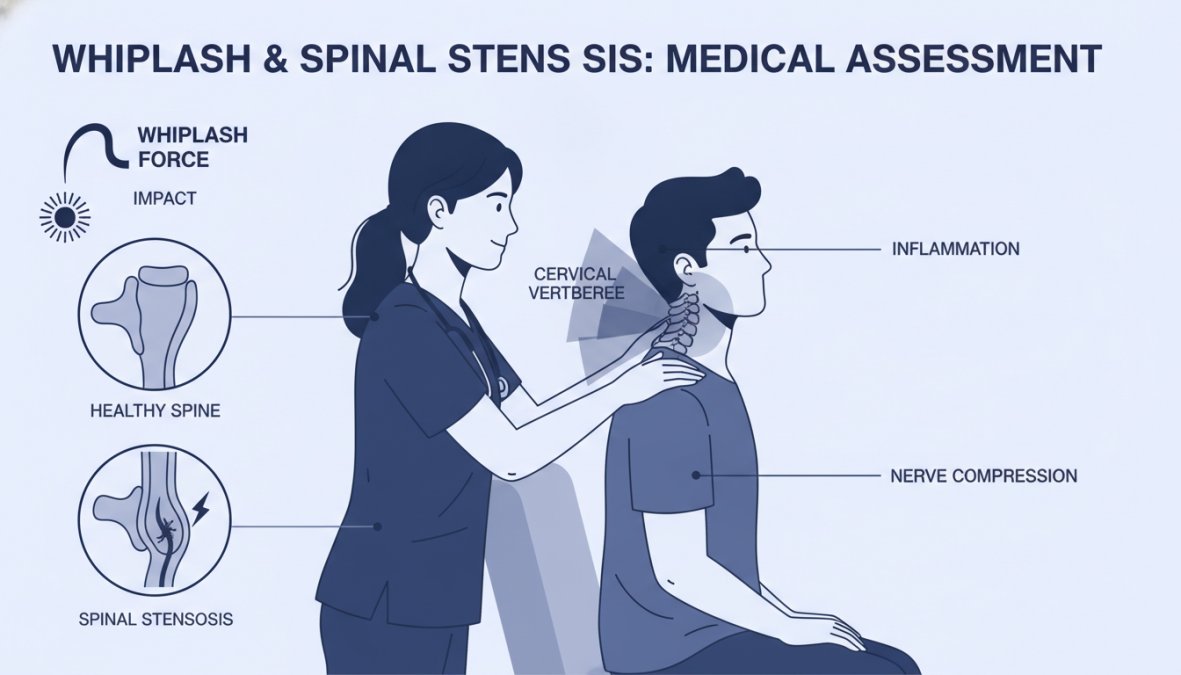 Professional illustration showing Can a car accident cause spinal stenosis?
The cervical spine contains seven vertebrae (C1 through C7) stacked with discs between them. Each disc is anchored by ligaments, the anterior and posterior longitudinal ligaments, and the ligamentum flavum. Whiplash forces can tear these ligaments and herniate the disc nucleus into the spinal canal. Because the cervical canal is narrower than the lumbar canal, even modest disc herniation can cause significant nerve compression.
A forceful impact can cause subluxation, partial dislocation, where one vertebra shifts slightly relative to its neighbour. This misalignment narrows the intervertebral foramen (the opening through which nerve roots exit the spinal canal), compressing the nerve root directly. Imaging shows this clearly on MRI or CT scans.
Inflammation and swelling post-accident compound the problem. Within hours of injury, inflammatory mediators flood the damaged tissue. Oedema (fluid accumulation) swells the ligaments, discs, and facet joints, further reducing canal space. This inflammatory phase peaks around 48-72 hours post-accident, which is why many accident victims experience worsening symptoms in the days following impact.
Watch Out
Do not delay seeking medical imaging after a car accident. Inflammation is most visible on MRI within the first 2-3 weeks post-accident. Waiting months for imaging can make causation harder to prove, as acute inflammatory changes may have resolved, leaving only chronic structural changes that insurers will argue are degenerative rather than accident-related.
Spinal Stenosis Symptoms After a Car Accident
The symptoms of post-accident spinal stenosis vary depending on which nerve roots are compressed and the severity of compression. Early recognition is essential because some symptoms worsen rapidly without treatment.
Radiculopathy, nerve root compression pain, is the hallmark symptom. In cervical stenosis, this manifests as sharp, burning pain radiating from the neck down one arm, often accompanied by tingling (paraesthesia) or numbness in the fingers. In lumbar stenosis, pain radiates into the buttock and down one or both legs. The pain often worsens with certain movements: neck extension in cervical cases, or prolonged standing and walking in lumbar cases.
Neurological deficits indicate more serious compression. Weakness in the arms or legs, loss of fine motor control, or loss of bladder/bowel control are red flags requiring urgent medical evaluation. These symptoms suggest the spinal cord itself is compressed, not merely a nerve root, and carry greater risk of permanent damage if untreated.
Immediately post-accident, you may experience acute muscle strain, sharp pain that worsens with movement and improves with rest, typically resolving within 2-4 weeks. Spinal stenosis pain, by contrast, is often progressive and persistent. It may improve slightly with rest but returns with activity. Neurological symptoms (numbness, tingling, weakness) that persist beyond the acute phase strongly suggest nerve compression rather than simple muscle strain.
Many accident victims report that symptoms fluctuate, depending on activity level, posture, and inflammation. This variability is normal and doesn't undermine your claim; it reflects the dynamic nature of disc herniation and inflammatory swelling.
Aggravation of Pre-Existing Spinal Stenosis After Car Accident
A significant proportion of accident victims have pre-existing, asymptomatic spinal stenosis. Many people over 40 have some degree of disc degeneration or canal narrowing without any symptoms. The car accident doesn't create the stenosis; it aggravates it, crossing the threshold from silent to symptomatic.
Scottish law recognises aggravation of pre-existing conditions as fully compensable injury. You are entitled to claim damages for the acceleration of a pre-existing condition, even if you had no prior symptoms. The legal test is whether the accident materially worsened the condition, made it symptomatic, or made existing symptoms significantly worse.
Proving causation requires medical evidence showing the accident caused or materially aggravated the stenosis. You'll need:
- Post-accident imaging showing new herniation, increased stenosis, or acute inflammatory changes
- Specialist medical report from a neurologist or spinal surgeon stating that the accident mechanism is consistent with the stenosis pattern observed
- Temporal relationship with symptoms appearing within a reasonable timeframe post-accident (typically within weeks, though delayed onset up to several months is defensible)
The specialist's causation opinion is critical. A well-written neurologist's report stating "The pattern of disc herniation and nerve compression observed on post-accident imaging is consistent with the high-velocity impact mechanism described, and represents acute aggravation of pre-existing degenerative disc disease" transforms your claim from disputed to compelling.
Diagnostic Imaging: MRI, CT Scans and Medical Records
Diagnostic imaging is the foundation of any spinal stenosis claim. Without imaging evidence, you have only subjective pain reports, which insurers routinely dispute. With imaging, you have objective proof of structural damage.
MRI (Magnetic Resonance Imaging) is the gold standard for visualising spinal stenosis. It shows soft tissue detail, discs, ligaments, nerve roots, spinal cord, with exceptional clarity. An MRI can reveal disc herniation, ligament rupture, oedema, and the degree of canal narrowing. Crucially, it can show whether stenosis is acute (post-accident) or chronic (pre-existing). Acute changes appear as bright signal intensity (oedema), whilst chronic changes show disc degeneration and fibrosis. A radiologist's report comparing pre- and post-accident imaging makes causation evident.
CT (Computed Tomography) scans are excellent for visualising bone, vertebral fractures, subluxation, and bony stenosis from facet joint arthritis. CT is faster than MRI and useful when MRI is contraindicated. However, CT shows soft tissue less clearly than MRI, so it's often used alongside MRI for comprehensive assessment.
Medical records are equally important. A&E records documenting your initial presentation, GP notes tracking symptom progression, and specialist appointment letters all build a timeline. Insurers scrutinise this timeline: if you didn't report symptoms until months after the accident, they may argue the stenosis is unrelated. Contemporaneous medical documentation of early symptoms and imaging findings strengthens causation significantly.
Pro Tip
Request all imaging on CD and obtain written radiologist reports, not just the images. The radiologist's interpretation, "acute disc herniation at C5-C6 with significant canal narrowing and nerve root compression", is far more persuasive than the images alone.
Treatment Options and Rehabilitation Protocols
Post-accident spinal stenosis treatment ranges from conservative management to surgical intervention, depending on severity and symptom progression. Understanding your treatment options is essential both for your health and for your compensation claim.
Conservative management is the first-line approach for most cases. This includes rest, anti-inflammatory medications (ibuprofen, naproxen), and activity modification. Many accident victims improve significantly with conservative care within 6-12 weeks. However, if symptoms persist or worsen, escalation to specialist treatment is necessary.
Pain management strategies include paracetamol and NSAIDs for mild-to-moderate pain. Stronger analgesia may be required for severe pain. Some patients benefit from muscle relaxants if muscle spasm accompanies nerve compression. These medications manage symptoms but don't address the underlying stenosis.
Epidural steroid injections deliver anti-inflammatory medication directly into the epidural space surrounding the spinal cord. This reduces inflammation and swelling, often providing relief for weeks or months. Many accident victims undergo 2-3 injections spaced 4-6 weeks apart.
Physical therapy is crucial for functional improvement. A physiotherapist designs exercises to strengthen the muscles supporting the spine, improve flexibility, and correct posture. For cervical stenosis, therapy includes neck stabilisation exercises and postural correction. For lumbar stenosis, core strengthening and lumbar stabilisation are priorities. Regular physiotherapy, typically 2-3 sessions per week for 8-12 weeks, often produces significant functional improvement.
Surgical intervention is considered when conservative and interventional treatments fail to provide adequate relief, or when neurological deficits are progressive. Common procedures include laminectomy (removal of the lamina to enlarge the spinal canal), discectomy (removal of herniated disc material), and fusion (joining two vertebrae to stabilise the spine). Surgery carries risks but can be life-changing for patients with severe, progressive neurological deficits or intractable pain. The decision to pursue surgery significantly impacts settlement value, as it demonstrates the severity of your condition.
Car Accident Back Injury Settlement: Your Compensation Rights
Settlement value for post-accident spinal stenosis claims depends on multiple factors. Understanding how insurers calculate compensation helps you evaluate settlement offers critically.
Factors affecting settlement value include severity of stenosis, presence of neurological deficits, treatment requirements, prognosis, age and occupation, impact on daily life, and quality of medical evidence. A typical mild-to-moderate spinal stenosis claim in Scotland might settle for £8,000-£15,000. Moderate cases with significant functional impact and ongoing treatment might reach £20,000-£40,000. Severe cases requiring surgery or resulting in permanent disability can exceed £50,000 or more.
Insurance adjuster tactics often aim to minimise settlement value. Common strategies include questioning causation, minimising symptoms, delaying settlement, and challenging medical opinion. Counter these tactics with strong documentation: maintain detailed symptom diaries, attend all medical appointments, obtain written specialist reports explicitly linking the accident to your stenosis, and have a solicitor review any settlement offer.
Mental Health Impact and Home Modifications
Chronic pain from spinal stenosis takes a psychological toll that often goes unrecognised in settlement negotiations. Persistent pain, functional limitations, and uncertainty about recovery trigger anxiety, depression, and social isolation. These psychological effects are compensable injuries in their own right and should be documented by your GP and, ideally, assessed by a clinical psychologist.
Home modification and ergonomics are essential for managing spinal stenosis long-term. Key modifications include a firm mattress and cervical pillow, an office chair with lumbar support, proper desk and workstation setup, bathroom modifications (grab bars, shower seats), and mobility aids. These modifications aren't luxuries; they're medical necessities that enable you to function. Document the cost of home modifications and include them in your claim.
Making a Personal Injury Claim in Scotland
Scotland's legal framework for personal injury claims is distinct from England and Wales. Understanding the Scottish process is essential for maximising your compensation.
Building your case with medical evidence begins immediately post-accident. Seek medical evaluation within 48 hours of impact, even if symptoms are mild. Request all medical records and compile them chronologically. Obtain specialist reports early, ideally 8-12 weeks post-accident, with explicit statements that the accident caused or materially aggravated the stenosis. Maintain a symptom diary throughout your recovery, recording daily pain levels, activities that worsen or improve symptoms, medications taken, and functional limitations.
Working with specialist solicitors is crucial for maximising your claim. Scotland Claims Injury Lawyers operates on a No Win No Fee basis, meaning you pay no upfront costs and retain 100% of your compensation if successful. A specialist personal injury solicitor will review your medical evidence, obtain expert reports, handle all communication with the insurer, negotiate settlement, or prepare your case for court if necessary.
In Glasgow and across Scotland, personal injury claims follow a structured process. After instructing a solicitor, they'll send a detailed claim letter to the insurer, including your medical evidence and a damages valuation. Many cases settle at this stage. If not, your solicitor will initiate court proceedings. Most cases settle before trial, but being prepared for litigation strengthens your negotiating position.
Spinal stenosis from a car accident is a serious, life-altering injury that deserves proper medical care and fair compensation. The medical evidence is clear: forceful impact can cause or aggravate stenosis, compressing nerve roots and causing chronic pain and dysfunction. Your right to compensation is grounded in both medical fact and Scottish law. Scotland Claims Injury Lawyers specialises in road traffic accident claims and offers No Win No Fee representation, meaning you keep all your compensation if your claim succeeds. With specialist legal support, strong medical documentation, and a clear understanding of your injury's impact, you can pursue the compensation you deserve without financial risk.
| Aspect |
Details |
Action Required |
| Initial medical assessment |
Seek evaluation within 48 hours post-accident |
A&E or GP appointment |
| Diagnostic imaging |
MRI or CT scan within 2-3 weeks post-accident |
Request written radiologist report |
| Specialist assessment |
Neurologist or spinal surgeon review within 8-12 weeks |
Obtain causation opinion in writing |
| Treatment documentation |
Maintain records of all physiotherapy, injections, medications |
File copies with solicitor |
| Symptom diary |
Daily pain levels, functional limitations, activity restrictions |
Provide to solicitor and insurers |
| Legal representation |
Instruct personal injury solicitor on No Win No Fee basis |
Contact Scotland Claims Injury Lawyers |
| Settlement negotiation |
Review insurer's offer against comparable cases |
Solicitor advises on fairness |
Frequently Asked Questions
Can a car accident directly cause spinal stenosis, or does it only aggravate existing conditions?
A car accident can both cause new spinal stenosis and aggravate pre-existing conditions. Forceful impact, whiplash, and vertebral misalignment from accidents can trigger nerve compression and spinal canal narrowing. However, proving causation requires medical evidence showing the accident caused measurable changes to the spinal cord and nerve roots. If you had asymptomatic stenosis before the accident, the impact may have activated or worsened symptoms, which still qualifies for a personal injury claim in Scotland if negligence is established.
What spinal stenosis symptoms after a car accident should prompt immediate medical attention?
Seek urgent medical care for radiating pain down arms or legs, numbness or tingling in extremities, weakness in legs or feet, loss of bladder or bowel control, or severe neck or lower back pain. These may indicate nerve root compression or spinal cord involvement. Document all symptoms carefully and obtain diagnostic imaging (MRI or CT scans) as soon as possible. Medical records create the evidence trail essential for both your recovery and any personal injury claim, establishing the link between the accident and your condition.
How do insurance adjusters typically challenge spinal stenosis claims after a car accident?
Insurance adjusters often argue that pre-existing conditions, not the accident, caused your symptoms—especially if you were asymptomatic before. They may question the timing of diagnosis, suggest your symptoms are unrelated to the forceful impact, or claim your recovery is progressing faster than claimed. They also scrutinise gaps in medical treatment. Counter this by maintaining comprehensive medical records, obtaining specialist reports from orthopedic or neurological experts, and documenting all pain and functional limitations. Clear causation evidence and consistent treatment records significantly strengthen your position against adjuster tactics.
Can I claim compensation for spinal stenosis from a car accident in Scotland?
Yes, if you can prove the accident caused or aggravated your spinal stenosis and that another party was negligent. You'll need medical evidence (diagnostic imaging, specialist reports) linking the accident to your condition, documentation of treatment costs and ongoing pain management, and proof of financial losses (medical expenses, lost wages, rehabilitation). Scottish law recognises both new injuries and aggravation of pre-existing conditions. A specialist personal injury solicitor can evaluate your case and advise on settlement value, ensuring you receive full compensation for your injury and recovery needs.